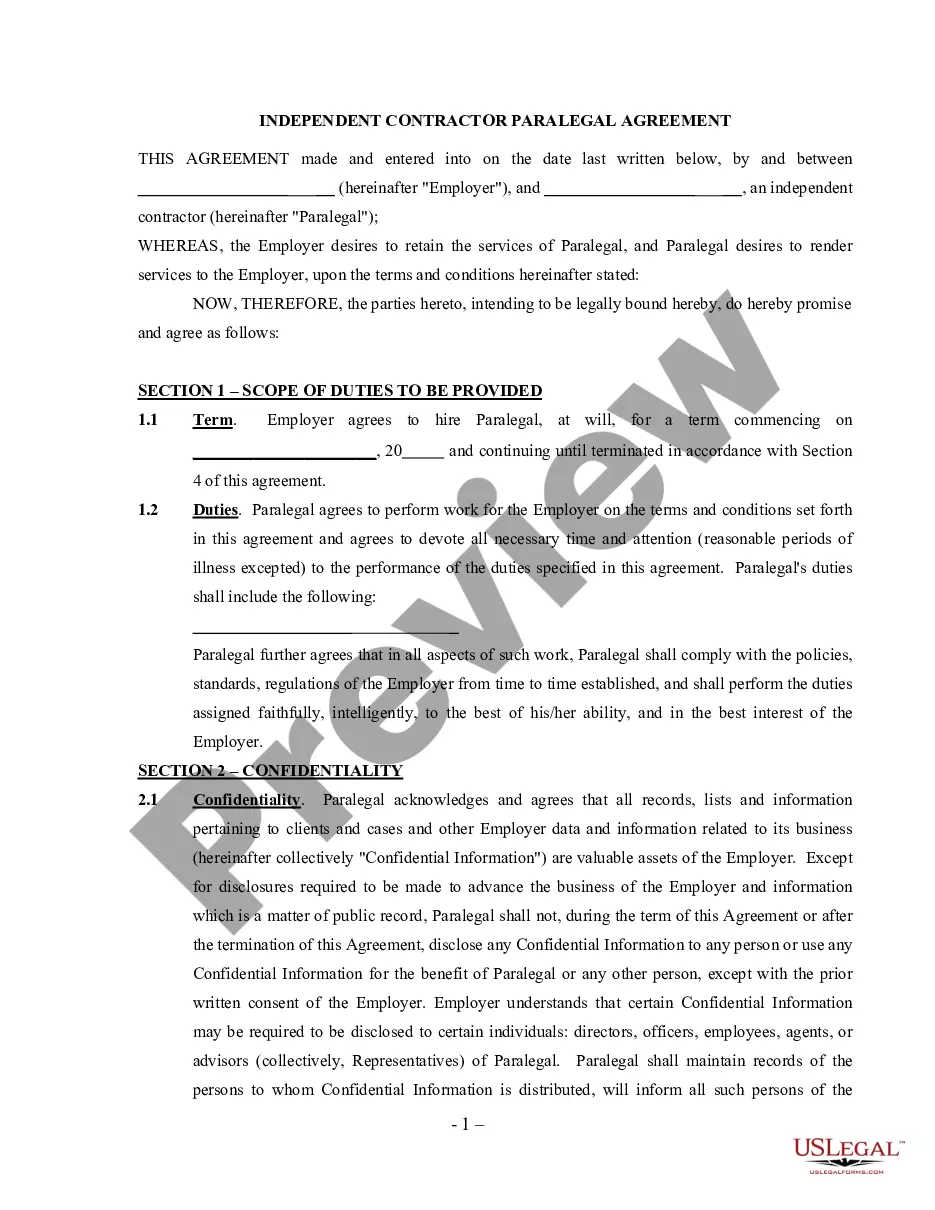
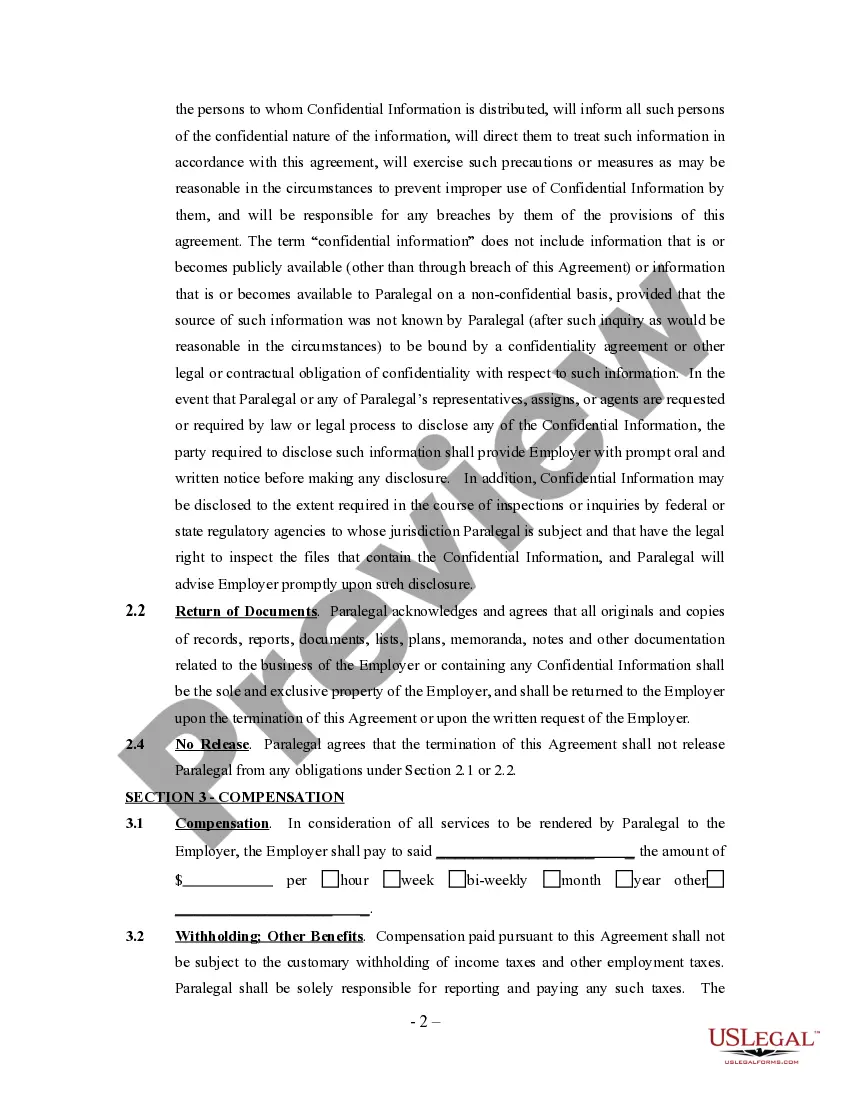
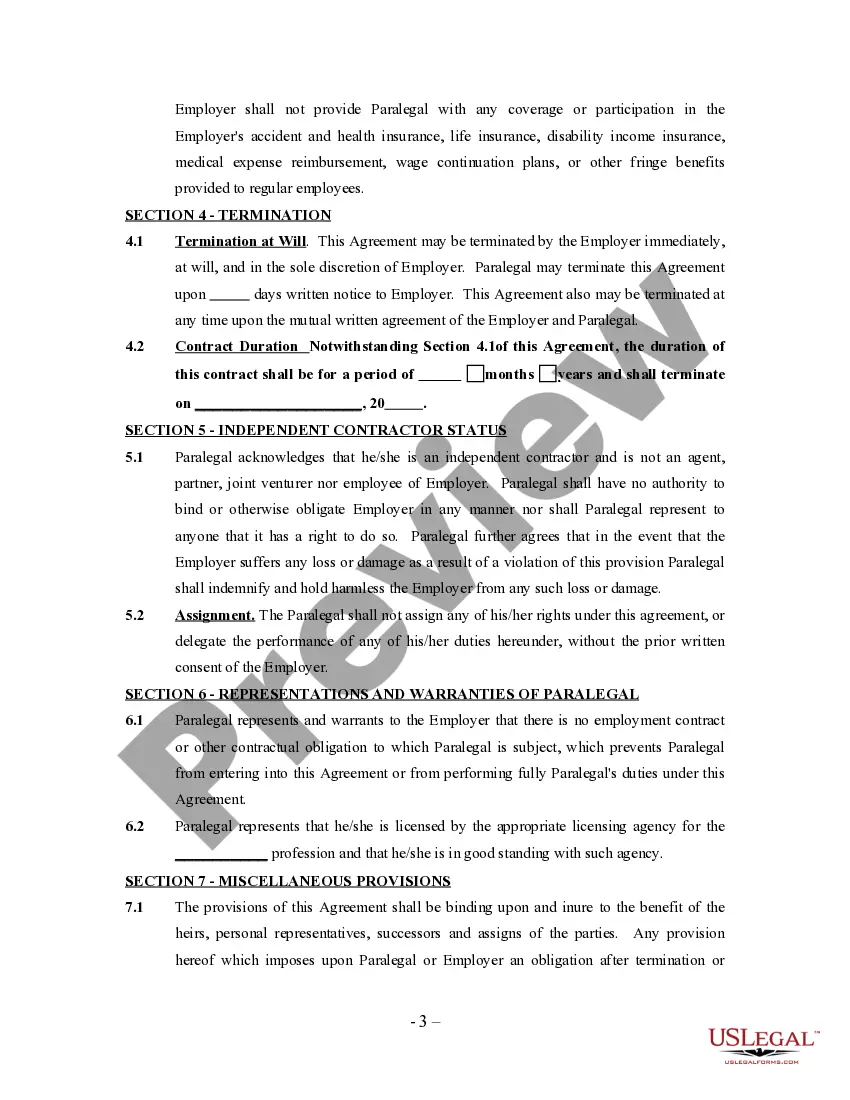
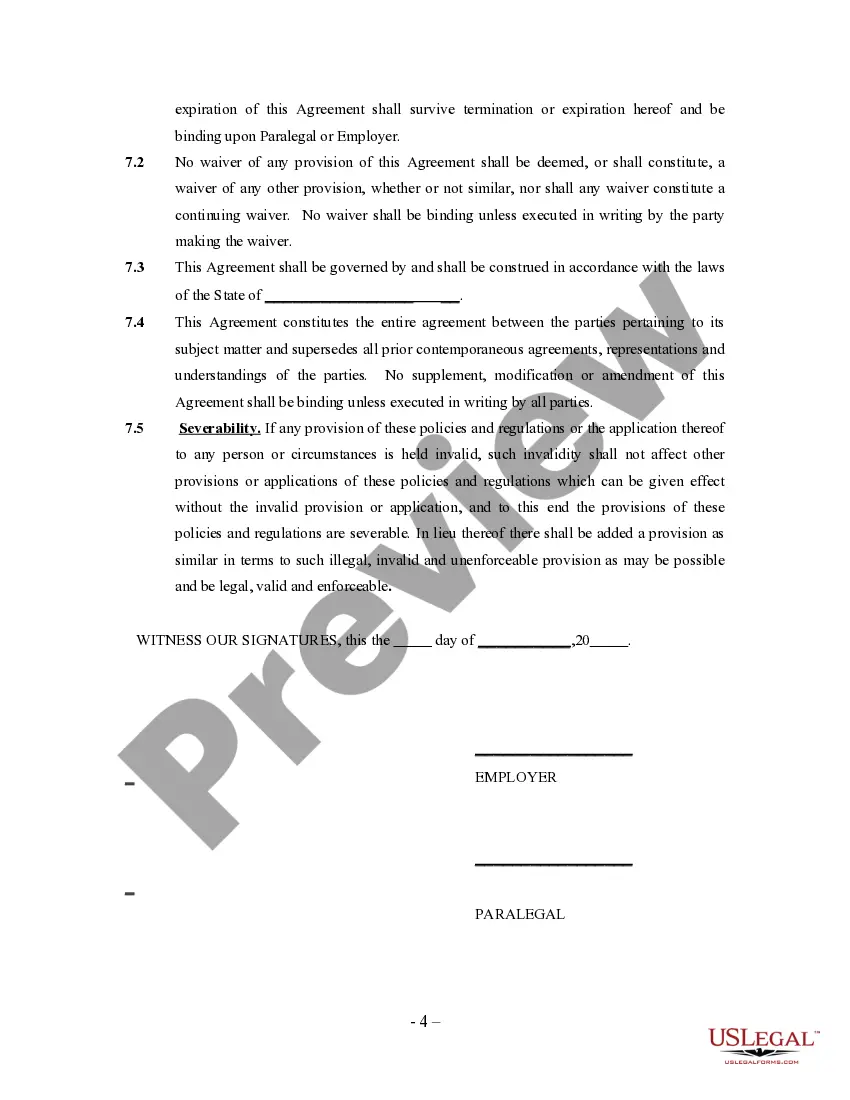
Employer contracts with a paralegal as independent contractor to provide paralegal services for employer as specified and agreed upon in the contract. Contract includes confidentiality clause.
Fairfax Virginia Paralegal Agreement - Self-Employed Independent Contractor
State:
Multi-State
County:
Fairfax
Control #:
US-INDC-131
Format:
Word;
Rich Text
274 downloads
Description
Free preview
Get your form ready online
Our built-in tools help you complete, sign, share, and store your documents in one place.
Built-in online Word editor
Make edits, fill in missing information, and update formatting in US Legal Forms—just like you would in MS Word.
Export easily
Download a copy, print it, send it by email, or mail it via USPS—whatever works best for your next step.
E-sign your document
Sign and collect signatures with our SignNow integration. Send to multiple recipients, set reminders, and more. Go Premium to unlock E-Sign.
Notarize online 24/7
If this form requires notarization, complete it online through a secure video call—no need to meet a notary in person or wait for an appointment.
Store your document securely
We protect your documents and personal data by following strict security and privacy standards.

Make edits, fill in missing information, and update formatting in US Legal Forms—just like you would in MS Word.

Download a copy, print it, send it by email, or mail it via USPS—whatever works best for your next step.

Sign and collect signatures with our SignNow integration. Send to multiple recipients, set reminders, and more. Go Premium to unlock E-Sign.

If this form requires notarization, complete it online through a secure video call—no need to meet a notary in person or wait for an appointment.

We protect your documents and personal data by following strict security and privacy standards.
Looking for another form?
How to fill out Paralegal Agreement - Self-Employed Independent Contractor?
Drafting legal paperwork can be challenging.
Moreover, if you opt to hire an attorney to create a business contract, documents for ownership transfer, pre-nuptial agreement, dissolution of marriage documents, or the Fairfax Paralegal Agreement - Self-Employed Independent Contractor, it could be quite expensive.
- What is the most cost-effective method to save time and resources while producing valid documents that adhere to your state's and local regulations.
- US Legal Forms serves as an ideal answer, regardless of whether you need templates for personal or commercial purposes.
- US Legal Forms is the largest online collection of region-specific legal forms, offering users the latest and professionally vetted templates for any situation centralized in one location.
- Thus, if you require the latest version of the Fairfax Paralegal Agreement - Self-Employed Independent Contractor, you can conveniently locate it on our site.
- Acquiring the documents takes very little time.
- Users with existing accounts should verify the validity of their subscription, Log In, and select the template using the Download button.
- If you haven't yet subscribed, follow these steps to acquire the Fairfax Paralegal Agreement - Self-Employed Independent Contractor.
- Review the page to confirm that there is a template for your area.
Form popularity
FAQ
Here's a look at the basic steps you'll need to take to create a simple and effective client contract: Include Contact Information of Both Parties.Specify Project Terms and Scope.Establish Payment Terms.Set the Schedule.Decide What Happens If a Contract Is Terminated.Determine Who Owns Final Copyrights.
How Do You Become Self-Employed? Think of a Name for Your Self-Employed Business. Consider what services you will offer, and then pick a name that describes what you do.Choose a Self-Employed Business Structure and Get a Proper License.Open a Business Bank Account.Advertise Your Independent Contractor Services.
Ten Tips for Making Solid Business Agreements and Contracts Get it in writing.Keep it simple.Deal with the right person.Identify each party correctly.Spell out all of the details.Specify payment obligations.Agree on circumstances that terminate the contract.Agree on a way to resolve disputes.
To set yourself up as a self-employed taxpayer with the IRS, you simply start paying estimated taxes (on Form 1040-ES, Estimated Tax for Individuals) and file Schedule C, Profit or Loss From Business, and Schedule SE, Self-Employment Tax, with your Form 1040 tax return each April.
You have to file an income tax return if your net earnings from self-employment were $400 or more. If your net earnings from self-employment were less than $400, you still have to file an income tax return if you meet any other filing requirement listed in the Form 1040 and 1040-SR instructionsPDF.
How do I create an Independent Contractor Agreement? State the location.Describe the type of service required.Provide the contractor's and client's details.Outline compensation details.State the agreement's terms.Include any additional clauses.State the signing details.
An independent contractor agreement is a legally binding document signed by a 1099 employee and the company that hires them. It outlines the scope of work and the terms under which that work will be completed, which goes a long way to making sure both parties are on the same page about the project from the start.
Paying yourself as an independent contractor Independent contractor pay allows your business the opportunity to stay on budget for projects rather than hire via a third party. As an independent contractor, you will need to pay self-employment taxes on your wages. You will file a W-9 with the LLC.
An independent contractor is a self-employed person or entity contracted to perform work foror provide services toanother entity as a nonemployee. As a result, independent contractors must pay their own Social Security and Medicare taxes.
Becoming an independent contractor is one of the many ways to be classified as self-employed. By definition, an independent contractor provides work or services on a contractual basis, whereas, self-employment is simply the act of earning money without operating within an employee-employer relationship.