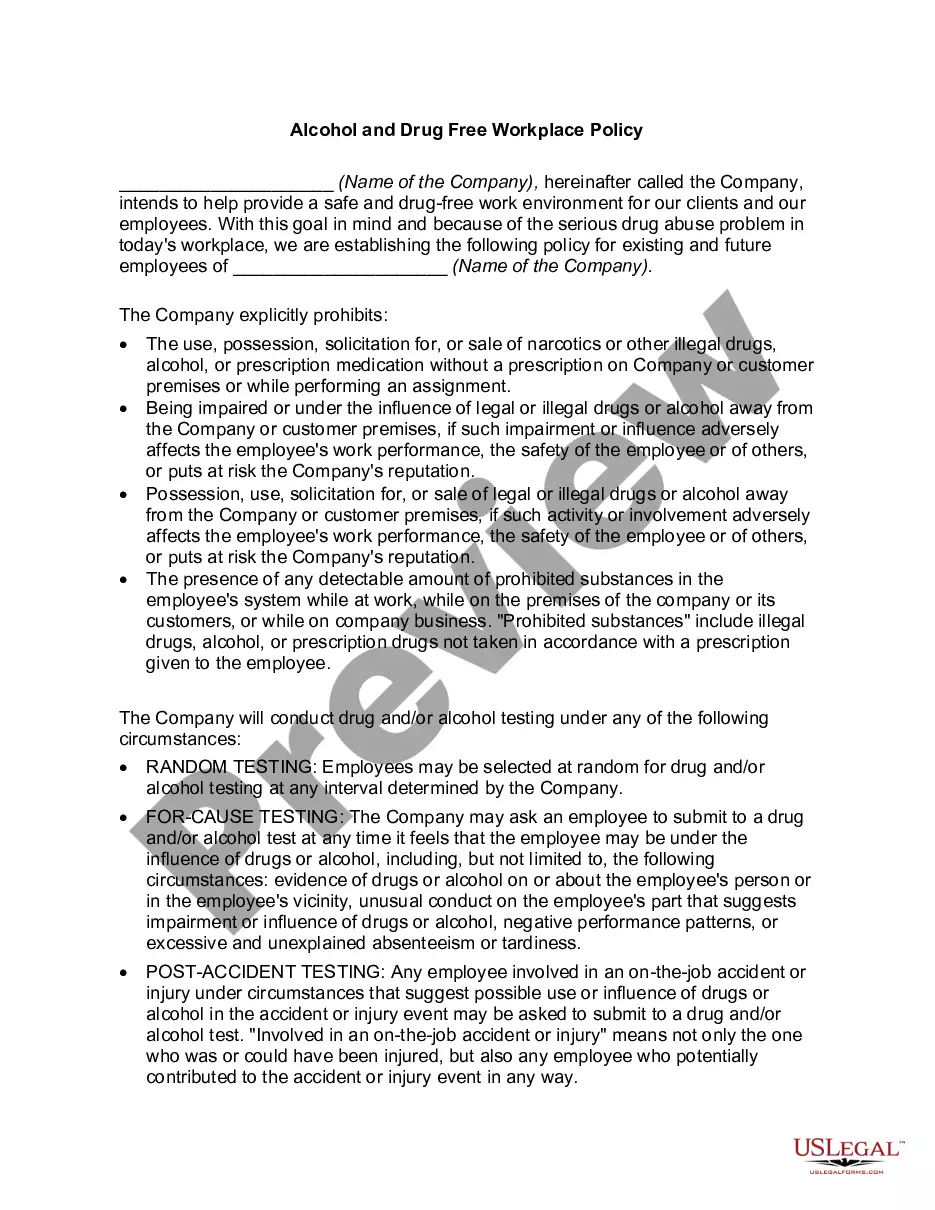
Policy for regarding Drugs in the workplace.
Santa Clara California Company Drug Policy
State:
Multi-State
Category:
County:
Santa Clara
Control #:
US-FR-S-1
Format:
PDF
102 downloads
Description
Free preview
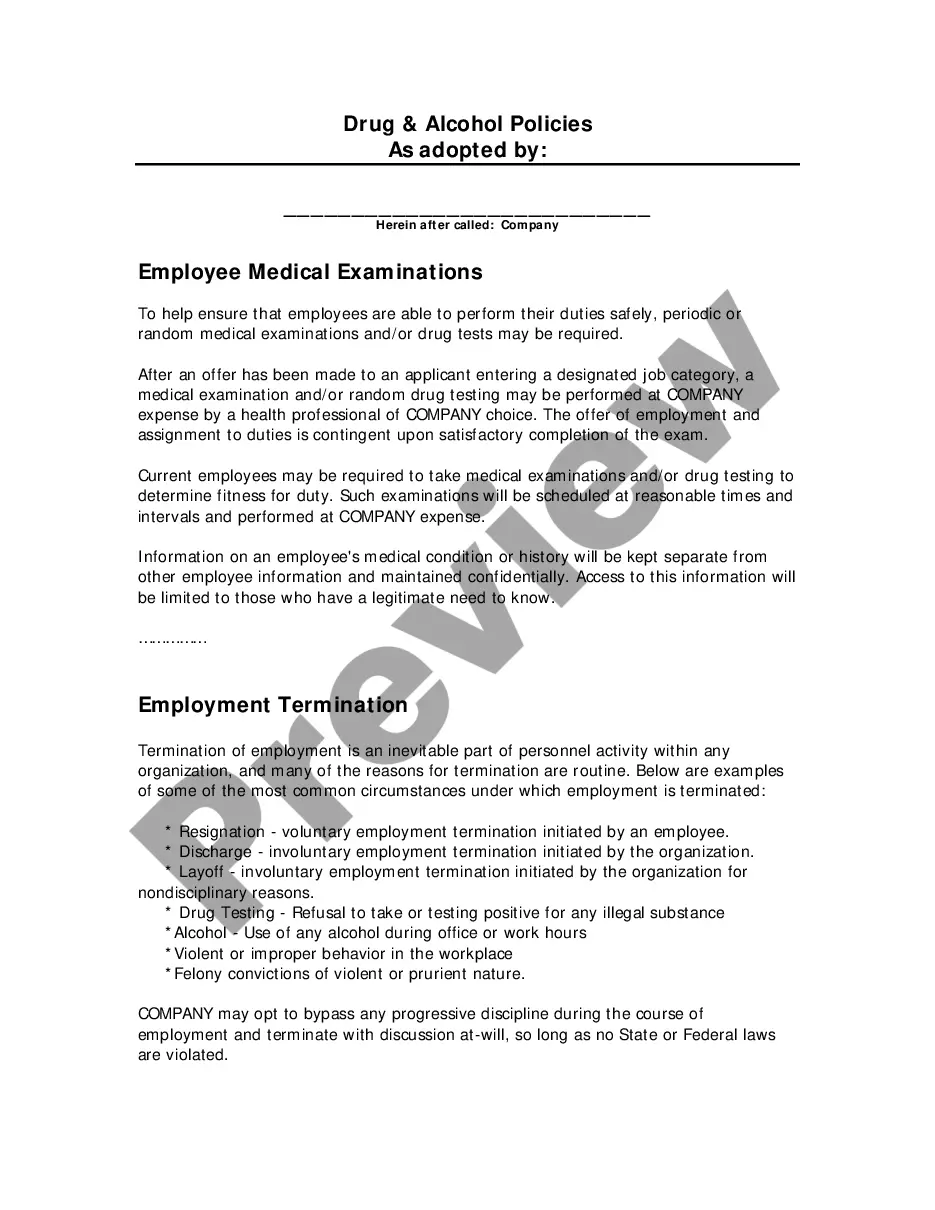
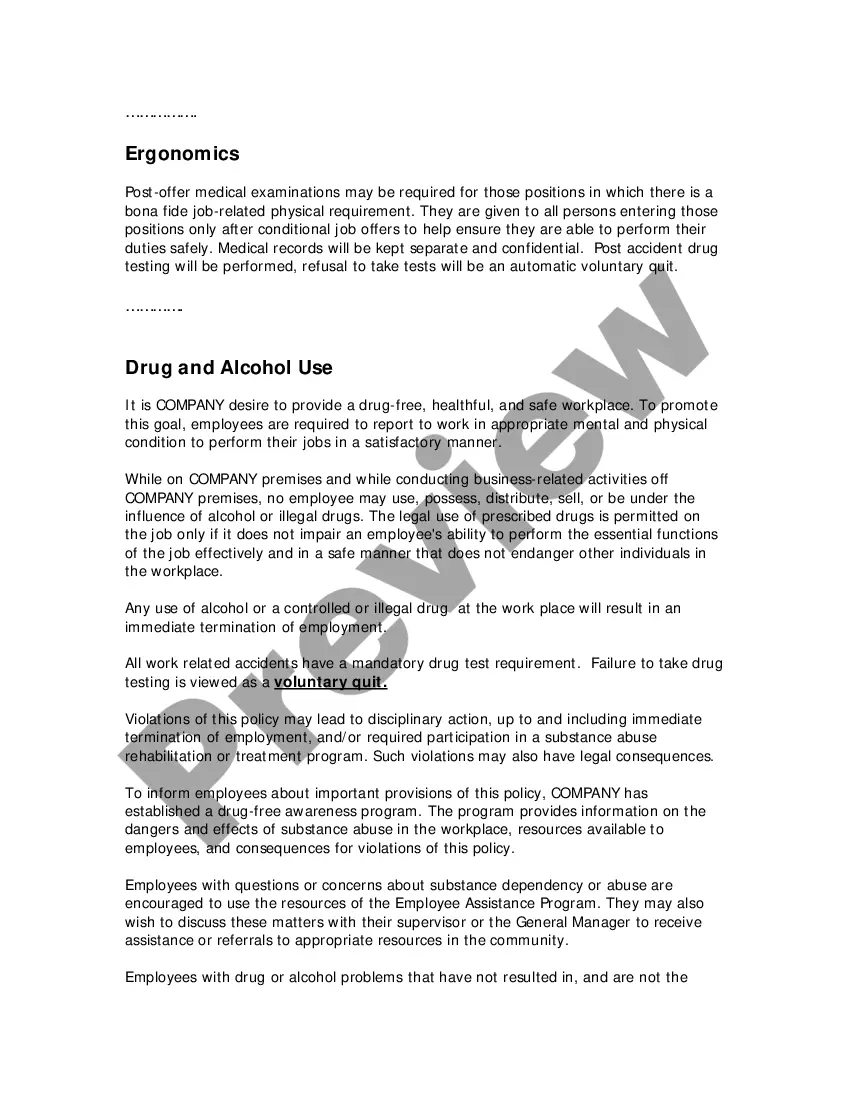
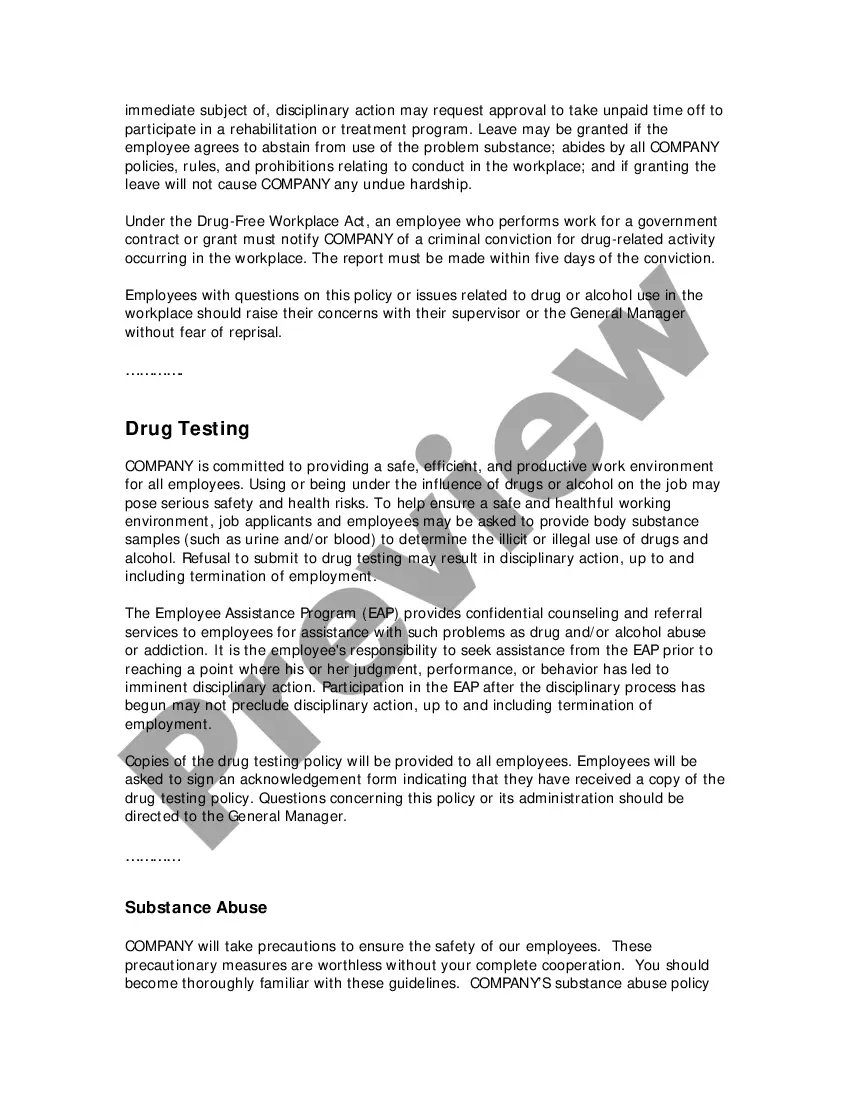
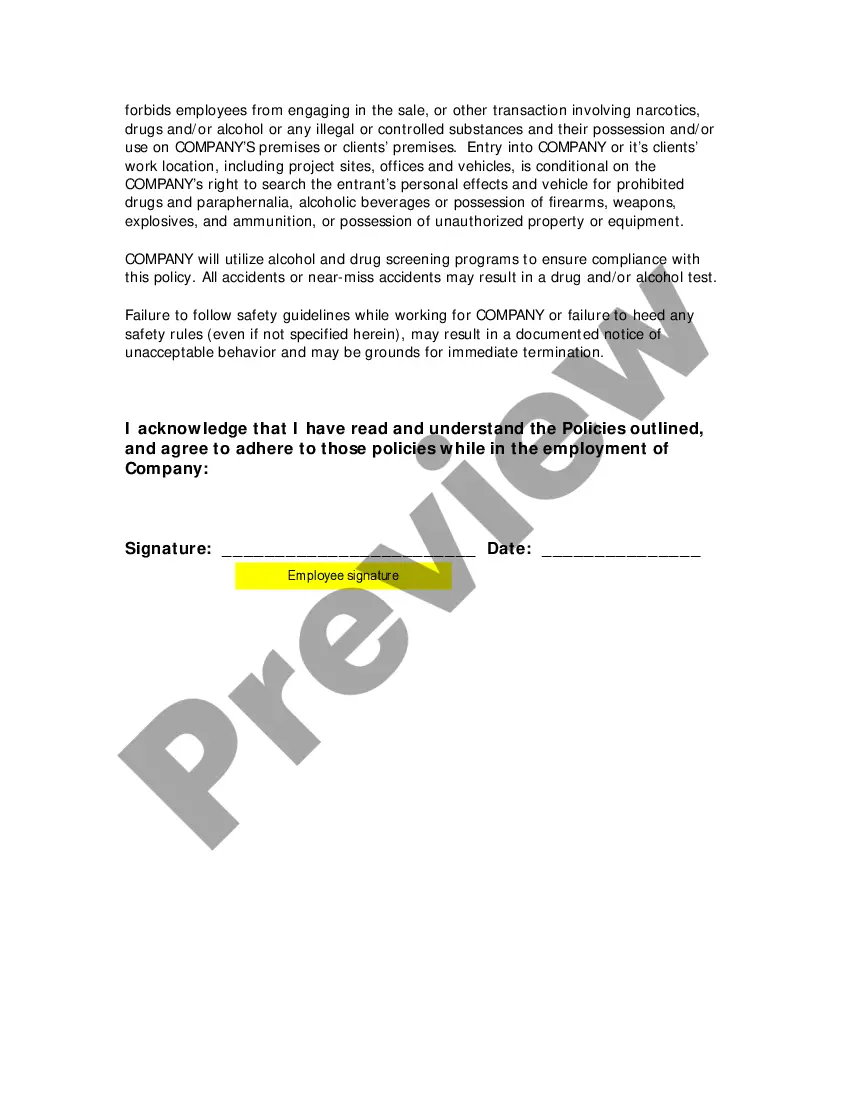
Get your form ready online
Our built-in tools help you complete, sign, share, and store your documents in one place.
Built-in online Word editor
Make edits, fill in missing information, and update formatting in US Legal Forms—just like you would in MS Word.
Export easily
Download a copy, print it, send it by email, or mail it via USPS—whatever works best for your next step.
E-sign your document
Sign and collect signatures with our SignNow integration. Send to multiple recipients, set reminders, and more. Go Premium to unlock E-Sign.
Notarize online 24/7
If this form requires notarization, complete it online through a secure video call—no need to meet a notary in person or wait for an appointment.
Store your document securely
We protect your documents and personal data by following strict security and privacy standards.

Make edits, fill in missing information, and update formatting in US Legal Forms—just like you would in MS Word.

Download a copy, print it, send it by email, or mail it via USPS—whatever works best for your next step.

Sign and collect signatures with our SignNow integration. Send to multiple recipients, set reminders, and more. Go Premium to unlock E-Sign.

If this form requires notarization, complete it online through a secure video call—no need to meet a notary in person or wait for an appointment.

We protect your documents and personal data by following strict security and privacy standards.
Looking for another form?
How to fill out Company Drug Policy?
Preparing documentation, such as the Santa Clara Company Drug Policy, to address your legal concerns is a challenging and time-intensive endeavor.
Numerous situations necessitate an attorney’s involvement, which also renders this process costly.
However, you can take control of your legal issues and handle them independently.
You can retrieve it in the My documents section in your account, whether on desktop or mobile. The onboarding process for new users is equally simple! Here’s what you need to do before acquiring the Santa Clara Company Drug Policy: Ensure that your document complies with your state/county as the rules for drafting legal documents may vary from one state to another.
- US Legal Forms is here to assist you.
- Our platform offers over 85,000 legal forms tailored for various situations and life events.
- We guarantee that each document adheres to the laws of every state, so you don’t have to be concerned about any legal compliance issues.
- If you are already acquainted with our site and hold a subscription with US, you are aware of how straightforward it is to obtain the Santa Clara Company Drug Policy template.
- Simply Log In to your account, download the template, and modify it to suit your requirements.
- Have you misplaced your document? No problem.
Form popularity
FAQ
When explaining a failed drug test, transparency is key. Clearly communicate the circumstances surrounding the failure, while emphasizing what you learned from the experience. It's beneficial to relate this to the Santa Clara California Company Drug Policy, highlighting your understanding of why such policies are important.
California law allows an employer to require a "suspicionless" drug test as a condition of employment after a job offer is tendered but before the employee begins working.
If you suspect an employee of being impaired on the job: Take immediate action to remove the employee from any safety-sensitive work and begin gathering evidence of the incident. If applicable state laws and your employer policy allows, send the employee for a drug or alcohol test.
Possible outcomes after failing drug test Consequences may include: Firing- in most cases, your employer will not fire you on the spot unless it is a recurrent habit. If this is your first time, your boss may give you another chance to prove yourself.
Prior to making an offer, an employer may ask an applicant whether he or she is currently using, or has in the past used, illegal drugs or alcohol as long as the questions are not likely to elicit information about past drug addiction, which is a disability under the Americans with Disabilities Act (ADA).
Refusing to take a drug test is much like refusing to take a breathalyzer; it's your right to say no, but just taking the test is usually the better option. The question you pose shouldn't be whether you can refuse a drug test, but instead whether refusal is a smart decision. Drug tests are ordered for many reasons.
Employers are generally allowed to drug test applicants on a pre-employment basis, provided that pre-employment drug tests are implemented and conducted in a fair and consistent manner to all applicants who are applying for a position within a specific job class.
While there is no requirement to notify an applicant in advance of a drug test, he or she is free to refuse to submit to it. Refusal to submit, of course, may be grounds to terminate the application process.
Getting Fired for Refusing to Take a Drug Test May Be Grounds for a Wrongful Termination Lawsuit. Employees have a right to privacy protected by the California Constitution, and generally speaking, the law prohibits employers from requiring a drug test once employment has begun.
Thus, as a part of the hiring process, many employers in the San Francisco Bay Area now require drug testing. Drug testing by employers has been and remains a controversial legal topic.