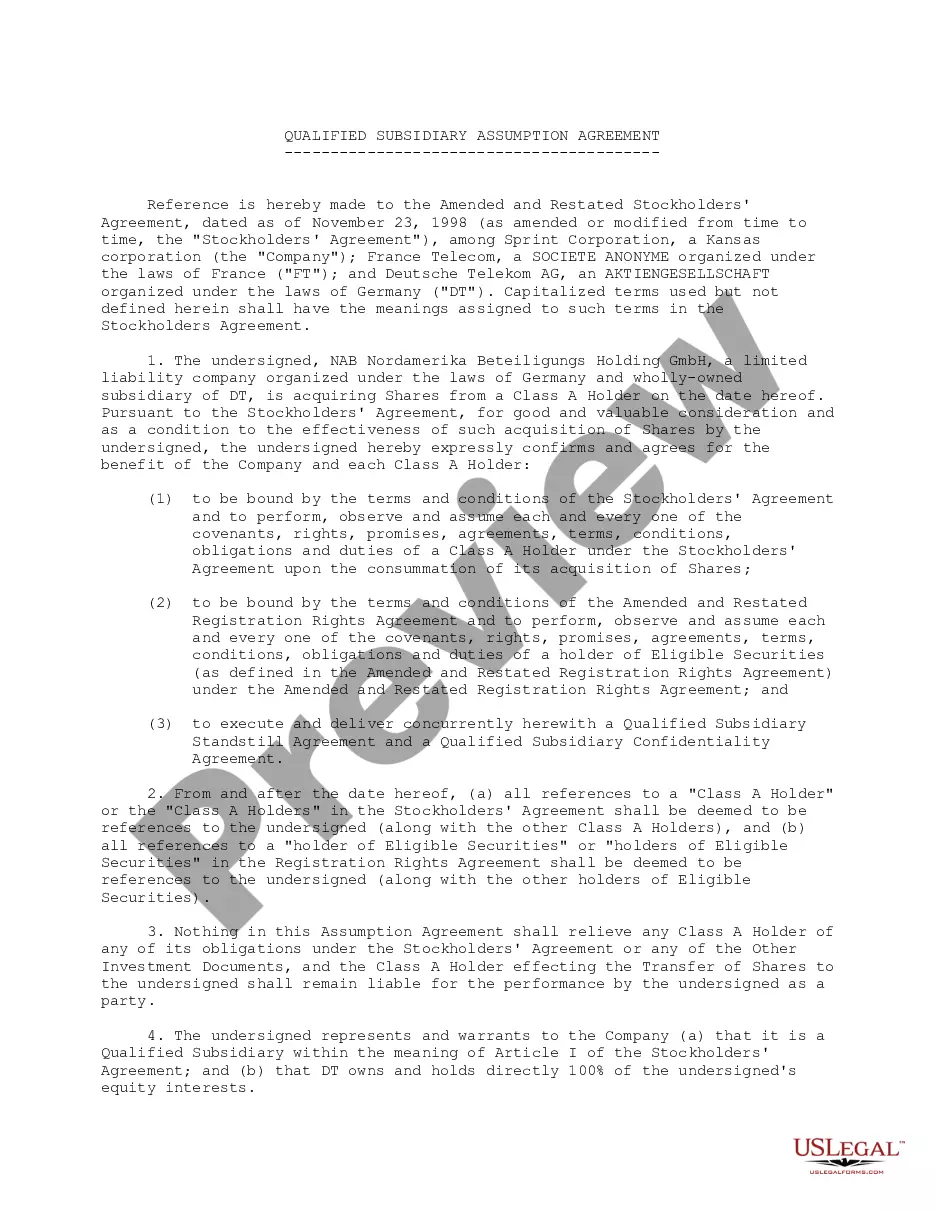
Clark Nevada Subsidiary Assumption Agreement
Description
Get your form ready online
Our built-in tools help you complete, sign, share, and store your documents in one place.
Make edits, fill in missing information, and update formatting in US Legal Forms—just like you would in MS Word.
Download a copy, print it, send it by email, or mail it via USPS—whatever works best for your next step.
Sign and collect signatures with our SignNow integration. Send to multiple recipients, set reminders, and more. Go Premium to unlock E-Sign.
If this form requires notarization, complete it online through a secure video call—no need to meet a notary in person or wait for an appointment.
We protect your documents and personal data by following strict security and privacy standards.

Make edits, fill in missing information, and update formatting in US Legal Forms—just like you would in MS Word.

Download a copy, print it, send it by email, or mail it via USPS—whatever works best for your next step.

Sign and collect signatures with our SignNow integration. Send to multiple recipients, set reminders, and more. Go Premium to unlock E-Sign.

If this form requires notarization, complete it online through a secure video call—no need to meet a notary in person or wait for an appointment.

We protect your documents and personal data by following strict security and privacy standards.
Looking for another form?

How to fill out Subsidiary Assumption Agreement?
A document process consistently accompanies any legal activity you undertake.
Launching a business, applying for or accepting a job offer, transferring ownership, and numerous other life situations require you to prepare official documents that vary from state to state.
That is the reason why having everything gathered in one location is extremely advantageous.
US Legal Forms is the largest online repository of current federal and state-specific legal documents.
Utilize it as required: print it or complete it electronically, sign it, and submit where necessary. This is the most straightforward and dependable method to obtain legal documents. All the templates available in our library are professionally crafted and checked for compliance with local laws and regulations. Prepare your documentation and manage your legal matters effectively with US Legal Forms!
- On this site, you can effortlessly find and obtain a document for any individual or business purpose utilized in your area, including the Clark Subsidiary Assumption Agreement.
- Finding templates on the platform is exceptionally straightforward.
- If you already possess a subscription to our service, Log In to your account, locate the sample through the search feature, and click Download to save it on your device.
- After that, the Clark Subsidiary Assumption Agreement will be available for future use in the My documents section of your profile.
- If you are engaging with US Legal Forms for the first time, follow this simple guide to acquire the Clark Subsidiary Assumption Agreement.
- Ensure you have navigated to the correct page with your local form.
- Utilize the Preview mode (if available) and browse through the template.
- Examine the description (if any) to confirm the form meets your needs.
- Search for an alternative document using the search function if the sample does not suit you.
- Click Buy Now once you locate the desired template.
- Select the appropriate subscription plan, then Log In or create an account.
- Choose the preferred payment option (with credit card or PayPal) to proceed.
- Select file format and save the Clark Subsidiary Assumption Agreement on your device.
Form popularity
FAQ
If the company changes owners in whole or in part, it is still the same company and this will not terminate any contracts. If, instead, the company sells its business (which is an asset of the company that it can sell like a car or a building), then the contracts are transferred as part of that sale.
If the company changes owners in whole or in part, it is still the same company and this will not terminate any contracts. If, instead, the company sells its business (which is an asset of the company that it can sell like a car or a building), then the contracts are transferred as part of that sale.
If the assets of a company are taken over or the company merges with another, this will affect its legal identity. When this happens, any contracts which that company is a party to will need to be adjusted so that any rights and obligations it has will transfer to the new company.
The General Rule and Exceptions The general rule with respect to contracts is that they are freely assignable. Like other types of property, agreements and the rights under those agreements can be transferred from one party to another. There are, however, exceptions to this general rule.
The general rule is that contracts are freely assignable unless the contract itself, a statute, or public policy dictates otherwise.
An assignment of contract occurs when one party to an existing contract (the "assignor") hands off the contract's obligations and benefits to another party (the "assignee"). Ideally, the assignor wants the assignee to step into his shoes and assume all of his contractual obligations and rights.
A company could choose to assign a contract to one party and assume that it will have rights outlined in the contract. However, an assignment will only transfer the company's rights, such as getting paid. The burden under the contract does not get transferred and will stay with the company.
Assignment of contract allows one person to assign, or transfer, their rights, obligations, or property to another. An assignment of contract clause is often included in contracts to give either party the opportunity to transfer their part of the contract to someone else in the future.
An assumption agreement, sometimes called an assignment and assumption agreement, is a legal document that allows one party to transfer rights and/or obligations to another party. It allows one party to "assume" the rights and responsibilities of the other party.
What is a Transfer Agreement? A transfer agreement is a legally binding document that conveys ownership from one person or entity to another.