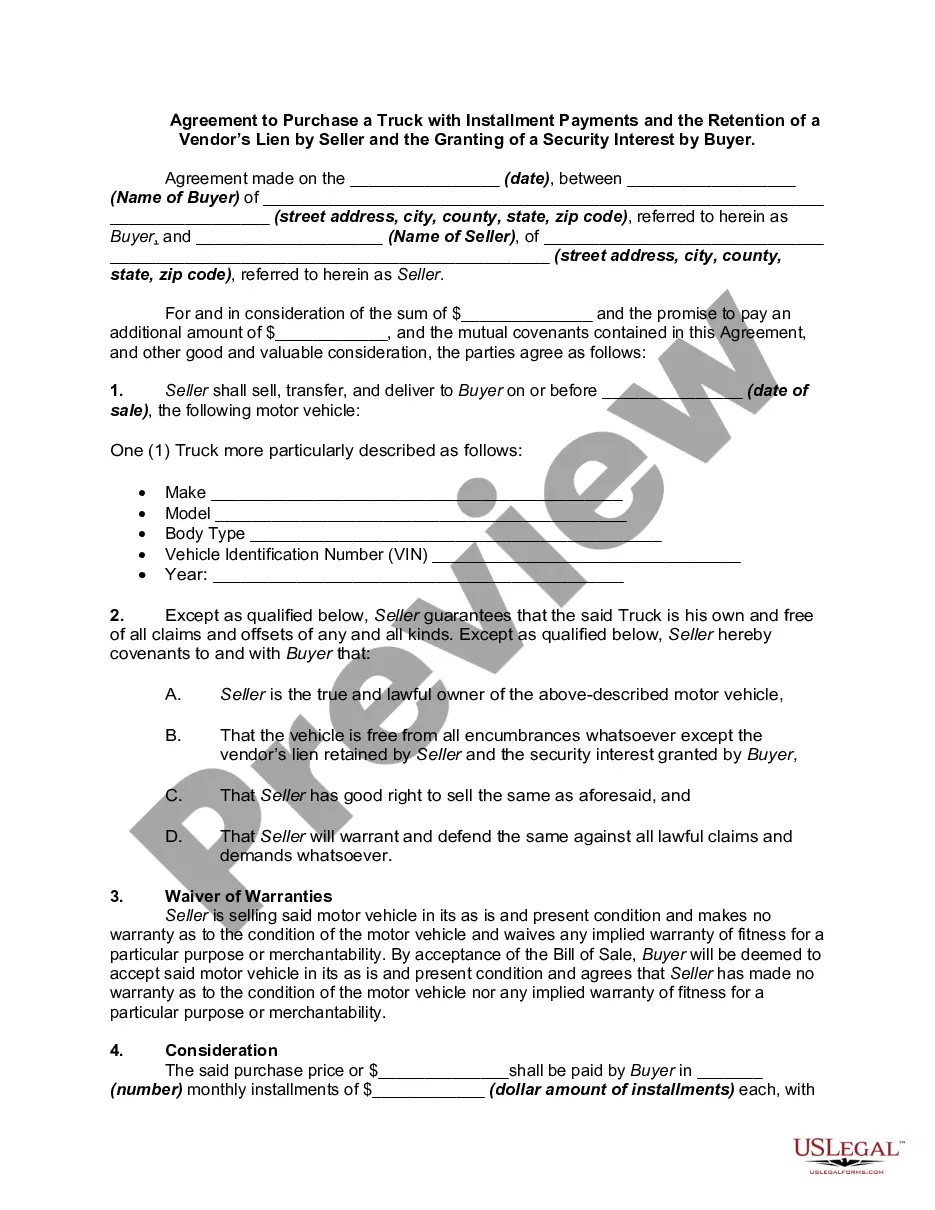
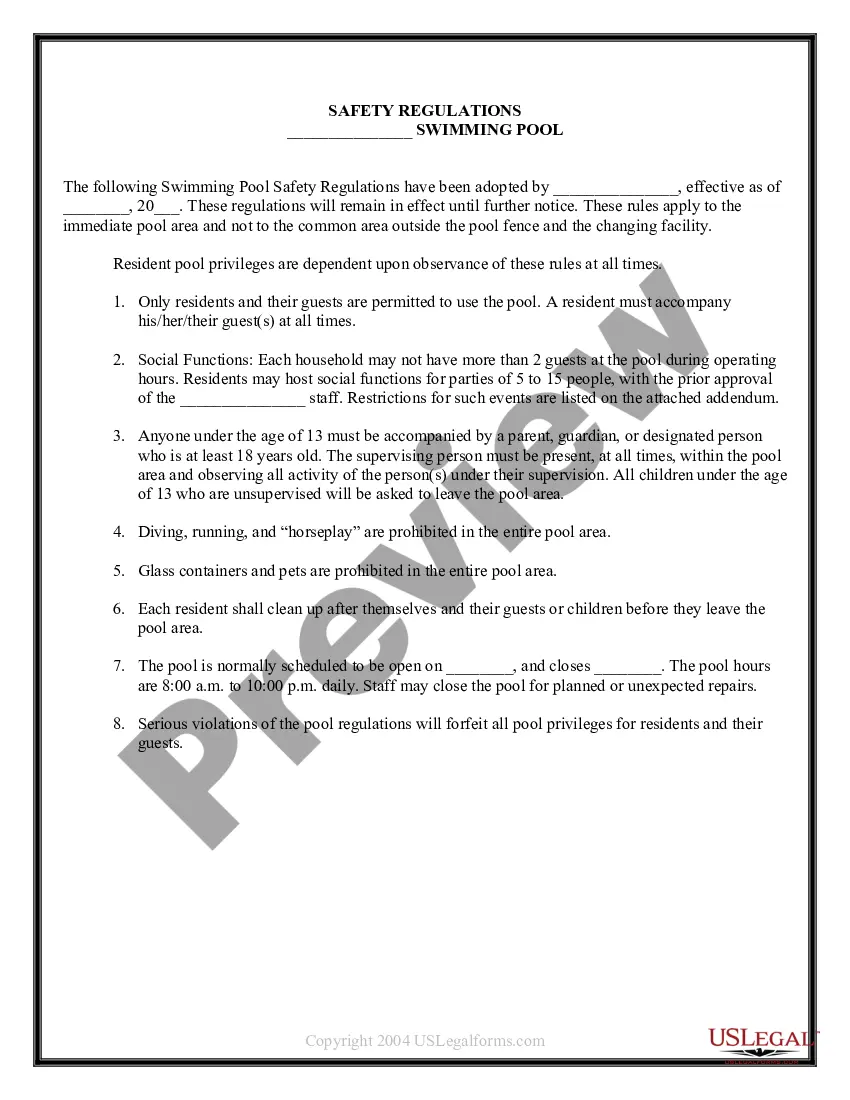
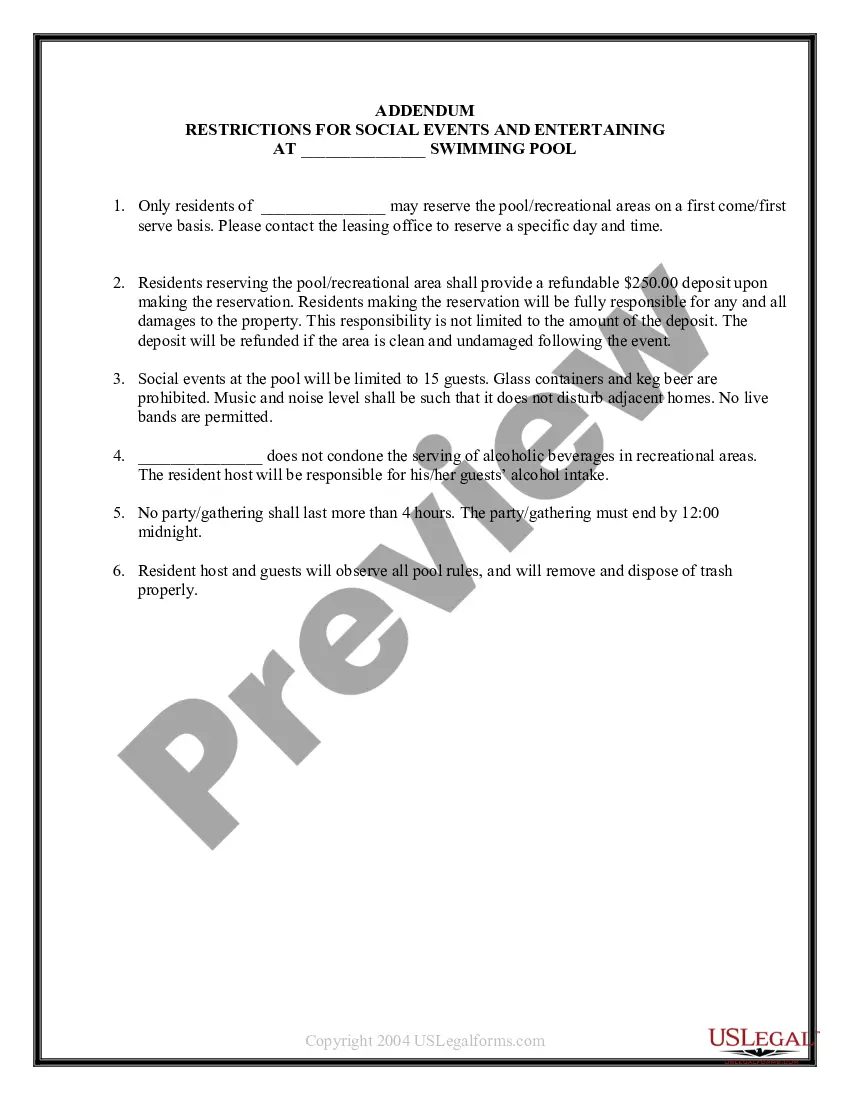
Apartment policy concerning the use of the complex swimming pool.
Wayne Michigan Apartment Complex Swimming Pool Policy
Category:
State:
Multi-State
County:
Wayne
Control #:
US-898LT
Format:
Word;
Rich Text
Instant download
Description








How to fill out Apartment Complex Swimming Pool Policy?
Creating documents, such as the Wayne Apartment Complex Swimming Pool Policy, to manage your legal issues is a challenging and time-intensive endeavor.
Many situations necessitate the involvement of a lawyer, which also makes this process costly.
However, you can take charge of your legal matters and manage them independently.
The onboarding process for new clients is equally easy! Here’s what steps to follow before downloading the Wayne Apartment Complex Swimming Pool Policy: Ensure that your document is relevant to your state or county as the rules for drafting legal documents may differ from one state to another. Explore more details about the form by viewing it or reading a brief introduction. If the Wayne Apartment Complex Swimming Pool Policy isn't what you were looking for, use the header to find another option. Log In or create an account to start using our service and access the document. Everything in order on your end? Click the Buy now button and select your subscription plan. Choose the payment method and enter your payment information. Your form is ready for download. It’s simple to locate and acquire the necessary template with US Legal Forms. Countless businesses and individuals are already enjoying our extensive library. Subscribe now if you wish to discover the additional benefits available with US Legal Forms!
- US Legal Forms is available to assist you.
- Our platform offers over 85,000 legal templates designed for various situations and life scenarios.
- We ensure that each document complies with the laws of every state, alleviating concerns about legal complications related to compliance.
- If you're familiar with our site and hold a subscription with US, you know how straightforward it is to obtain the Wayne Apartment Complex Swimming Pool Policy form.
- Just Log In to your profile, download the template, and modify it to suit your requirements.
- Lost your form? No problem. You can retrieve it in the My documents section of your account - whether on desktop or mobile.
Form popularity
FAQ
In Michigan, homes with pools must adhere to the following fence requirements: A swimming pool must be completely enclosed by a wall, fence, or other protective enclosure that is at least 4 feet tall. It must not provide any footing for climbing, and should be designed to prevent passage through or under the enclosure.
In-Ground Swimming Pools In-ground pools are required to be surrounded by a barrier (fence or wall) that is a minimum of 4 feet tall with slats that are no further apart than 4 inches or a mesh size (chain link fences) no larger than 2 ¼ inches.
Requirements: Under the Act, all outdoor swimming pools must have a 4-foot fence or other barrier around the outer perimeter of the pool, with no gaps in coverage. The barrier must also be sufficiently away from the pool's edge so a child who penetrates the barrier or fence does not immediately fall into the pool.
Pool fencing must be a minimum height of 1200mm. The top of the fence must be a minimum of 900mm away from climbable objects including trees, pergolas, barbecues, toys, pot plants and furniture. Any gaps in the fencing must be less than 100mm. The pool fence must be constructed from durable materials.
Permits and inspections are required for projects that can hold more than 24 inches of water. That includes: in-ground pools. above-ground pools.
NOTE: Indiana State Pool Code requires a yard fence around above ground residential swimming pools that are less than 48" in height or a fence around the pool itself. In-ground pools have the option to use a 400 lb auto cover or yard fence. 6.
Fencing In almost all cases, public-use pools are required to have some kind of fencing around the pool. States, cities, and counties usually specify exactly what is required of these fences in terms of material, spacing, gates, locks, and more.
Remove any top decking concrete walkways, coping tiles and any other concrete around the pool that you don't want anymore. Toss it into the pool over the holes you have made. Cover the old cement with a layer of crushed rock. Then cover this with a layer of sand, or just fill it up the rest of the way with dirt.
Fencing In almost all cases, public-use pools are required to have some kind of fencing around the pool. States, cities, and counties usually specify exactly what is required of these fences in terms of material, spacing, gates, locks, and more.
If you have a deck at the edge of your above-ground pool, it should comply with local building codes, including a childproof fence around its outside edge if required. Some states and local governments have passed laws requiring protective barriers around all types of swimming pools, both inground and above-ground.