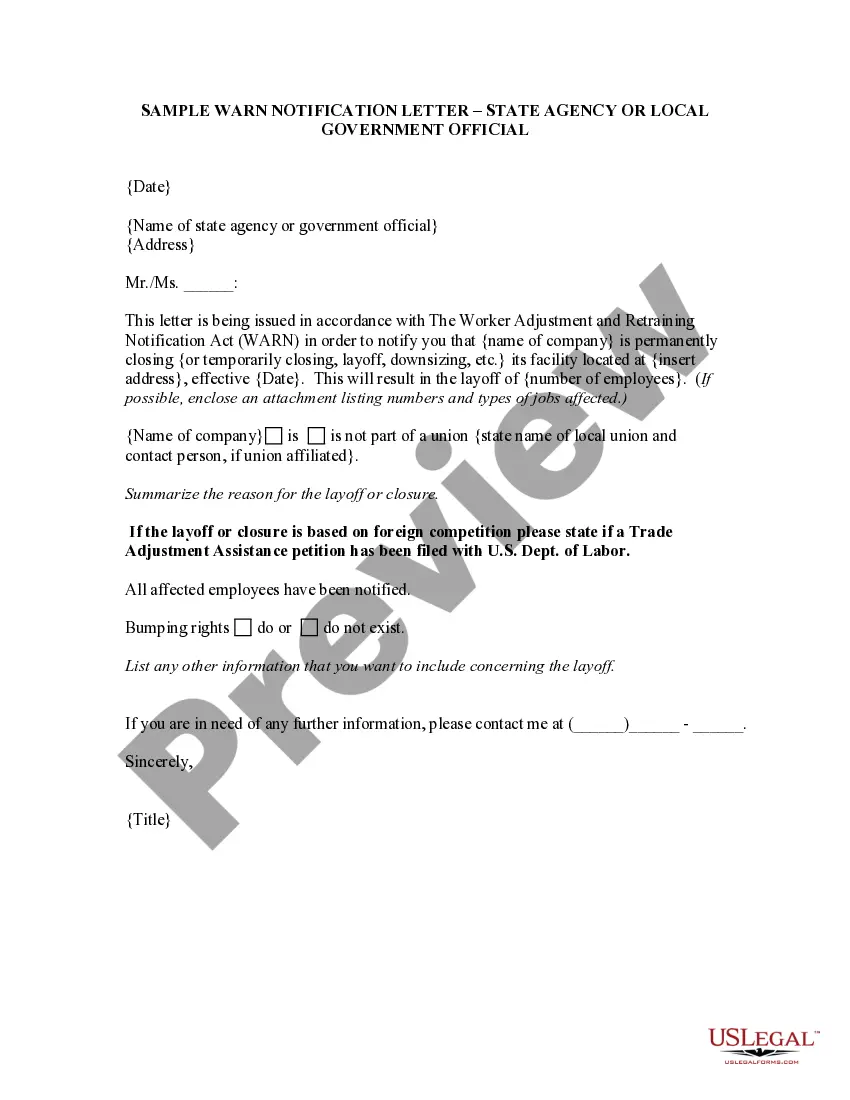
Sacramento California Sample WARN Notification Letter - State Agency or Government Official
Description
Get your form ready online
Our built-in tools help you complete, sign, share, and store your documents in one place.
Make edits, fill in missing information, and update formatting in US Legal Forms—just like you would in MS Word.
Download a copy, print it, send it by email, or mail it via USPS—whatever works best for your next step.
Sign and collect signatures with our SignNow integration. Send to multiple recipients, set reminders, and more. Go Premium to unlock E-Sign.
If this form requires notarization, complete it online through a secure video call—no need to meet a notary in person or wait for an appointment.
We protect your documents and personal data by following strict security and privacy standards.

Make edits, fill in missing information, and update formatting in US Legal Forms—just like you would in MS Word.

Download a copy, print it, send it by email, or mail it via USPS—whatever works best for your next step.

Sign and collect signatures with our SignNow integration. Send to multiple recipients, set reminders, and more. Go Premium to unlock E-Sign.

If this form requires notarization, complete it online through a secure video call—no need to meet a notary in person or wait for an appointment.

We protect your documents and personal data by following strict security and privacy standards.
Looking for another form?

How to fill out Sample WARN Notification Letter - State Agency Or Government Official?
Legislation and policies in every domain differ from region to region.
If you are not a lawyer, it's easy to become overwhelmed by numerous rules when drafting legal documents.
To prevent costly legal help when creating the Sacramento Sample WARN Notification Letter - State Agency or Government Official, you require a confirmed template suitable for your county.
That's the simplest and most cost-effective way to acquire current templates for any legal purposes. Discover everything with just a few clicks and maintain your documentation organized with US Legal Forms!
- This is where the US Legal Forms platform proves to be beneficial.
- US Legal Forms is a reliable online repository trusted by millions, featuring over 85,000 state-specific legal templates.
- It serves as an excellent option for professionals and individuals who seek do-it-yourself templates for various personal and business situations.
- All documents can be reused: once you acquire a sample, it stays accessible in your account for future use.
- Therefore, with an active account, you simply need to Log In and re-download the Sacramento Sample WARN Notification Letter - State Agency or Government Official from the My documents section.
- For first-time users, a few additional steps are necessary to obtain the Sacramento Sample WARN Notification Letter - State Agency or Government Official.
- Review the page content to confirm you have located the correct sample.
- Utilize the Preview feature or examine the form description if present.
Form popularity
FAQ
The enforcement of the WARN law and labor law violations should be directed to the California Department of Industrial Relations.
Training. Worker Adjustment and Retraining Notification Act (WARN) - Preamble to the 1989 Final Rule.
The WARN Act is triggered by: Plant closings. The shutdown of a single employment site, facility or operating unit, that results in a loss of at least 50 full-time employees, during a 30 day period or. Mass layoffs.
California's Worker Adjustment and Retraining Notification (WARN) Act expands on the requirements of the federal WARN Act and provides protection to employees, their families and communities by requiring employers to give affected employees and other state and local representatives notice 60 days in advance of a plant
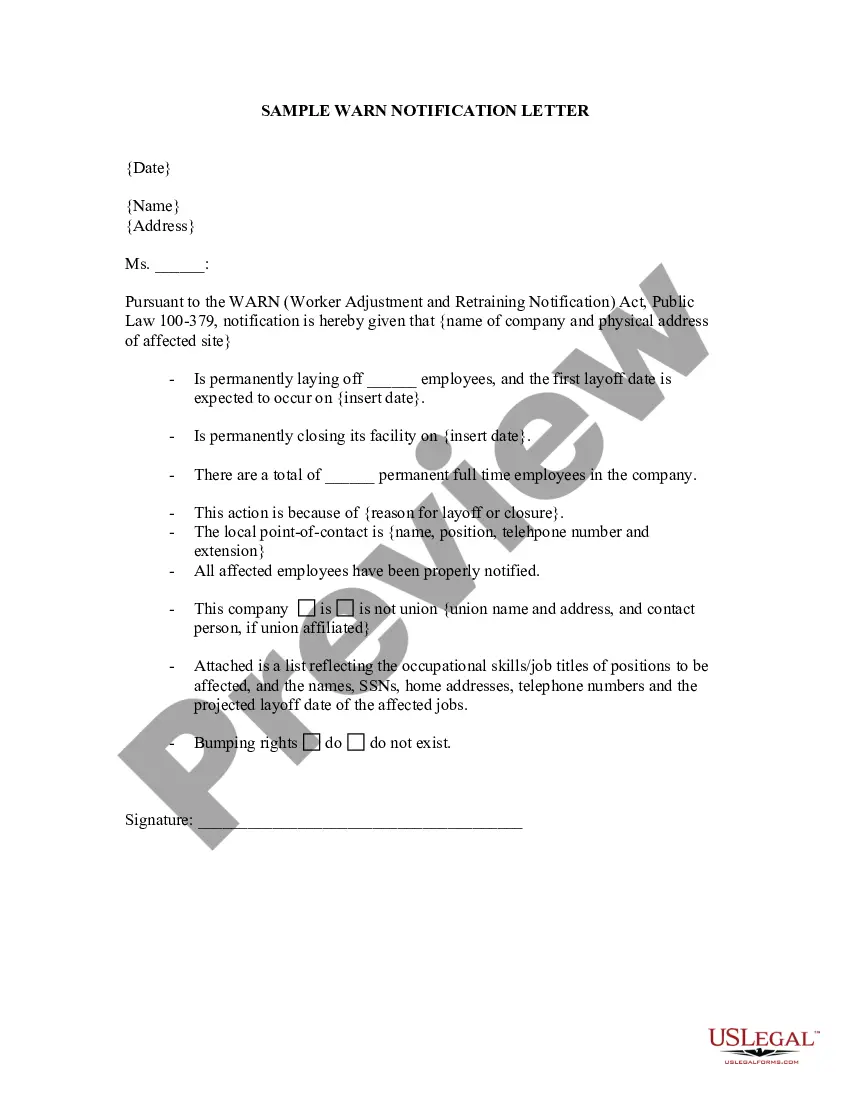
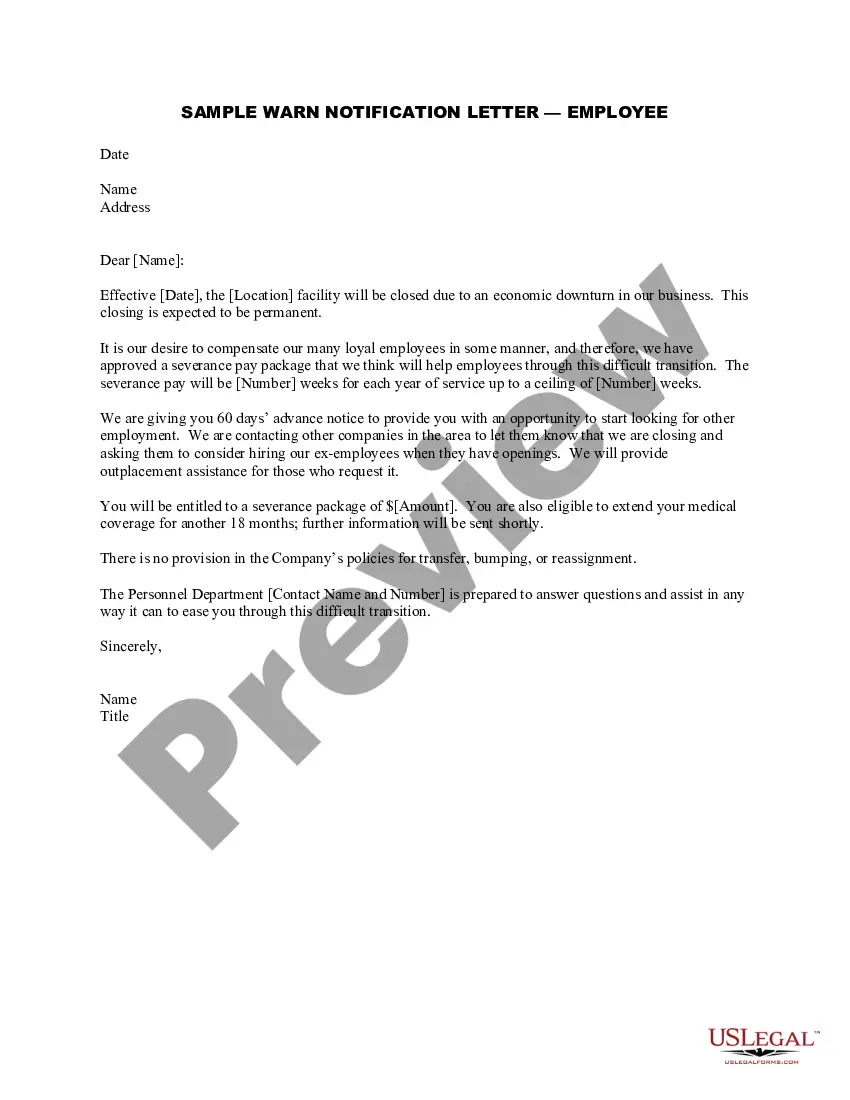
Dear Recipient Name: We regret to inform you that circumstances will force Employer Name to conduct layoffs or close our facility/one of our facilities. As required by the Worker Adjustment and Retraining Notification Act of 1988, this letter serves to give you 60 days' advance notice of the layoffs/closing.
WARN makes certain exceptions to the requirements when layoffs occur due to unforeseeable business circumstances, faltering companies, and natural disasters.
Worker Adjustment and Retraining Notification Act (WARN) (29 USC 2100 et. seq.) - Protects workers, their families and communities by requiring most employers with 100 or more employees to provide notification 60 calendar days in advance of plant closings and mass layoffs.
The Illinois WARN Act requires employers with 75 or more full-time employees to give workers and state and local government officials 60 days advance notice of a plant closing or mass layoff.
Being laid off means you have lost your job due to changes that the company has decided to make on its end. The difference between being laid off and being fired is that if you are fired, the company considers that your actions have caused the termination. If you are laid off, you didn't necessarily do anything wrong.
The period of the WARN Act violation is the smaller of the following: The period of time between 60 days before you lost your job, and the day you were actually notified you were losing your job in the mass layoff, relocation or plant closure; or. One-half of the number of days you were employed by the employer.