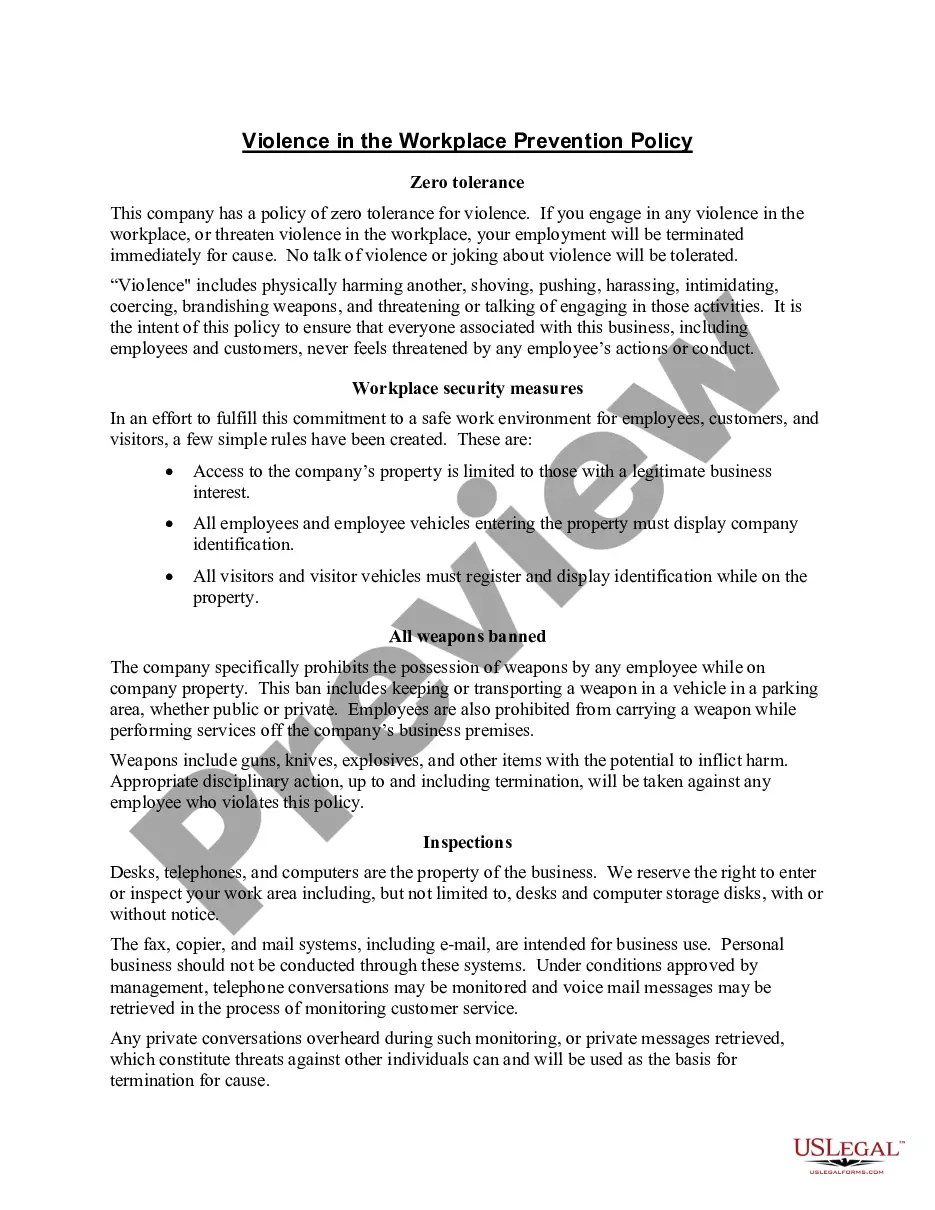
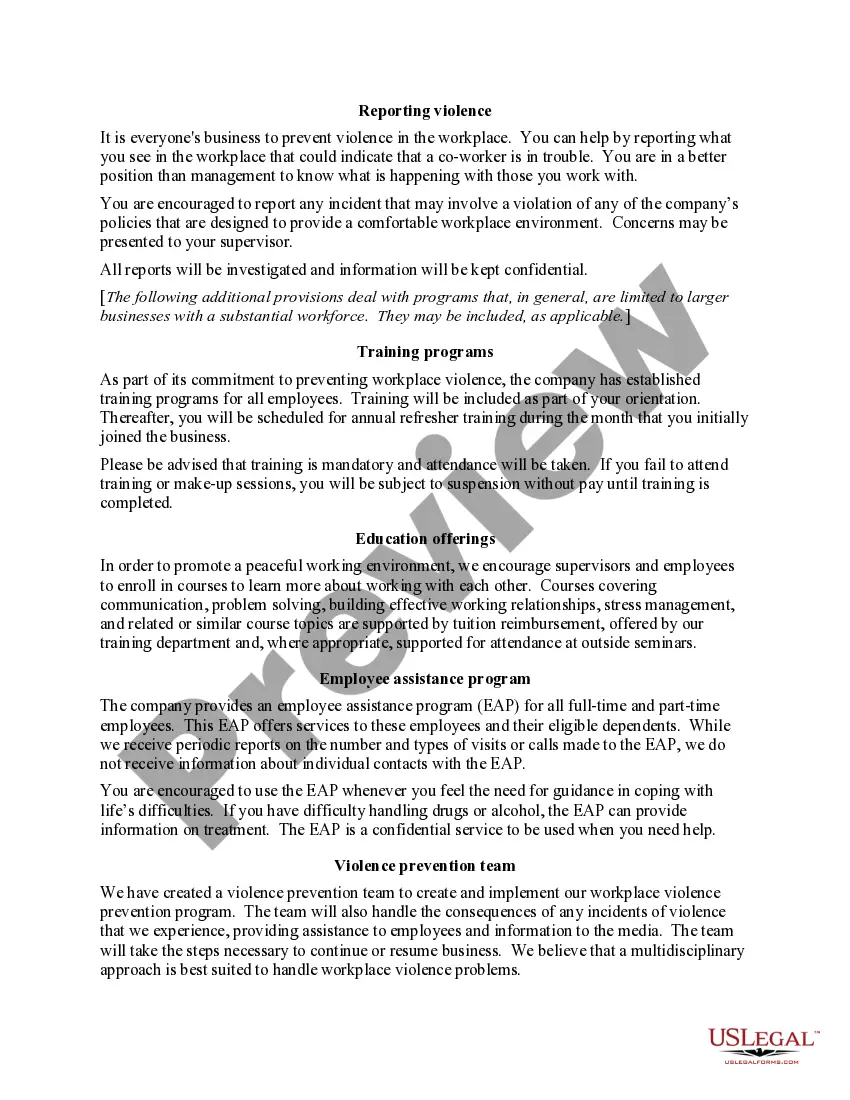
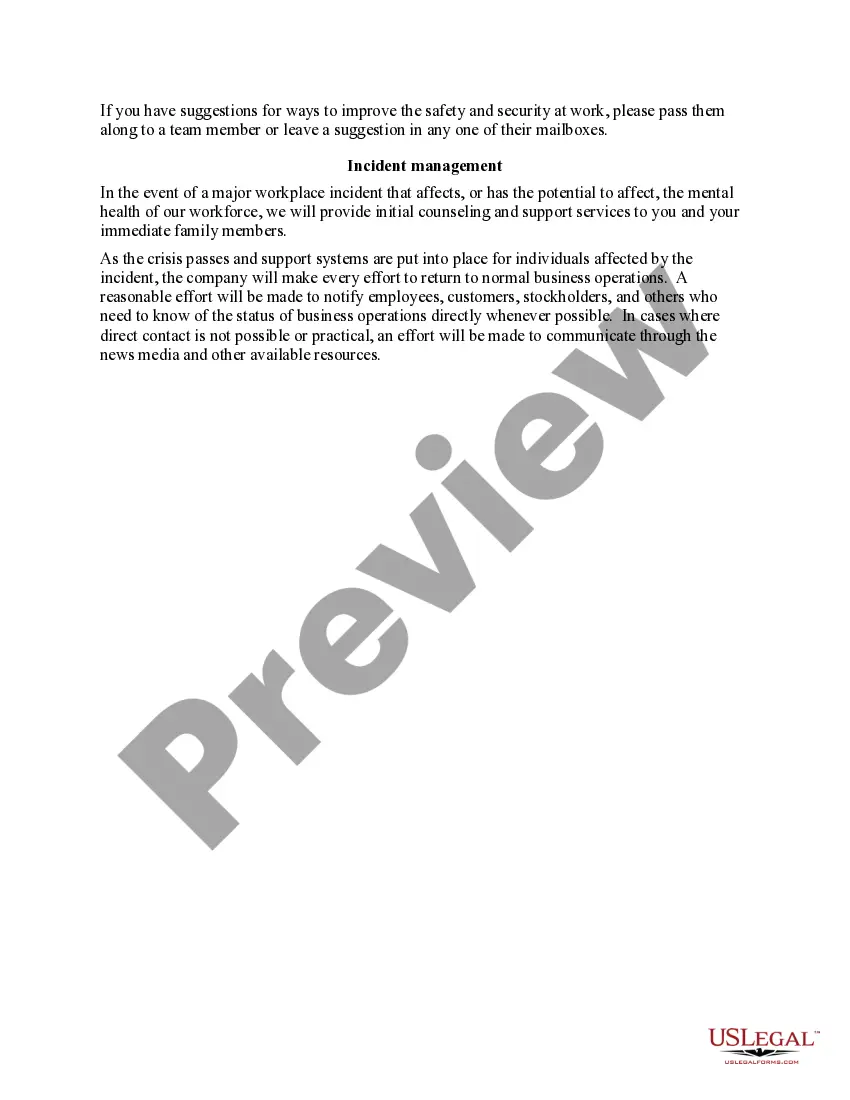
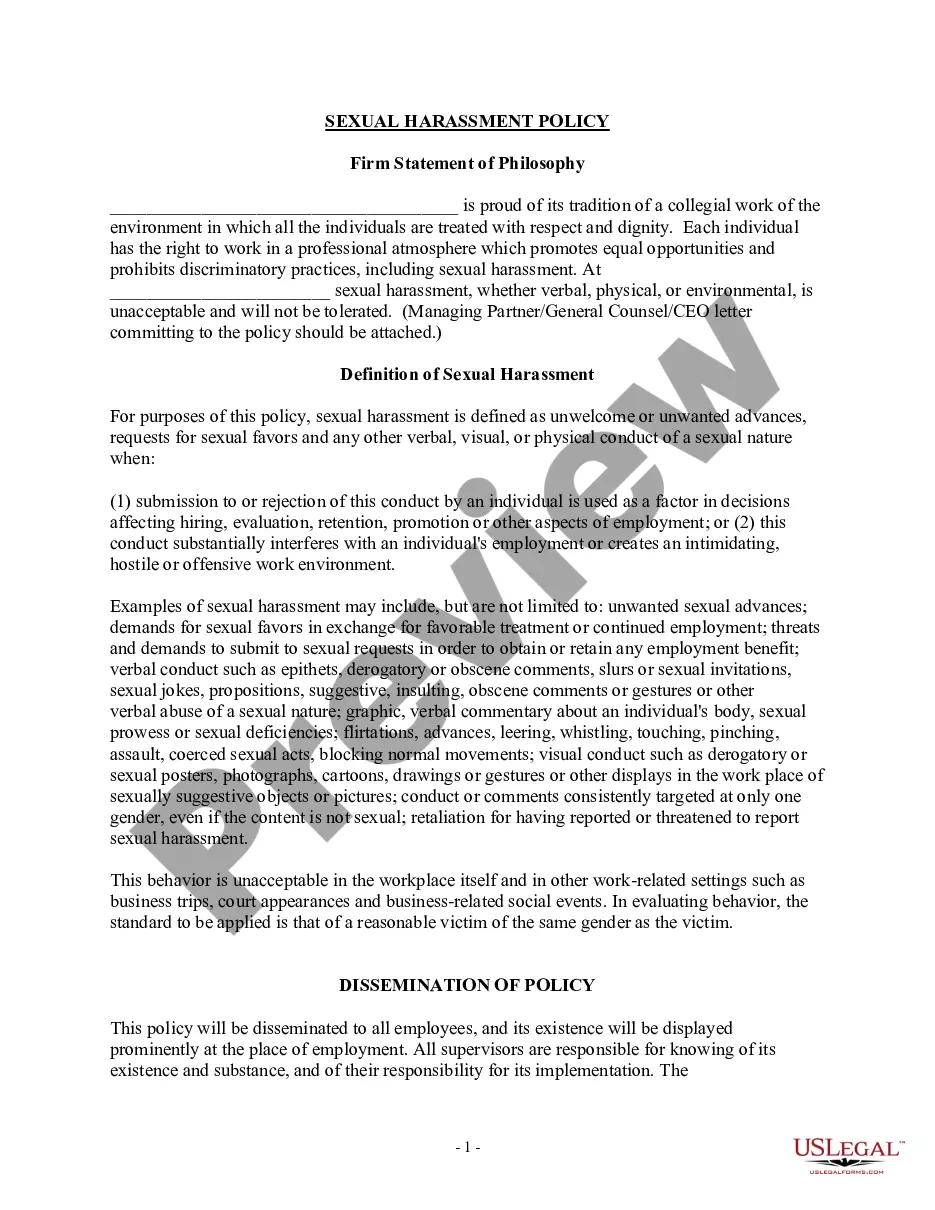
Contra Costa California Violence in the Workplace Prevention Policy
Description
Get your form ready online
Our built-in tools help you complete, sign, share, and store your documents in one place.
Make edits, fill in missing information, and update formatting in US Legal Forms—just like you would in MS Word.
Download a copy, print it, send it by email, or mail it via USPS—whatever works best for your next step.
Sign and collect signatures with our SignNow integration. Send to multiple recipients, set reminders, and more. Go Premium to unlock E-Sign.
If this form requires notarization, complete it online through a secure video call—no need to meet a notary in person or wait for an appointment.
We protect your documents and personal data by following strict security and privacy standards.

Make edits, fill in missing information, and update formatting in US Legal Forms—just like you would in MS Word.

Download a copy, print it, send it by email, or mail it via USPS—whatever works best for your next step.

Sign and collect signatures with our SignNow integration. Send to multiple recipients, set reminders, and more. Go Premium to unlock E-Sign.

If this form requires notarization, complete it online through a secure video call—no need to meet a notary in person or wait for an appointment.

We protect your documents and personal data by following strict security and privacy standards.
Looking for another form?
How to fill out Violence In The Workplace Prevention Policy?
A document procedure consistently accompanies every legal action you undertake.
Establishing a business, submitting or accepting a job offer, transferring property, and numerous other life situations necessitate that you prepare formal documentation that differs across states.
That is why having everything compiled in a single location is highly advantageous.
US Legal Forms is the most extensive online repository of current federal and state-specific legal documents.
Use it as required: print it or complete it electronically, sign it, and send it where needed. This is the easiest and most reliable method to obtain legal documentation. All templates available in our library are expertly crafted and confirmed for compliance with local laws and regulations. Prepare your documents and manage your legal matters effectively with US Legal Forms!
- Here, you can effortlessly find and download a document for any personal or professional need relevant to your area, including the Contra Costa Violence in the Workplace Prevention Policy.
- Finding forms on the platform is incredibly straightforward.
- If you already have a subscription to our service, Log In to your account, search for the sample using the search bar, and click Download to save it on your device.
- After that, the Contra Costa Violence in the Workplace Prevention Policy will be available for future use in the My documents section of your profile.
- If you are using US Legal Forms for the first time, adhere to this straightforward guide to acquire the Contra Costa Violence in the Workplace Prevention Policy.
- Ensure you have accessed the correct page featuring your local form.
- Utilize the Preview mode (if available) to review the sample.
- Examine the description (if available) to confirm that the form satisfies your needs.
- If the sample is unsuitable, look for an alternative document through the search function.
- Click Buy Now when you locate the necessary template.
- Choose the appropriate subscription plan, then Log In or register for an account.
- Select your preferred payment method (by credit card or PayPal) to proceed.
- Choose the file format and save the Contra Costa Violence in the Workplace Prevention Policy on your device.
Form popularity
FAQ
The violence prevention policy should explicitly state the consequences of making threats or committing acts of violence in the workplace. A comprehensive workplace violence prevention policy and program should also include procedures and responsibilities to be taken in the event of a violent incident in the workplace.
It is intended to make employees, including supervisors and managers, aware of the potential for violence in the workplace, to increase their abilities to recognize early warning signs of potentially violent situations, and to understand how to respond to actual or potential incidents.
The building blocks for developing an effective workplace violence prevention program include: (1) Management commitment and employee participation, (2) Worksite analysis, (3) Hazard prevention and control, (4) Safety and health training, and (5) Recordkeeping and program evaluation.
The safe work procedures to follow to prevent violence....2.5 Training of supervisors and workers, when they are hired and on an ongoing basis Prevent or minimize the risk of violence. Recognize and control potentially violent situations. Respond to incidents and obtain assistance. Report, investigate and document incidents.
Part of your comprehensive program should include an emergency action plan with regular drills conducted to ensure that all employees know what to do in the event of a workplace violence incident. Consider inviting local law enforcement in to help conduct these drills and to conduct mock training exercises.
The policy must recognize the potential hazard of violence in the workplace and provide that all prospective employees are informed of the potential for violence. The policy should clearly spell out the employer's responsibility to provide a violence-free workplace and its commitment to violence prevention.
(1) Management commitment and employee participation, (2) Worksite analysis, (3) Hazard prevention and control, (4) Safety and health training, and (5) Recordkeeping and program evaluation. A violence prevention program focuses on developing processes and procedures appropriate for the workplace in question.
Types of Workplace Violence Type 1: Criminal Intent.Type 2: Customer/Client.Type 3: Worker-on-Worker.Type 4: Personal Relationship.
Every covered employer is required to develop a workplace violence prevention plan. The plan must include procedures to identify and evaluate risk factors for workplace violence, correct hazards, prepare for workplace violence emergencies, and respond to and investigate violent incidents.