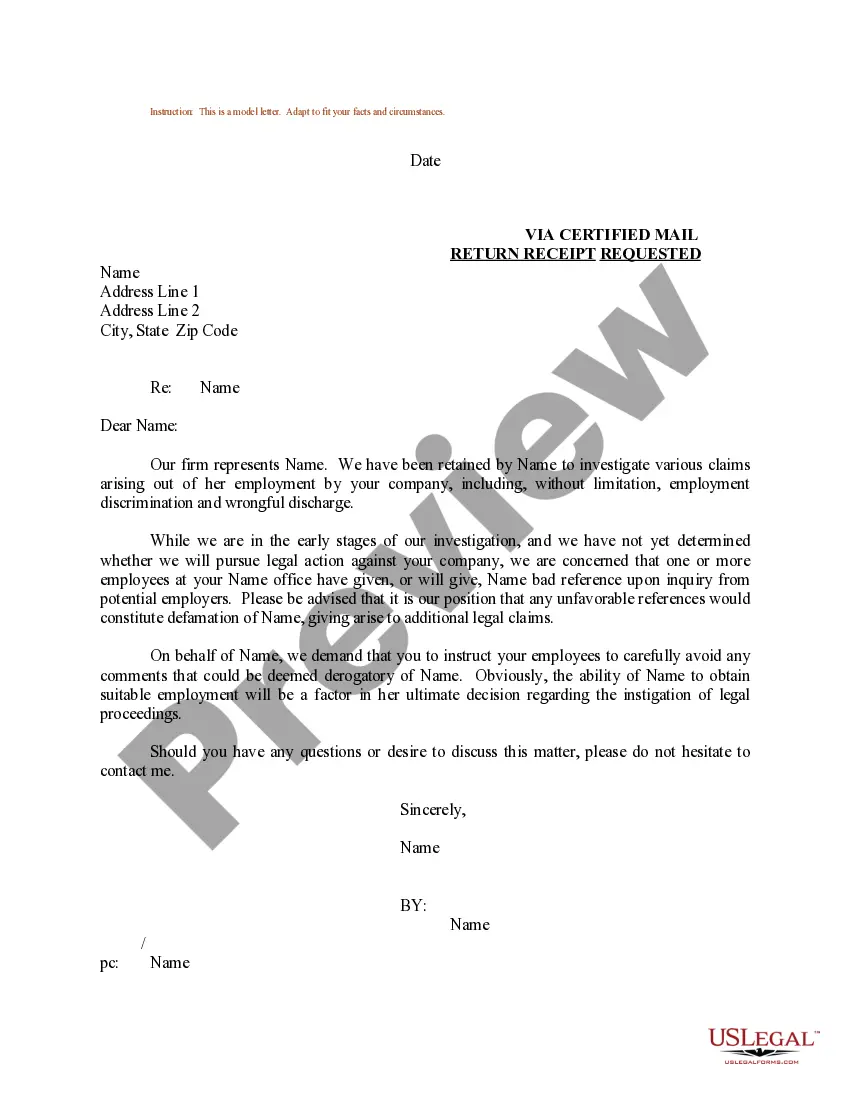
Suffolk New York Sample Letter for Employment Discrimination - Wrongful Discharge
Description
Get your form ready online
Our built-in tools help you complete, sign, share, and store your documents in one place.
Make edits, fill in missing information, and update formatting in US Legal Forms—just like you would in MS Word.
Download a copy, print it, send it by email, or mail it via USPS—whatever works best for your next step.
Sign and collect signatures with our SignNow integration. Send to multiple recipients, set reminders, and more. Go Premium to unlock E-Sign.
If this form requires notarization, complete it online through a secure video call—no need to meet a notary in person or wait for an appointment.
We protect your documents and personal data by following strict security and privacy standards.

Make edits, fill in missing information, and update formatting in US Legal Forms—just like you would in MS Word.

Download a copy, print it, send it by email, or mail it via USPS—whatever works best for your next step.

Sign and collect signatures with our SignNow integration. Send to multiple recipients, set reminders, and more. Go Premium to unlock E-Sign.

If this form requires notarization, complete it online through a secure video call—no need to meet a notary in person or wait for an appointment.

We protect your documents and personal data by following strict security and privacy standards.
Looking for another form?


How to fill out Sample Letter For Employment Discrimination - Wrongful Discharge?
Drafting legal paperwork can be challenging. Furthermore, if you opt to hire a lawyer to create a business contract, documents for ownership transfer, pre-nuptial agreement, divorce documents, or the Suffolk Sample Letter for Employment Discrimination - Wrongful Discharge, it may result in significant expenses.
So what is the most practical method to conserve both time and money while producing valid forms that fully comply with your state and local regulations.
Review the form description and utilize the Preview option, if accessible, to verify it’s the template you require. Don’t be concerned if the template does not meet your needs – search for the suitable one in the header. Hit Buy Now once you locate the necessary sample and choose the most appropriate subscription. Log In or create an account to purchase your subscription. Complete the payment with a credit card or via PayPal. Choose the document format for your Suffolk Sample Letter for Employment Discrimination - Wrongful Discharge and download it. Afterward, you can print it and fill it out on paper or transfer the samples to an online editor for quicker and more efficient completion. US Legal Forms allows you to reuse all documents you’ve ever obtained multiple times – locate your templates in the My documents tab within your profile. Give it a try now!
- US Legal Forms is a fantastic option, no matter if you're looking for templates for personal or business purposes.
- US Legal Forms boasts the largest online repository of state-specific legal documents, offering users the most current and professionally verified forms for any situation collected all in one location.
- Thus, if you require the latest version of the Suffolk Sample Letter for Employment Discrimination - Wrongful Discharge, you can effortlessly find it on our platform.
- Acquiring the documents takes minimal time.
- Users with an existing account should confirm their subscription is active, Log In, and select the sample using the Download button.
- If you haven't signed up yet, here’s how you can obtain the Suffolk Sample Letter for Employment Discrimination - Wrongful Discharge.
- Browse the page and ensure there's a template available for your area.
Form popularity
FAQ
Give details about your dispute. Tell the reason you believe you were terminated. Tell any contract or policy provisions that were violated. Tell about any incidents that indicate you were terminated for a prohibited reason. Discuss any documentation you have that support your position.
Read on to learn about three examples of wrongful termination in California. #1 - Racial Discrimination. #2 - Sexual Harassment. #3 - Family and Medical Leave Act Violations.
According to EEOC data, the average out-of-court settlement for employment discrimination claims is about $40,000. Studies of verdicts have shown that about 10% of wrongful termination cases result in a verdict of $1 million or more.
To be wrongfully terminated is to be fired for an illegal reason, which may involve violation of federal anti-discrimination laws or a contractual breach. For instance, an employee cannot be fired on the basis of her race, gender, ethnic background, religion, or disability.
Your chances of winning a discrimination case will depend on how you proceed. The Harvard Law and Policy Review published an article in 2009 which found that employees only win discrimination cases against their employers 15% of the time.
Wrongful discharge is often used as legal shorthand to describe something known as wrongful termination in violation of public policy a sort of catch-all, judge-made rule that prohibits employers in many states from firing an employee who opposes or refuses to participate in certain unlawful or unethical
$50,000 to an employee if the employer has between 15 and 100 employees; $100,000 if the employer has 101 to 200 employees; $200,000 if the employer has 201 to 500 employees; and. $300,000 if the employer has more than 500 employees.
The first example of a wrongful discharge is when an employer fires an employee because of the employee's protected status, such as race, color, sex, religion, national origin, etc. This type of wrongful discharge falls under the federal or local anti-discrimination laws.
The legal consequences may include court-ordered payment of lost wages, expenses and even punitive damages. In some cases, wrongful termination may also result in statutory penalties such as fines.