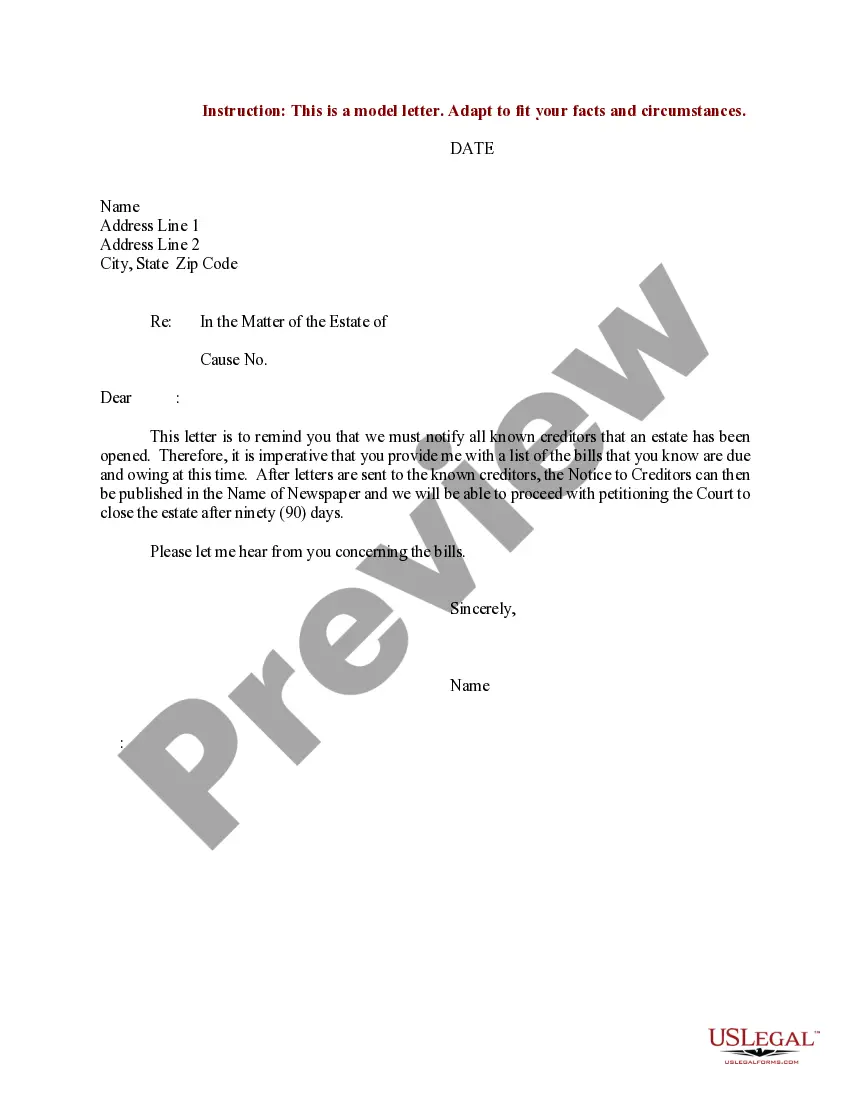
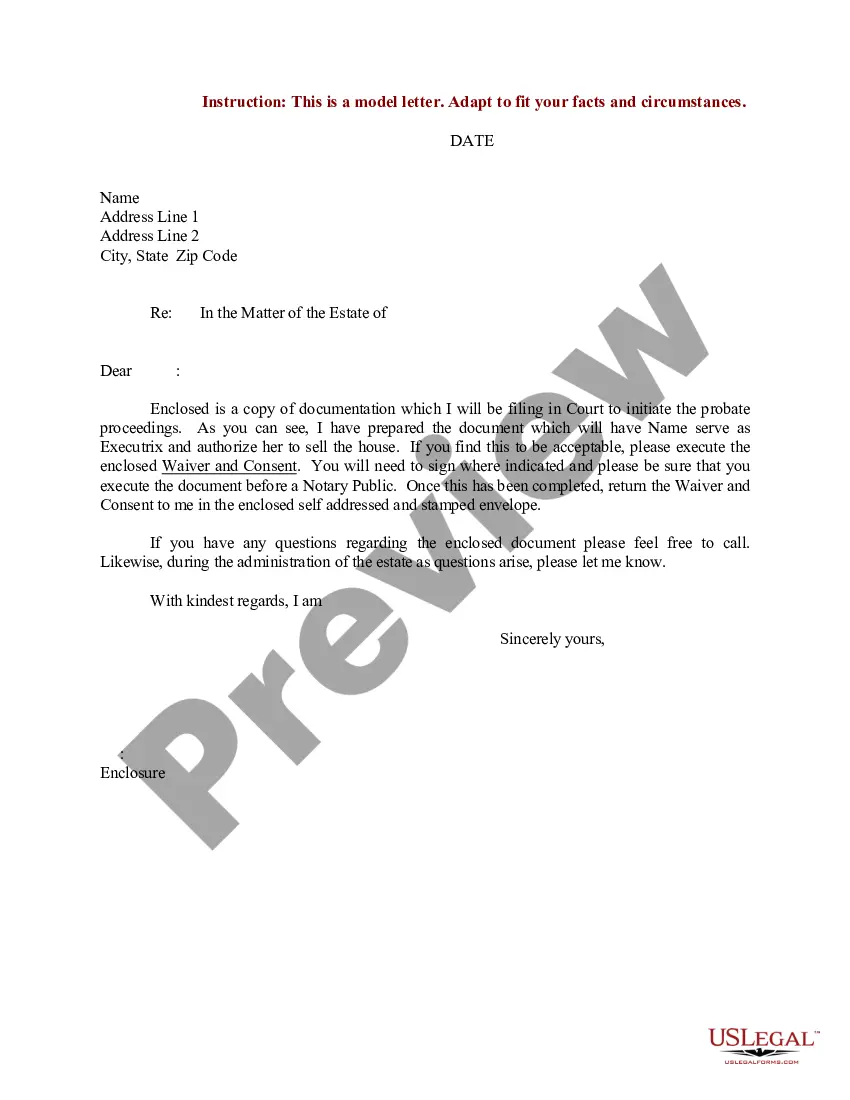
Wayne Michigan Sample Letter for Creditor Notification of Estate Opening
Description
Get your form ready online
Our built-in tools help you complete, sign, share, and store your documents in one place.
Make edits, fill in missing information, and update formatting in US Legal Forms—just like you would in MS Word.
Download a copy, print it, send it by email, or mail it via USPS—whatever works best for your next step.
Sign and collect signatures with our SignNow integration. Send to multiple recipients, set reminders, and more. Go Premium to unlock E-Sign.
If this form requires notarization, complete it online through a secure video call—no need to meet a notary in person or wait for an appointment.
We protect your documents and personal data by following strict security and privacy standards.

Make edits, fill in missing information, and update formatting in US Legal Forms—just like you would in MS Word.

Download a copy, print it, send it by email, or mail it via USPS—whatever works best for your next step.

Sign and collect signatures with our SignNow integration. Send to multiple recipients, set reminders, and more. Go Premium to unlock E-Sign.

If this form requires notarization, complete it online through a secure video call—no need to meet a notary in person or wait for an appointment.

We protect your documents and personal data by following strict security and privacy standards.
Looking for another form?
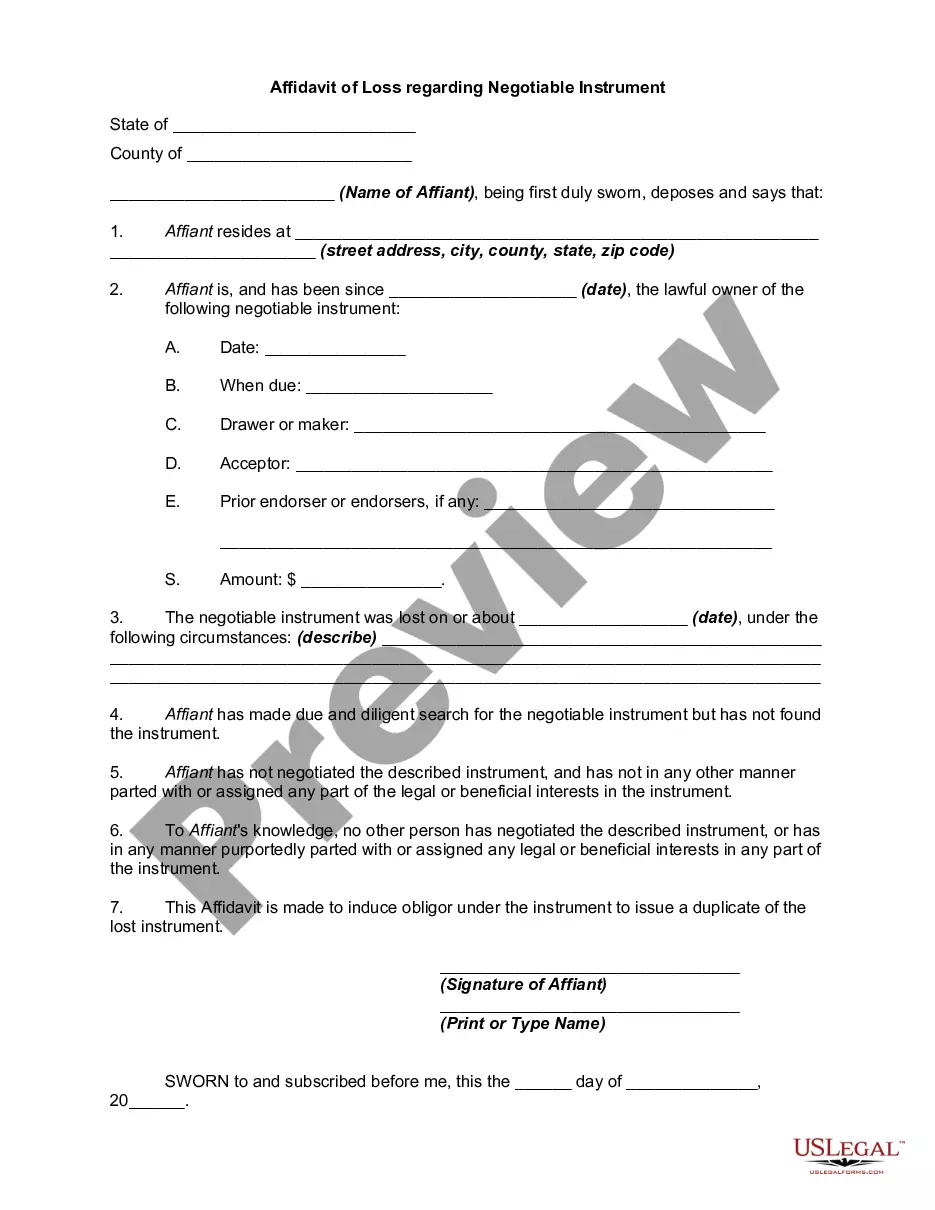
How to fill out Sample Letter For Creditor Notification Of Estate Opening?
Laws and statutes in every domain differ from jurisdiction to jurisdiction.
If you're not a lawyer, it's simple to become confused amidst a multitude of standards concerning the creation of legal documents.
To steer clear of expensive legal support while drafting the Wayne Sample Letter for Creditor Notification of Estate Opening, you require a confirmed template applicable to your locality.
That's the easiest and most economical method to acquire up-to-date templates for any legal purpose. Discover them all with just a few clicks and maintain your documentation organized with US Legal Forms!
- That's when the US Legal Forms platform proves to be advantageous.
- US Legal Forms is a reliable online compilation utilized by millions, featuring over 85,000 state-specific legal documents.
- It serves as an ideal solution for both professionals and individuals seeking DIY templates for various life and business situations.
- All forms can be reused: once you acquire a sample, it stays accessible in your profile for future use.
- Thus, if you possess a valid subscription account, you can merely Log In and re-download the Wayne Sample Letter for Creditor Notification of Estate Opening from the My documents section.
- For newcomers, a few additional steps are needed to obtain the Wayne Sample Letter for Creditor Notification of Estate Opening.
- Review the page content to verify you've located the correct sample.
- Utilize the Preview feature or read the form specifics if available.
Form popularity
FAQ
Assets owned in the deceased's name only (such as real estate, bank accounts, stocks and bonds) and personal property exceeding $15,000 generally have to go to probate court. Michigan law also allows for a streamlined probate process in the case of smaller estates under a certain value.
Executor Fees in Michigan For example, if in the last year, executor fees were typically 1.5%, then 1.5% would be considered reasonable and 3% may be unreasonable. But the court can take into account other factors such as how complicated the estate is to administer and may increase or decrease the amount from there.
In general, non-probate assets are those that have a beneficiary or payable-on-death designation. These can include life insurance policies, bank accounts or brokerage accounts with a transfer-on-death designation, some retirement assets like 401k accounts, or jointly-owned property.
Please be aware that the Wayne County Probate Court's processing backlog is now approximately three to four weeks.
How to Open an Estate Account Begin the probate process. The steps for beginning this process depend on the state in which the deceased person resided.Obtain a tax ID number for the estate account.Bring all required documents to the bank.Open the estate account.
An estate cannot be closed in less than five months from filing. The estate's creditors must be notified of the decedent's death. They are given a four-month period to file their claims against the estate.
The state or county public administrator (this person must wait 42 days after the decedent's death, and there must be no known heir or U.S. resident beneficiary entitled to share of the decedent's estate)
Since every estate is different, the time it takes to settle the estate may also differ. Most times, an executor would take 8 to 12 months. But depending on the size and complexity of the estate, it may take up to 2 years or more to settle the estate.
An executor must account to the residuary beneficiaries named in the Will (and sometimes to others) for all the assets of the estate, including all receipts and disbursements occurring over the course of administration.
In the State of Michigan, probate is necessary when someone passes away while owning property or assets that are listed under their name alone. If the deceased individual has joint ownership over certain property, it's possible the assets may be transferred to the other owner with little to no court involvement.