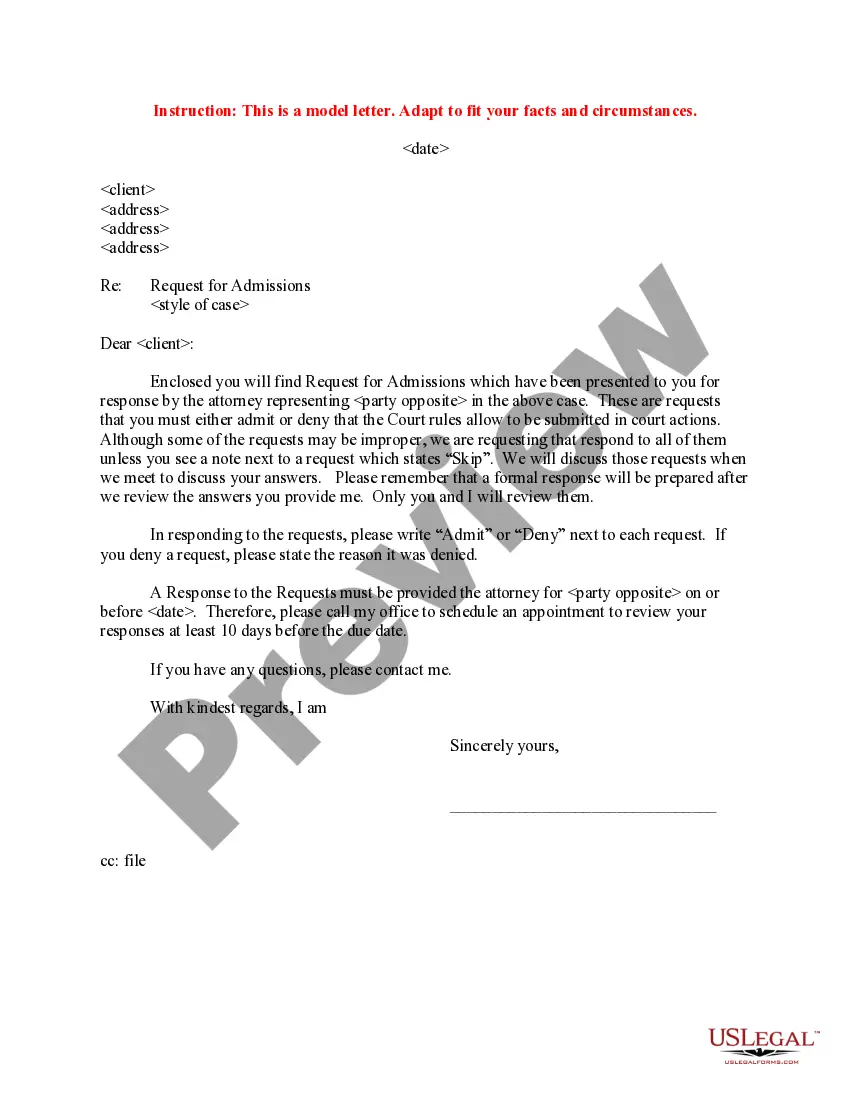
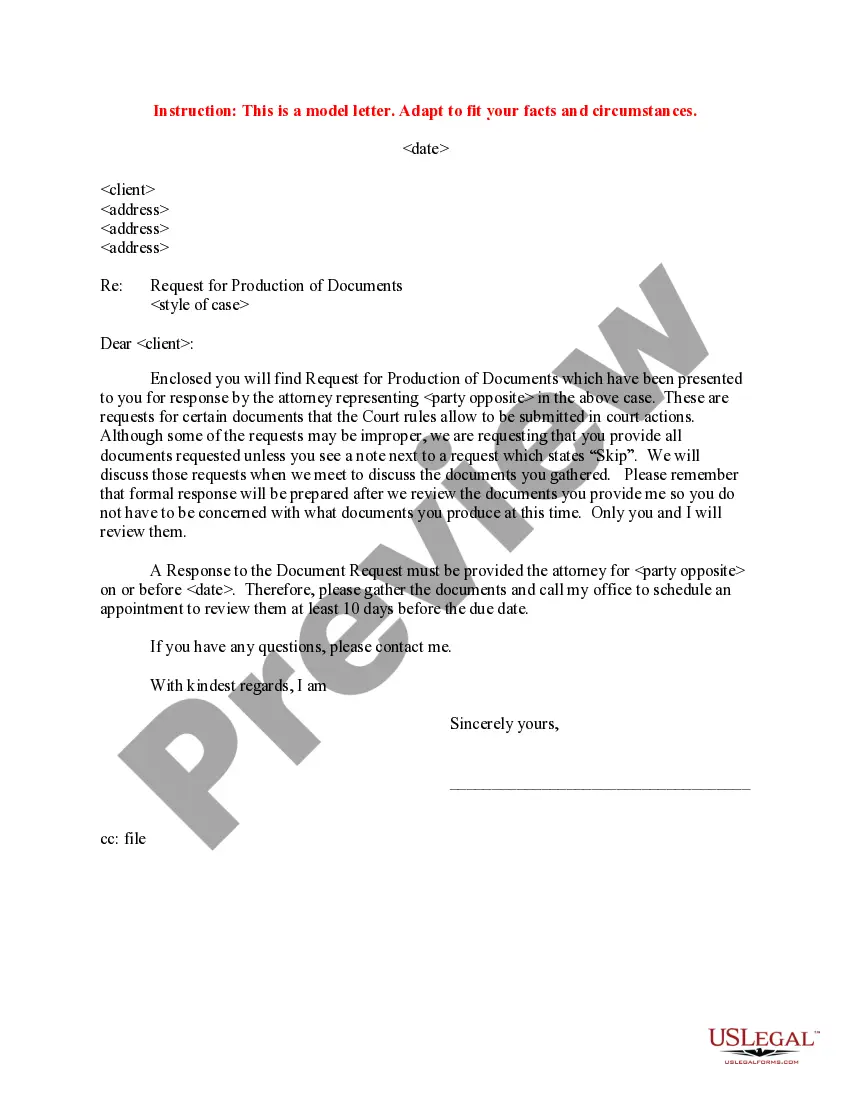
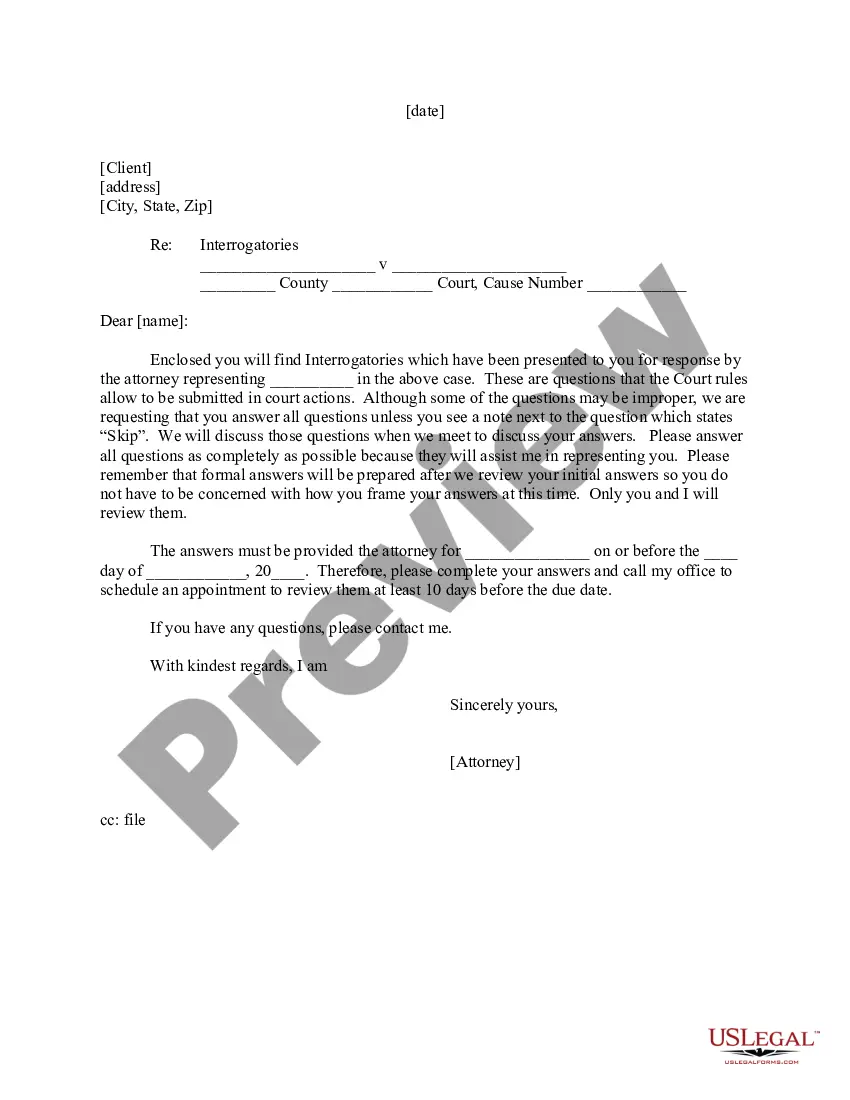
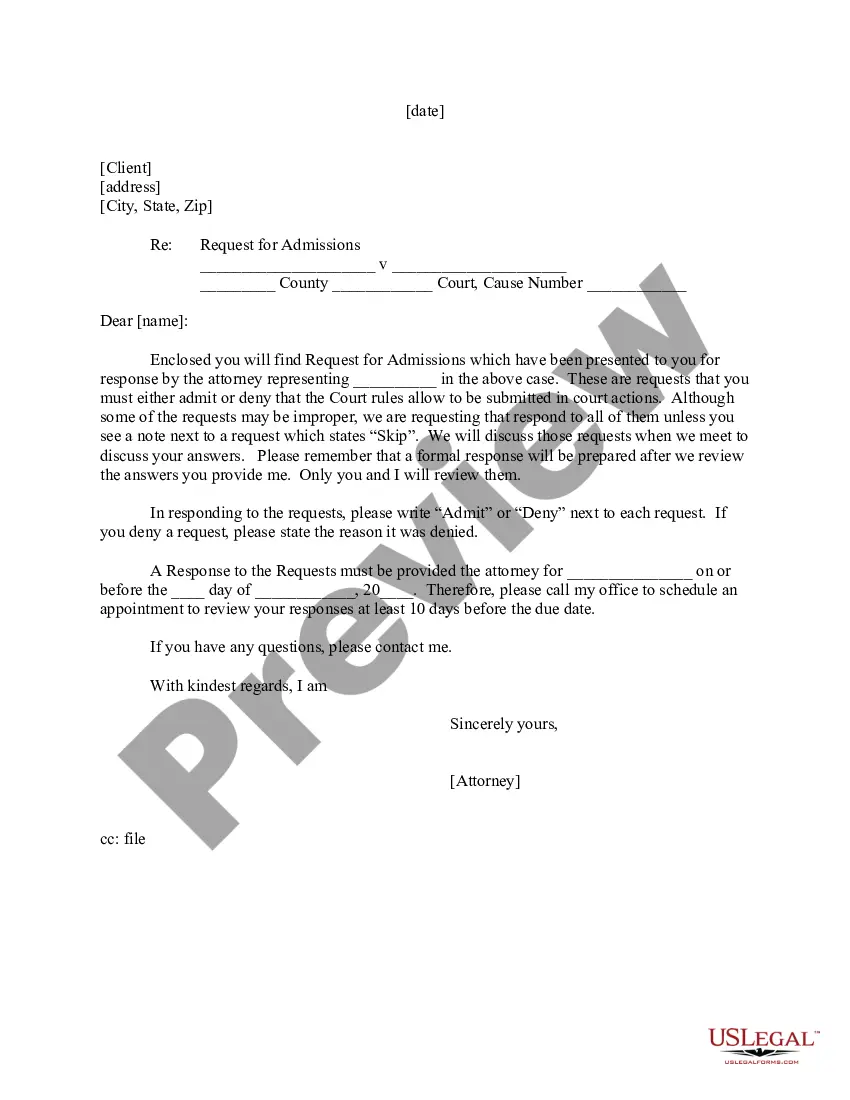
Santa Clara California Sample Letter to Client regarding Request for Admissions to Answer
Description


How to fill out Sample Letter To Client Regarding Request For Admissions To Answer?
Whether you plan to launch your business, engage in a contract, seek your ID renewal, or address family-related legal issues, you must gather specific documentation compliant with your local laws and regulations.
Finding the appropriate paperwork can require significant time and effort unless you utilize the US Legal Forms library.
The service offers users over 85,000 expertly crafted and validated legal templates for any personal or business occasion. All documents are categorized by state and area of use, so choosing a copy like Santa Clara Sample Letter to Client regarding Request for Admissions to Answer is quick and straightforward.
Download the Santa Clara Sample Letter to Client regarding Request for Admissions to Answer in the desired file format. Print the document or complete it and sign it electronically using an online editor to save time. Documents available on our website are reusable. With an active subscription, you can access all previously acquired paperwork at any time in the My documents section of your profile. Stop wasting time on an endless search for up-to-date formal documents. Register for the US Legal Forms platform and keep your paperwork organized with the most comprehensive online form collection!
- Log in to your account on the US Legal Forms website and click the Download button next to the form you need.
- If you are a new user, some extra steps will be required to obtain the Santa Clara Sample Letter to Client regarding Request for Admissions to Answer.
- Ensure that the sample matches your specific needs and complies with state law regulations.
- Examine the form description and view the Preview if available on the page.
- Utilize the search bar at the top to specify your state to find another template.
- Click Buy Now once you locate the correct document.
- Choose the subscription plan that best meets your requirements to proceed.
- Log in to your account and pay for the service with a credit card or PayPal.
Form popularity
FAQ
Rule 36, found in the Federal Rules of Civil Procedure, governs requests for admission. This rule allows one party to request that another party admit the truth of certain matters related to the case, simplifying the process by narrowing down areas of dispute. Utilizing a Santa Clara California Sample Letter to Client regarding Request for Admissions to Answer can help in drafting these requests accurately and efficiently, ensuring compliance with Rule 36.
Responses to Requests for Admissions The party to whom requests for admissions have been directed must respond separately to each item by admitting the truth of the statement, by denying the item, or by explaining why it cannot specifically admit or deny the item.
If you admit the request, write admit for your response. If you deny the request, write deny. If you have to qualify an answer or deny only a part, you must specify the part that is true and deny the rest.
If you admit the request, write admit for your response. If you deny the request, write deny. If you have to qualify an answer or deny only a part, you must specify the part that is true and deny the rest.
Requests for admissions may be used to (1) establish the truth of specified facts, (2) admit a legal conclusion, (3) determine a party's opinion relating to a fact, (4) settle a matter in controversy, and (5) admit the genuineness of documents.
These include requests related to discoverable facts, opinions, the application of the law to facts, and the genuineness of documents. Bear in mind, if a party receives a request for admission that includes the mention of a document, federal rules dictate the production of documents for confirmation.
You have 30 days from the date the requests were served to you (35 if served by mail within California) to serve your responses to the requests for admission.
When responding to Requests for Admissions, remember to answer as follows: Admit: If any portion of the Request for Admission is true then you must admit to that portion of the request. You are also allowed to have a hybrid response admit the part of the request that is true while denying another part. See C.C.P.
2033.210. (a) The party to whom requests for admission have been directed shall respond in writing under oath separately to each request. (b) Each response shall answer the substance of the requested admission, or set forth an objection to the particular request.
Answering Requests for Admissions is very similar to answering interrogatoriesyou have an obligation to respond in good faith and you have to be careful about your garbage objections. However, the code makes it clear that the requirements in responding to Requests for Admissions are higher.