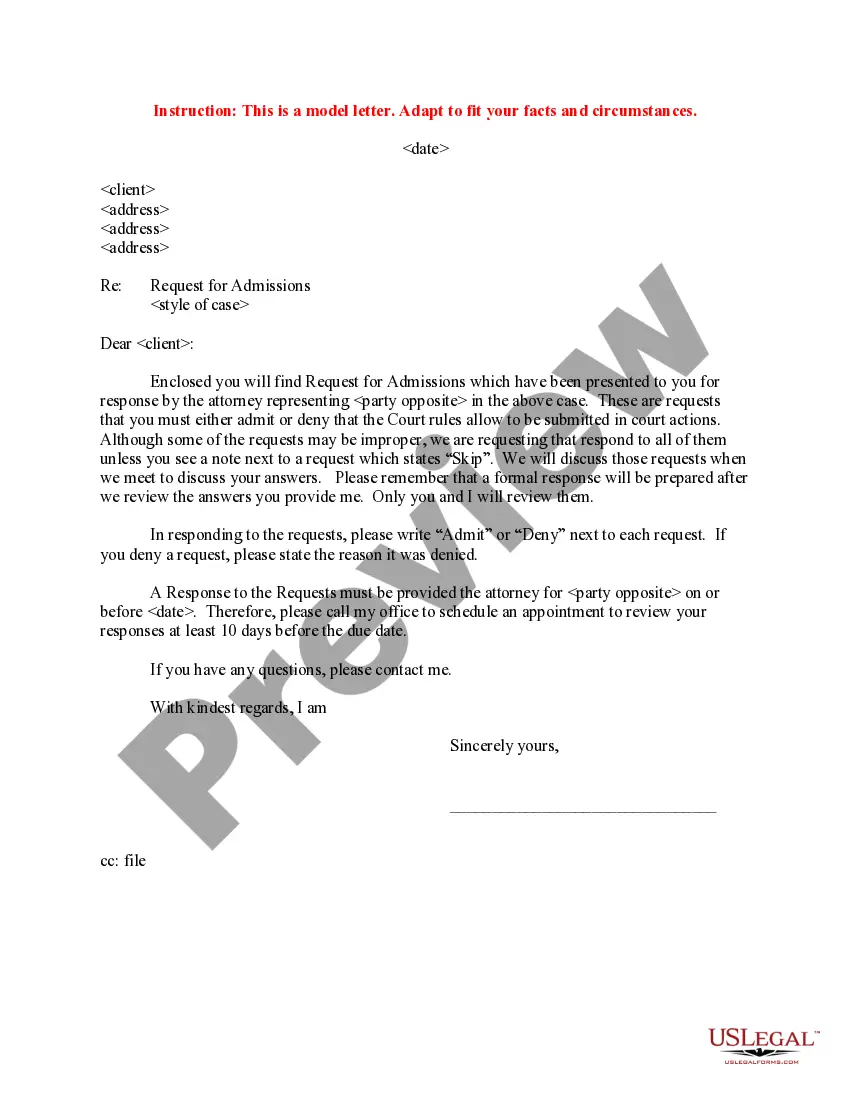
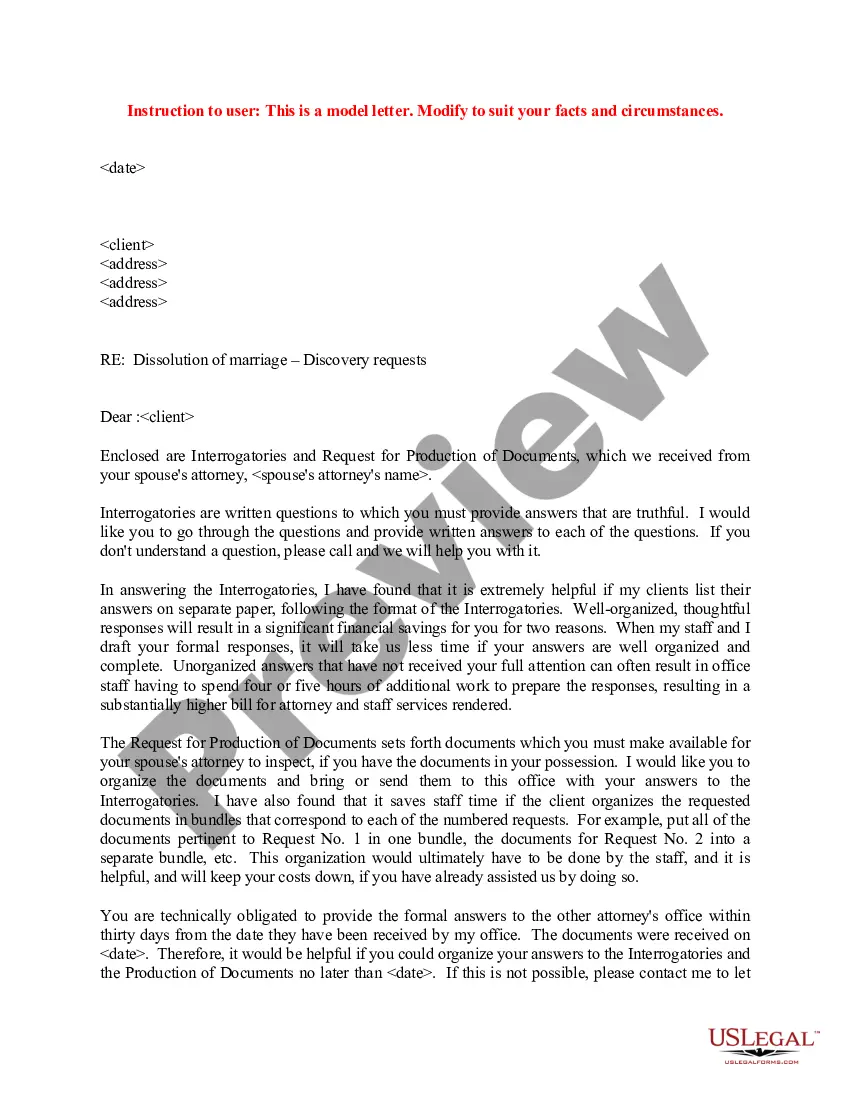
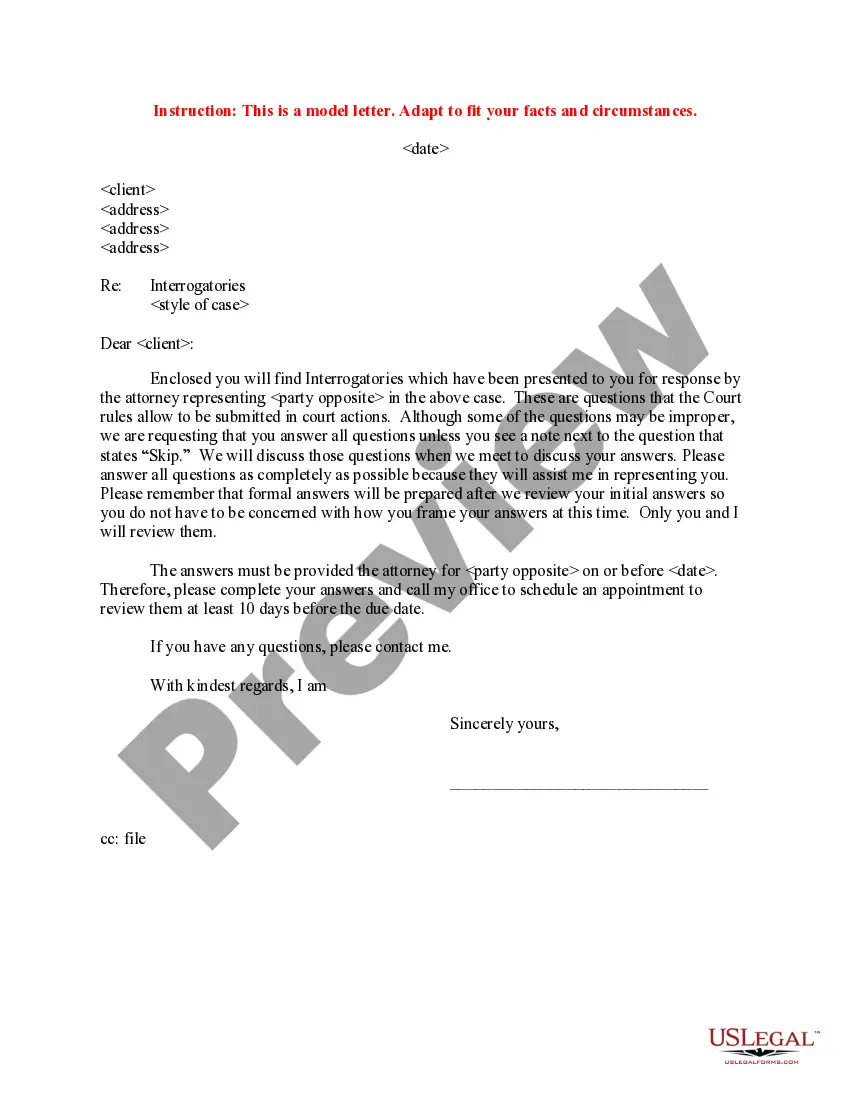
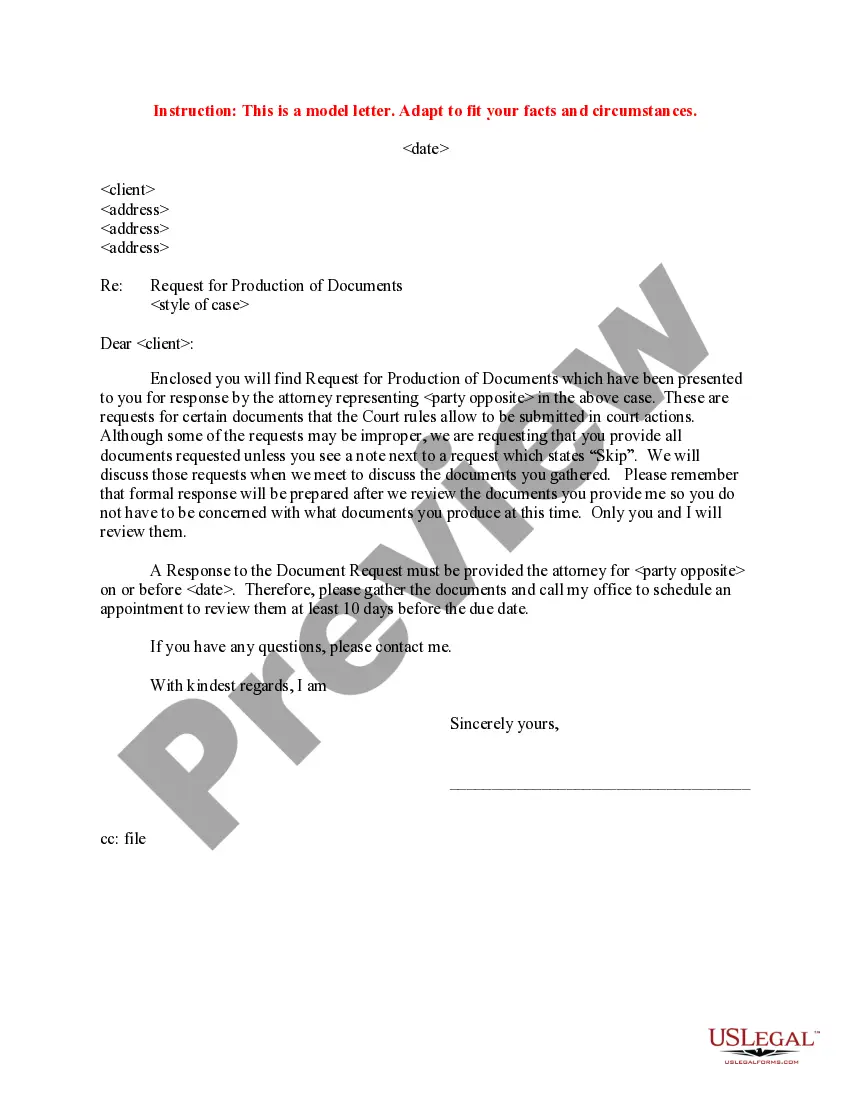
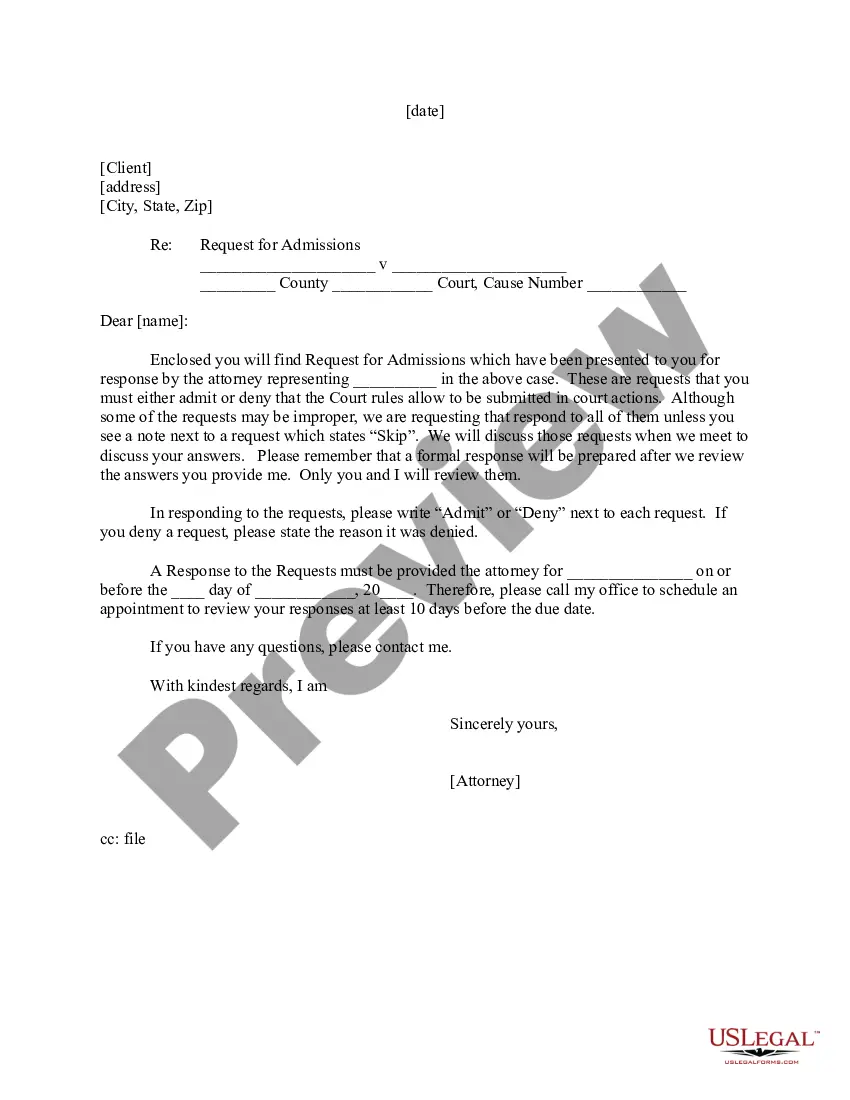
Orange California Sample Letter to Client regarding Request for Admissions to Answer
Description



How to fill out Sample Letter To Client Regarding Request For Admissions To Answer?
Organizing documents for business or personal requirements is undoubtedly a significant obligation.
When drafting a contract, a public service application, or a power of attorney, it's crucial to take into account all federal and state statutes and regulations of the particular region.
Nonetheless, smaller counties and even towns also have legislative processes that must be evaluated.
To find what meets your needs, employ the search tab in the header of the page.
- All these components make drafting an Orange Sample Letter to Client regarding Request for Admissions to Answer without expert assistance stressful and time-intensive.
- It's feasible to save on attorney fees by preparing your documentation and crafting a legally acceptable Orange Sample Letter to Client regarding Request for Admissions to Answer independently, utilizing the US Legal Forms online library.
- This is the premier web catalog of state-specific legal templates, which are professionally validated, ensuring their legitimacy when you select a format for your area.
- Returning subscribers simply need to Log In to their accounts to access and download the necessary form.
- If you have yet to subscribe, follow the instructions outlined below to acquire the Orange Sample Letter to Client regarding Request for Admissions to Answer.
- Inspect the page you've opened and confirm if it contains the template you're looking for.
- To do this, utilize the form description and preview if those functionalities are available.
Form popularity
FAQ
Requests for admissions may be used to (1) establish the truth of specified facts, (2) admit a legal conclusion, (3) determine a party's opinion relating to a fact, (4) settle a matter in controversy, and (5) admit the genuineness of documents. See C.C.P.
The requests for admission that you receive will include a list of statements or facts that the other party wishes you to admit are true. Your answers must be as complete and straightforward as possible (California Code of Civil Procedure (CCP) § 2033.220), and be accurate to the best of your knowledge.
Requests for admissions may be used to (1) establish the truth of specified facts, (2) admit a legal conclusion, (3) determine a party's opinion relating to a fact, (4) settle a matter in controversy, and (5) admit the genuineness of documents. See C.C.P.
The request is impermissibly compound. The propounding party may ask you to admit only one fact per statement. You may object to any request that asks you to admit two or more different facts in a single request.
In a civil action, a request for admission is a discovery device that allows one party to request that another party admit or deny the truth of a statement under oath. If admitted, the statement is considered to be true for all purposes of the current trial.
How to respond Object to the request. Admit that everything in the request is true. Deny that everything in the request is true. Cannot honestly admit or deny the request. If you cannot admit or deny the request, you must provide an explanation.
(1) Admit so much of the matter involved in the request as is true, either as expressed in the request itself or as reasonably and clearly qualified by the responding party. (2) Deny so much of the matter involved in the request as is untrue.
These include requests related to discoverable facts, opinions, the application of the law to facts, and the genuineness of documents. Bear in mind, if a party receives a request for admission that includes the mention of a document, federal rules dictate the production of documents for confirmation.
Responses to Requests for Admissions The party to whom requests for admissions have been directed must respond separately to each item by admitting the truth of the statement, by denying the item, or by explaining why it cannot specifically admit or deny the item.
Requests for admissions are written requests that ask the other side to admit or deny certain facts about the case. (NRCP 36; JCRCP 36.) They could also ask the other side to admit or deny statements or opinions of fact, the application of law to fact, or whether a document is genuine.