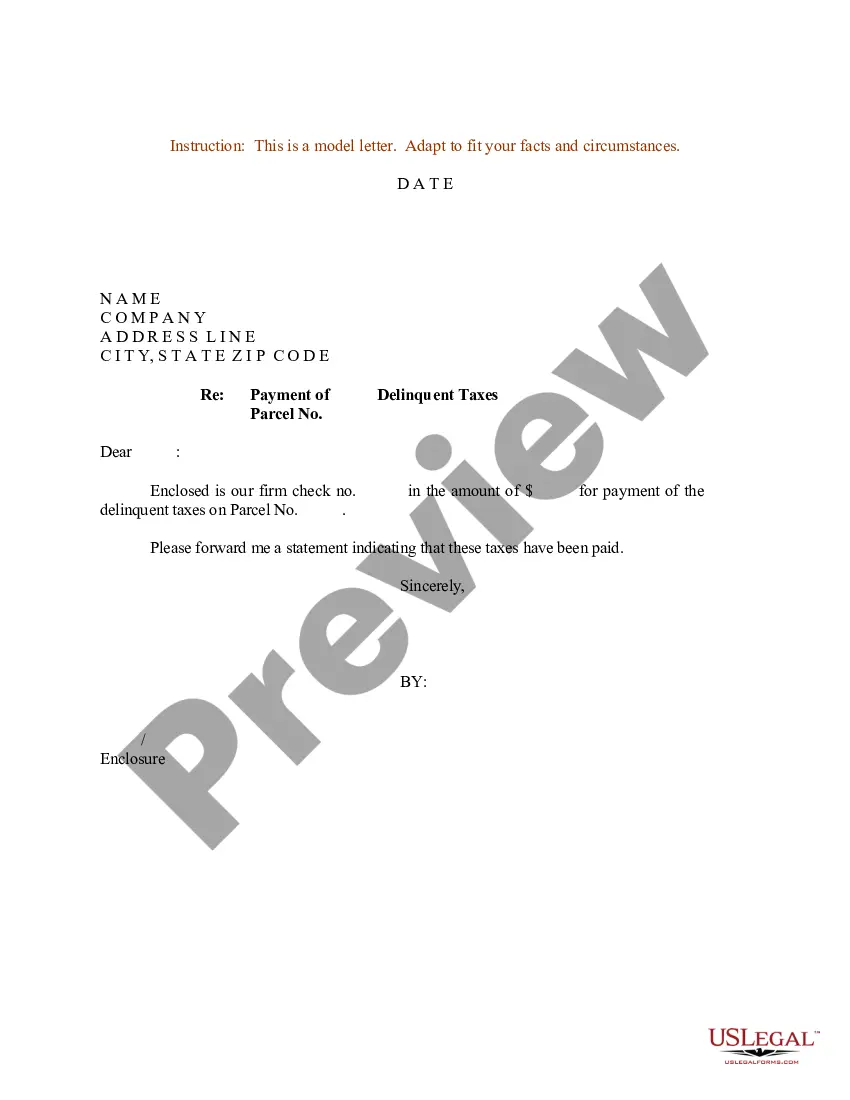
Bronx New York Sample Letter for Delinquent Taxes
Description
Get your form ready online
Our built-in tools help you complete, sign, share, and store your documents in one place.
Make edits, fill in missing information, and update formatting in US Legal Forms—just like you would in MS Word.
Download a copy, print it, send it by email, or mail it via USPS—whatever works best for your next step.
Sign and collect signatures with our SignNow integration. Send to multiple recipients, set reminders, and more. Go Premium to unlock E-Sign.
If this form requires notarization, complete it online through a secure video call—no need to meet a notary in person or wait for an appointment.
We protect your documents and personal data by following strict security and privacy standards.

Make edits, fill in missing information, and update formatting in US Legal Forms—just like you would in MS Word.

Download a copy, print it, send it by email, or mail it via USPS—whatever works best for your next step.

Sign and collect signatures with our SignNow integration. Send to multiple recipients, set reminders, and more. Go Premium to unlock E-Sign.

If this form requires notarization, complete it online through a secure video call—no need to meet a notary in person or wait for an appointment.

We protect your documents and personal data by following strict security and privacy standards.
Looking for another form?
How to fill out Sample Letter For Delinquent Taxes?
Statutes and guidelines in every domain differ across the nation.
If you're not an attorney, it's simple to become confused by the various rules when it comes to creating legal documents.
To evade expensive legal counsel while drafting the Bronx Sample Letter for Delinquent Taxes, you require a verified template appropriate for your area.
Select one of the subscription plans and log in or create a new account. Choose how you wish to pay for your subscription (using a credit card or PayPal). Choose the format in which you want to save the document and click Download. Complete and sign the template either physically after printing it or do it all electronically. This is the easiest and most economical method to obtain current templates for any legal needs. Find them with just a few clicks and manage your paperwork efficiently with US Legal Forms!
- That's where the US Legal Forms platform proves to be beneficial.
- US Legal Forms is a reliable web repository trusted by millions, containing over 85,000 state-specific legal documents.
- It's an ideal solution for professionals and individuals seeking do-it-yourself templates for various personal and commercial situations.
- All the forms can be reused: once you acquire a sample, it stays available in your profile for future use.
- Thus, if you have an account with an active subscription, you can simply Log In and re-download the Bronx Sample Letter for Delinquent Taxes from the My documents section.
- For first-time users, a few additional steps are needed to obtain the Bronx Sample Letter for Delinquent Taxes.
- Review the page content to make sure you selected the correct sample.
- Utilize the Preview feature or check the form description if available.
- Look for another document if there are discrepancies with any of your specifications.
- Click the Buy Now button to acquire the template once you find the appropriate one.
Form popularity
FAQ
New York is an average state for tax lien certificates and a good state for tax deed sales, but rules vary and some municipalities have their own sales. New York Tax Lien Auctions are usually in April or August but can vary; New York Tax Deed Sales occur throughout the year.
Each year, the Department of Finance sells tax liens. If your property has unpaid debt that qualifies for a lien sale, we will sell your lien debt (the amount owed) to an authorized buyer.
For more information about the Tax lien Sale, visit nyc.gov/liensale, or call 311. From outside NYC call 212-NEW-YORK. People with hearing impairments should call TTY: 212-504-4115. For general information about taxes and to pay online please visit the Department of Finance website.
Property taxes are considered delinquent for purposes of this program under either of the following circumstances: The taxes remain unpaid one year after the last date on which they could have been paid without interest.
This notice is sent when the Department's records indicate that the taxpayer did not file a return by its due date. There are many versions of the Delinquent Notice, based on tax type.
NY State Statute of Collections for Taxes It is 20 years from the date the DTF could file a warrant. While the IRS has ten years to legally collect the taxes, NY State has 20 years.
Under the existing program, which expires Monday, New York City sells property tax and water debts to private investors for about 75 cents on the dollar, allowing those firms to collect servicing fees as they pursue the money and, potentially, take possession of people's homes.
In a tax lien sale, the City sells delinquent liens to a single authorized buyer, who does not take title to the property, but does purchase the right to collect the money owed plus interest and fees. Ultimately, if the property owner does not pay, the lien holder may foreclose and the building will be sold at auction.
Generally, when taxes remain unpaid, the taxing authority will eventually sell the lien (and if you don't pay the past-due amount to the lien purchaser, that party can foreclose or use some other method to get title to the home), or sell the property itself in a tax sale.
Generally, when taxes remain unpaid, the taxing authority will eventually sell the lien (and if you don't pay the past-due amount to the lien purchaser, that party can foreclose or use some other method to get title to the home), or sell the property itself in a tax sale.