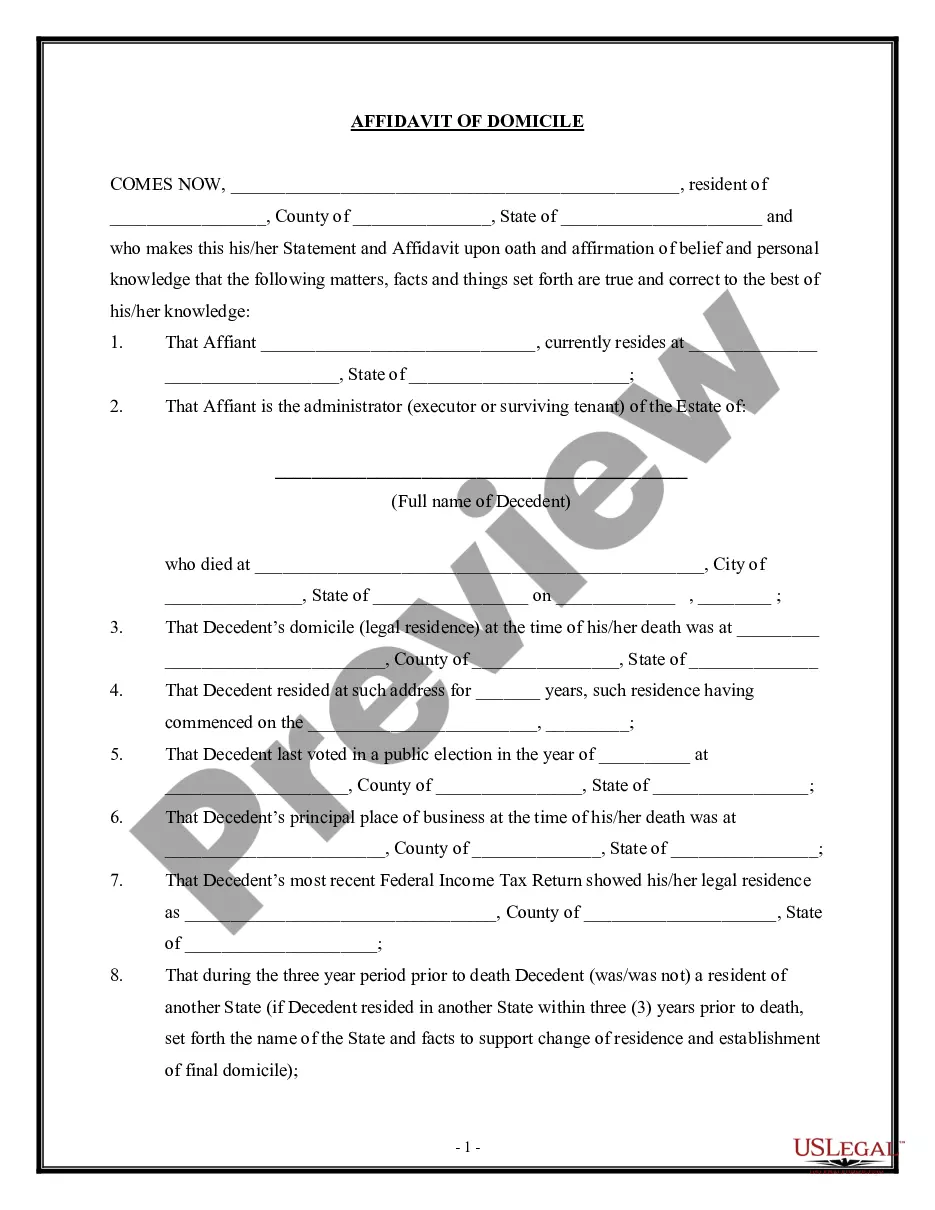
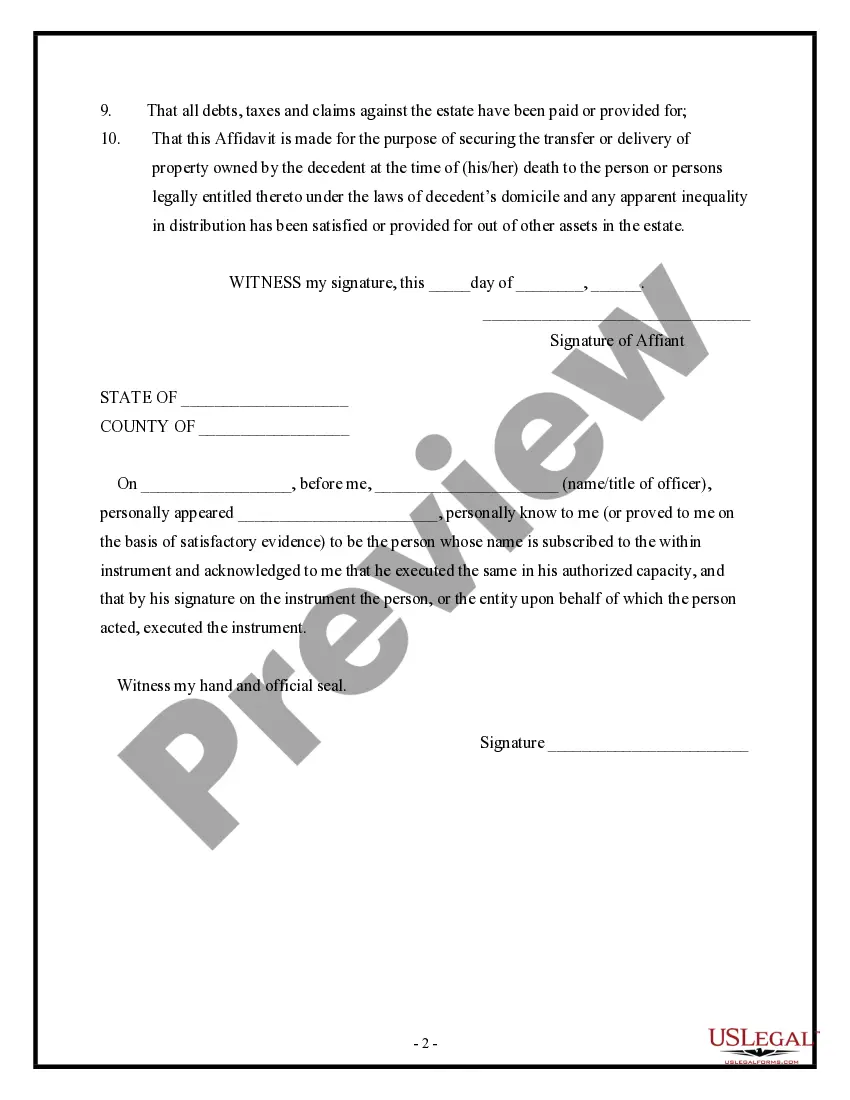
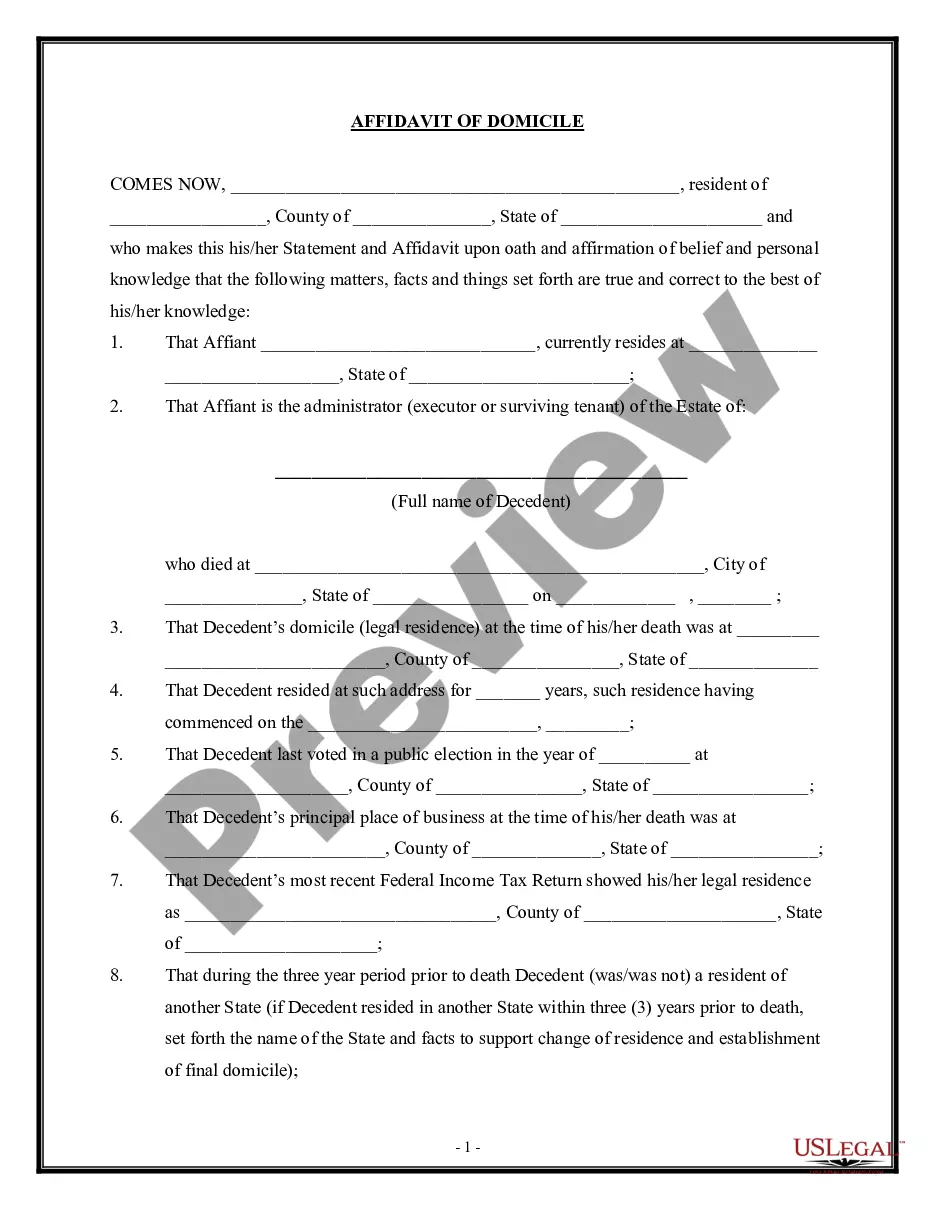
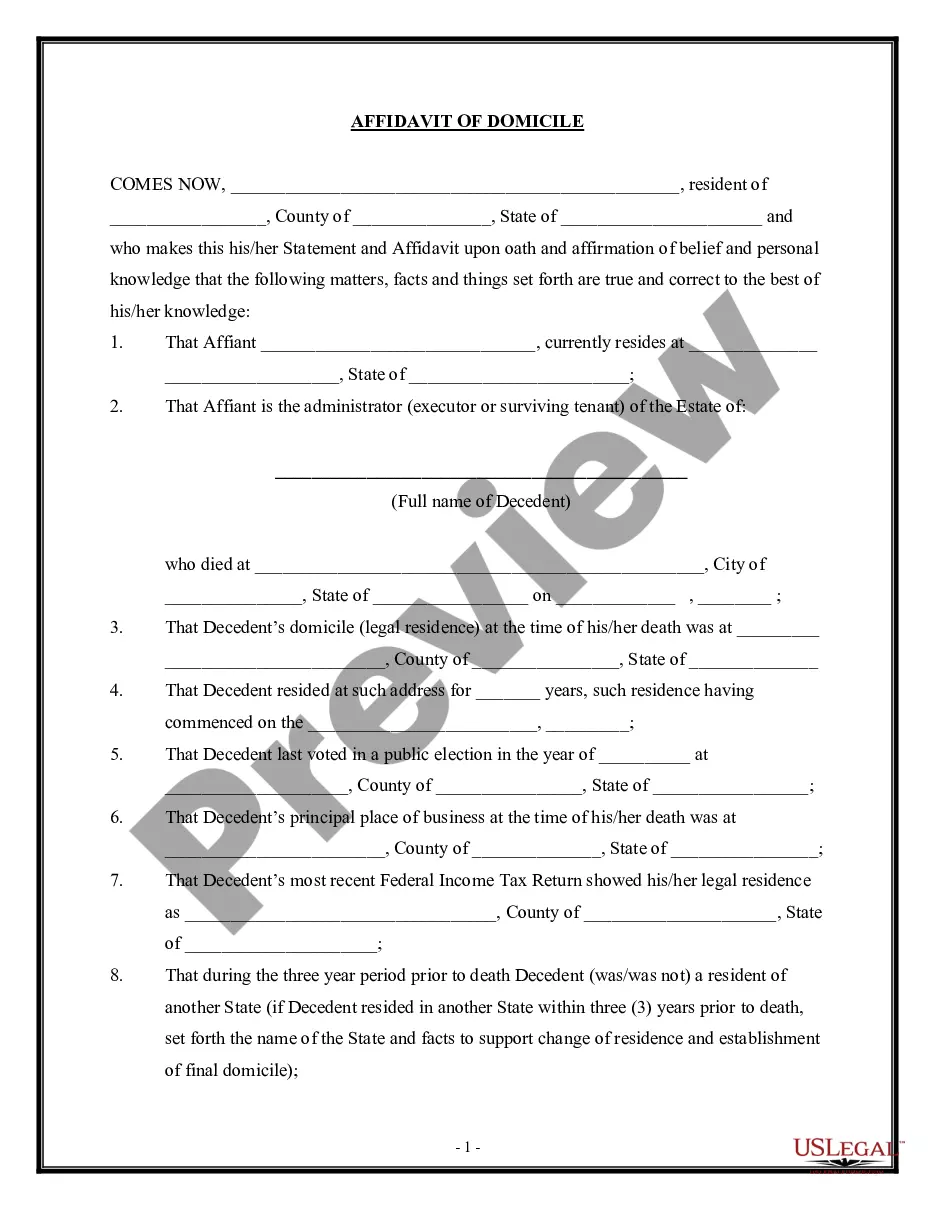
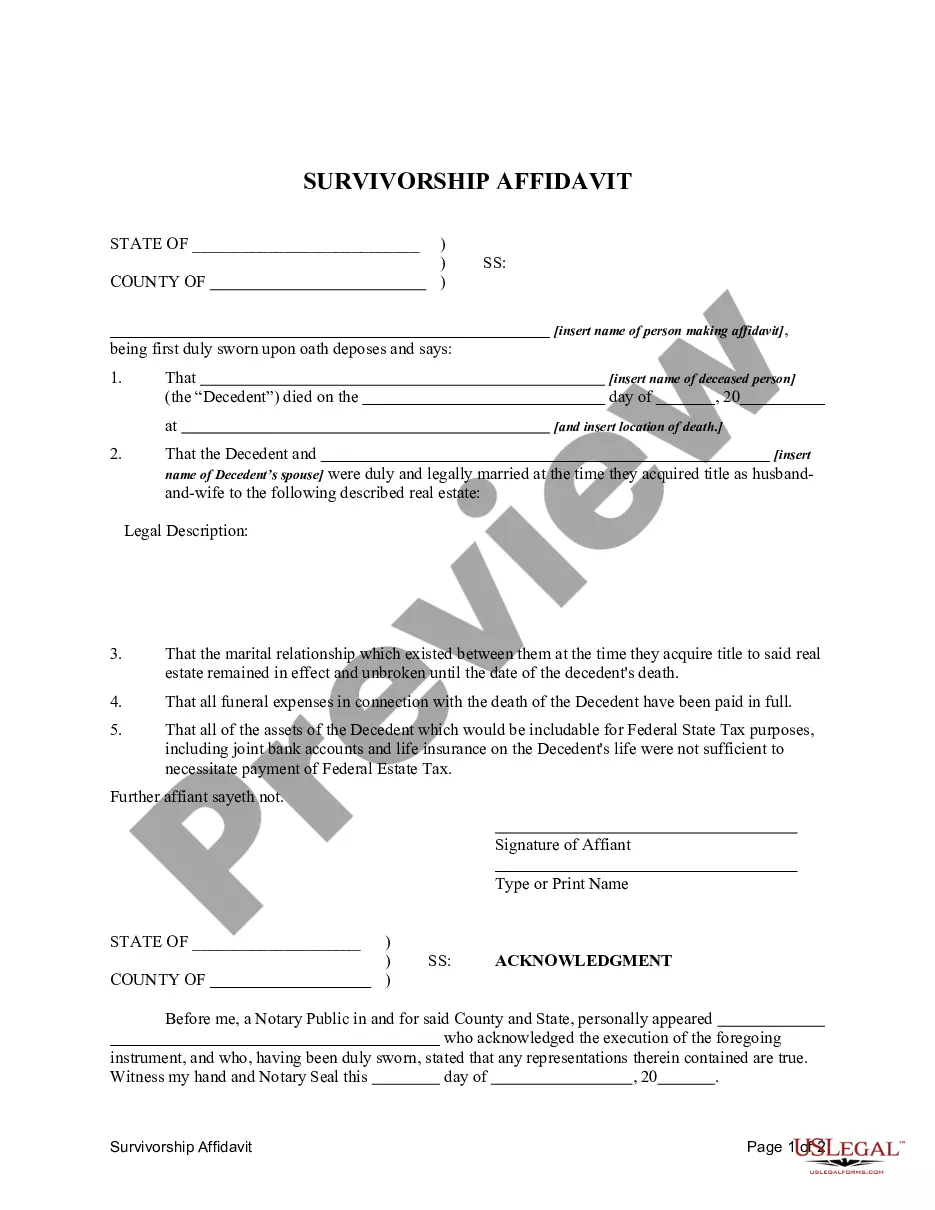
This form is an Affidavit of Domicile. This form provides that the affiant upon oath and affirmation of belief and personal knowledge verifies the address of the decedent at the time of death. The form must be signed in the presence of a notary public.
Bronx New York Affidavit of Domicile
342 downloads
Description
Free preview

Get your form ready online
Our built-in tools help you complete, sign, share, and store your documents in one place.
Built-in online Word editor
Make edits, fill in missing information, and update formatting in US Legal Forms—just like you would in MS Word.
Export easily
Download a copy, print it, send it by email, or mail it via USPS—whatever works best for your next step.
E-sign your document
Sign and collect signatures with our SignNow integration. Send to multiple recipients, set reminders, and more. Go Premium to unlock E-Sign.
Notarize online 24/7
If this form requires notarization, complete it online through a secure video call—no need to meet a notary in person or wait for an appointment.
Store your document securely
We protect your documents and personal data by following strict security and privacy standards.

Make edits, fill in missing information, and update formatting in US Legal Forms—just like you would in MS Word.

Download a copy, print it, send it by email, or mail it via USPS—whatever works best for your next step.

Sign and collect signatures with our SignNow integration. Send to multiple recipients, set reminders, and more. Go Premium to unlock E-Sign.

If this form requires notarization, complete it online through a secure video call—no need to meet a notary in person or wait for an appointment.

We protect your documents and personal data by following strict security and privacy standards.
Looking for another form?


How to fill out Affidavit Of Domicile?
A document procedure consistently accompanies any legal action you undertake.
Establishing a company, applying for or accepting a job proposal, transferring ownership, and numerous other life situations necessitate you to prepare formal documentation that varies across the nation.
This is why having everything gathered in one location is so advantageous.
US Legal Forms is the largest digital collection of current federal and state-specific legal templates.
Select the appropriate subscription plan, then Log In or register an account. Choose the preferred payment option (with credit card or PayPal) to proceed. Select file format and download the Bronx Affidavit of Domicile onto your device. Utilize it as needed: print it or fill it out electronically, sign it, and submit where required. This is the simplest and most reliable way to acquire legal documents. All templates offered by our library are expertly formulated and verified for compliance with local laws and regulations. Prepare your documentation and manage your legal matters efficiently with US Legal Forms!
- Here, you can effortlessly locate and obtain a document for any personal or business purpose utilized in your region, including the Bronx Affidavit of Domicile.
- Finding samples on the platform is remarkably straightforward.
- If you already possess a subscription to our library, Log In to your account, search for the sample using the search bar, and click Download to save it on your device.
- Subsequently, the Bronx Affidavit of Domicile will be accessible for further use in the My documents section of your profile.
- If you are using US Legal Forms for the first time, follow this straightforward guide to obtain the Bronx Affidavit of Domicile.
- Ensure you have opened the correct page with your localized form.
- Use the Preview mode (if accessible) and review the sample.
- Read the description (if available) to confirm the template meets your needs.
- Look for an alternative document using the search option if the sample does not suit your needs.
- Click Buy Now when you find the necessary template.
Form popularity
FAQ
File this form in Surrogate's Court. You can use this program if: If the decedent (the person who died) had $50,000 or less in personal property. If the decedent owned real property, he/she owned it jointly with someone else and you don't plan to sell the real estate.
When the person who died (the Decedent) had less than $50,000 of personal property then it's considered a small estate, and is called a Voluntary Administration. It does not matter if the Decedent had a Will or not.
Provide Appropriate Proof of ResidencyA New York State license, permit or non-driver id card, a recent bank statement, or a recent pay stub showing your current New York State address are just some of the acceptable proofs of residency.
The filing fee is $1.00. The easiest way to make the court papers is to use the Small Estate DIY (Do-It-Yourself) Form program. This program walks you step-by-step to complete the paperwork you need and gives you helpful definitions and legal information.
Step 1 Verify Eligibility. This will consist of examining the estate of the decedent.Step 2 Gather Documents.Step 3 File the Affidavit.Section A Surviving Spouse.Section B Surviving Spouse, Blood Relative Or Creditor.Payment Request By Affiant.Section C Creditor Statement Only.New York Notary Public Action.
New York has a simplified probate process for small estates. To use it, an executor files a written request with the local probate court asking to use the simplified procedure. The court may authorize the executor to distribute the assets without having to jump through the hoops of regular probate.
To prepare a small estate for an administrative hearing, the executor of the estate will need to file the will,a copy of the death certificate, and a small estate affidavit petition for the hearing with the Surrogate Court where the deceased lived.