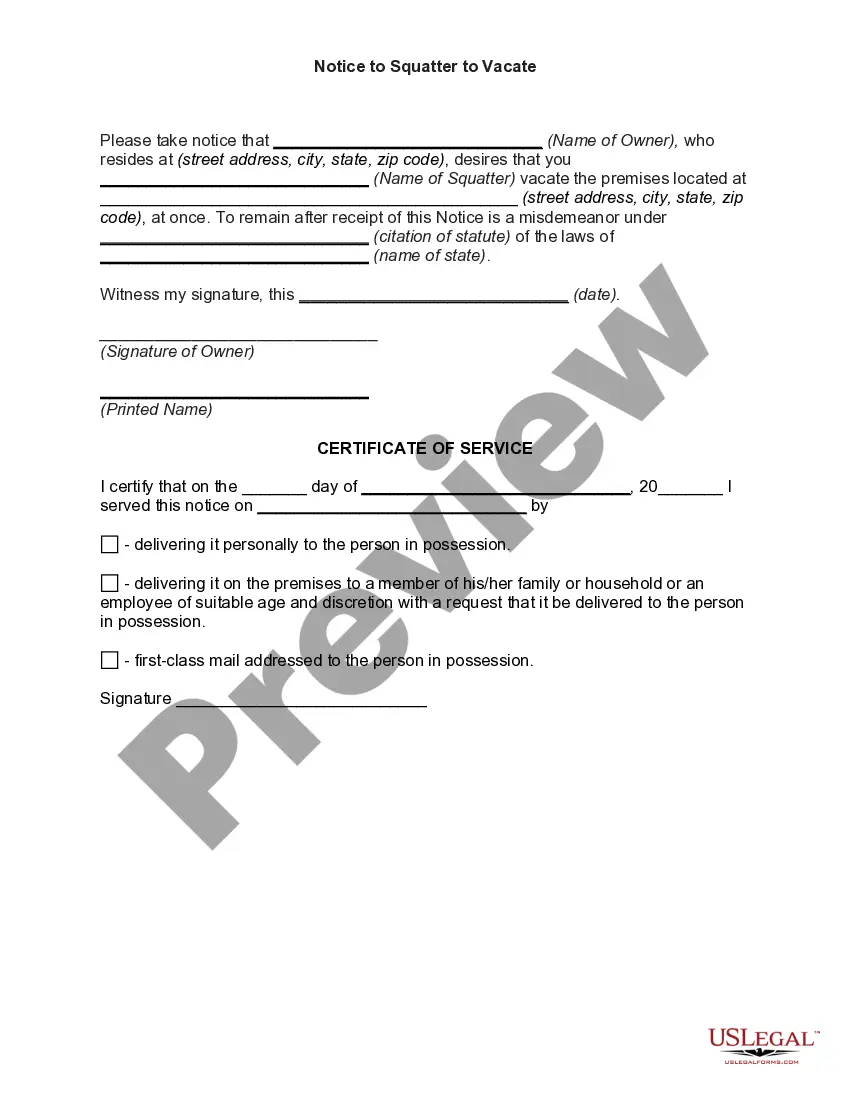
San Diego California Notice to Vacate for Squatters
Description
Get your form ready online
Our built-in tools help you complete, sign, share, and store your documents in one place.
Make edits, fill in missing information, and update formatting in US Legal Forms—just like you would in MS Word.
Download a copy, print it, send it by email, or mail it via USPS—whatever works best for your next step.
Sign and collect signatures with our SignNow integration. Send to multiple recipients, set reminders, and more. Go Premium to unlock E-Sign.
If this form requires notarization, complete it online through a secure video call—no need to meet a notary in person or wait for an appointment.
We protect your documents and personal data by following strict security and privacy standards.

Make edits, fill in missing information, and update formatting in US Legal Forms—just like you would in MS Word.

Download a copy, print it, send it by email, or mail it via USPS—whatever works best for your next step.

Sign and collect signatures with our SignNow integration. Send to multiple recipients, set reminders, and more. Go Premium to unlock E-Sign.

If this form requires notarization, complete it online through a secure video call—no need to meet a notary in person or wait for an appointment.

We protect your documents and personal data by following strict security and privacy standards.
Looking for another form?

How to fill out Notice To Vacate For Squatters?
A document process consistently accompanies any legal action you undertake.
Establishing a business, submitting or accepting a job proposal, transferring ownership, and numerous other life circumstances require you to prepare formal paperwork that differs across the nation.
That’s why having everything consolidated in one location is so advantageous.
US Legal Forms is the largest online repository of current federal and state-specific legal documents.
This is the most uncomplicated and reliable method to obtain legal documents. All samples provided by our library are expertly prepared and verified for compliance with local laws and regulations. Prepare your documents and handle your legal matters efficiently with US Legal Forms!
- On this platform, you can effortlessly locate and obtain a document for any personal or commercial purpose used in your area, including the San Diego Notice to Vacate for Squatters.
- Finding templates on the site is incredibly simple.
- If you already possess a subscription to our service, sign in to your account, search for the template using the search box, and click Download to save it to your device.
- Subsequently, the San Diego Notice to Vacate for Squatters will be accessible for further use in the My documents section of your account.
- If you are engaging with US Legal Forms for the first time, follow this straightforward guide to acquire the San Diego Notice to Vacate for Squatters.
- Ensure you have accessed the correct page with your local form.
- Utilize the Preview feature (if available) and review the sample.
Form popularity
FAQ
The implications of the new squatters law in California affect both property owners and squatters. Owners must follow strict notice requirements and timelines to ensure a legal eviction process. By leveraging the San Diego California Notice to Vacate for Squatters, landlords can effectively manage these changes and protect their property rights without legal complications.
1. Contact the Police. If a squatter is a trespasser and not a former tenant who has turned into a squatter, you should telephone the police. The squatter, in this case, is breaking the trespassing laws and the police should be able to remove them.
A squatter can claim rights to a property after residing there for a certain time. In California, it takes 5 years of continuous use or maintenance for a squatter to make an adverse possession claim (CCP § 318, 325). When a squatter claims adverse possession, they can gain ownership of the property legally.
There are few situations as stressful for landlords as having squatters. A squatter is someone that neither owns property nor pays rent to reside there. Despite this fact, squatting is legal in the state of California much like it is elsewhere in the country.
The doctrine of adverse possession conveyancing, allows third parties claim to a right over land (to which they originally had no legal title to) which they have occupied continuously for over 12 years with the intention of excluding all others including the true owner (also commonly known as Squatters Rights).
What are squatters rights (and how can these be challenged)? Long term squatters can eventually become the registered owner of a property if they (or a succession of squatters) have occupied it continuously for 10 years (or 12 years if it is unregistered).
Removing squatters can take anywhere from days to months and maybe even years in rare circumstances. However, the legal eviction process typically only takes 4-5 weeks depending on what's involved.
The unlawful detainer lawsuit is the only legal way to remove a squatter, also known as a tenant or occupant who refuses to vacate your property. This process applies to residential rentals, commercial rentals, investment purchases, and foreclosure acquisitions.