Houston Texas Order on Defendant's Motion for Discovery
Description
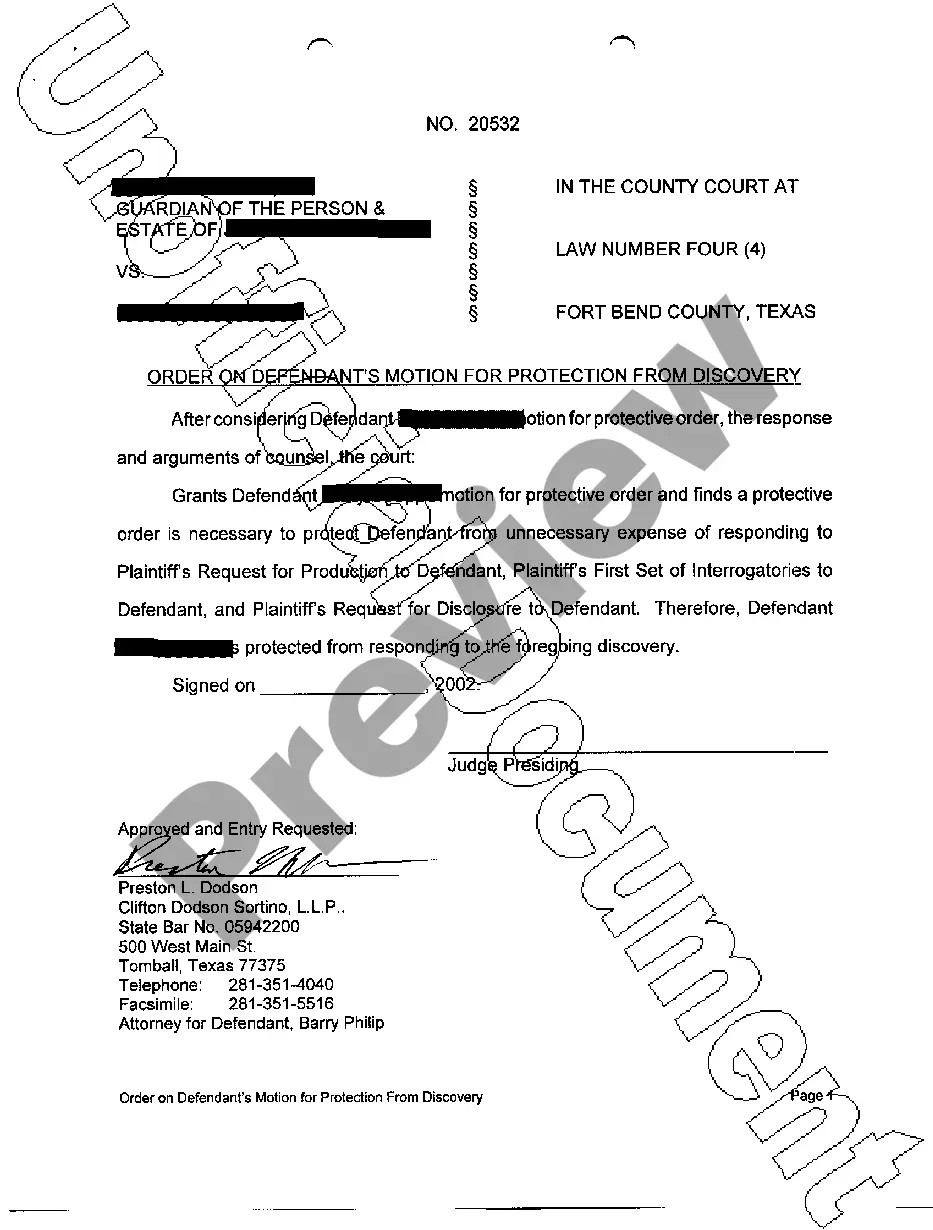


How to fill out Texas Order On Defendant's Motion For Discovery?
We consistently aim to reduce or evade legal repercussions when managing intricate legal or financial matters.
To achieve this, we enlist costly legal solutions as a general practice.
Nonetheless, not all legal issues share the same level of complexity.
Many of these can be handled independently.
Take advantage of US Legal Forms whenever you need to find and download the Houston Texas Order on Defendant's Motion for Discovery or any other document swiftly and securely.
- US Legal Forms is a digital repository of current DIY legal documents covering various topics from wills and powers of attorney to articles of incorporation and petitions for dissolution.
- Our repository empowers you to manage your affairs without the need for legal representation.
- We offer access to legal document templates that aren't always readily available to the public.
- Our templates are tailored to specific states and regions, making the search process considerably easier.
Form popularity
FAQ
Discovery enables everyone involved to know the facts and information about the case. Discovery may be completed before settlement negotiations occur and certainly before a trial beings. Discovery consists of four key actions: interrogatories, requests for production, requests for admission and depositions.
Except as exempted by Rule 194.2(d) or as otherwise agreed by the parties or ordered by the court, a party must, without awaiting a discovery request, provide to the other parties the information or material described in Rule 194.2, 194.3, and 194.4. Production.
Every case filed in Texas state court requires the plaintiff to choose a discovery plan: Level One, which applies only for cases where the plaintiff seeks less than $100,000 in damages; Level Two, which applies by default to all other cases and has its own specific set of deadlines; and Level Three, which allows the
Under new Rule 190.3, discovery begins when initial disclosures are due (as opposed to when suit is filed under the old rules) and continues until: 30 days before the trial date in Family Code cases; or. In other cases, the earlier of. 30 days before the trial date, or. Nine months after initial disclosures are due.
What is Level One Discovery, and What Changes Were Made to Discovery Rules and Limits? Level One discovery now applies to divorces in which the parties claim the marital estate is worth less than a total amount of $250,000and this limit is an increase over the previous limit of $50,000.
Yes ? discovery is considered a public record in most states. This means that both the prosecution and defense are allowed access to ?discovery? evidence before trial for their preparation purposes. This includes interviews with witnesses, police reports, DNA results, etc.
Under Level 2 discovery, each side is only allowed 25 written interrogatories that ask for more than identifying information about a document. Additionally, the responding party may respond by telling the other side where the information can be found in public records instead of answering the question directly.
Amended Rule 190.2(b) ends the discovery period 180 days after the date the first discovery request is served; imposes a fifteen limit maximum on interrogatories, requests for production, and requests for admission; and allows for additional disclosures.