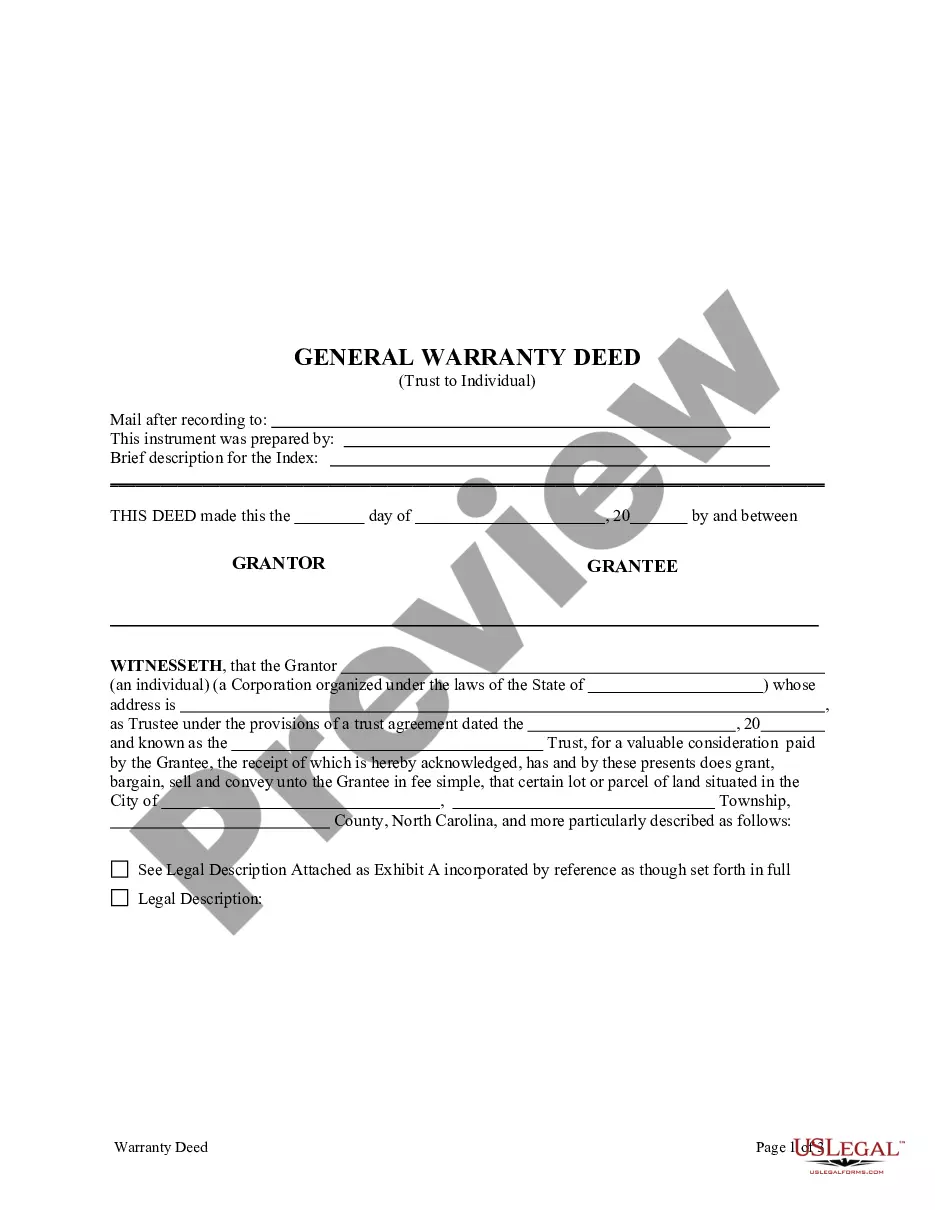
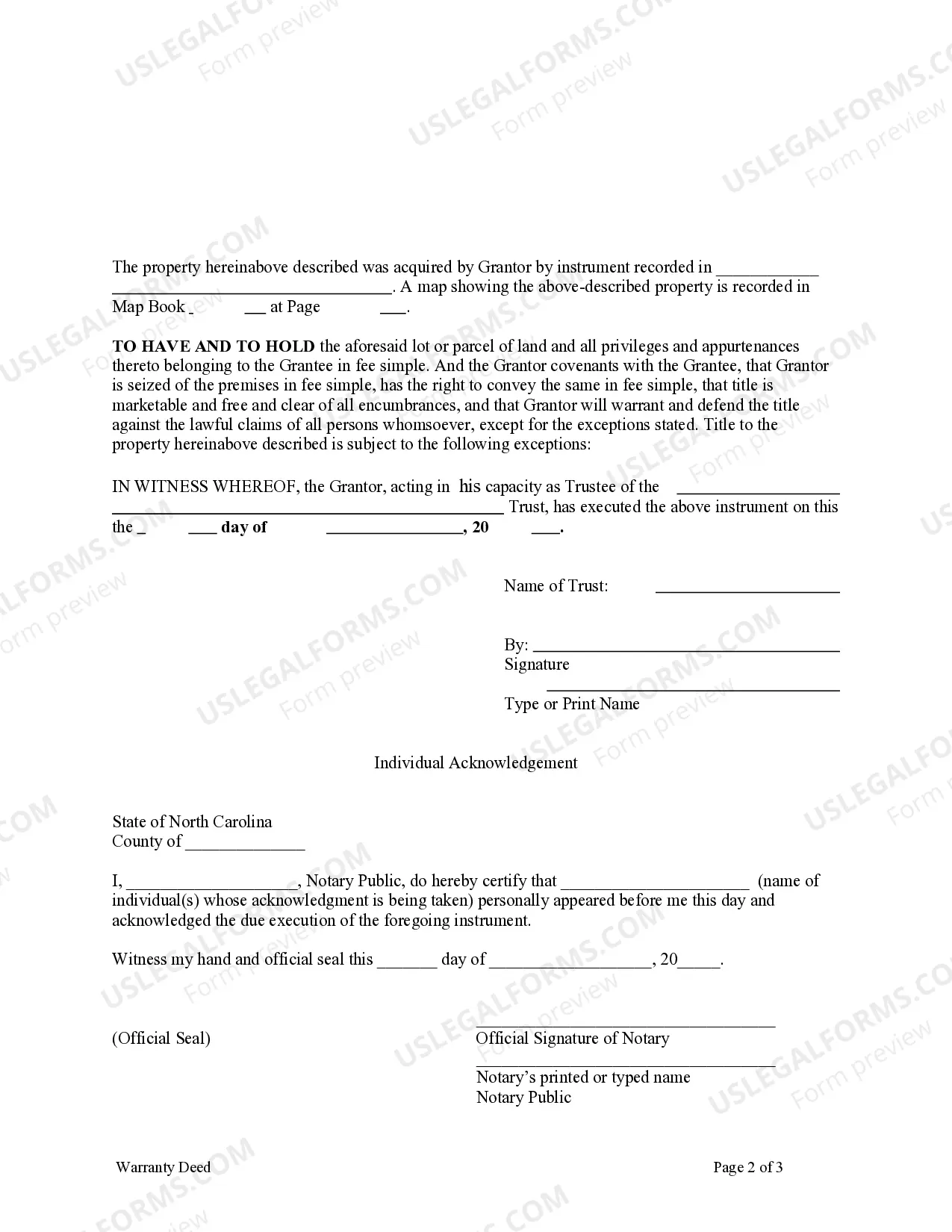
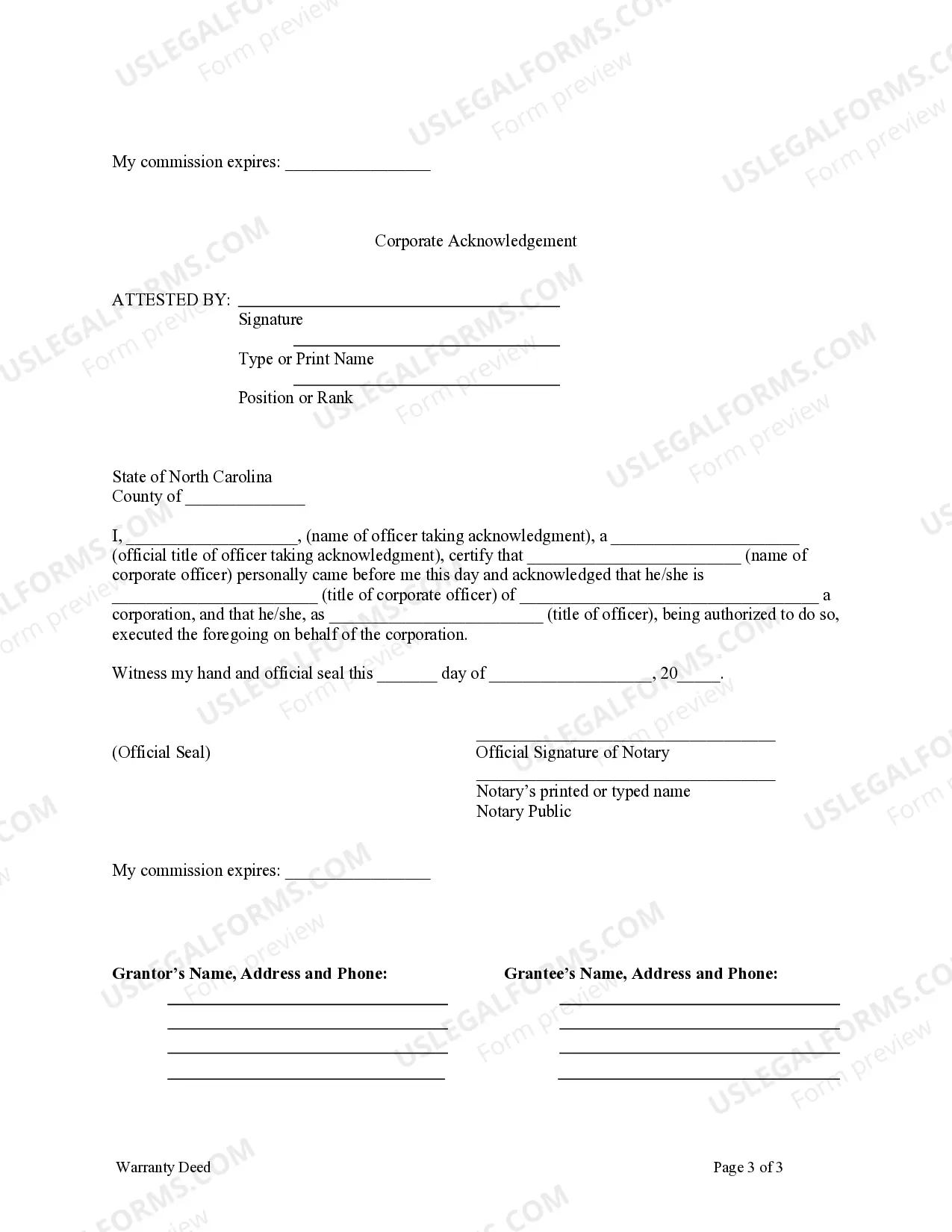
This form is a General Warranty Deed where the Grantor is a Trust and the Grantee is an Individual. Grantor conveys and generallys warrant the described property to the Grantee. This deed complies with all state statutory laws.
Cary North Carolina General Warranty Deed - Trust to Individual
State:
North CarolinaPlease select your state
Select state
Category:
City:
Cary
Control #:
NC-024-78
Format:
Word;
Rich Text
33 downloads
Description
Free preview

Get your form ready online
Our built-in tools help you complete, sign, share, and store your documents in one place.
Built-in online Word editor
Make edits, fill in missing information, and update formatting in US Legal Forms—just like you would in MS Word.
Export easily
Download a copy, print it, send it by email, or mail it via USPS—whatever works best for your next step.
E-sign your document
Sign and collect signatures with our SignNow integration. Send to multiple recipients, set reminders, and more. Go Premium to unlock E-Sign.
Notarize online 24/7
If this form requires notarization, complete it online through a secure video call—no need to meet a notary in person or wait for an appointment.
Store your document securely
We protect your documents and personal data by following strict security and privacy standards.

Make edits, fill in missing information, and update formatting in US Legal Forms—just like you would in MS Word.

Download a copy, print it, send it by email, or mail it via USPS—whatever works best for your next step.

Sign and collect signatures with our SignNow integration. Send to multiple recipients, set reminders, and more. Go Premium to unlock E-Sign.

If this form requires notarization, complete it online through a secure video call—no need to meet a notary in person or wait for an appointment.

We protect your documents and personal data by following strict security and privacy standards.
Looking for another form?
How to fill out North Carolina General Warranty Deed - Trust To Individual?
Locating certified templates tailored to your local laws can be difficult unless you access the US Legal Forms repository.
It is an online collection of over 85,000 legal documents for both personal and professional requirements and various real-life scenarios.
All the files are accurately sorted by usage area and jurisdiction, making it simple to find the Cary North Carolina General Warranty Deed - Trust to Individual as easy as pie.
Provide your credit card information or utilize your PayPal account to pay for the subscription. Download the Cary North Carolina General Warranty Deed - Trust to Individual. Save the template on your device to complete it and access it again in the My documents section of your profile whenever needed. Maintaining documentation organized and in accordance with legal standards is crucial. Take advantage of the US Legal Forms library to have essential document templates readily available for any of your needs!
- Examine the Preview mode and form details.
- Ensure that you’ve selected the appropriate one that satisfies your needs and fully aligns with your local jurisdiction criteria.
- Search for another template, if necessary.
- If you notice any discrepancies, use the Search tab above to locate the correct one. If it fits your needs, proceed to the next step.
- Purchase the document.
Form popularity
FAQ
Completing a general warranty deed requires attention to detail and proper execution. Begin by filling in all required information, including both parties' names and the legal description of the property. After completing the deed, ensure it is signed, dated, and notarized to fulfill legal requirements. For added convenience and accuracy, using US Legal Forms can provide you with the necessary templates and guidance for a Cary North Carolina General Warranty Deed - Trust to Individual.
Filling out a general warranty deed involves several key steps. First, clearly identify the grantor (the person transferring the property) and the grantee (the person receiving the property). Next, accurately describe the property being transferred, including its legal description. Lastly, sign the deed in front of a notary to complete the process; using US Legal Forms can help simplify these steps for a Cary North Carolina General Warranty Deed - Trust to Individual.
To effectively fill out a warranty form, begin by gathering all necessary information about the property and the parties involved. Ensure you include details such as the property address, the names of the grantor and grantee, and the date of transfer. It's essential to follow the instructions provided on the form carefully. For assistance, consider using a service like US Legal Forms that offers templates to streamline the process for a Cary North Carolina General Warranty Deed - Trust to Individual.
Yes, a warranty deed serves as a legal document that can prove ownership of a property. In the case of a Cary North Carolina General Warranty Deed - Trust to Individual, this document affirms that the seller legally owns the property and has the right to sell it. However, it's essential to ensure that the deed is properly recorded to maintain a public record of ownership.
While a Cary North Carolina General Warranty Deed - Trust to Individual offers strong protection for the buyer, it does have some disadvantages. The seller must guarantee clear title to the property, which can create liability risks if issues arise. Additionally, the selling process can become lengthy if repair issues need resolution before closing.
Transferring a property title to a family member in North Carolina typically involves using a Cary North Carolina General Warranty Deed - Trust to Individual. You'll need to complete the deed with the names of both the current owner and the family member. After signing the deed in front of a notary, file it with the local register of deeds to formalize the title transfer.
To effectively transfer property with a Cary North Carolina General Warranty Deed - Trust to Individual, you must prepare the deed accurately, including the names of both the buyer and seller. Next, ensure the deed is signed before a notary public to validate it. Finally, record the deed with the local county office to ensure public acknowledgment of the property transfer.
Transferring a home warranty generally involves contacting your home warranty provider to inform them of the change in ownership. You may need to provide details about the new owner and the property. Each company has its own process, so having your original warranty documents handy can aid in this process. This ensures a smooth transition without gaps in coverage.
To transfer a property using a Cary North Carolina General Warranty Deed - Trust to Individual, you must first prepare the deed, which includes details about the property, the seller, and the buyer. Once you have the deed ready, sign it in front of a notary public. After notarization, file the deed with the county register of deeds where the property is located to officially complete the transfer.
To transfer ownership of a property in North Carolina, you typically need to execute a Cary North Carolina General Warranty Deed - Trust to Individual. This deed must be completed, signed, and notarized before submitting it to the Register of Deeds. Ensure all relevant information is accurate to facilitate a smooth transfer. Using resources like USLegalForms can provide you with the right templates and guidance for a successful transfer.