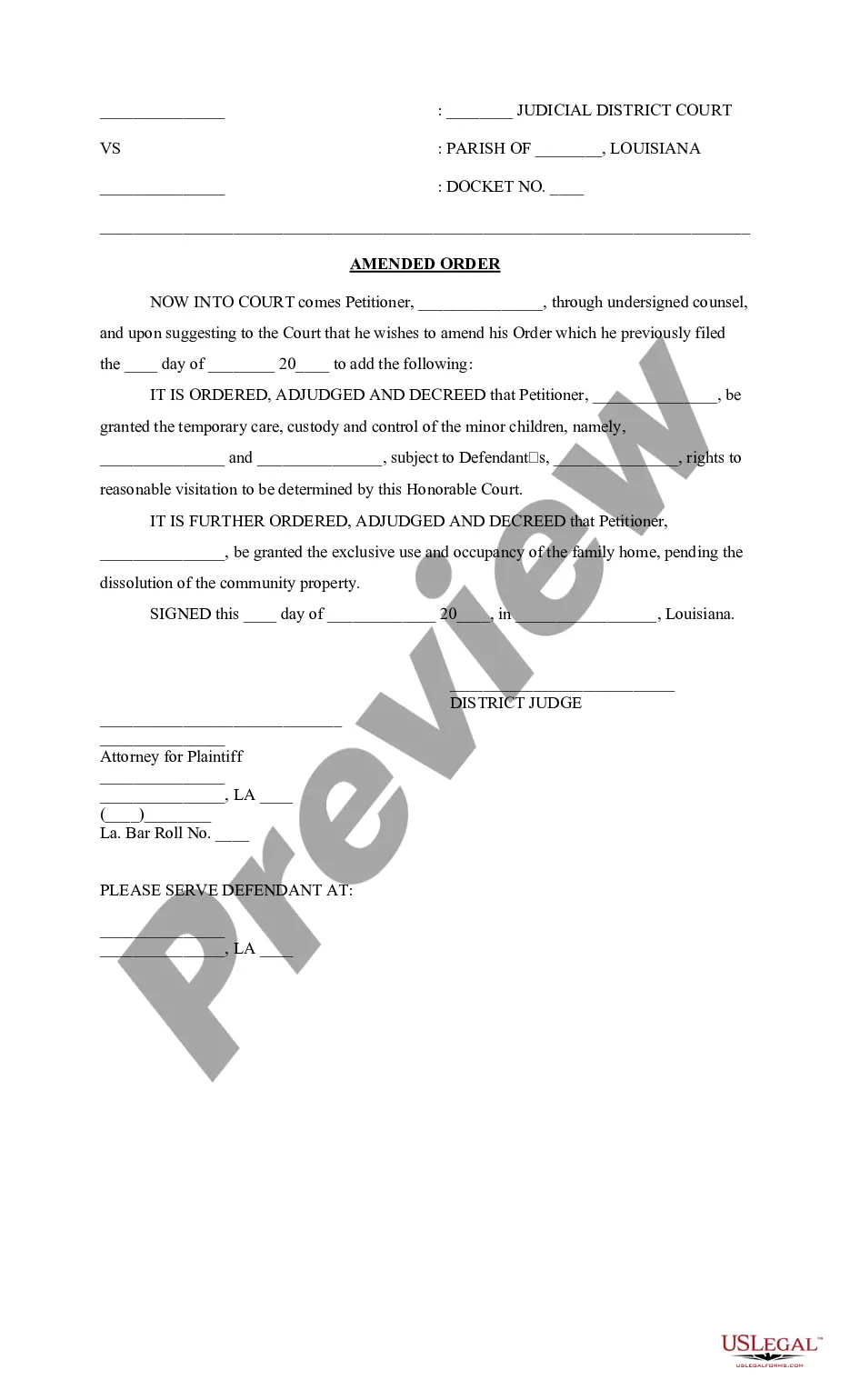
New Orleans Louisiana Amended Order of Custody
Description

Get your form ready online
Our built-in tools help you complete, sign, share, and store your documents in one place.
Make edits, fill in missing information, and update formatting in US Legal Forms—just like you would in MS Word.
Download a copy, print it, send it by email, or mail it via USPS—whatever works best for your next step.
Sign and collect signatures with our SignNow integration. Send to multiple recipients, set reminders, and more. Go Premium to unlock E-Sign.
If this form requires notarization, complete it online through a secure video call—no need to meet a notary in person or wait for an appointment.
We protect your documents and personal data by following strict security and privacy standards.

Make edits, fill in missing information, and update formatting in US Legal Forms—just like you would in MS Word.

Download a copy, print it, send it by email, or mail it via USPS—whatever works best for your next step.

Sign and collect signatures with our SignNow integration. Send to multiple recipients, set reminders, and more. Go Premium to unlock E-Sign.

If this form requires notarization, complete it online through a secure video call—no need to meet a notary in person or wait for an appointment.

We protect your documents and personal data by following strict security and privacy standards.
Looking for another form?
How to fill out Louisiana Amended Order Of Custody?
Irrespective of societal or occupational standing, completing legal documents is a regrettable requirement in modern times.
Frequently, it’s nearly impossible for individuals without a legal background to create such papers independently, primarily because of the complex terminology and legal nuances they entail.
This is where US Legal Forms proves to be beneficial.
Ensure the form you've located is appropriate for your area since the regulations of one state or county do not apply to another.
Examine the form and read a brief overview (if provided) of scenarios for which the document can be utilized.
- Our platform provides an extensive assortment of over 85,000 pre-formulated state-specific documents suitable for nearly every legal circumstance.
- US Legal Forms also serves as an exceptional tool for partners or legal advisers aiming to enhance their efficiency by using our DIY papers.
- Whether you require the New Orleans Louisiana Amended Order of Custody or any other document that will be recognized in your state or county, with US Legal Forms, everything is easily accessible.
- Here’s how to obtain the New Orleans Louisiana Amended Order of Custody in minutes using our reliable platform.
- If you are already a member, you can proceed to Log In to your account to access the appropriate form.
- However, if you are new to our library, ensure that you take the following steps before acquiring the New Orleans Louisiana Amended Order of Custody.
Form popularity
FAQ
By age 11, courts typically allow the child to state his or her preference. Other factors may focus on the parents, like which parent is more likely to take care of the daily physical, emotional, developmental, educational, and special needs of your child.
Louisiana law states that a child has a right to time with both parents, so if the court awards one parent primary physical custody, the judge will order visitation for the noncustodial parent.
This phrase means that the proposed change benefits the children more than the impact of the change would harm them. Because Louisiana law presumes that stability and continuation of a custody arrangement is good for children, the Courts also consider any change to the custody schedule as potentially harmful.
Unmarried Fathers and Child Custody For married couples, parenting rights are equal and immediate at the time of birth. For unmarried parents, all rights belong to the mother. Unmarried fathers have no legal rights to custody or visitation.
In law, there is no fixed age that determines when a child can express a preference as to where they want to live. However, legally, a child cannot decide who they want to live with until they are 16 years old. Once a child reaches the age of 16, they are legally allowed to choose which parent to live with.
Louisiana law states that a child has a right to time with both parents, so if the court awards one parent primary physical custody, the judge will order visitation for the noncustodial parent. (La. Civ.
How to Win a Child Support Modification Case 1 Take advantage of the rights you already have. 2 Reach out to your ex-partner if you think they'll be amicable. 3 Solicit free legal help if you can't hire an attorney. 4 Do it on your own only if you can't get help. 5 Determine what has changed to justify a modification.
If the child is at least 12 years old, courts will usually give the child's preference some weight. Courts don't have to follow a child's custodial preference. The court decides how much weight to give each child's opinion by considering the rationale behind the child's preference.
Non-custodial parents who have a history of family violence or physical abuse toward the child or children may not be allowed visitation privileges and if allowed by the courts, only under supervised visitation.