Iowa Quitclaim Deed from Individual to Corporation
Understanding this form
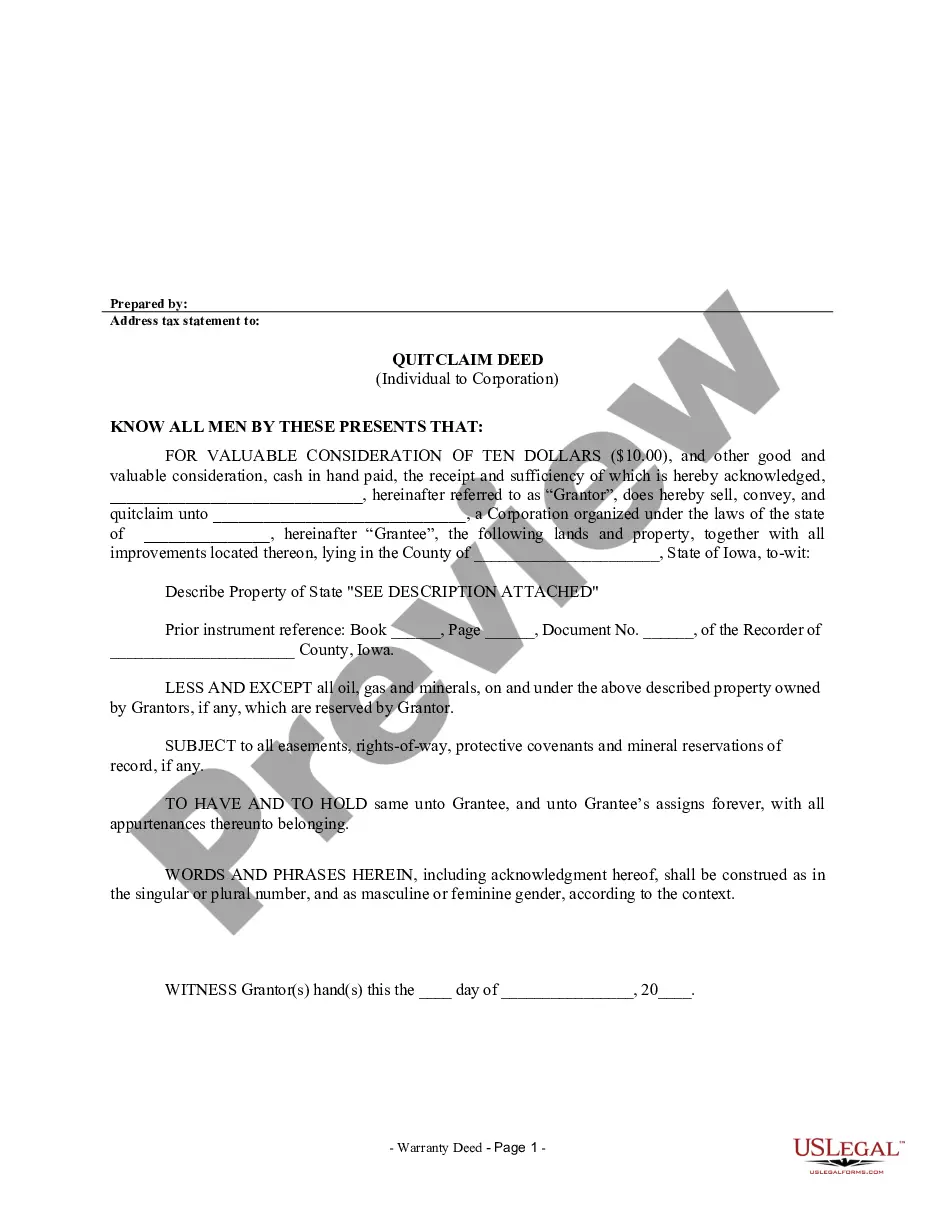
The Quitclaim Deed from Individual to Corporation is a legal document that allows an individual (the grantor) to transfer ownership of a property to a corporation (the grantee) without any warranty of title. This form is different from a warranty deed as it does not guarantee that the grantor holds the title free and clear of any claims. This document is essential for legal property transfers in various scenarios, ensuring that the rights to the specified real estate are conveyed to the corporation efficiently and legally.
Key parts of this document
- Names and addresses of the grantor (individual) and grantee (corporation).
- Description of the property being transferred.
- Reservation of oil, gas, and minerals by the grantor.
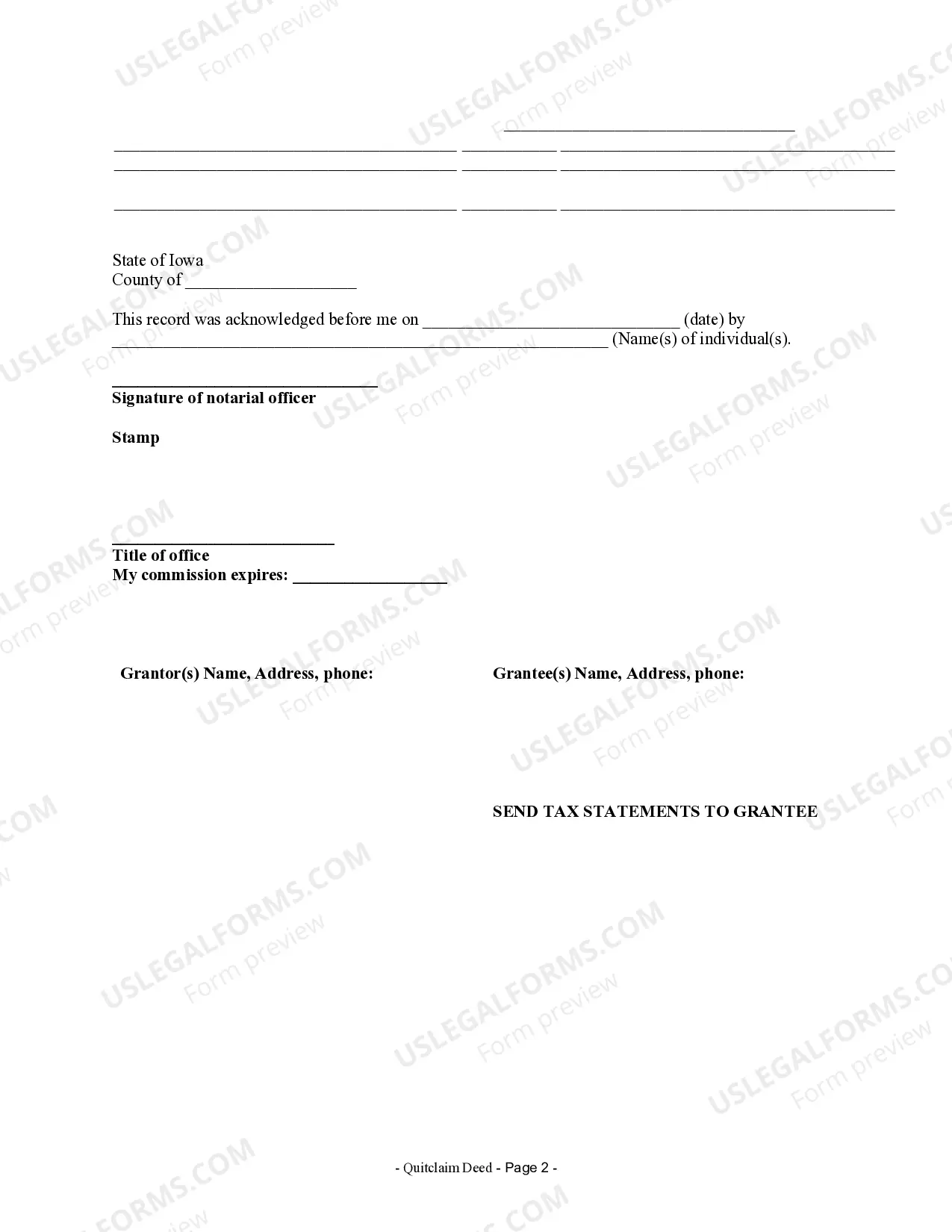
- Signatures of the grantor and notarization requirements.
- Reference to prior instrument for detailed property description.


When to use this form
This form is used when an individual wishes to transfer property to a corporation, often in situations such as business formation, asset reallocation, or estate planning. It is particularly useful when the individual does not need to provide guarantees concerning the propertyâs title and wants a straightforward transfer process.
Intended users of this form
- Individuals looking to transfer real estate to a corporation.
- Business owners needing to manage their assets legally.
- Real estate professionals facilitating property transfers.
- Individuals engaged in estate planning who wish to involve corporations in their property holdings.
How to prepare this document
- Identify the grantor and grantee by entering their names and addresses.
- Provide a detailed description of the property being transferred.
- Include any necessary references to previous documents related to the property.
- Sign and date the form in the presence of a notary public.
- Ensure the form is filed with the appropriate local authorities, if required.
Is notarization required?
Yes, this form must be notarized to be legally valid. Always ensure the signatory appears before a notary public, who will verify identities and witness the signing to add an additional layer of legal assurance.
Get your form ready online
Our built-in tools help you complete, sign, share, and store your documents in one place.
Make edits, fill in missing information, and update formatting in US Legal Forms—just like you would in MS Word.
Download a copy, print it, send it by email, or mail it via USPS—whatever works best for your next step.
Sign and collect signatures with our SignNow integration. Send to multiple recipients, set reminders, and more. Go Premium to unlock E-Sign.
If this form requires notarization, complete it online through a secure video call—no need to meet a notary in person or wait for an appointment.
We protect your documents and personal data by following strict security and privacy standards.

Make edits, fill in missing information, and update formatting in US Legal Forms—just like you would in MS Word.

Download a copy, print it, send it by email, or mail it via USPS—whatever works best for your next step.

Sign and collect signatures with our SignNow integration. Send to multiple recipients, set reminders, and more. Go Premium to unlock E-Sign.

If this form requires notarization, complete it online through a secure video call—no need to meet a notary in person or wait for an appointment.

We protect your documents and personal data by following strict security and privacy standards.
Typical mistakes to avoid
- Failing to include a complete and accurate property description.
- Not having the form notarized when required.
- Forgetting to retain a copy of the deed for personal records.
- Incorrectly stating the names or details of the parties involved.
Advantages of online completion
- Convenience of downloading and completing the form at your convenience.
- Editability for customization to fit specific transfer needs.
- Access to forms prepared by licensed attorneys ensures legal compliance.
Looking for another form?

Form popularity
FAQ
The form transfers property from an individual grantor to a corporation grantee without any warranty of title. It is used for asset transfers where the grantor does not guarantee clear title. The document requires the grantor’s signature, notarization, a property description (often tied to a prior instrument), and identification of the grantor and grantee’s names/addresses. It's intended for efficient, straightforward transfers.
It transfers ownership from a grantor (an individual) to a grantee (a corporation) without any warranty of title. The Iowa form requires the grantor and grantee names and addresses, a property description (often via a prior instrument), the grantor’s signature and notarization, and may include a reservation of oil, gas, and minerals. Use this form for a simple corporate transfer.
Tax responsibility for a quitclaim deed varies by jurisdiction and is not dictated by this form. The template focuses on the transfer mechanics—grantor, grantee, property description, signatures, and notarization—without assigning tax obligations. Parties should consult a tax professional to determine any transfer taxes or recording fees that may apply in their situation.
This form does not specify costs. Filing or recording fees vary by county, and additional charges for notary services or courier handling may apply. To confirm current fees, check with the county recorder and a title professional before filing this deed.
This form is specifically drafted to transfer property from an individual to a corporation, with the grantee identified as a corporation. For a transfer to an LLC, a quitclaim deed drafted for an LLC as the grantee should be used, or adapt the form to name the LLC and meet any applicable corporate structures and filings.
This form transfers from an individual to a corporation and states no warranty of title, with a property description linked to a prior instrument and a possible reservation of oil, gas, and minerals. A deed to an LLC would designate the LLC as the grantee and may entail different ownership or liability considerations for the entity.