District of Columbia Home Sale Forms
Handle every step of a District of Columbia home sale with confidence. Our attorney-drafted templates keep paperwork simple, accurate, and ready to use.

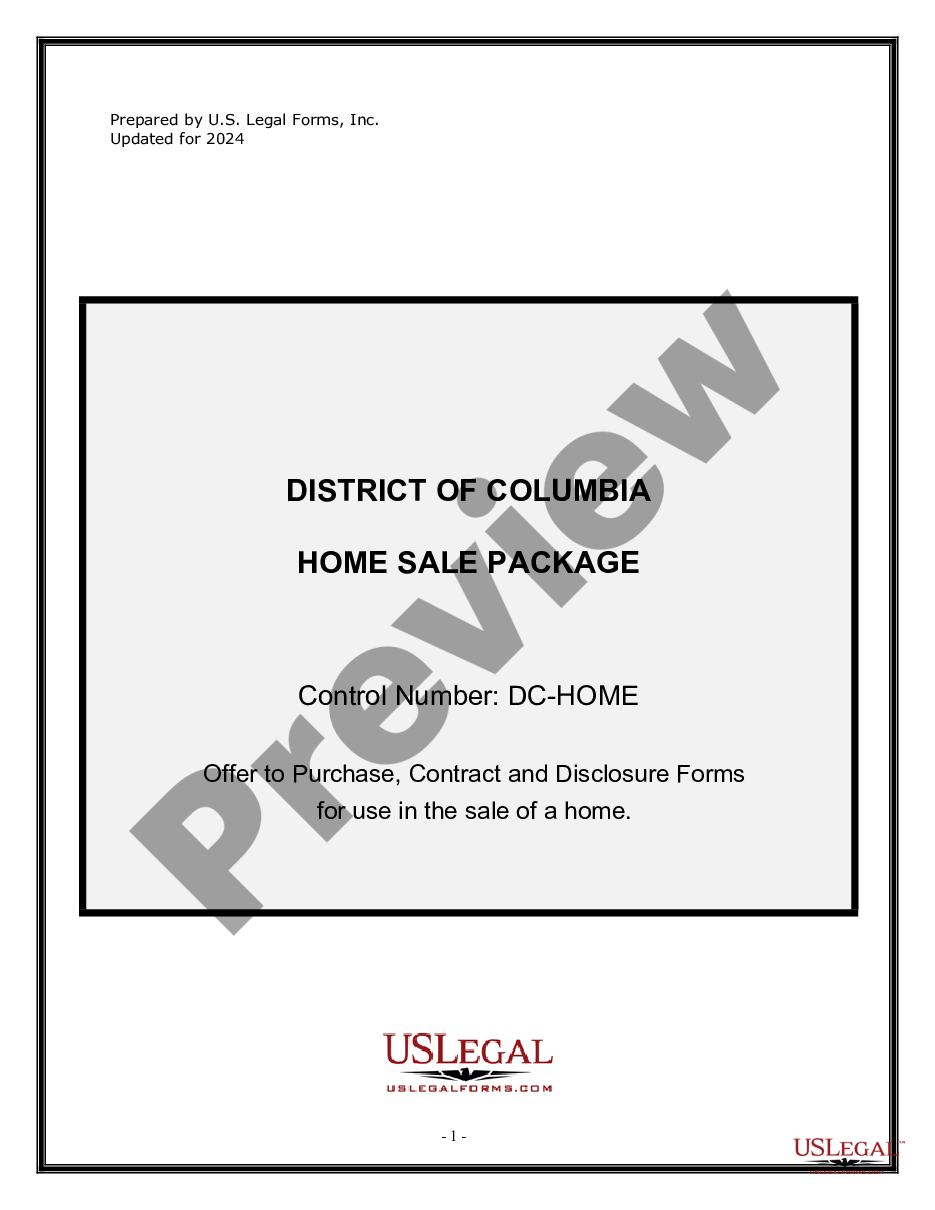
Home Sales Package
PopularEverything needed to sell or buy a home - sale contract, offer to purchase, disclosure statements, and lead-paint disclosure.
Similar documents: key differences
- Purchase Agreement vs. Letter of Intent — a purchase agreement is legally binding, while a letter of intent signals interest without committing either party.
- General Warranty Deed vs. Quitclaim Deed — a general warranty deed guarantees the seller's full ownership history, while a quitclaim deed transfers only whatever interest the grantor currently holds.
- Seller's Disclosure vs. Lead-Based Paint Disclosure — a seller's disclosure covers general property conditions, while the lead-based paint disclosure addresses a single federally mandated hazard.
- Earnest Money Receipt vs. Escrow Agreement — an earnest money receipt confirms a deposit was received, while an escrow agreement governs how and when those funds are released.
- Home Inspection Addendum vs. Repair Addendum — an inspection addendum sets the right to inspect, while a repair addendum documents agreed repairs after inspection results are reviewed.
- Closing Statement vs. Title Commitment — a closing statement shows the final financial accounting of the transaction, while a title commitment outlines the conditions under which title insurance will be issued.
Search for more forms
Common District of Columbia Home Sale Forms documents
- Purchase Agreement — establishes the sale price, contingencies, and terms both parties agree to before closing.
- Property Disclosure Statement — informs the buyer of known defects, hazards, or material conditions affecting the property.
- Deed Transfer Form — officially conveys title from the seller to the buyer upon closing.
- Earnest Money Receipt — documents the buyer's good-faith deposit and the conditions under which it is held or returned.
- Lead-Based Paint Disclosure — required for homes built before 1978 to notify buyers of potential lead hazards.
- Home Inspection Contingency Addendum — gives the buyer the right to negotiate or withdraw based on inspection findings.
- Closing Settlement Statement — itemizes all credits, debits, fees, and proceeds for both parties at the time of settlement.
FAQs
DC law does not require an attorney to complete a home sale, but an attorney or licensed title company typically handles the closing process. For FSBO transactions especially, having an attorney review your documents adds an important layer of protection.
Sellers must provide a Seller's Disclosure of Real Property Condition form. If the property was built before 1978, a federally required Lead-Based Paint Disclosure must also be provided to the buyer before or at contract signing.
Earnest money is a deposit the buyer makes to demonstrate serious intent to purchase. In the District of Columbia, it is held in escrow — typically by a title company — and applied toward closing costs or returned to the buyer if the deal falls through under a written contingency.
A home inspection contingency gives the buyer a set window to have the property professionally inspected. If significant issues are found, the buyer can request repairs, renegotiate the price, or walk away from the deal without losing their earnest money.
At closing, both parties sign the final documents, the deed is prepared for recordation, funds are disbursed, and ownership officially transfers to the buyer. DC closings are typically handled by a title company, and the deed is then recorded with the DC Office of Recorder of Deeds.
Key legal points
- The District of Columbia requires sellers to complete a Seller's Disclosure of Real Property Condition before or at the time of contract signing.
- DC law mandates a lead-based paint disclosure for any residential property constructed prior to 1978.
- The District of Columbia imposes a deed recordation tax and a transfer tax, both of which must be accounted for at closing.
- Earnest money deposits in DC are typically held in escrow by a licensed title company or real estate attorney until settlement.
- DC does not require a real estate attorney to close a transaction, but using one is common and often recommended for FSBO transactions.
- The buyer's right to conduct a home inspection is not automatic — it must be written into the purchase agreement as a contingency.
- All deed transfers in the District of Columbia must be recorded with the DC Office of Recorder of Deeds to be legally effective against third parties.
- First-time homebuyers in DC may qualify for the DC Home Purchase Assistance Program, which can affect the structure of the purchase agreement.
- Any addenda or amendments to the original purchase agreement must be signed by all parties to be enforceable.
How to get started
Start your District of Columbia home sale in minutes with these straightforward steps.
- Browse the home sale forms library and select the document type that fits your transaction.
- Preview the template to confirm it covers the terms, disclosures, and contingencies you need.
- Subscribe to access the full, attorney-drafted form ready for editing.
- Fill in the property details, party information, and agreed terms using the built-in online editor.
- Download your completed document, print it for signatures, or share it digitally with the other party.
Practical tip
In the District of Columbia, both the recordation tax and the transfer tax are negotiable between buyer and seller, so address who pays each one explicitly in the purchase agreement to avoid surprises at the closing table.