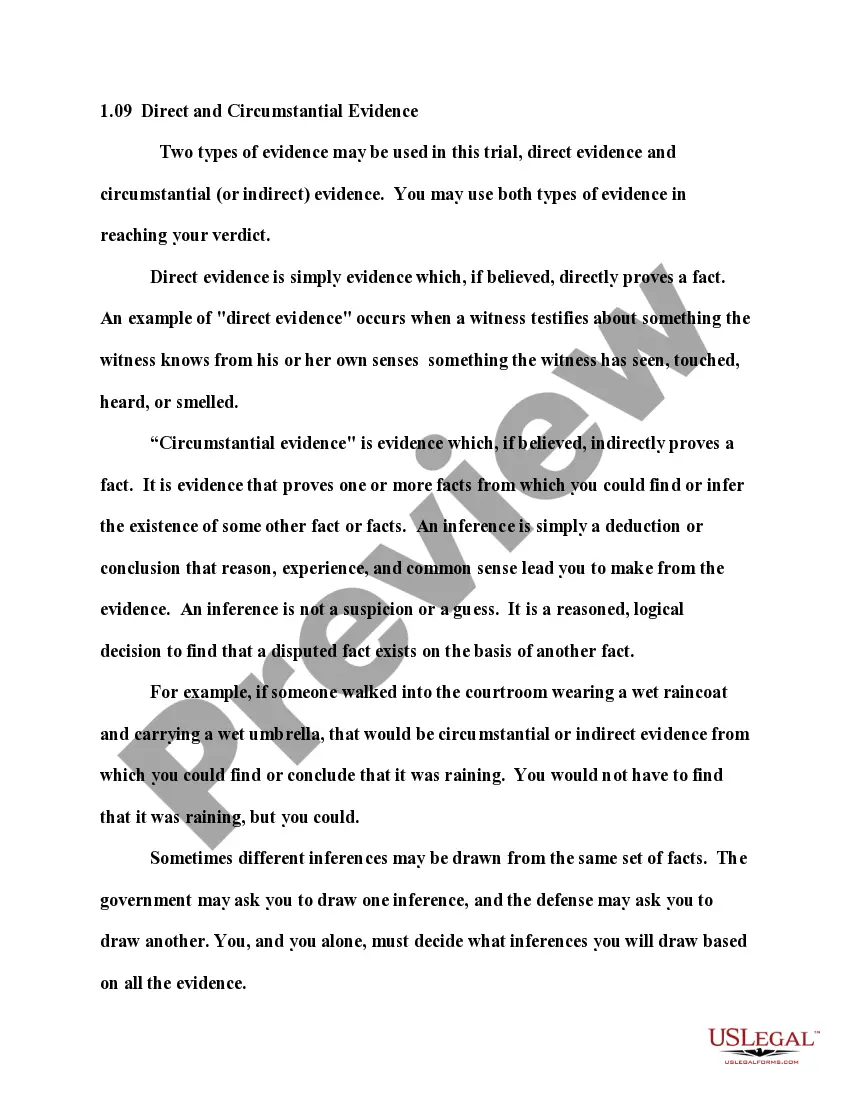
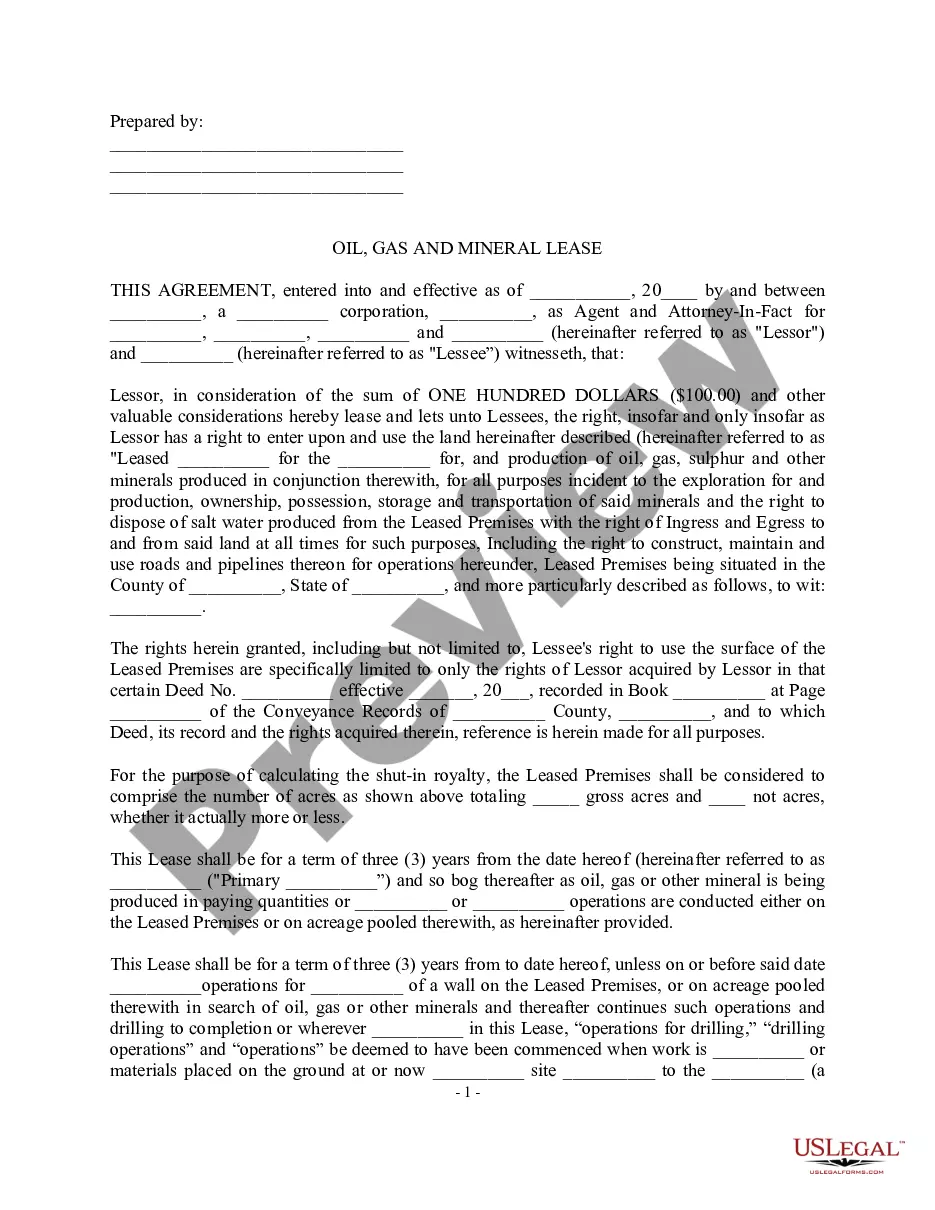
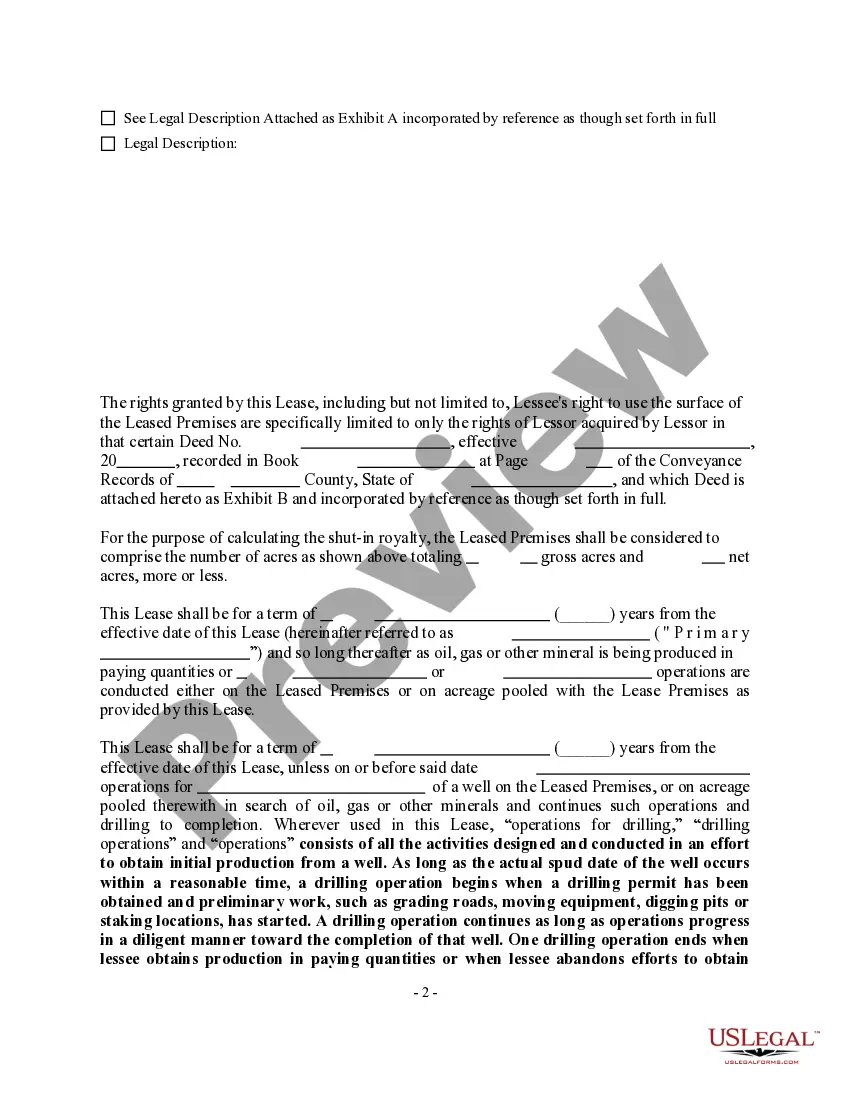
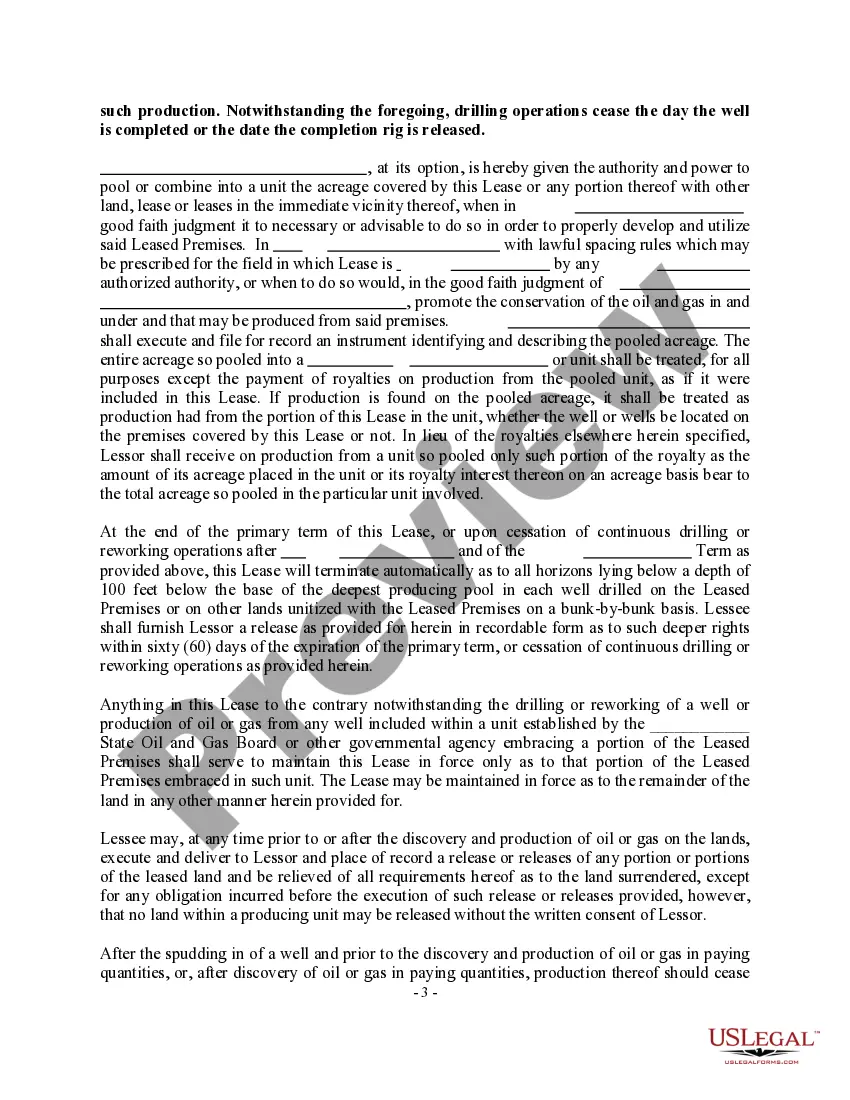
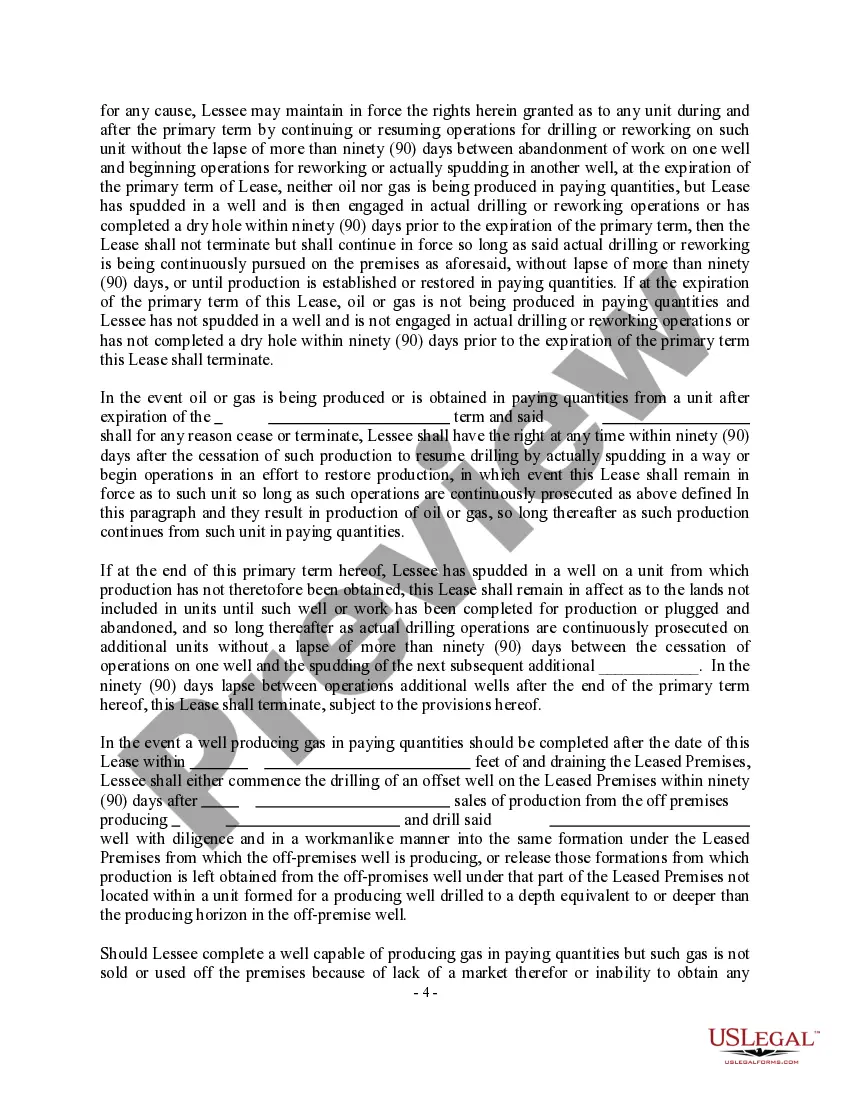
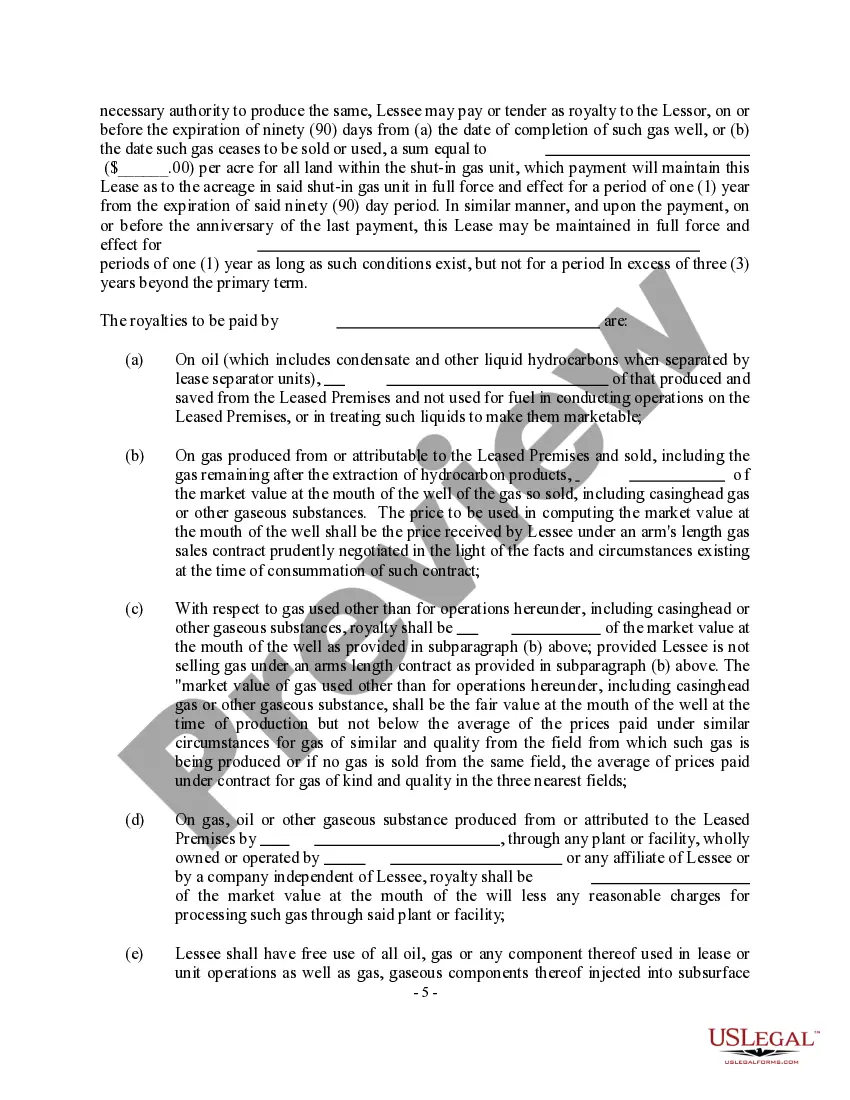
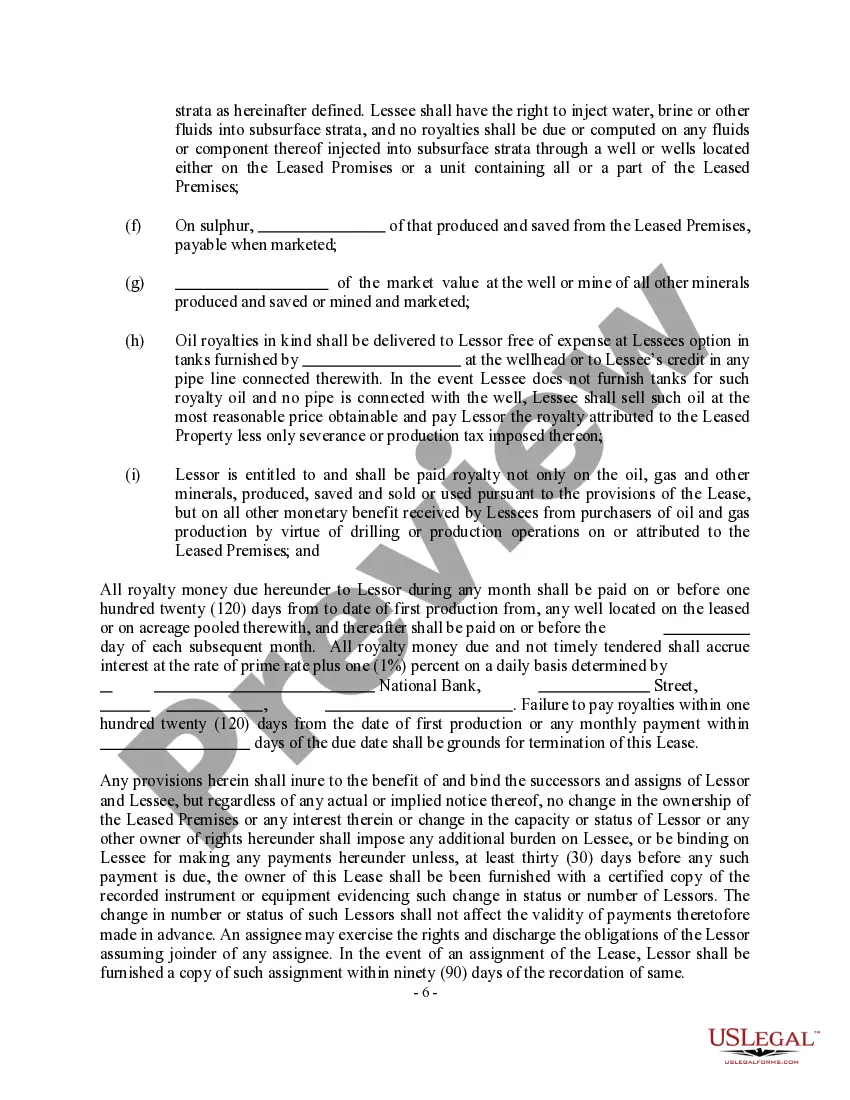
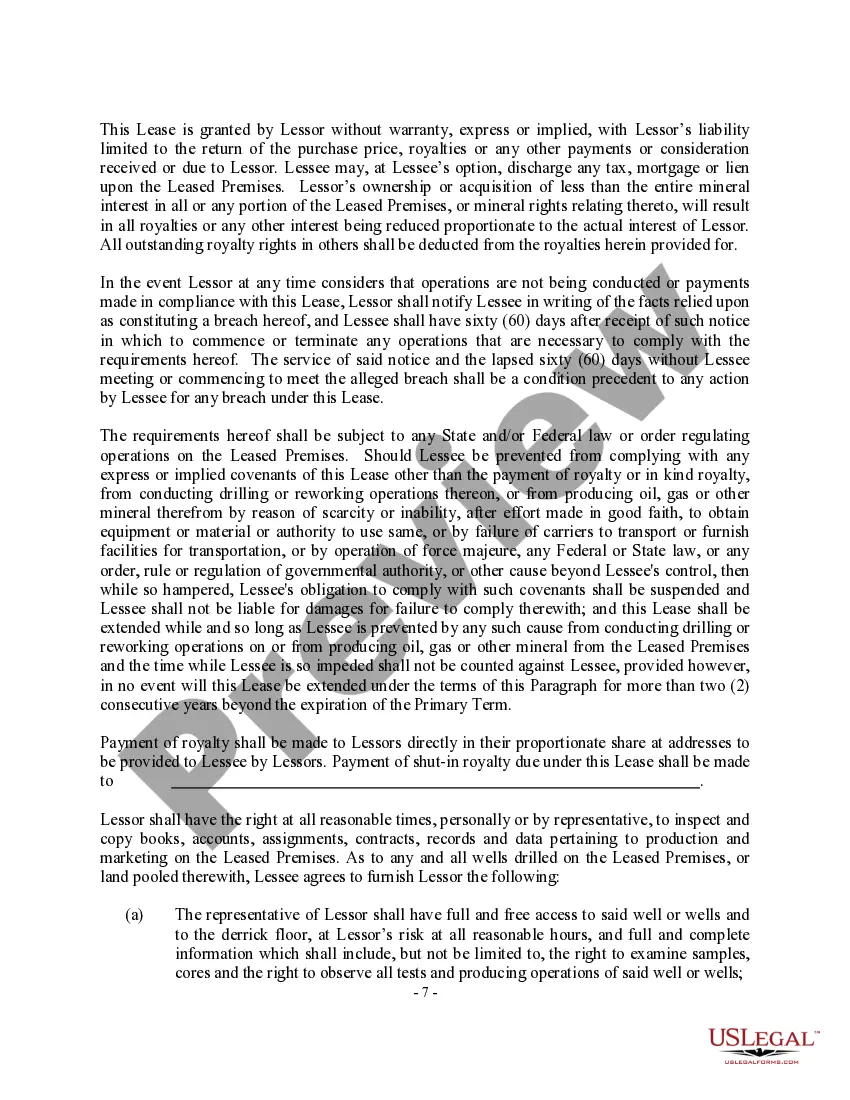
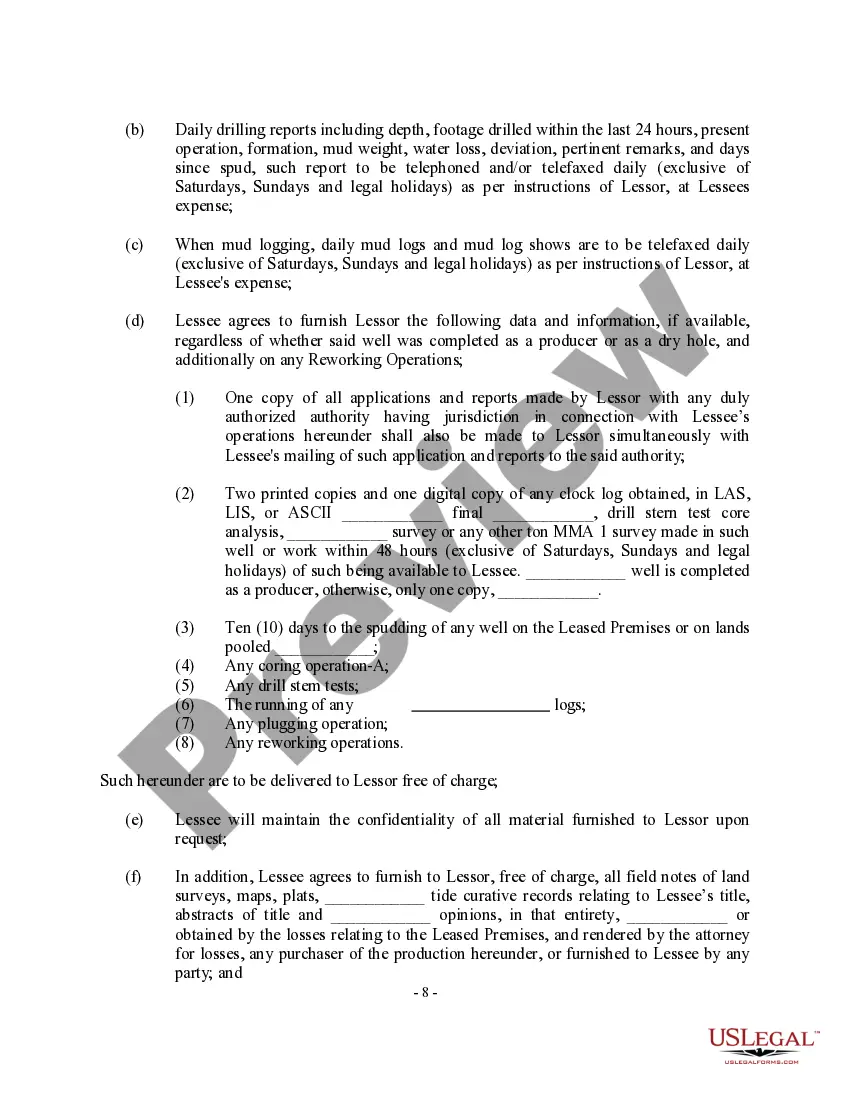
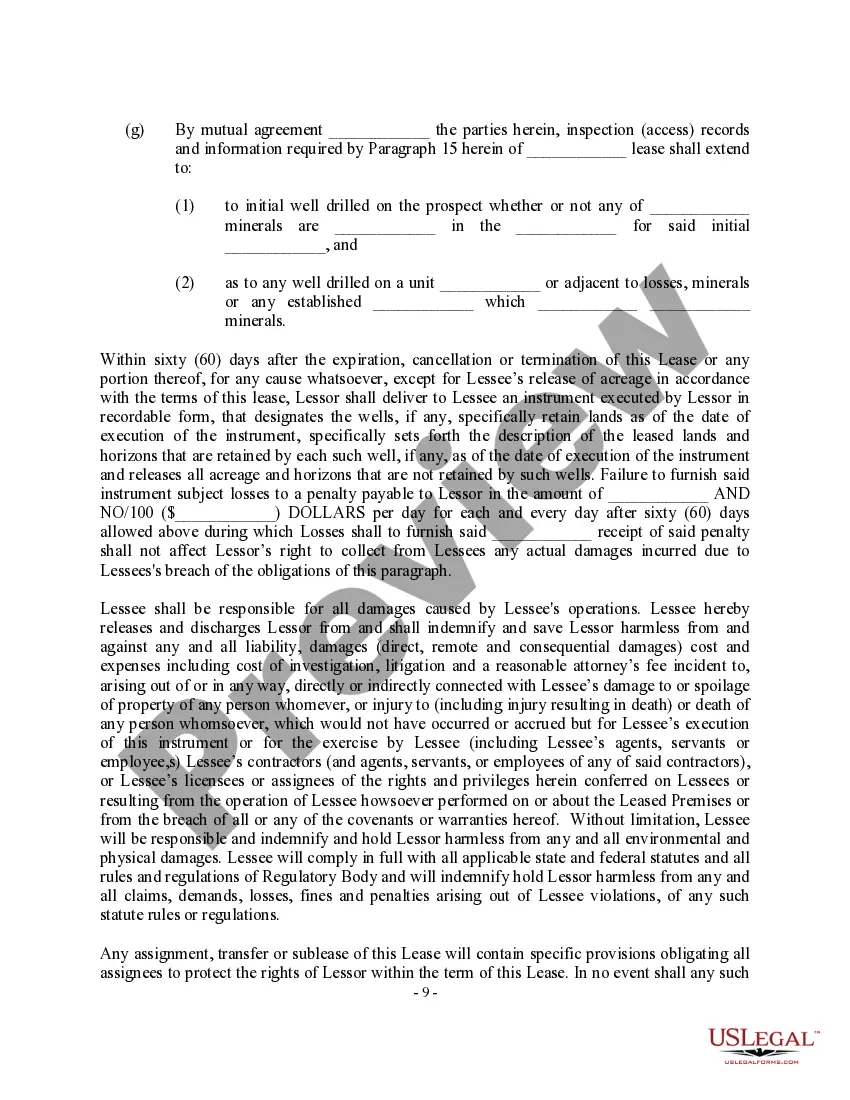
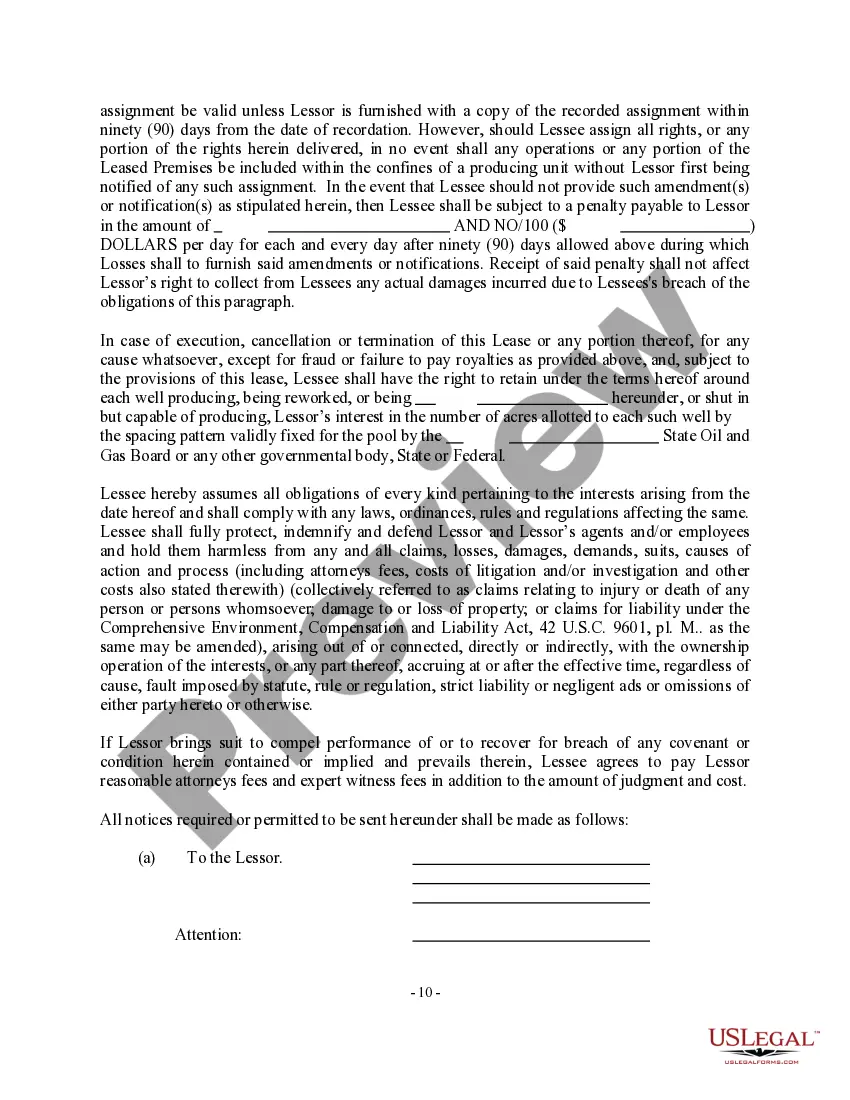
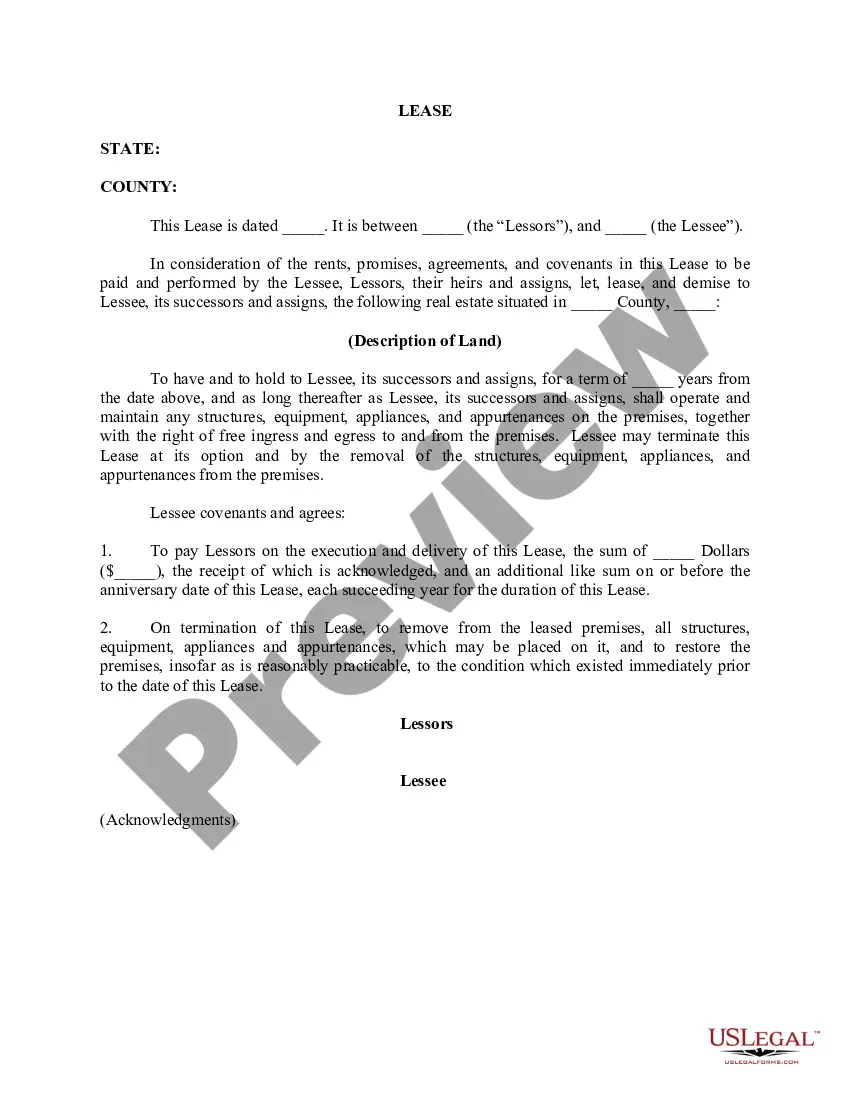
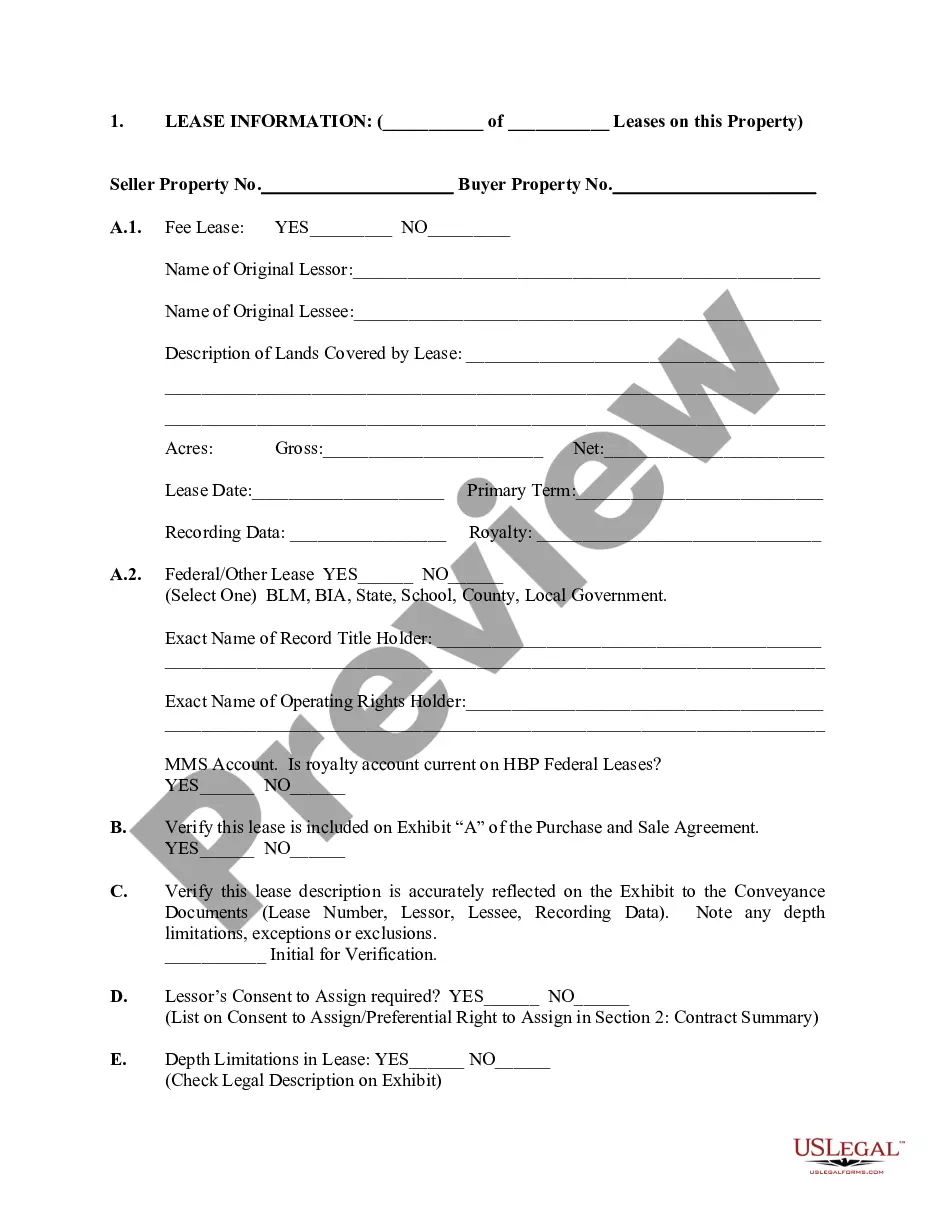
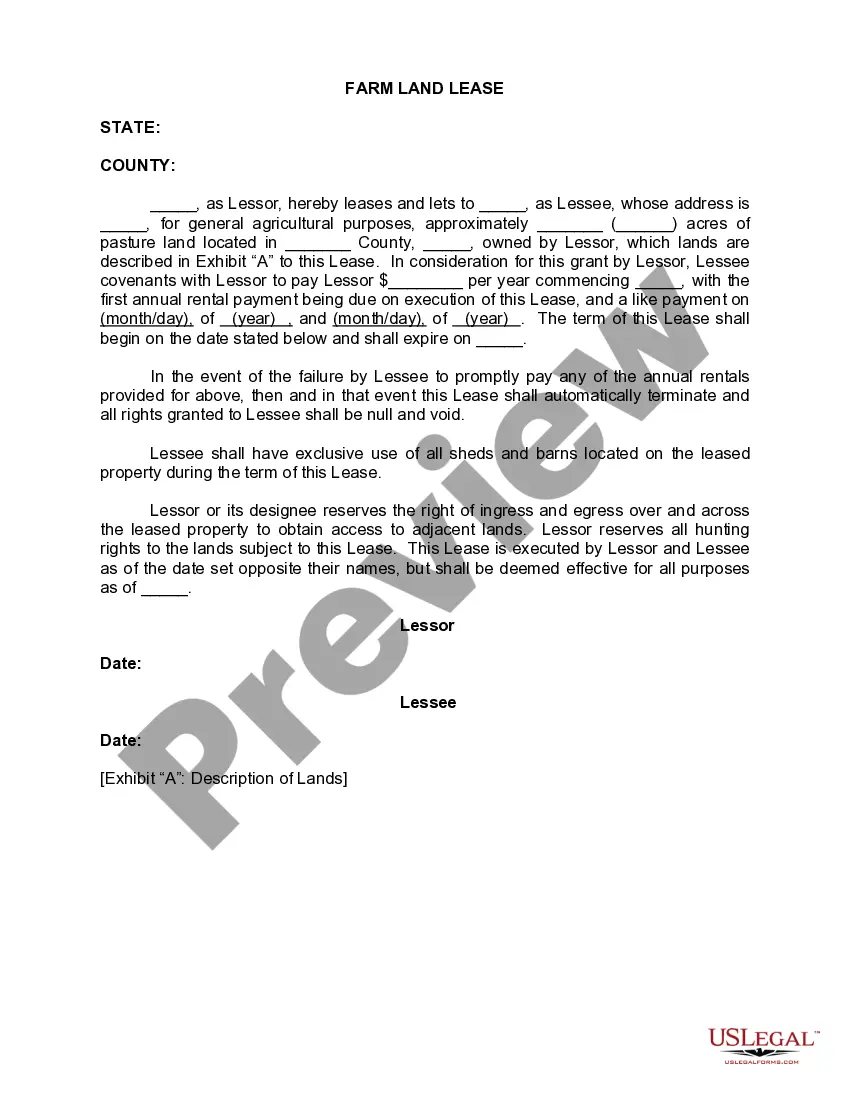
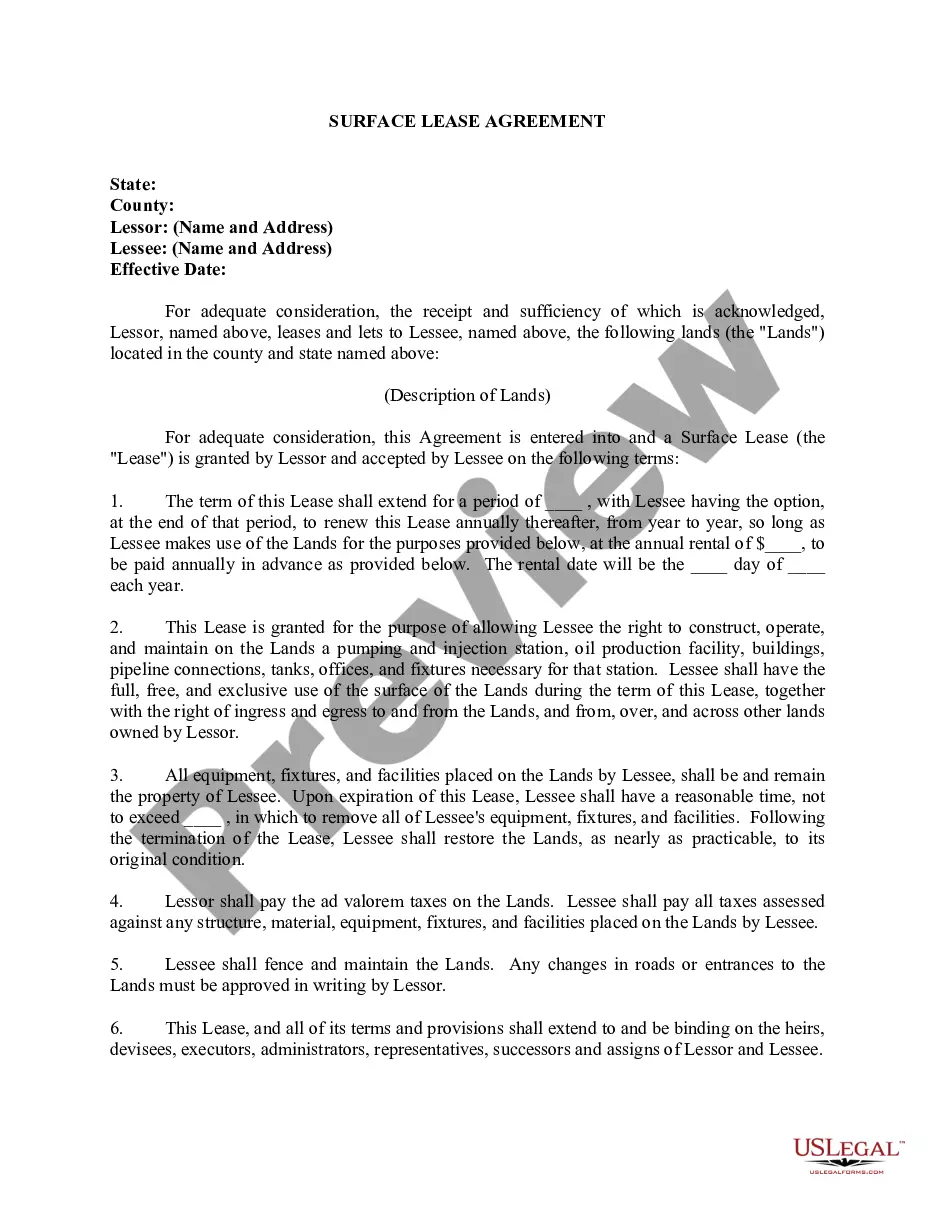
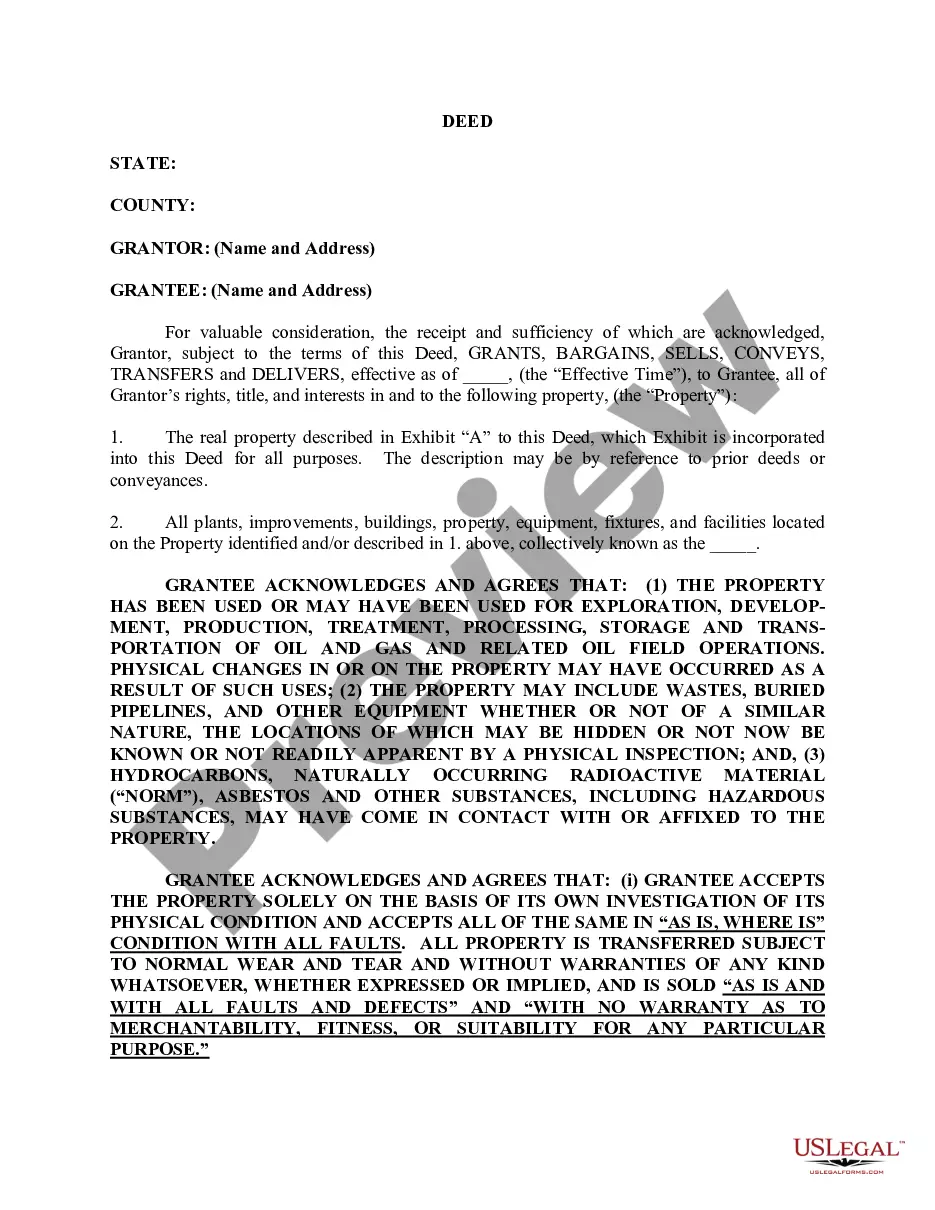
This form is an Oil, Gas and Mineral Lease. The lessor grants a right to the lessee to enter and use certain property for the production of oil, gas, and sulphur. The document must be signed in the presence of a notary public.
Wyoming Oil, Gas and Mineral Lease
Category:
State:
Multi-State
Control #:
US-00577
Format:
Word;
Rich Text
Instant download
Description
Free preview


How to fill out Oil, Gas And Mineral Lease?
If you want to finish, acquire, or print legal document templates, utilize US Legal Forms, the largest collection of legal forms available online. Take advantage of the site’s user-friendly and straightforward search to locate the documents you need. Various templates for commercial and personal purposes are organized by categories and states, or keywords. Use US Legal Forms to find the Wyoming Oil, Gas and Mineral Lease in just a few clicks.
If you are already a US Legal Forms user, Log In to your account and click the Download button to obtain the Wyoming Oil, Gas and Mineral Lease. You can also access forms you previously downloaded in the My documents section of your account.
If you are using US Legal Forms for the first time, follow the instructions below: Step 1. Make sure you have selected the form for the correct state/region. Step 2. Use the Review option to examine the form’s content. Don’t forget to read the description. Step 3. If you are not satisfied with the form, utilize the Search field at the top of the screen to find other forms in the legal form template. Step 4. Once you have identified the form you need, click the Buy now button. Choose the payment plan you prefer and enter your details to register for an account. Step 5. Complete the transaction. You can use your credit card or PayPal account to finalize the transaction. Step 6. Select the format of the legal form and download it to your device. Step 7. Complete, modify, and print or sign the Wyoming Oil, Gas and Mineral Lease.
The ability to easily access and manage your legal documents is crucial for both personal and professional matters. US Legal Forms provides the tools needed to streamline this process.
Start your journey with US Legal Forms today and discover the convenience of having all your legal needs met with just a few clicks.
- Every legal document template you purchase is yours permanently.
- You have access to every form you downloaded in your account.
- Go to the My documents section and select a form to print or download again.
- Stay competitive and obtain, and print the Wyoming Oil, Gas and Mineral Lease with US Legal Forms.
- There are thousands of professional and state-specific forms you can use for your business or personal needs.
- Utilize the resources provided to ensure you are compliant with all legal requirements.
- Explore the vast library of legal forms available at your fingertips.
Form popularity
FAQ
The state holds nearly two-fifths of U.S. coal reserves at producing mines. Wyoming was the eighth-largest crude oil-producing state in the nation in 2022, accounting for 2% of U.S. total crude oil output. The state was the 10th-largest natural gas producer, and accounted for about 3% of U.S. marketed gas production.
Usually the potential buyer will break down your ownership into net royalty acres which are the net mineral acres you own normalized to a 12.5% royalty. Also understanding the terms of the lease including when the lease expires and if there is an option to extend the lease can affect the value.
If you collect royalty income of $100,000, you could pay $30,000+ in taxes and only keep $70,000 and it would takes years to collect. Your basis in mineral rights can affect how much tax you owe when selling mineral rights vs collecting royalties. If you inherited mineral rights, it nearly always makes sense to sell.
As a mineral rights value rule of thumb, the 3X cash flow method is often used. To calculate mineral rights value, multiply the 12-month trailing cash flow by 3. For a property with royalty rights, a 5X multiple provides a more accurate valuation (stout.com).
The royalty rate on State of Wyoming leased minerals is usually 16.66%, and has been since the 1980s. The royalty rate on new private mineral leases in the most productive parts of Campbell, Platte, Johnson, Converse and neighboring counties usually ranges from 17% to 20%.
Buying mineral rights in Wyoming Find land with mineral rights for sale in Wyoming that includes legal subsurface ownership of oil and gas minerals and other valuable rocks and resources. The 14 matching properties for sale in Wyoming have an average listing price of $1,085,389 and price per acre of $4,197.
If it has ?Coal and other minerals reserved to U.S.? then the government owns the rights including sand, gravel, and others. If not listed, the mineral rights may belong to the landowner; however, mineral rights are usually accompanied by a court-recorded ?mineral title opinion? to be valid.
The cost basis for inherited mineral rights is ?fair value.? It's simply the book value of what you receive on the day you acquire it. If you sell your rights afterward, you'll have to pay capital gains tax on the difference between your cost basis and the sale price.