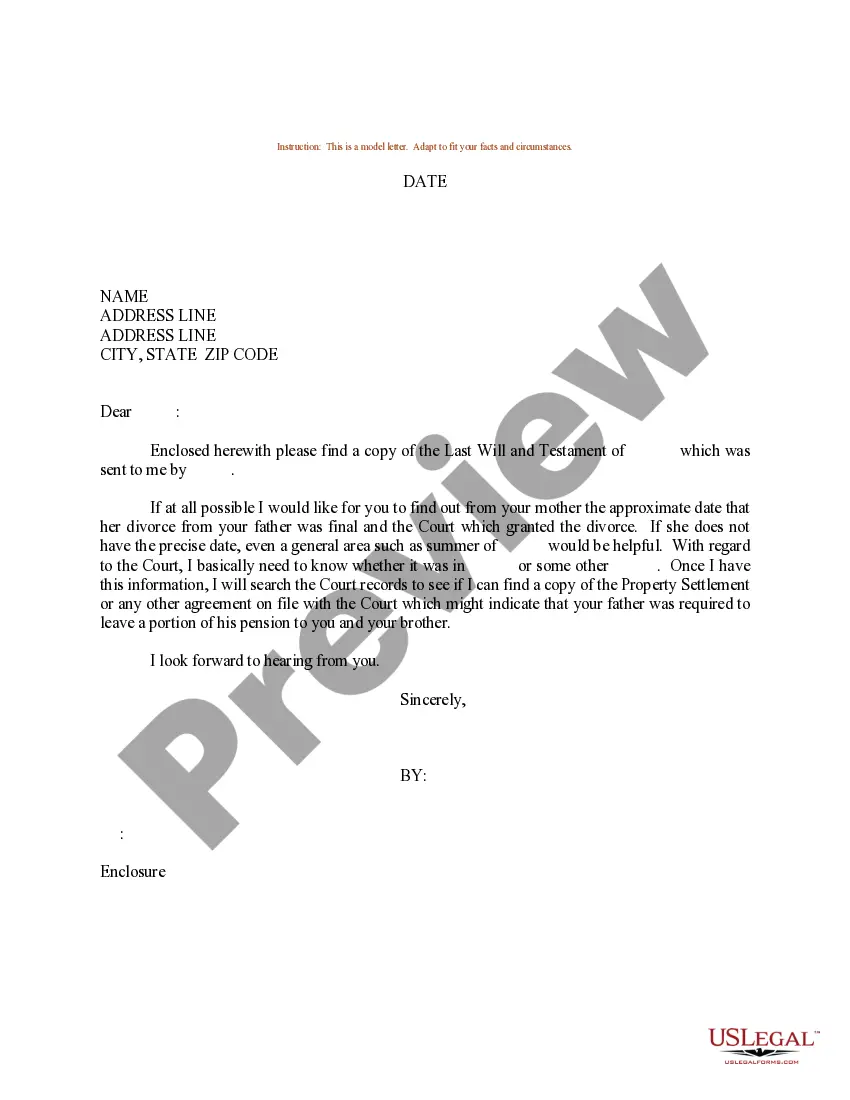
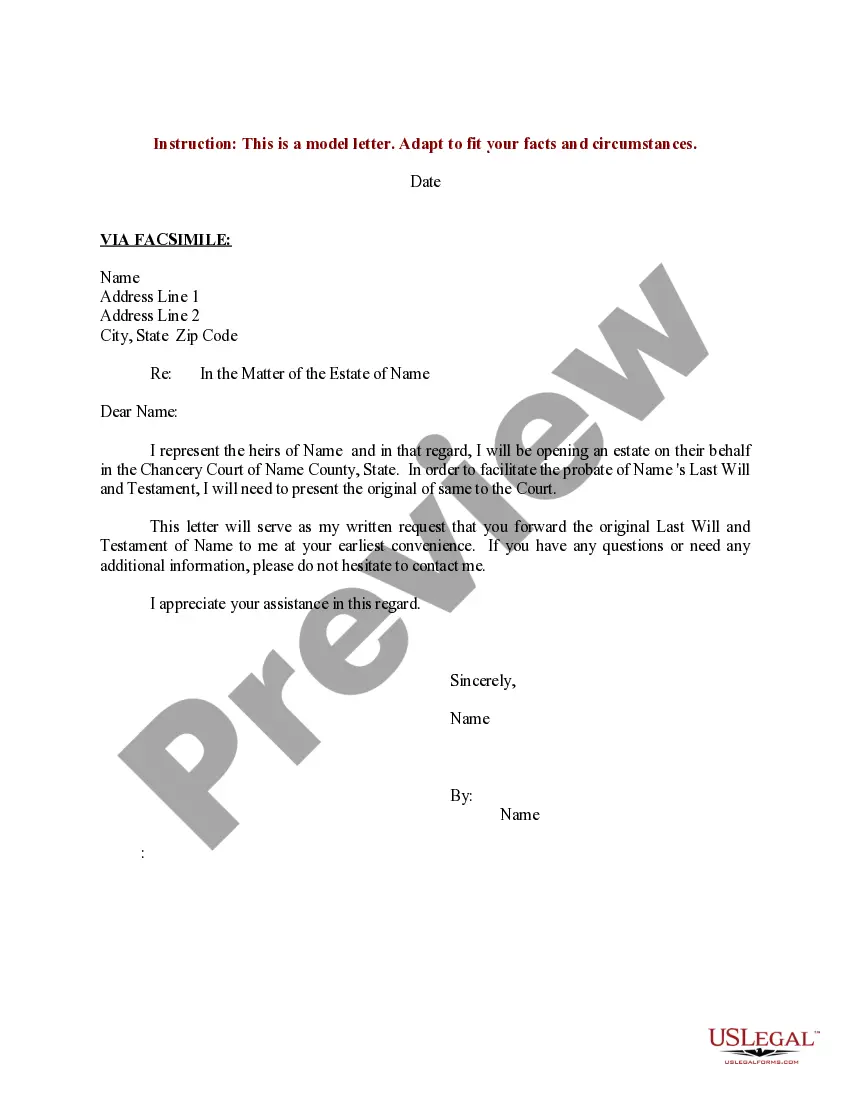
West Virginia Sample Letter transmitting Last Will and Testament of Decedent
Description
Get your form ready online
Our built-in tools help you complete, sign, share, and store your documents in one place.
Make edits, fill in missing information, and update formatting in US Legal Forms—just like you would in MS Word.
Download a copy, print it, send it by email, or mail it via USPS—whatever works best for your next step.
Sign and collect signatures with our SignNow integration. Send to multiple recipients, set reminders, and more. Go Premium to unlock E-Sign.
If this form requires notarization, complete it online through a secure video call—no need to meet a notary in person or wait for an appointment.
We protect your documents and personal data by following strict security and privacy standards.

Make edits, fill in missing information, and update formatting in US Legal Forms—just like you would in MS Word.

Download a copy, print it, send it by email, or mail it via USPS—whatever works best for your next step.

Sign and collect signatures with our SignNow integration. Send to multiple recipients, set reminders, and more. Go Premium to unlock E-Sign.

If this form requires notarization, complete it online through a secure video call—no need to meet a notary in person or wait for an appointment.

We protect your documents and personal data by following strict security and privacy standards.
Looking for another form?








How to fill out Sample Letter Transmitting Last Will And Testament Of Decedent?
Locating the appropriate legal document template can be a challenge. Obviously, there are numerous templates available online, but how do you find the legal form you require? Utilize the US Legal Forms website. This service offers thousands of templates, including the West Virginia Sample Letter transmitting Last Will and Testament of Decedent, suitable for both business and personal needs. All forms are verified by professionals and comply with state and federal regulations.
If you are currently registered, Log In to your account and click on the Obtain button to access the West Virginia Sample Letter transmitting Last Will and Testament of Decedent. Use your account to search through the legal forms you have previously purchased. Visit the My documents section of your account to retrieve an additional copy of the documents you need.
If you are a new user of US Legal Forms, here are straightforward instructions you can follow: First, ensure you have selected the correct form for your locality. You can review the form using the Review button and read the form description to confirm it is suitable for you. If the form does not meet your needs, utilize the Search field to find the correct form. Once you are confident that the form is appropriate, click the Acquire now button to obtain the form. Choose the pricing plan you wish and enter the necessary information. Create your account and complete your order using your PayPal account or credit card. Select the file format and download the legal document template to your device. Finally, complete, modify, print, and sign the acquired West Virginia Sample Letter transmitting Last Will and Testament of Decedent.
In conclusion, US Legal Forms is your go-to resource for accessing a diverse array of legal document templates that are reliable and compliant with applicable laws.
- US Legal Forms is the largest collection of legal forms where you can find a wide range of document templates.
- Utilize the service to download properly crafted documents that adhere to state regulations.
- The platform is user-friendly and provides an extensive library for legal needs.
- Templates are regularly updated to ensure compliance with the latest legal standards.
- Customer support is available for any queries related to document selection.
- All documents are designed to meet both business and personal requirements.
Form popularity
FAQ
A West Virginia small estate affidavit, also known as a 'short form settlement', is a form that can be used to hasten the distribution of an estate worth $50,000 or less in the State of West Virginia.
Real property solely in the name of the person who died, personal property owned solely by the decedent, and. personal bank accounts that must be divided or retitled to beneficiaries during the probate process.
Making a Will in West Virginia Decide what property to include in your will. Decide who will inherit your property. Choose an executor to handle your estate. Choose a guardian for your children. Choose someone to manage children's property. Make your will. Sign your will in front of witnesses. Store your will safely.
Additionally, West Virginia does not require probate for estates worth less than $100,000. Real estate assets do not count toward the $100,000 total.
Assets won't need to go through probate if they are listed in a will or living trust. Additionally, West Virginia does not require probate for estates worth less than $100,000. Real estate assets do not count toward the $100,000 total.
It is necessary to probate an estate when the decedent has solely-held assets; that is, assets that do not have a joint or co-owner with rights of survivorship, a beneficiary (on the security or account, not in the will), or pay-on-death designee.
IMPORTANT NOTE: Notarization is NOT required for a valid will in West Virginia. A ?Self-Proof Affidavit,? which is signed by the attesting witnesses, assists with probate and is usually used.
Letters of Administration are given at the time of the appointment that prove authority to handle the affairs of the estate. Appraisement of the Estate & Non-Probate Inventory of the Estate WV Code § 44-1-14: The Appraisement of the Estate forms and instructions are given at the appointment.