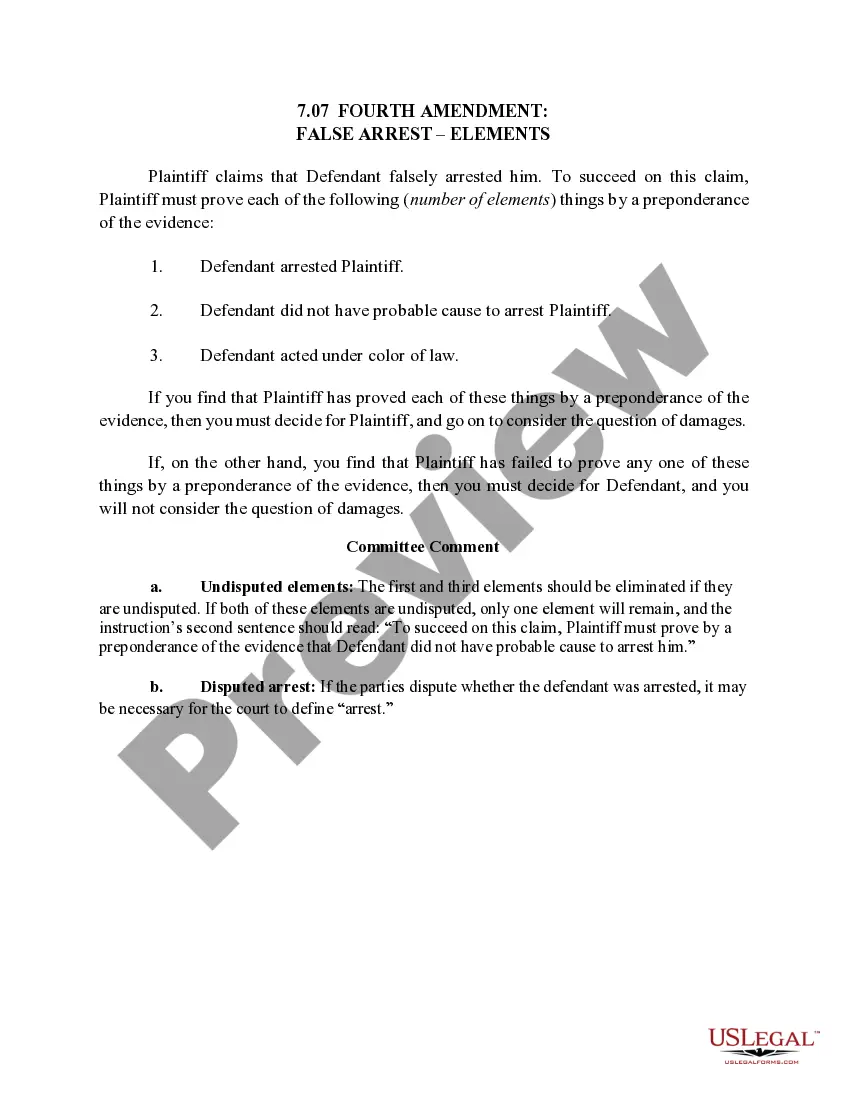
This is a Complaint pleading for use in litigation of the title matter. Adapt this form to comply with your facts and circumstances, and with your specific state law. Not recommended for use by non-attorneys.
West Virginia Complaint For False Arrest and Imprisonment - 4th and 14th Amendment, US Constitution - Jury Trial Demand
Category:
State:
Multi-State
Control #:
US-000280
Format:
Word;
Rich Text
Instant download
Description
Free preview






Get your form ready online
Our built-in tools help you complete, sign, share, and store your documents in one place.
Built-in online Word editor
Make edits, fill in missing information, and update formatting in US Legal Forms—just like you would in MS Word.
Export easily
Download a copy, print it, send it by email, or mail it via USPS—whatever works best for your next step.
E-sign your document
Sign and collect signatures with our SignNow integration. Send to multiple recipients, set reminders, and more. Go Premium to unlock E-Sign.
Notarize online 24/7
If this form requires notarization, complete it online through a secure video call—no need to meet a notary in person or wait for an appointment.
Store your document securely
We protect your documents and personal data by following strict security and privacy standards.

Make edits, fill in missing information, and update formatting in US Legal Forms—just like you would in MS Word.

Download a copy, print it, send it by email, or mail it via USPS—whatever works best for your next step.

Sign and collect signatures with our SignNow integration. Send to multiple recipients, set reminders, and more. Go Premium to unlock E-Sign.

If this form requires notarization, complete it online through a secure video call—no need to meet a notary in person or wait for an appointment.

We protect your documents and personal data by following strict security and privacy standards.
Looking for another form?


How to fill out Complaint For False Arrest And Imprisonment - 4th And 14th Amendment, US Constitution - Jury Trial Demand?
Finding the correct legal document format can be quite challenging. Clearly, there are numerous templates available online, but how will you locate the legal form you require? Utilize the US Legal Forms website. The service offers thousands of templates, including the West Virginia Complaint For False Arrest and Imprisonment - 4th and 14th Amendment, US Constitution - Jury Trial Demand, which you can use for business and personal purposes. All of the forms are reviewed by professionals and comply with state and federal regulations.
If you are already registered, Log In to your account and click on the Obtain button to find the West Virginia Complaint For False Arrest and Imprisonment - 4th and 14th Amendment, US Constitution - Jury Trial Demand. Use your account to search through the legal forms you have purchased previously. Visit the My documents tab of your account and obtain an additional copy of the document you need.
If you are a new user of US Legal Forms, here are simple instructions that you can follow: First, ensure you have selected the correct form for your city/region. You can preview the form using the Preview option and review the form outline to ensure it is suitable for you. If the form does not meet your needs, use the Search field to find the appropriate form. Once you are confident the form is acceptable, click the Purchase now option to acquire the form. Choose the pricing plan you need and enter the required information. Create your account and complete your order using your PayPal account or credit card. Select the file format and download the legal document format to your system. Complete, modify, print, and sign the received West Virginia Complaint For False Arrest and Imprisonment - 4th and 14th Amendment, US Constitution - Jury Trial Demand. US Legal Forms is the largest collection of legal forms where you can find a variety of document templates. Utilize the service to obtain professionally crafted documents that adhere to state requirements.
Form popularity
FAQ
Entrapment law in West Virginia states that a person may not be convicted if they were induced to commit a crime by law enforcement agents. The defense argues that the individual would not have committed the crime without this persuasion. This principle is vital in cases of false arrest and imprisonment. If you are considering a West Virginia Complaint For False Arrest and Imprisonment - 4th and 14th Amendment, US Constitution - Jury Trial Demand, consulting the US Legal Forms platform can guide you through the legal landscape.
The four elements of false imprisonment include the intention to confine, actual confinement, awareness of the confinement, and lack of lawful justification. Each element must be proven for a successful claim. Understanding these elements is essential when filing a West Virginia Complaint For False Arrest and Imprisonment - 4th and 14th Amendment, US Constitution - Jury Trial Demand. The US Legal Forms platform offers resources to help you navigate this process effectively.
A common defense to false imprisonment is the consent of the individual. If a person voluntarily agrees to the confinement, it may not be considered false imprisonment. Additionally, law enforcement officers may claim they acted within their legal authority when making an arrest. In cases involving a West Virginia Complaint For False Arrest and Imprisonment - 4th and 14th Amendment, US Constitution - Jury Trial Demand, understanding these defenses is crucial.
The right to a jury trial is an essential pillar of criminal law in the United States. The Sixth Amendment guarantees that those accused of a crime be tried by a local, impartial jury.
Governmental actors violate due process when they frustrate the fairness of proceedings, such as when a prosecutor fails to disclose evidence to a criminal defendant that suggests they may be innocent of the crime, or when a judge is biased against a criminal defendant or a party in a civil action.
The Trial of all Crimes, except in Cases of Impeachment, shall be by Jury; and such Trial shall be held in the State where the said Crimes shall have been committed; but when not committed within any State, the Trial shall be at such Place or Places as the Congress may by Law have directed. U.S. Const. amend.
Amendment Seven to the Constitution was ratified on December 15, 1791. It protects the right for citizens to have a jury trial in federal courts with civil cases where the claim exceeds a certain dollar value. It also prohibits judges in these trials from overruling facts revealed by the jury.
In all criminal prosecutions, the accused shall enjoy the right to a speedy and public trial, by an impartial jury of the State and district wherein the crime shall have been committed, which district shall have been previously ascertained by law, and to be informed of the nature and cause of the accusation; to be ...
Louisiana, 391 U.S. 145, 149 (1968) (noting the Article III provision but grounding the analysis of whether the jury trial right applies in state court in the Sixth and Fourteenth Amendments; we hold that the Fourteenth Amendment guarantees a right of jury trial in all criminal cases which?were they to be tried in a ...
14th Amendment - Citizenship Rights, Equal Protection, Apportionment, Civil War Debt.