West Virginia Summons
Overview of this form
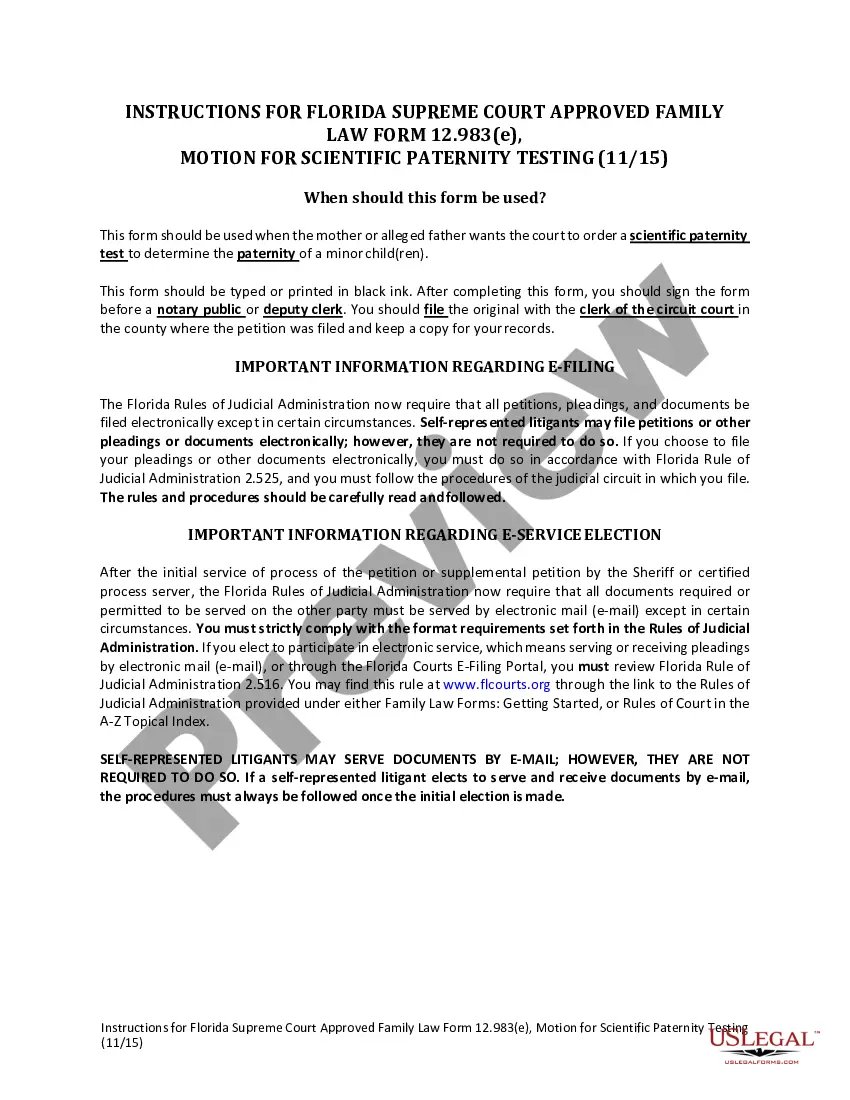
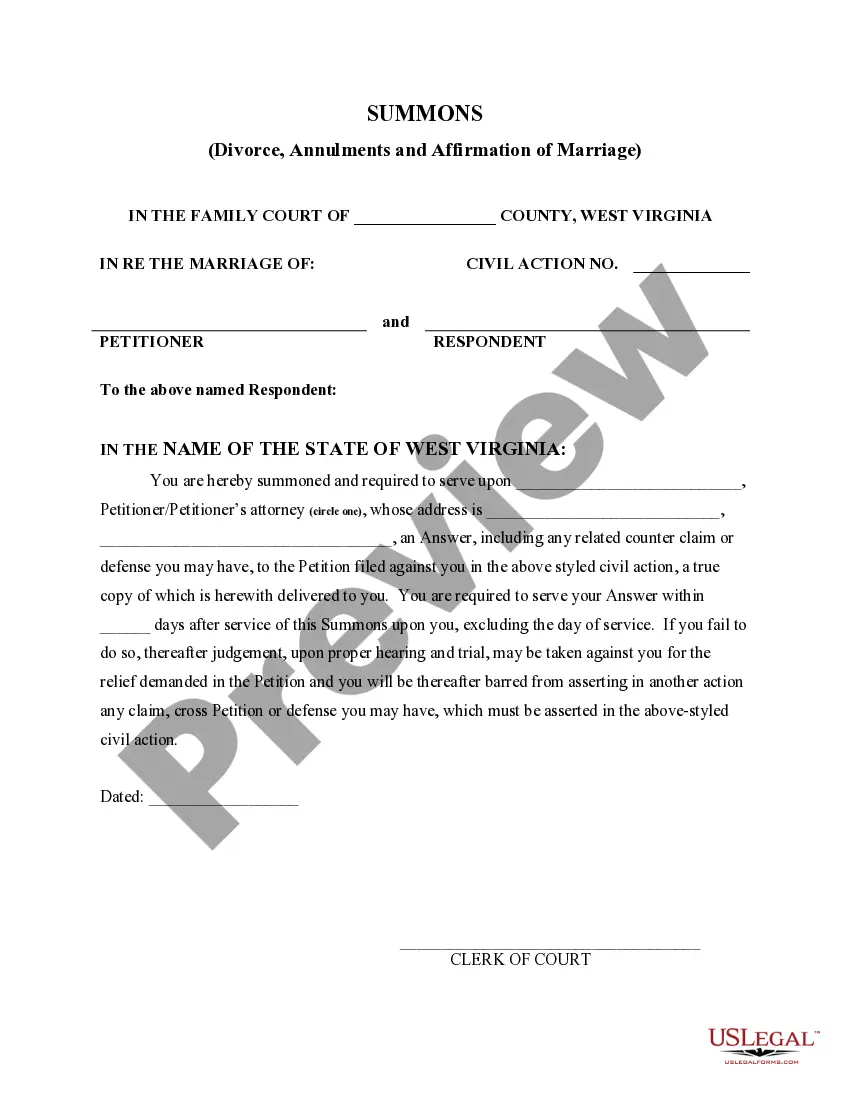
A Summons is a legal document that informs the Respondent that a Petition for Divorce has been filed against them. Its primary purpose is to ensure that the Respondent is aware of the proceedings and to compel them to respond. This form differs from other legal documents, such as a Petition or Complaint, as it focuses specifically on notifying the Respondent of the divorce action and their obligation to respond within a certain timeframe.
What’s included in this form
- Heading stating the Respondent's name and the jurisdiction.
- Instructions to the Respondent to serve an Answer to the Petition.
- Address and name of the Petitioner or their attorney.
- The timeframe within which the Respondent must file their Answer.
- Consequences of failing to respond to the Summons.
- Signature block for the Clerk of Court.
Common use cases
This Summons should be used when a Petition for Divorce has been filed in a court. It serves as the formal notification to the Respondent, indicating they are being sued for divorce. Use this form to initiate the divorce process and ensure the Respondent is aware of the necessity to respond, thereby allowing the legal process to move forward.
Who this form is for
- Individuals filing for divorce who need to notify their spouse.
- Legal representatives acting on behalf of a Petitioner in divorce cases.
- Any party involved in a divorce proceeding as the Petitioner who requires formal acknowledgment of their Petition by the Respondent.
Completing this form step by step
- Enter the name of the Respondent at the top of the Summons.
- Fill in the name and address of the Petitioner or their attorney.
- Specify the number of days the Respondent has to file their Answer.
- Ensure the Clerk of Court's signature is included to validate the Summons.
- File the completed Summons with the Clerk of Court and serve it to the Respondent.
Does this form need to be notarized?
This form does not typically require notarization unless specified by local law. Ensure that local regulations are checked prior to proceeding with filing.
Get your form ready online
Our built-in tools help you complete, sign, share, and store your documents in one place.
Make edits, fill in missing information, and update formatting in US Legal Forms—just like you would in MS Word.
Download a copy, print it, send it by email, or mail it via USPS—whatever works best for your next step.
Sign and collect signatures with our SignNow integration. Send to multiple recipients, set reminders, and more. Go Premium to unlock E-Sign.
If this form requires notarization, complete it online through a secure video call—no need to meet a notary in person or wait for an appointment.
We protect your documents and personal data by following strict security and privacy standards.

Make edits, fill in missing information, and update formatting in US Legal Forms—just like you would in MS Word.

Download a copy, print it, send it by email, or mail it via USPS—whatever works best for your next step.

Sign and collect signatures with our SignNow integration. Send to multiple recipients, set reminders, and more. Go Premium to unlock E-Sign.

If this form requires notarization, complete it online through a secure video call—no need to meet a notary in person or wait for an appointment.

We protect your documents and personal data by following strict security and privacy standards.
Common mistakes
- Failing to fill in the Respondent's name correctly.
- Not specifying the correct timeframe to respond.
- Omitting the correct address for the Petitioner or their attorney.
- Not obtaining the necessary signature from the Clerk of Court.
- Serving the Summons improperly, which may delay proceedings.
Benefits of completing this form online
- Convenient access to legal forms from anywhere.
- Editable templates ensure accuracy and personalization.
- Guidance provided by licensed attorneys ensures compliance with legal standards.
- Time-saving as the form can be downloaded and completed at your pace.
Looking for another form?
Form popularity
FAQ
According to the LinkedIn conversation, most process servers rarely or never actually say the words, 'you've been served,' but depending on the state in which they serve and the reaction of the defendant that opinion can change. Keep reading for more from your peers on this topic.
Search online to find someone to serve the summons. Put the words process server and the name of the state or country where the defendant lives. Ask your local sheriff's office to help.
Don't ignore it. If you do this, the court will simply rule in the issuer or debt collector's favor. Try to work things out. Answer the summons. Consult an attorney. Go to court. Respond to the ruling.
Read the summons and make sure you know the date you must answer by. Read the complaint carefully. Write your answer. Sign and date the answer. Make copies for the plaintiff and yourself. Mail a copy to the plaintiff. File your answer with the court by the date on the summons.
A summons may be served on a person outside this state in any manner provided in this article or by sending a copy of the summons and complaint to the person to be served by first class mail, postage prepaid, requiring a return receipt.
Current filing fees are: In district court, the fee for defendant's first filing is typically $223.00, but that might vary depending on the type of case. To verify your filing fee, click to visit Filing Fees and Waivers. In justice court, the fee for defendant's first filing is typically $71.
Tell the server to: Give the papers to a responsible adult where the Defendant lives, or to someone in charge where the Defendant works. Say, These are court papers. Then, mail (first-class) a copy of the papers to the Defendant at the same address where s/he left the papers.
Talking to their family members and friends. contacting former employers. contacting sport or hobby groups. searching Canada 411.