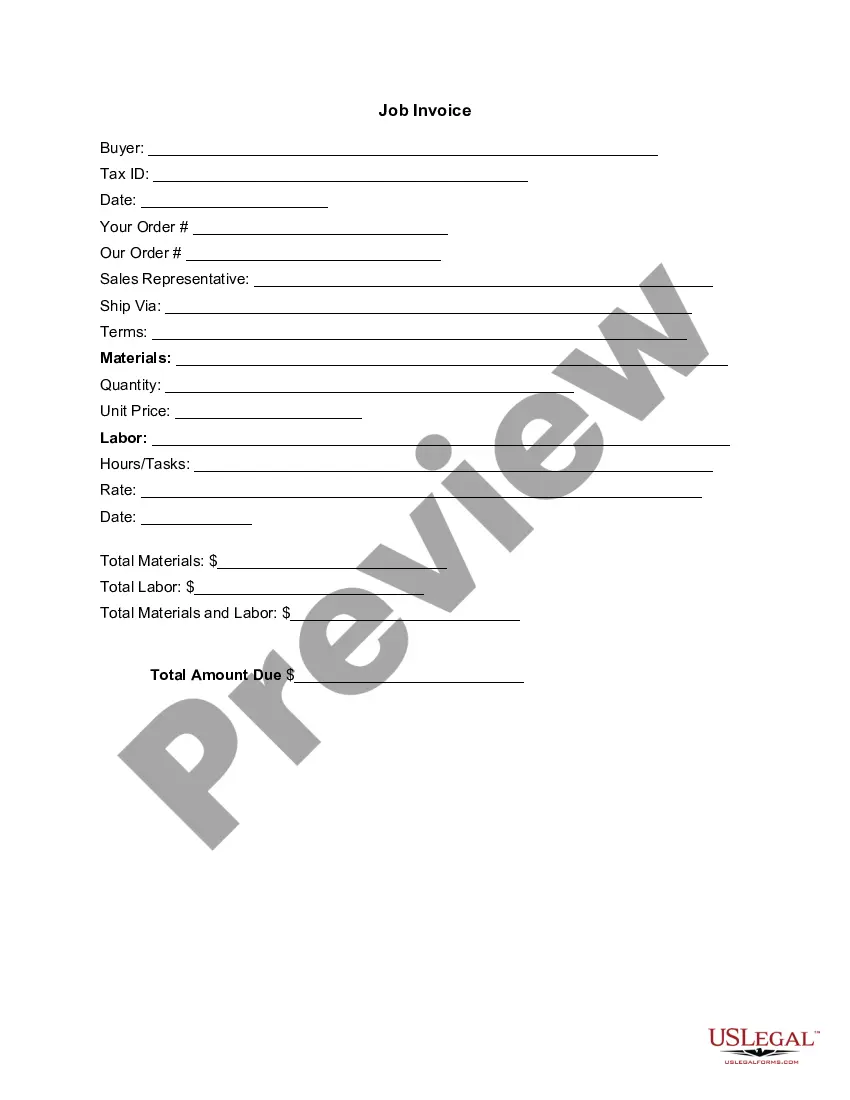
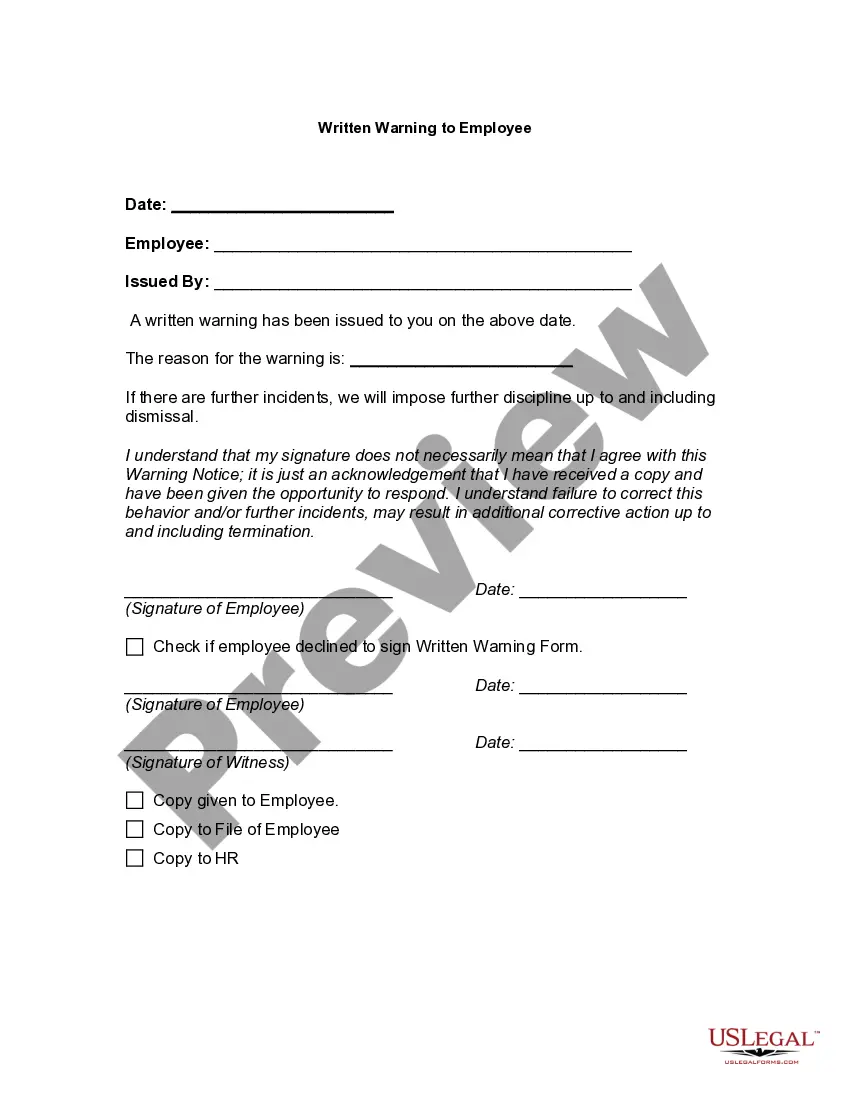
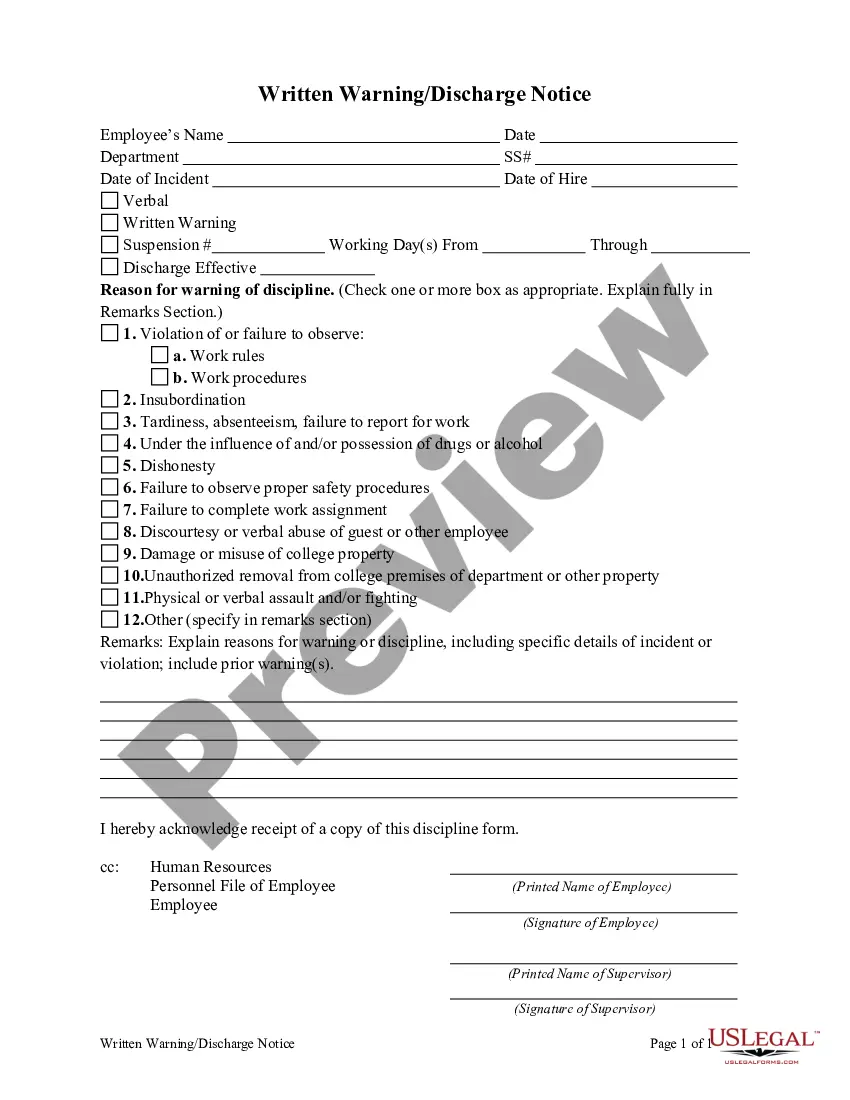
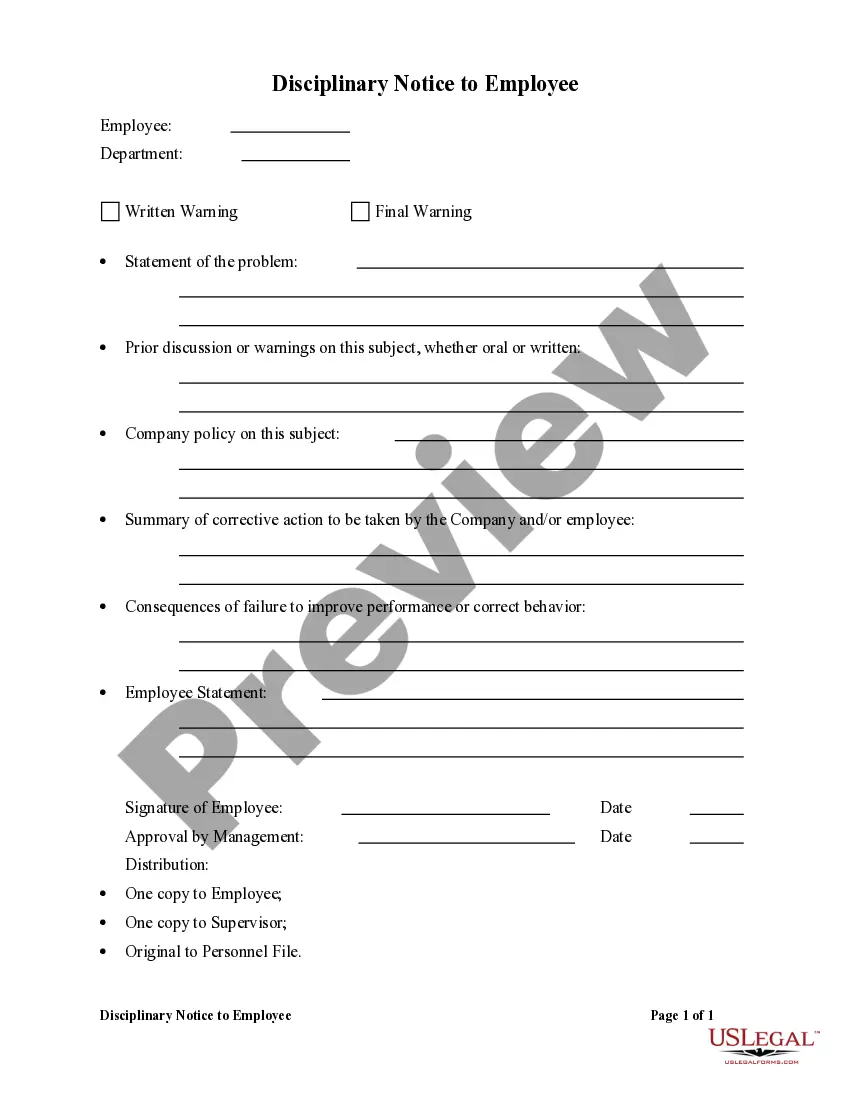
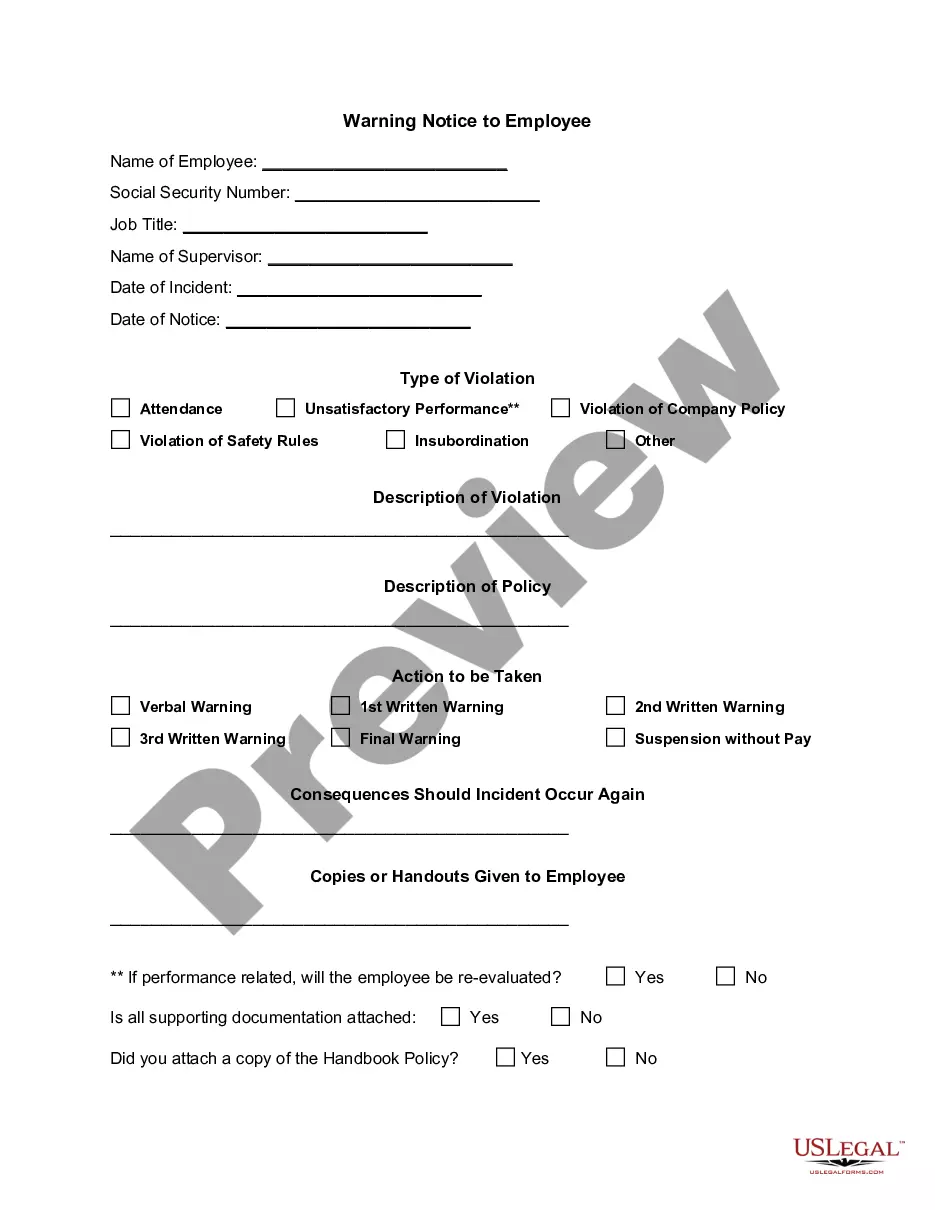
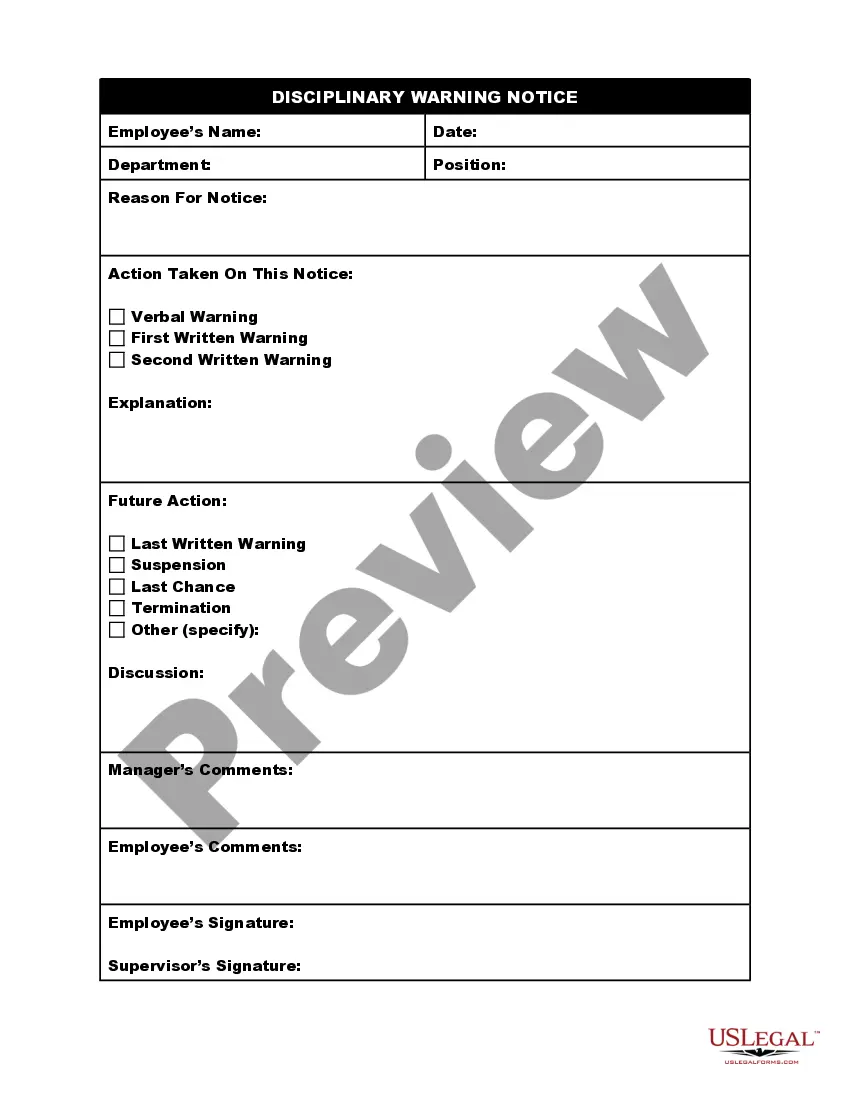
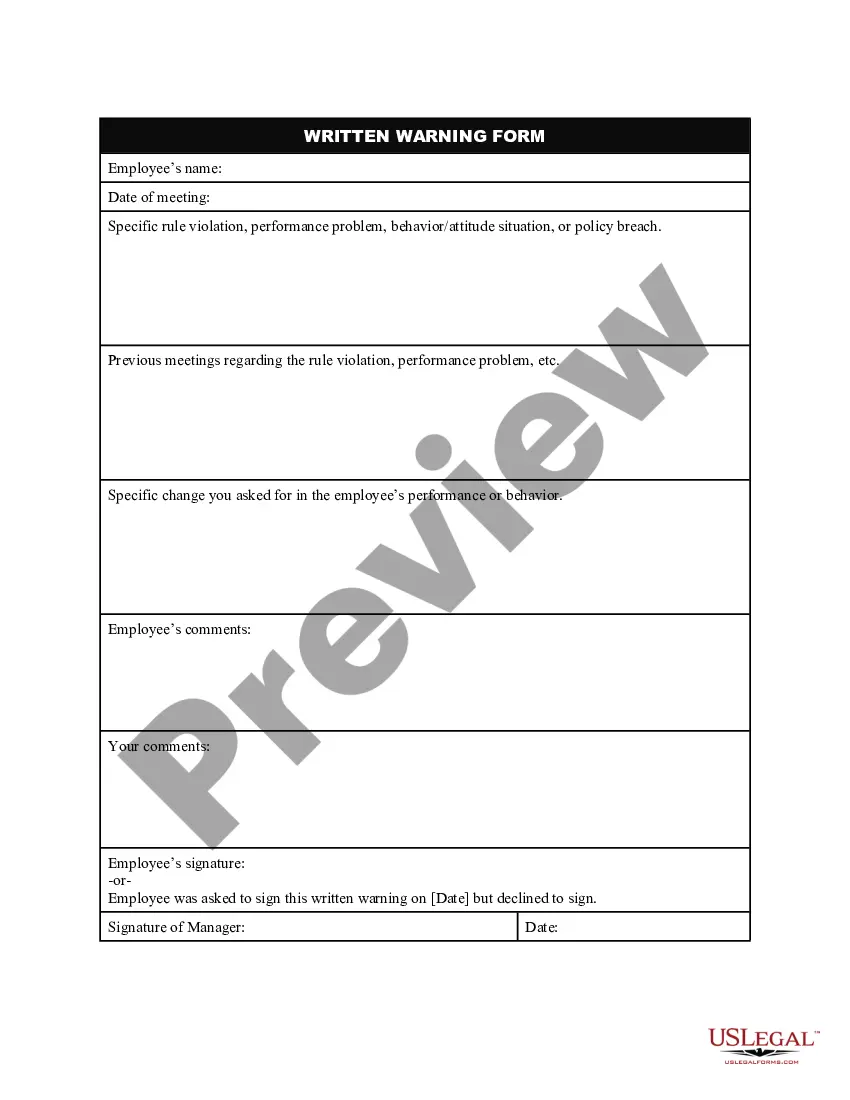
Wisconsin Written Warning to Employee
Description
Get your form ready online
Our built-in tools help you complete, sign, share, and store your documents in one place.
Make edits, fill in missing information, and update formatting in US Legal Forms—just like you would in MS Word.
Download a copy, print it, send it by email, or mail it via USPS—whatever works best for your next step.
Sign and collect signatures with our SignNow integration. Send to multiple recipients, set reminders, and more. Go Premium to unlock E-Sign.
If this form requires notarization, complete it online through a secure video call—no need to meet a notary in person or wait for an appointment.
We protect your documents and personal data by following strict security and privacy standards.

Make edits, fill in missing information, and update formatting in US Legal Forms—just like you would in MS Word.

Download a copy, print it, send it by email, or mail it via USPS—whatever works best for your next step.

Sign and collect signatures with our SignNow integration. Send to multiple recipients, set reminders, and more. Go Premium to unlock E-Sign.

If this form requires notarization, complete it online through a secure video call—no need to meet a notary in person or wait for an appointment.

We protect your documents and personal data by following strict security and privacy standards.
Looking for another form?
How to fill out Written Warning To Employee?
Are you in a situation where you require documents for various business or particular reasons almost every time.
There are numerous legal document templates obtainable online, yet finding versions you can trust is not simple.
US Legal Forms offers a wide array of form templates, such as the Wisconsin Written Warning to Employee, which are designed to comply with federal and state regulations.
Utilize US Legal Forms, one of the largest collections of legal forms, to save time and avoid mistakes.
The service provides professionally crafted legal document templates that you can use for a variety of purposes. Create an account on US Legal Forms and start simplifying your life.
- If you are already familiar with the US Legal Forms website and possess an account, simply Log In.
- Afterward, you can download the Wisconsin Written Warning to Employee template.
- If you do not have an account and wish to start using US Legal Forms, follow these steps.
- Choose the form you need and make sure it is for your specific city/region.
- Utilize the Preview button to review the form.
- Read the description to ensure you have selected the correct form.
- If the form is not what you are looking for, use the Search field to find the form that suits your needs and requirements.
- Once you find the correct form, click on Purchase now.
- Select the pricing plan you want, complete the necessary information to create your account, and pay for your order using your PayPal or Visa or Mastercard.
- Choose a convenient file format and download your copy.
- You can find all the document templates you have purchased in the My documents section. You can obtain an additional copy of the Wisconsin Written Warning to Employee at any time, if desired.
- Simply go through the necessary form to obtain or print the document template.
Form popularity
FAQ
In the context of layoffs, 'warn' refers to the advance notice that an employer must provide to employees under certain circumstances. This is tied to the Worker Adjustment and Retraining Notification (WARN) Act in Wisconsin. Providing a Wisconsin Written Warning to Employee ensures that employees understand the situation and can prepare accordingly. Clear communication is essential in maintaining trust during layoffs.
Fair Reasons for Dismissal However, the Fair Work Commission has determined that you should not dismiss any employee without a valid, sound, and defensible reason given the circumstances, and a fair dismissal process, in order to minimise the risks of a subsequent unfair dismissal claim.
At-will employment is an employer-employee agreement in which a worker can be fired or dismissed for any reason, without warning, and without explanation.
It depends. If the parties agreed in the contract that resignation should be made with 60-day prior written notice, or any longer period for that matter, then that stipulation is enforceable by the employer.
It is not illegal for your employer to terminate your employment on the spot, without any notice. Under Wisconsin law, unless an employee is specifically contracted to provide services for a company for an agreed-upon amount of time, an employer does not have to give any notice or reason to terminate an employee.
A termination letter will give the name of the company and your full name and your supervisor will likely use company letterhead with an official signature and title.
Federally, and in most states, a termination letter is not legally required. In some states, currently including Arizona, California, Illinois and New Jersey, written termination notices are required by law. Some of these states have specific templates employers must use for the letter.
A wrongful termination requires that you be fired for an illegal reason. Illegal reasons could include violation of antidiscrimination laws, violation of whistleblower laws, or breach of contract for example.
For example, if your Wisconsin employer fires you for discriminatory reasons, in violation of an employment contract, or in retaliation for exercising your rights, you may have a legal claim for wrongful termination.
Wisconsin is an at-will employment state, which means that an employer can fire an employee unless the reason for the termination is unlawful.