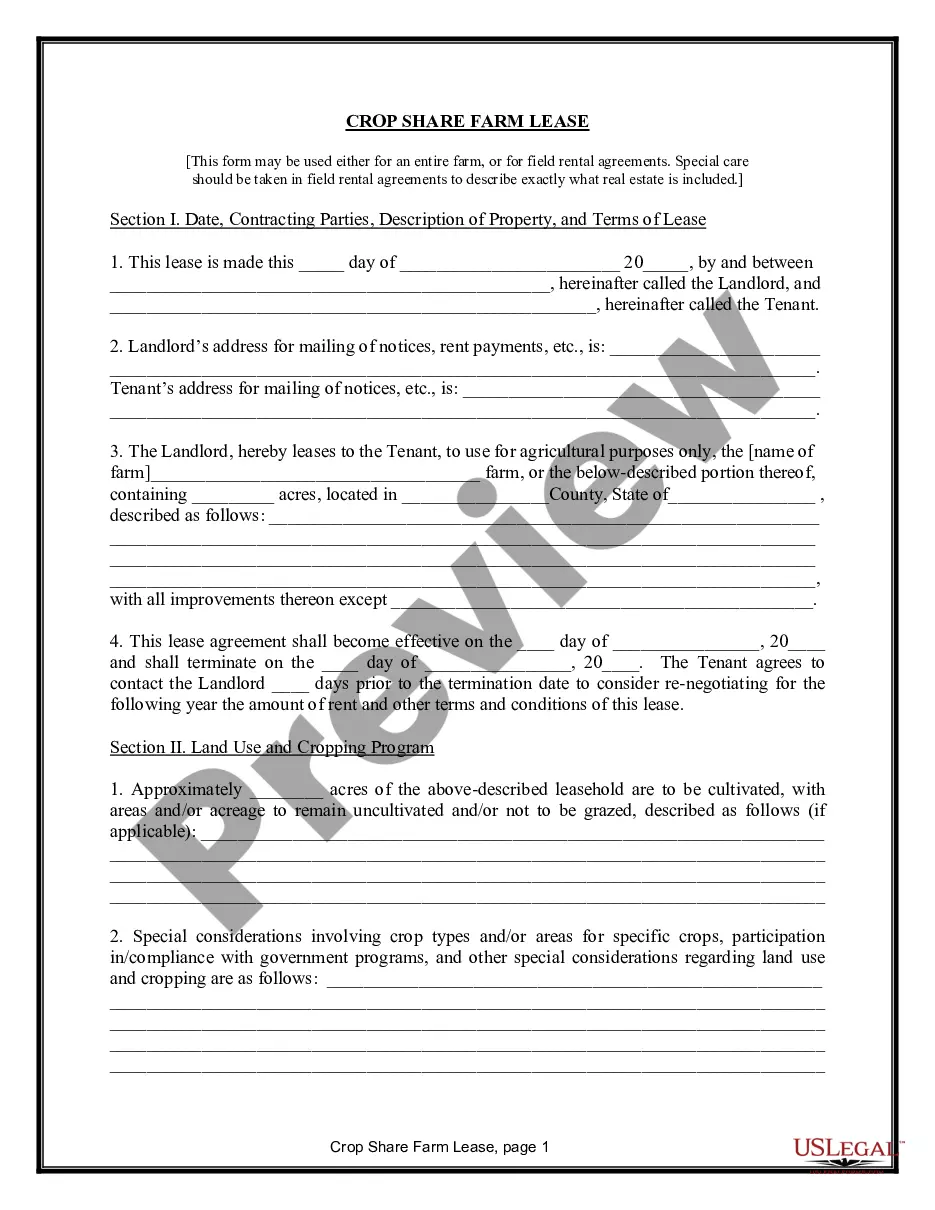
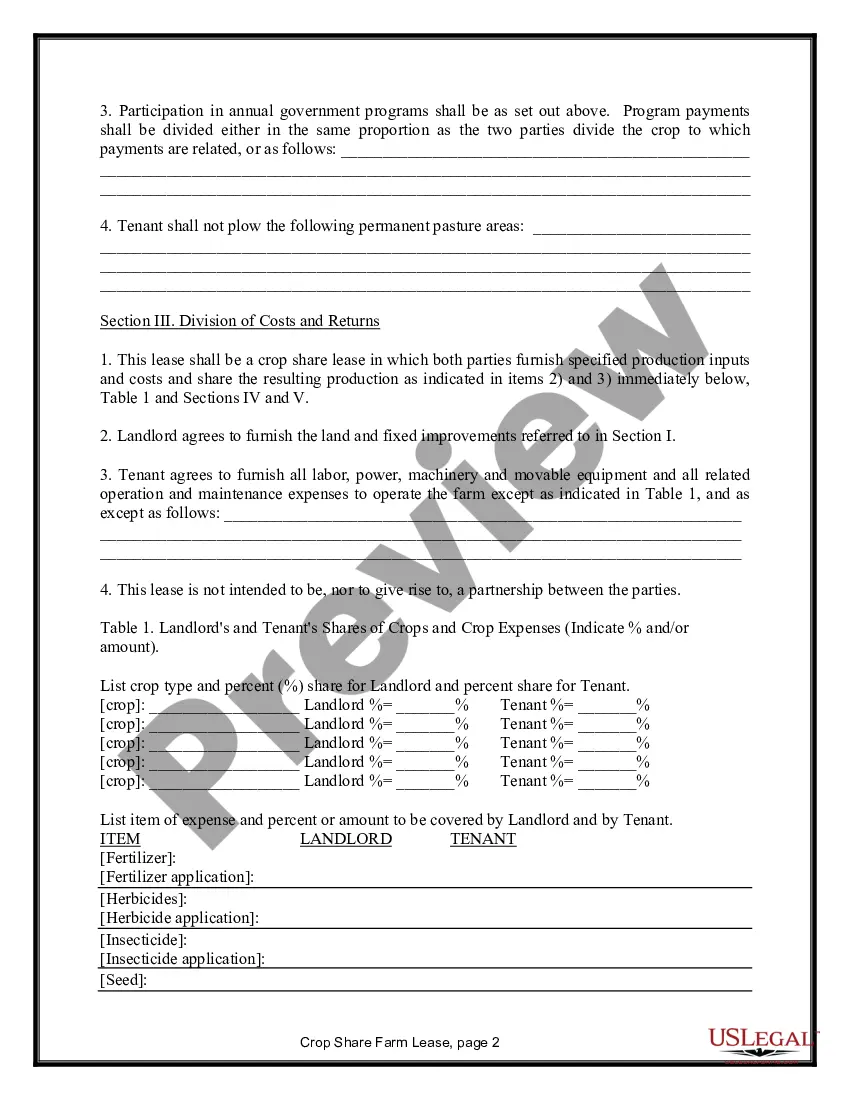
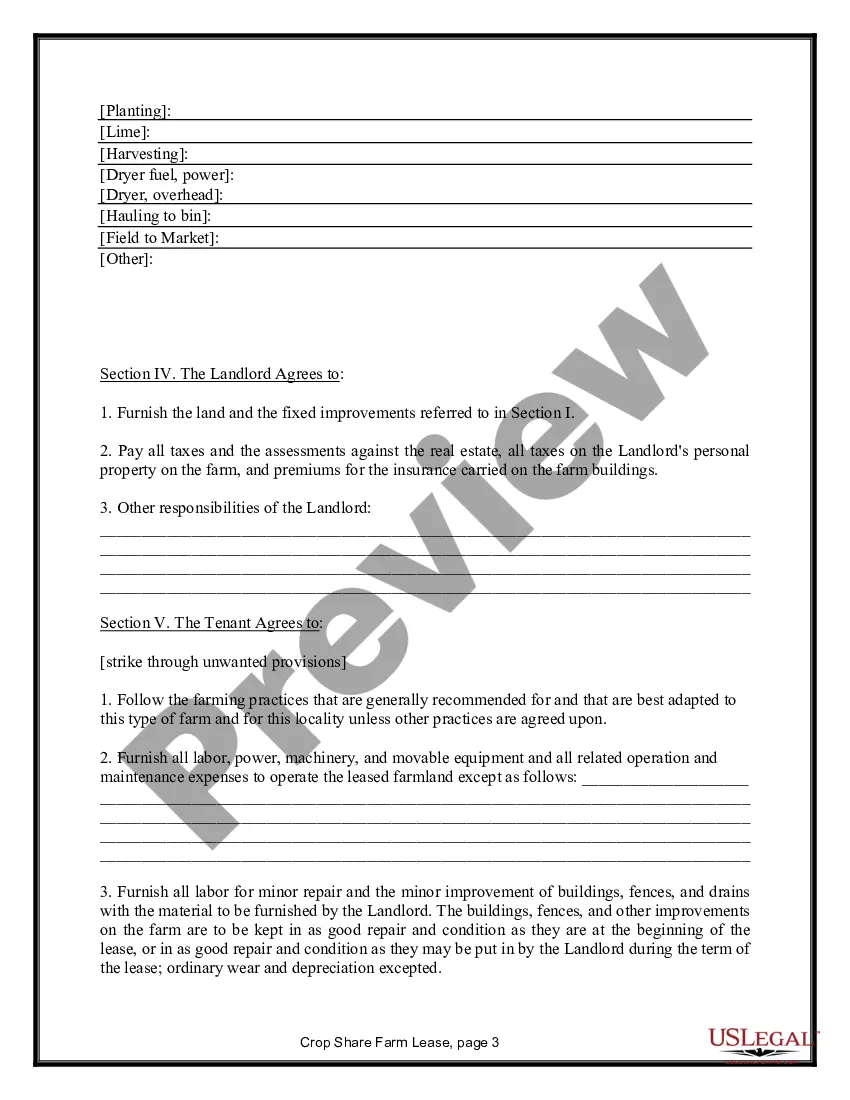
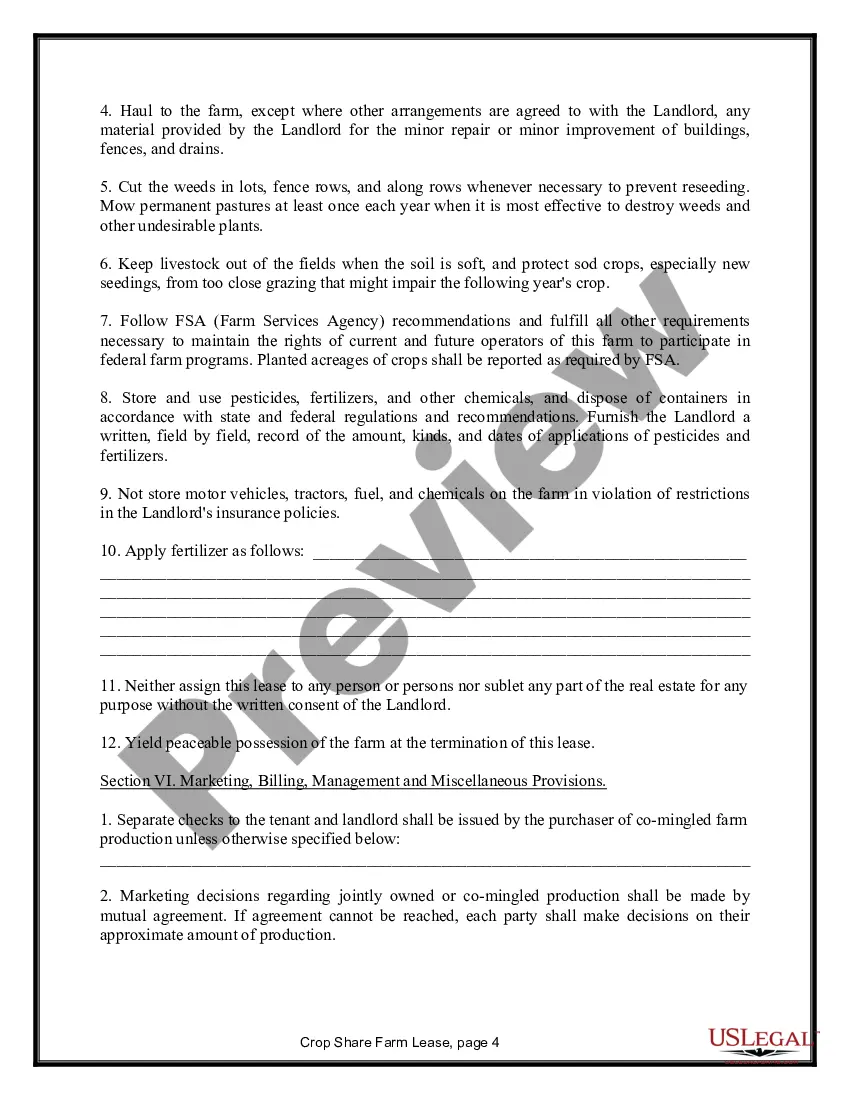
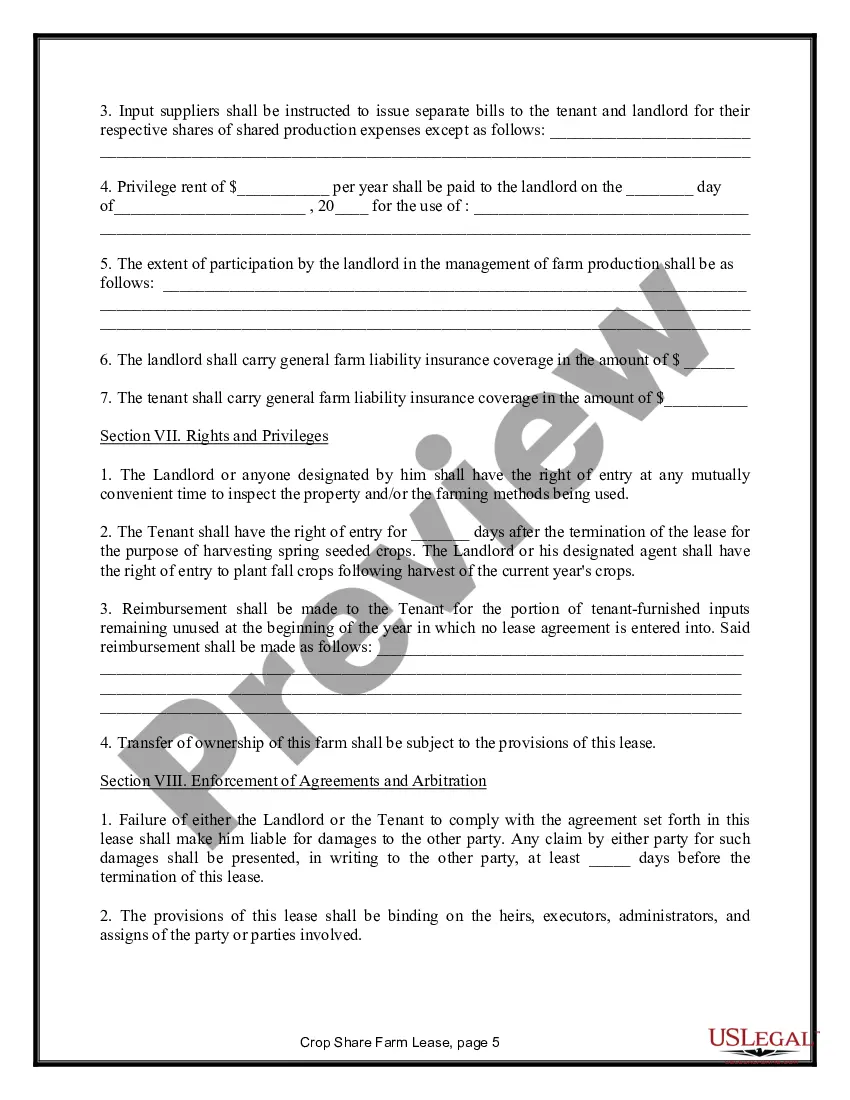
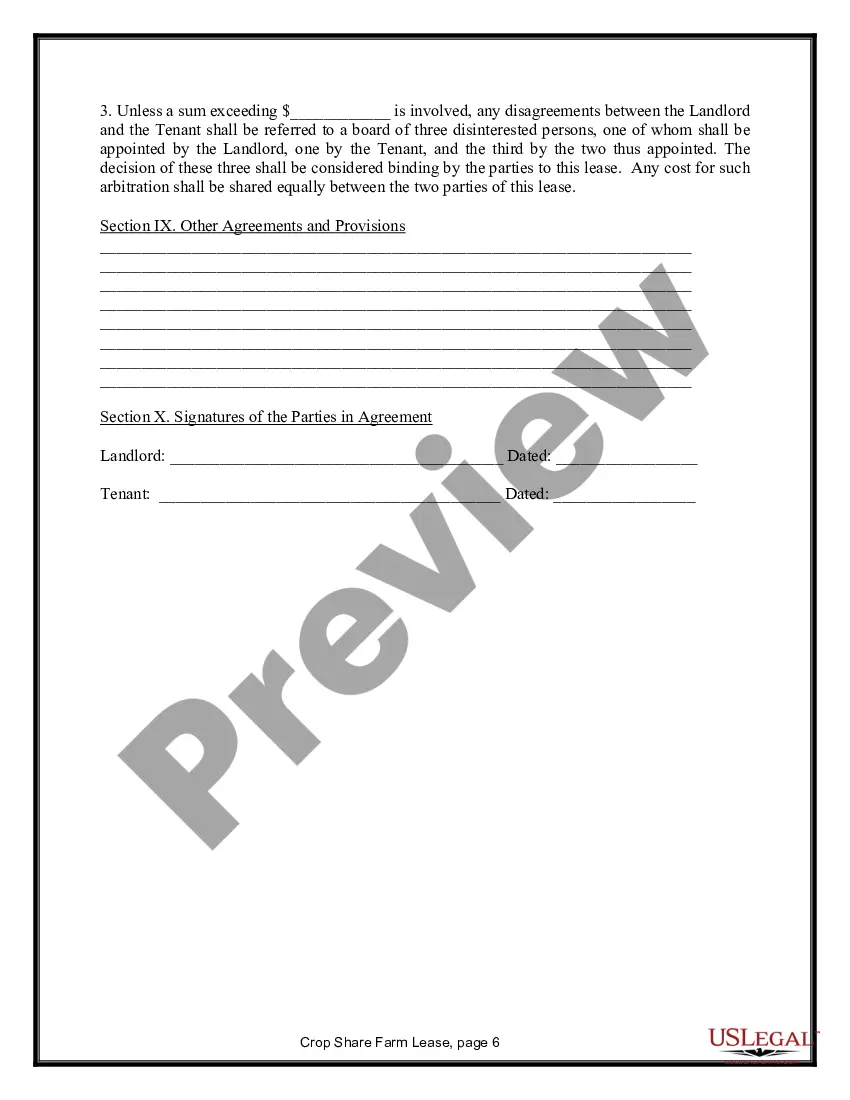
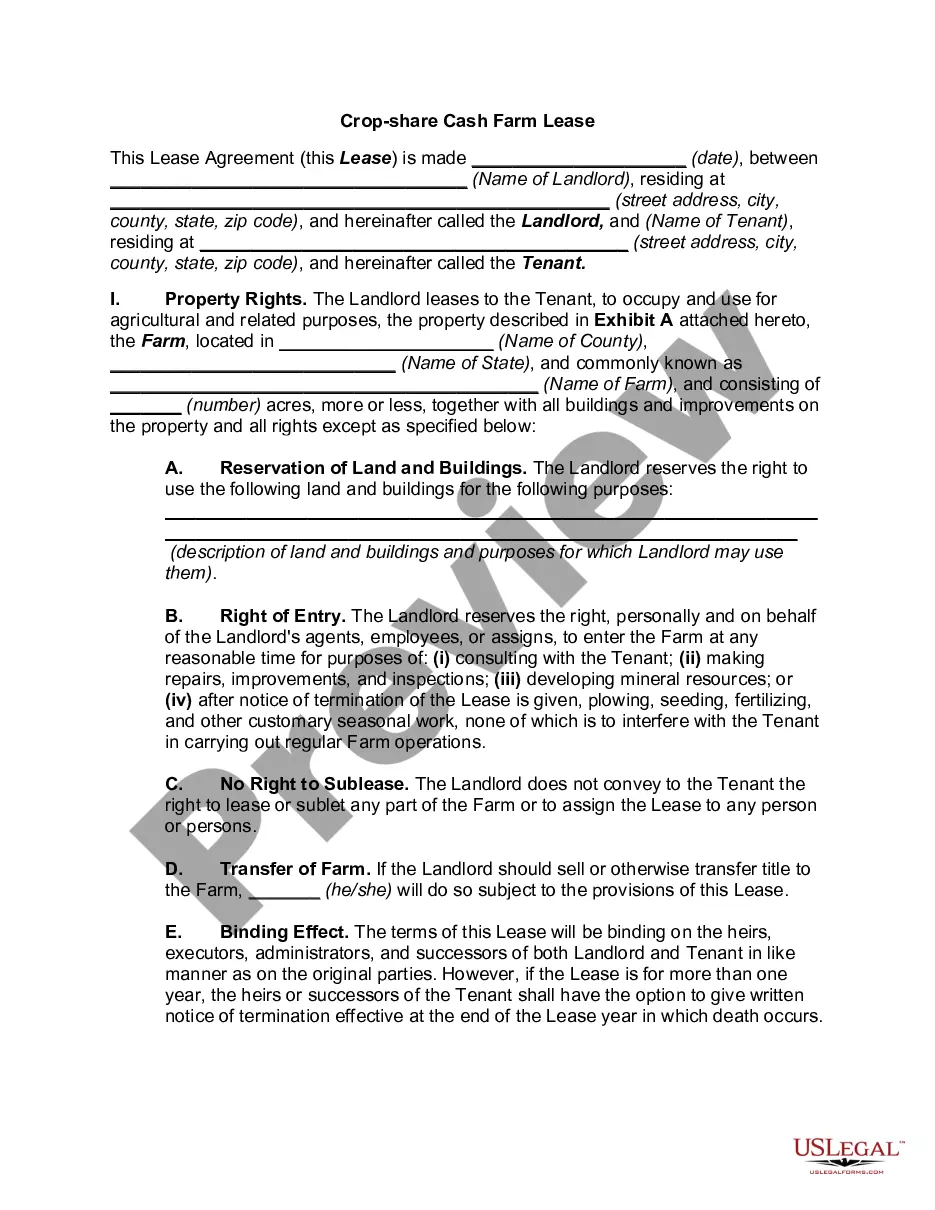
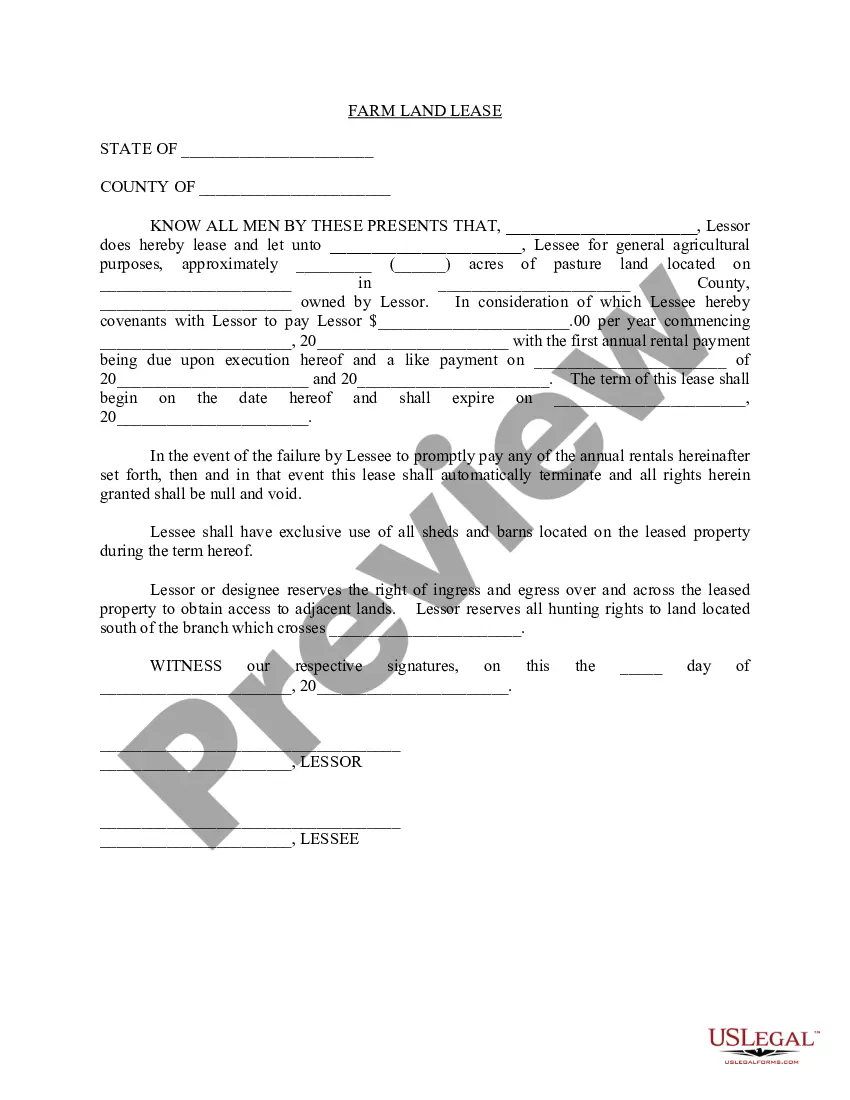
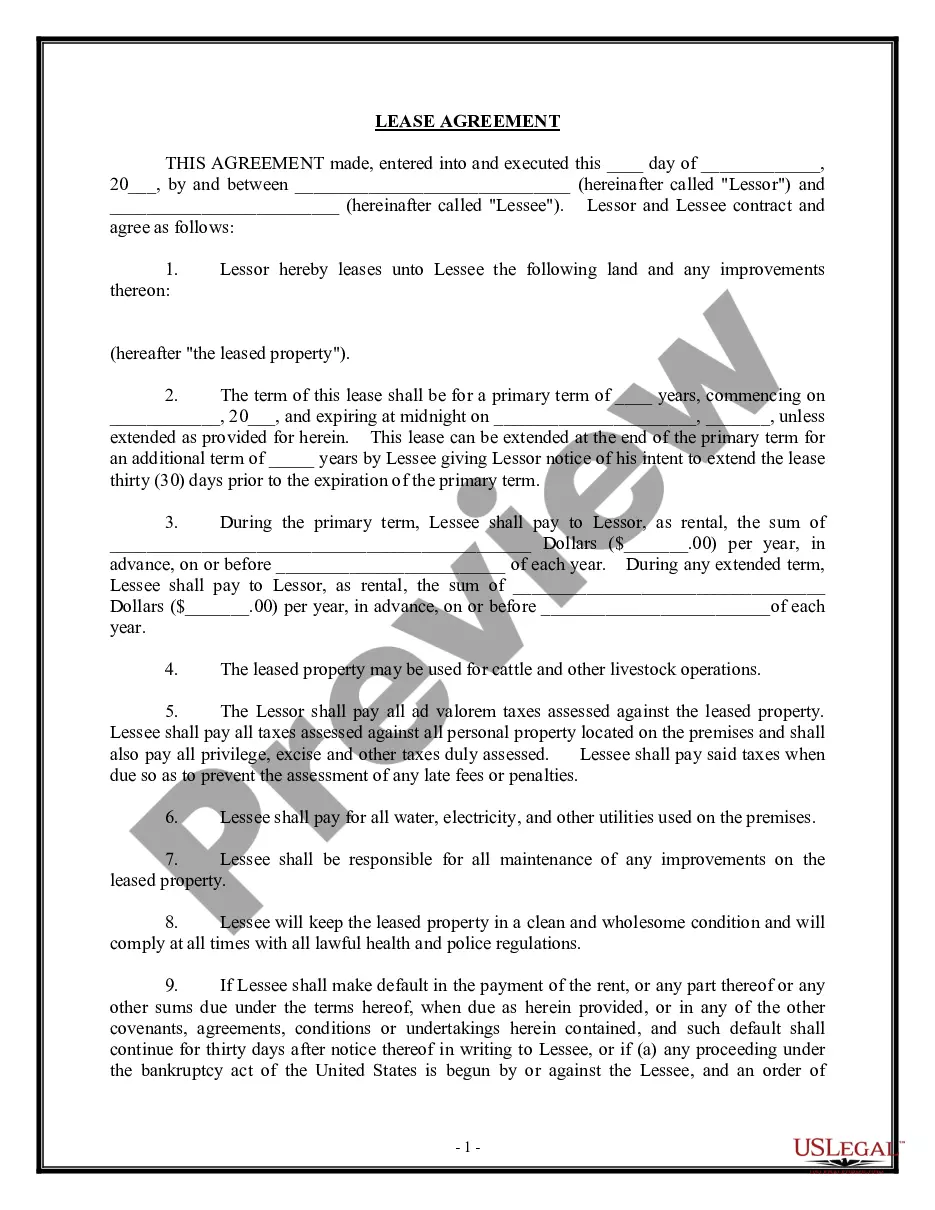
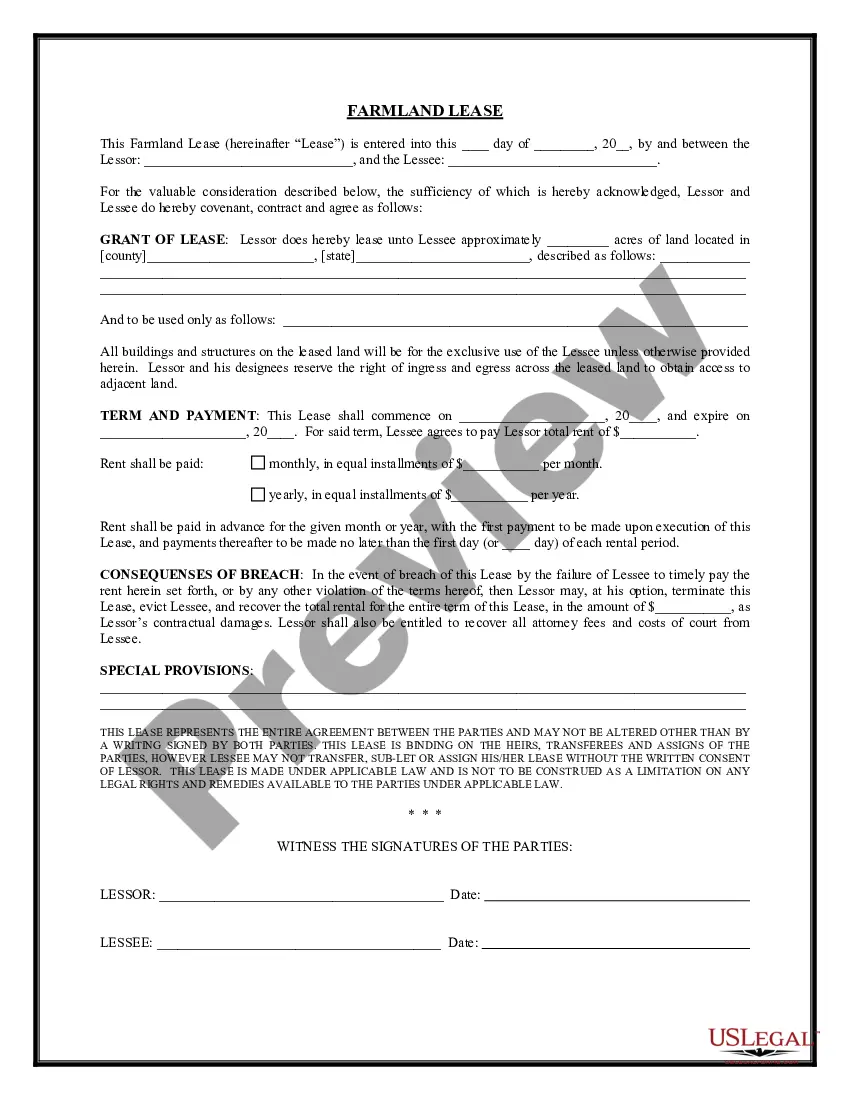
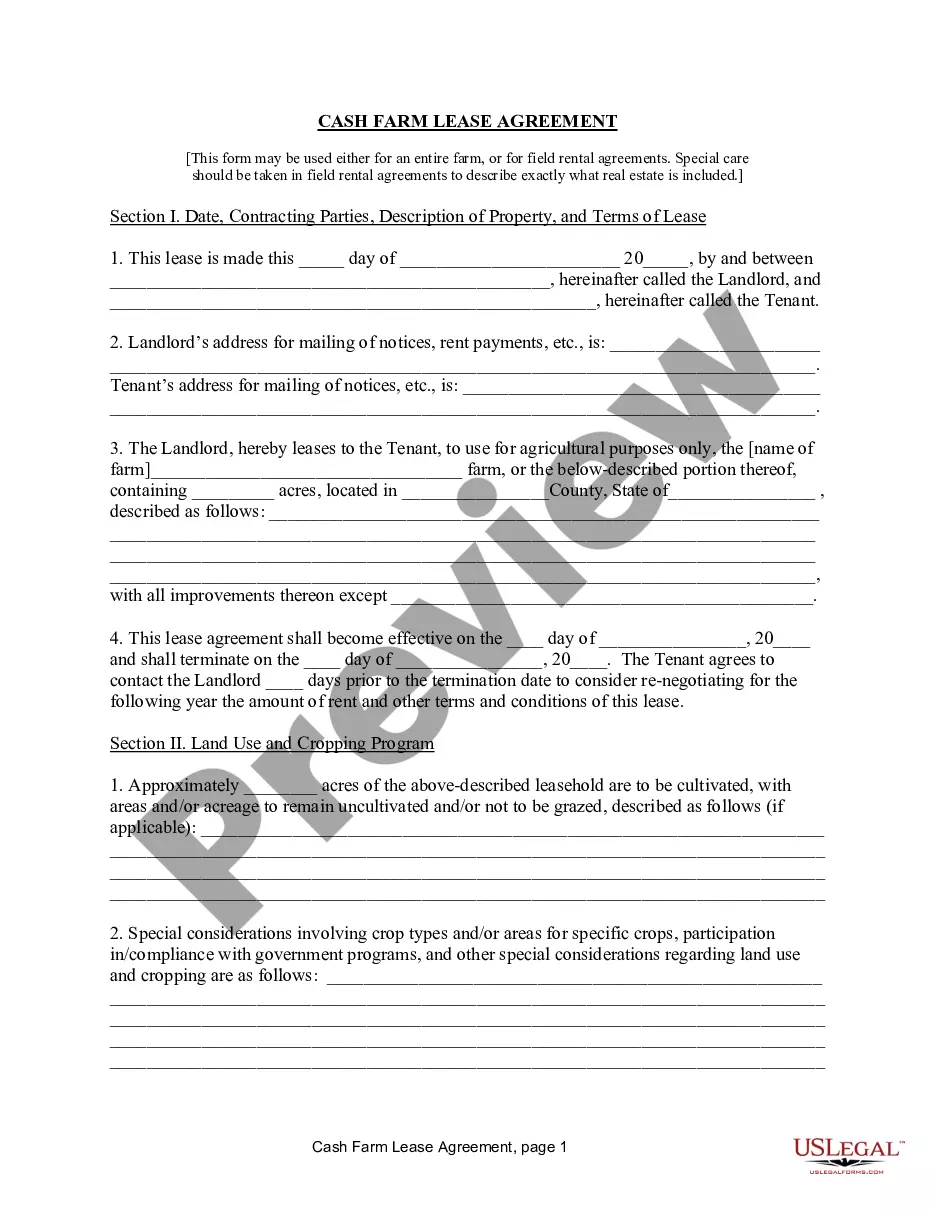
Detailed crop share farmland lease. Costs and crops are shared by landowner and tenant. Provides for detailed division of costs.
Washington Farm Lease or Rental - Crop Share
State:
Multi-State
Category:
Control #:
US-854LT
Format:
Word;
Rich Text
120 downloads
Description
Free preview
Get your form ready online
Our built-in tools help you complete, sign, share, and store your documents in one place.
Built-in online Word editor
Make edits, fill in missing information, and update formatting in US Legal Forms—just like you would in MS Word.
Export easily
Download a copy, print it, send it by email, or mail it via USPS—whatever works best for your next step.
E-sign your document
Sign and collect signatures with our SignNow integration. Send to multiple recipients, set reminders, and more. Go Premium to unlock E-Sign.
Notarize online 24/7
If this form requires notarization, complete it online through a secure video call—no need to meet a notary in person or wait for an appointment.
Store your document securely
We protect your documents and personal data by following strict security and privacy standards.

Make edits, fill in missing information, and update formatting in US Legal Forms—just like you would in MS Word.

Download a copy, print it, send it by email, or mail it via USPS—whatever works best for your next step.

Sign and collect signatures with our SignNow integration. Send to multiple recipients, set reminders, and more. Go Premium to unlock E-Sign.

If this form requires notarization, complete it online through a secure video call—no need to meet a notary in person or wait for an appointment.

We protect your documents and personal data by following strict security and privacy standards.
Looking for another form?
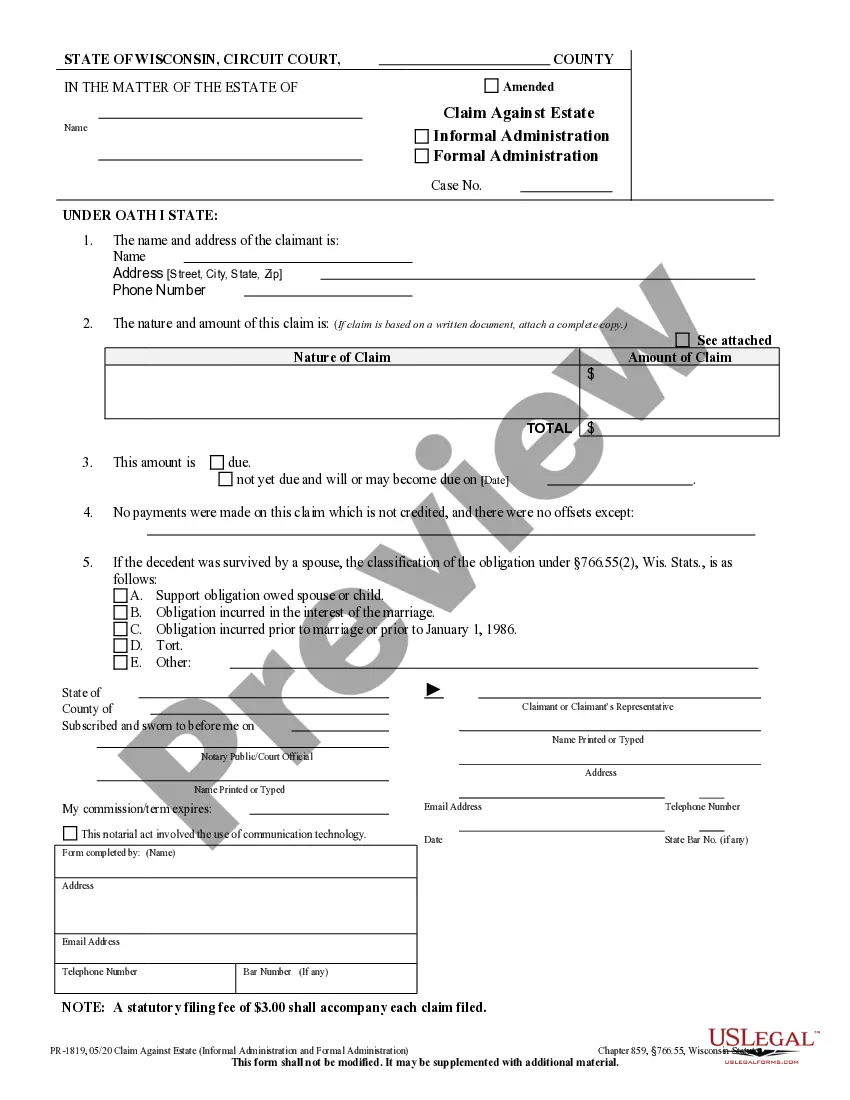
How to fill out Farm Lease Or Rental - Crop Share?
Locating the appropriate legal document template can be challenging.
Certainly, there are numerous templates accessible online, but how can you find the legal document you need.
Utilize the US Legal Forms website. The platform offers a vast array of templates, such as the Washington Farm Lease or Rental - Crop Share, that you can employ for business and personal purposes.
- All the forms are verified by experts and meet federal and state requirements.
- When you are currently registered, Log In to your account and click on the Download button to get the Washington Farm Lease or Rental - Crop Share.
- Use your account to access the legal forms you have purchased previously.
- Visit the My documents section of your account and download another copy of the document you need.
- When you are a new user of US Legal Forms, here are simple steps for you to follow.
- First, ensure you have selected the correct form for your city/region. You can scan the form using the Preview option and review the form details to ensure it is suitable for you.
Form popularity
FAQ
Today, the United States Department of Agriculture (USDA) estimates that at least 30 percent of American farmland is owned by non-operators who lease it out to farmers.
High interest rates, unpredictable harvests, and unscrupulous landlords and merchants often kept tenant farm families severely indebted, requiring the debt to be carried over until the next year or the next.
Some farmers lost their farms or their status as cash or share tenants because of crop failures, low cotton prices, laziness, ill health, poor management, exhaustion of the soil, excessive interest rates, or inability to compete with tenant labor.
Taking into account both part-owner and tenant farmers, a full 40 percent of U.S. farmland today is rented from others. Overall, that accounts for 355 million acres, worth $32 billion in rent annually. However, although more than half of cropland is rented, rental accounts for only 25 percent of pastureland.
Poor living conditions and hygiene for livestock.Excessive use of agro-chemicals.Deforestation and alteration of the natural environment.Risks on human health.Higher risks of cancer and birth defects.The use of chemical hormones in food.Possibility of poor quality food products.More items...
Crop-share arrangements refer to a method of leasing crop land where the production (crop) is shared between the landowner and the operator. Other income items, such as government payments and crop residue, are also often shared as are some of the production expenses.
Approximately 39 percent of the 911 million acres of farmland in the contiguous 48 States was rented. More than half of cropland is rented, compared with just over 25 percent of pastureland.
However some tenant farmers proved successful and ultimately moved off rented lands to purchase their own tracts. Generally, however, this was not the case and the system, along with sharecropping, proved to be a failure. "Tenant Farming ." Gale Encyclopedia of U.S. Economic History. .
The chief disadvantage is that the tenant agrees to pay a definite sum before he knows what his income will be. The crop-sharing lease is usually workable only in strictly cash-crop farming. The tenant gets part of the returns.
The traditional share arrangement for a grain crop like corn or wheat is one-third to the landowner and two-thirds to the tenant. Usually, the expenses paid, and crop received, are equal to the share i.e. the landowner would pay one-third of the expenses and receive one-third of the crop.