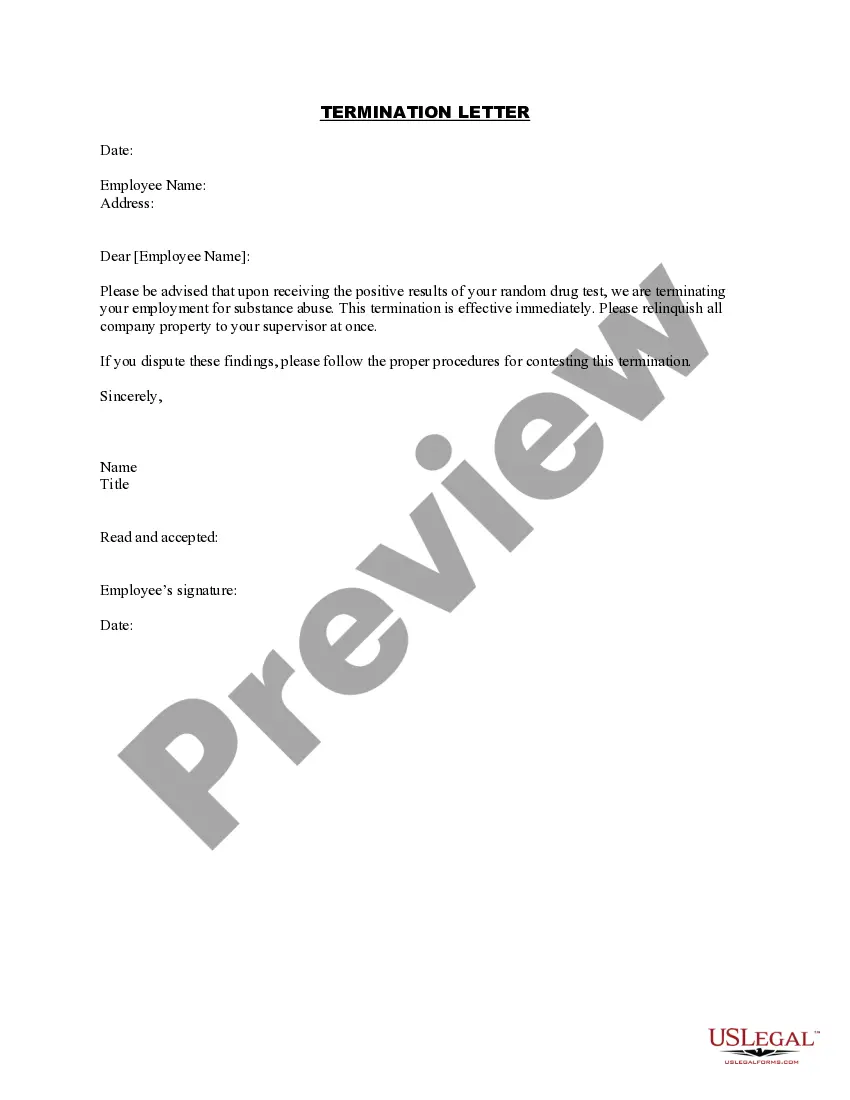
Washington Termination Letter - Substance Abuse
Description
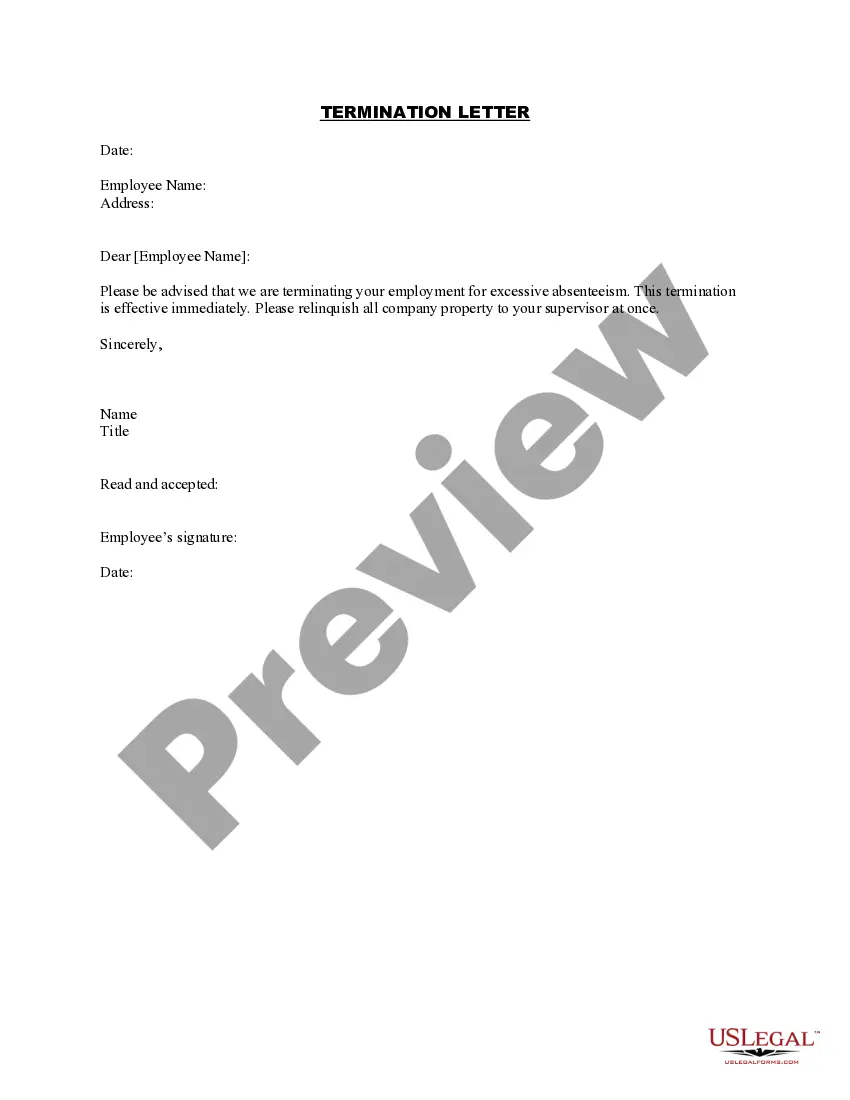
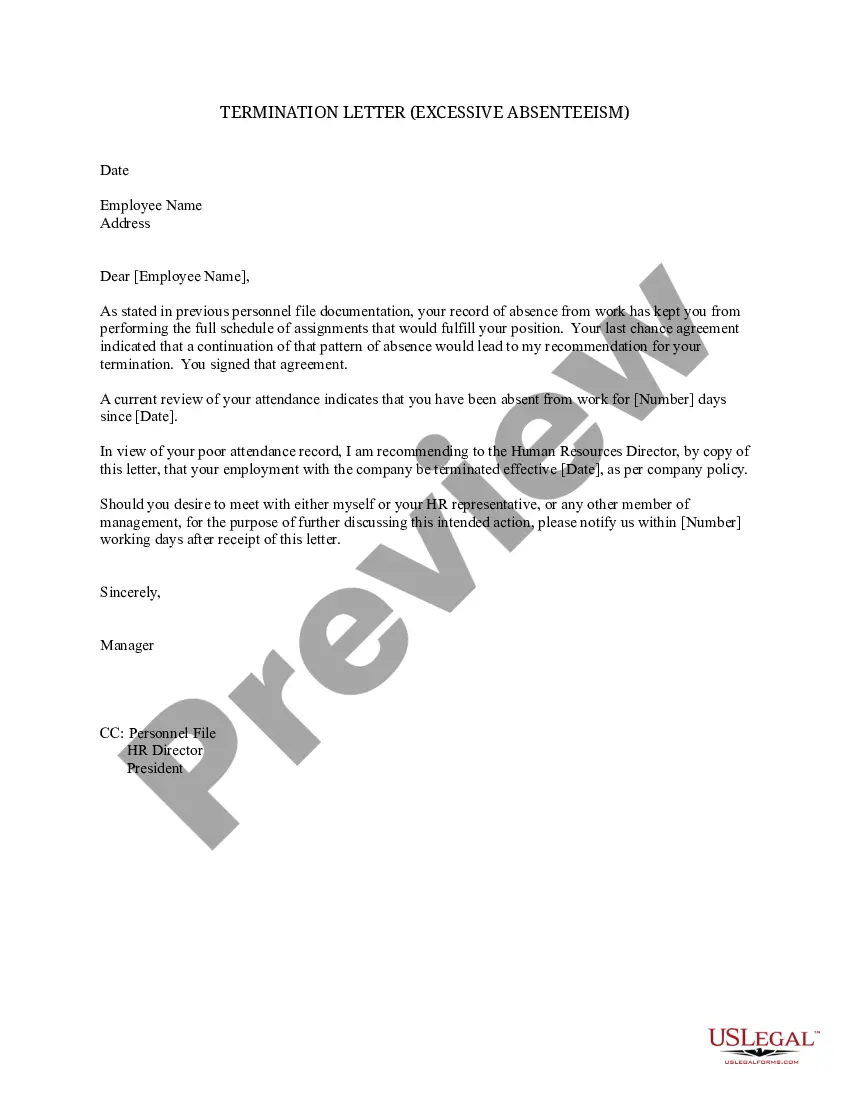
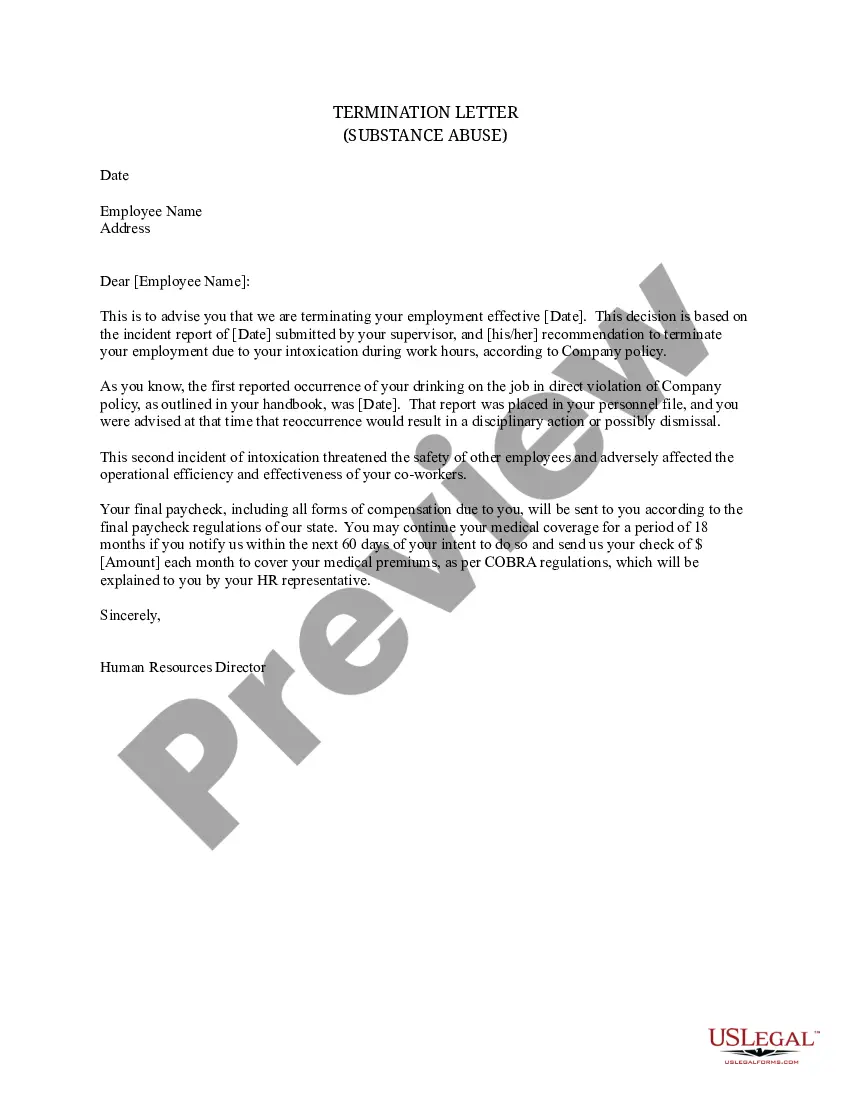
How to fill out Termination Letter - Substance Abuse?
If you require to complete, acquire, or generate legitimate document templates, utilize US Legal Forms, the largest assortment of legal forms available on the web.
Take advantage of the site's straightforward and user-friendly search to access the documents you need.
Different templates for commercial and personal applications are sorted by categories and claims, or keywords and phrases.
Step 3. If you are not satisfied with the form, use the Search field at the top of the screen to find other versions of your legal form template.
Step 4. Once you have found the form you desire, select the Purchase now button. Choose the pricing plan you prefer and input your information to register for an account.
- Use US Legal Forms to obtain the Washington Termination Letter - Substance Abuse with just a few clicks.
- If you're already a US Legal Forms user, Log In to your account and click the Download button to get the Washington Termination Letter - Substance Abuse.
- You can also find forms you’ve previously downloaded in the My documents section of your account.
- If you are using US Legal Forms for the first time, follow the instructions below.
- Step 1. Ensure you have selected the form for your specific city/state.
- Step 2. Utilize the Review option to check the form's details. Don't forget to read the summary.
Form popularity
FAQ
This statute allows the state to detain an individual involuntarily if the state can prove the individual (1) suffers from a mental disorder; and (2) the individual is either a danger to themselves, others or property.
2) Does an individual in treatment or recovery from opioid use disorder have a disability under the ADA? Typically, yes, unless the individual is currently engaged in illegal drug use.
Are Substance Use Disorders Considered Disabilities? In short, yes. Diagnosable drug and alcohol addictions, or substance use disorders (SUDs), are considered disabilities under Section 504 of the Rehabilitation Act, the Americans with Disabilities Act (ADA), and Section 1557 of the Affordable Care Act.
According to the National Institute on Drug Abuse (NIDA) drug addiction is classified as a mental illness because addiction changes the brain in fundamental ways, disturbing a person's normal hierarchy of needs and desires, and substituting new priorities connected with procuring and using drugs.
A new Washington state law that took effect Sunday allows someone to be involuntarily committed if they are deemed at-risk of harming themselves.
While substance abuse disorders are covered by the VA, they're not considered to be directly service-connected. However, they can be considered secondarily service-connected if the substance abuse disorder arose because of the service-connected condition.
Current illegal drug use is not protected, but recovering addicts are protected under the ADA.
Information about Ricky's Law: Involuntary Detention for Substance Use Disorders. Ricky's Law, effective April 1, 2018, allows the state's mental health system to involuntarily detain adults and minors who are determined to pose a likelihood of serious harm as a result of a substance use disorder.
Alcohol addiction is not, therefore, covered by the Act. However, an employee may have a physical or mental impairment that does amount to a disability within the meaning of the Act but which was caused by or was the result of alcohol addiction, for example a serious liver condition or a depressive illness.
Q: Is drug or alcohol use considered a disability? A: Drug and alcohol addiction is considered to be a disability. Casual drug users or social drinkers are not considered to be disabled.