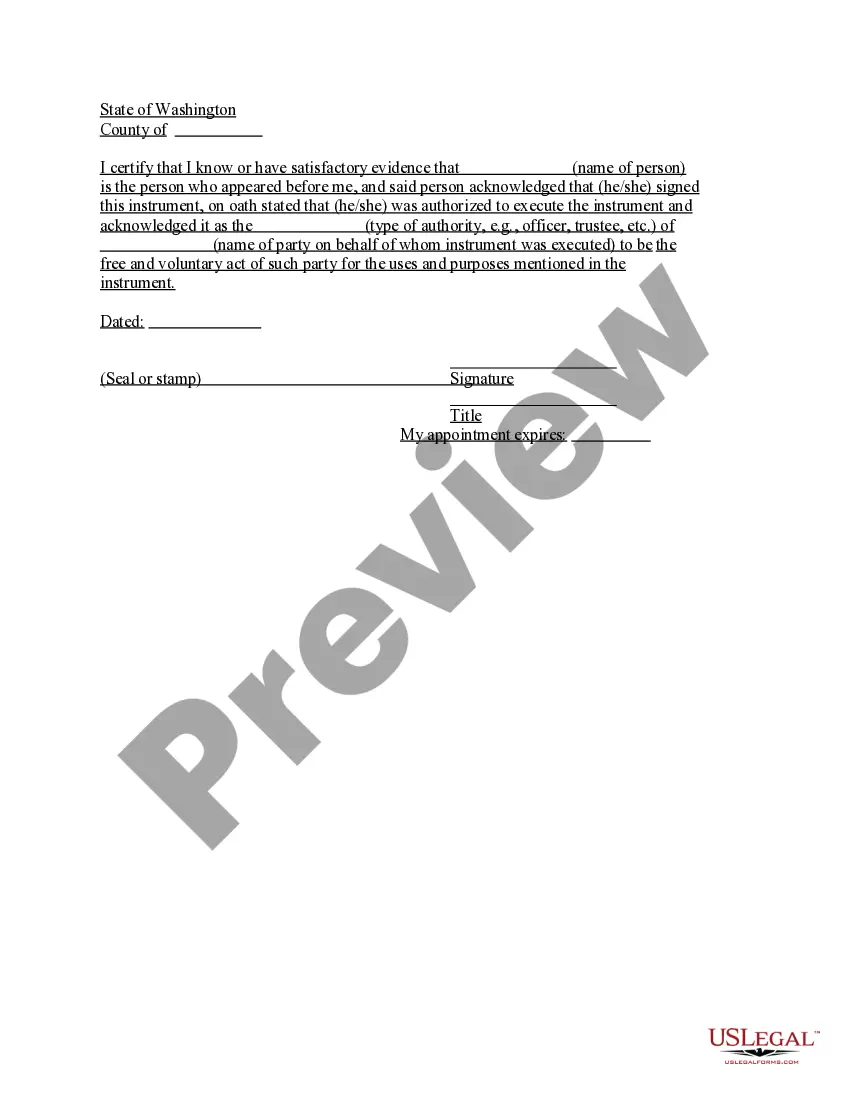
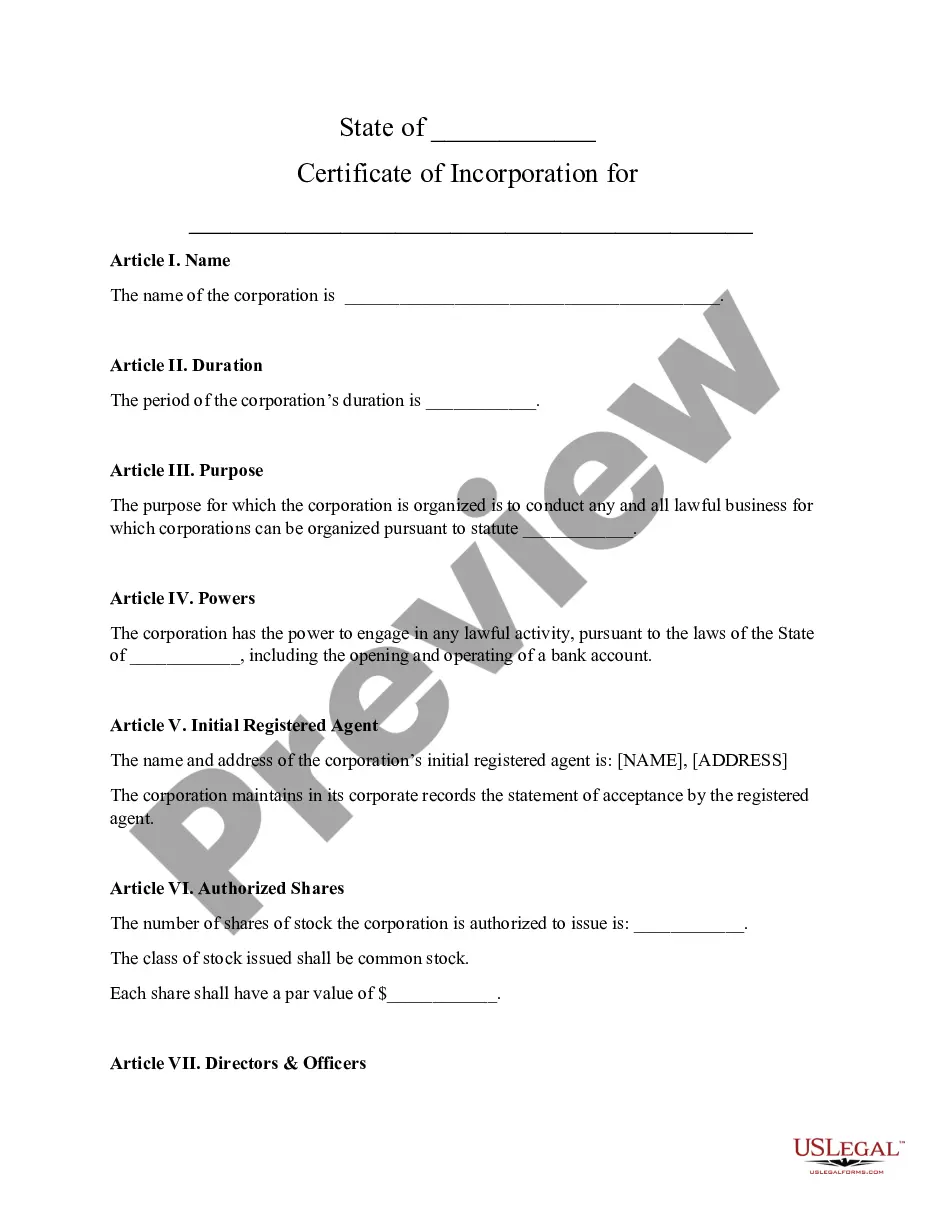
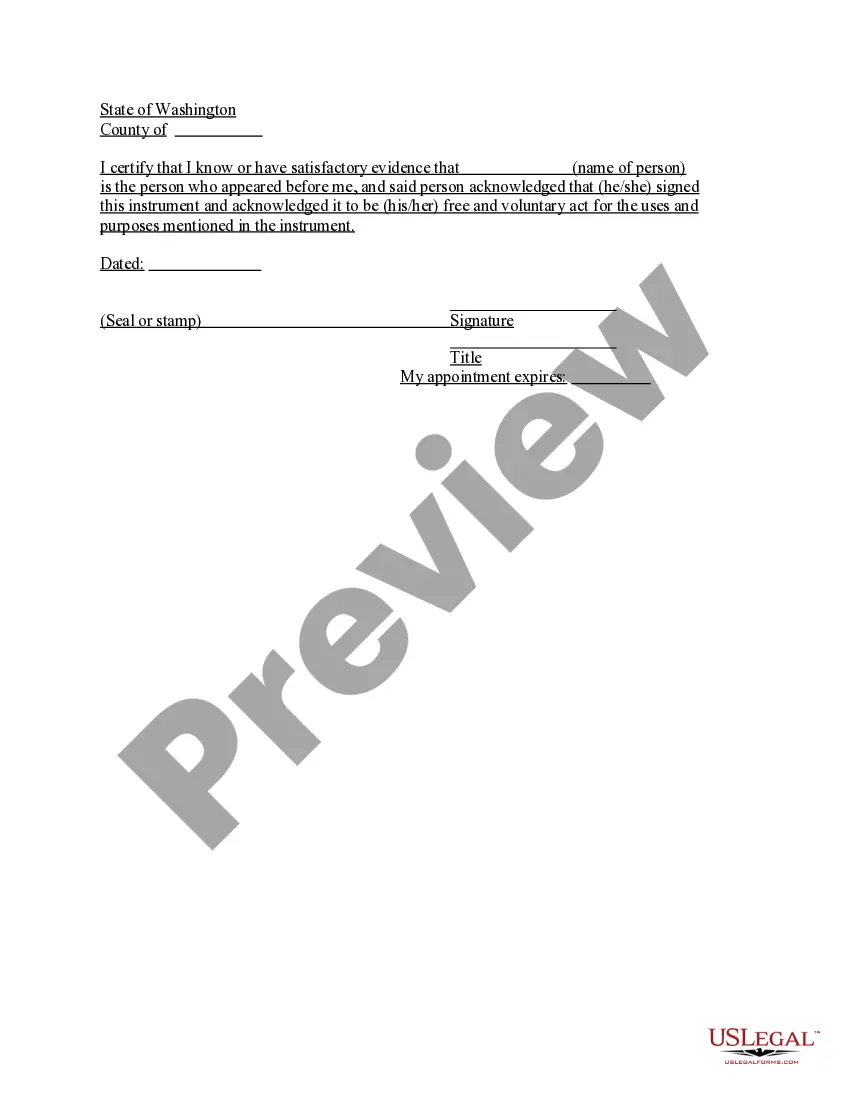
Washington A certificate of acknowledgment for a corporation, substantially in the following form or, after December 31, 1985
Understanding this form
A certificate of acknowledgment for a corporation is a legal document that verifies the identity of a person who has signed a corporate document. This form is commonly used to affirm that the individual who executed the document did so in their capacity within the corporation, ensuring its authenticity and adherence to legal requirements. It differs from other acknowledgment forms by specifically addressing corporate signatories and their authority to act on behalf of the corporation.
Key parts of this document
- Name of the person acknowledging their signature.
- Type of authority held by the signer (e.g., officer, trustee).
- Name of the corporation or party for whom the document was executed.
- Date the acknowledgment was made.
- Signature of the acknowledging party.
- Seal or stamp of the corporation, if required.
When to use this document
This form is typically used in corporate settings when a document needs to be executed formally, such as contracts, bylaws, or resolutions. It serves as proof that the individual signing the document has been duly authorized to do so, adding a layer of legal protection for the corporation involved.
Who this form is for
This form is intended for the following parties:
- Corporate officers responsible for executing documents.
- Trustees or authorized representatives of a corporation.
- Legal professionals assisting corporations with documentation.
- Corporate secretaries managing records and compliance.
Steps to complete this form
- Identify the person acknowledging the signature and insert their name.
- Specify the type of authority the individual possesses within the corporation.
- Enter the name of the corporation or entity on behalf of which the instrument is executed.
- Fill in the date when the acknowledgment is made.
- Collect the necessary signatures and affix any required seals.
Does this form need to be notarized?
This form does not typically require notarization unless specified by local law. However, having the acknowledgment notarized may enhance its validity in certain situations.
Get your form ready online
Our built-in tools help you complete, sign, share, and store your documents in one place.
Make edits, fill in missing information, and update formatting in US Legal Forms—just like you would in MS Word.
Download a copy, print it, send it by email, or mail it via USPS—whatever works best for your next step.
Sign and collect signatures with our SignNow integration. Send to multiple recipients, set reminders, and more. Go Premium to unlock E-Sign.
If this form requires notarization, complete it online through a secure video call—no need to meet a notary in person or wait for an appointment.
We protect your documents and personal data by following strict security and privacy standards.

Make edits, fill in missing information, and update formatting in US Legal Forms—just like you would in MS Word.

Download a copy, print it, send it by email, or mail it via USPS—whatever works best for your next step.

Sign and collect signatures with our SignNow integration. Send to multiple recipients, set reminders, and more. Go Premium to unlock E-Sign.

If this form requires notarization, complete it online through a secure video call—no need to meet a notary in person or wait for an appointment.

We protect your documents and personal data by following strict security and privacy standards.
Avoid these common issues
- Failing to include the correct name of the person acknowledging the signature.
- Omitting the date of acknowledgment.
- Not clearly stating the individual's authority within the corporation.
- Forgetting to sign or notarize the document, if required.
Benefits of using this form online
- Convenience of accessing and downloading the form instantly.
- Editability allows for small changes without starting from scratch.
- Reliable templates drafted by licensed attorneys ensure legal compliance.
Looking for another form?
Form popularity
FAQ
The preparer of the document adds both acknowledgment certificates for the notary public to decide and execute the acknowledgment certificate most appropriate to the situation. However, most documents that name two principal signers will generally include two notarial certificatesone for each signer.
Yes, effective March 27, 2020, Washington Notaries can apply for their remote endorsements. A bill was signed into law on April 26, 2019, allowing Notaries to perform remote online notarizations. This law was set to take effect October 1, 2020, but has been moved up to an earlier date due to the COVID-19 crisis.
No, in Washington, you do not need to notarize your will to make it legal. However, Washington allows you to make your will "self-proving" and you'll need to go to a notary if you want to do that. A self-proving will speeds up probate because the court can accept the will without contacting the witnesses who signed it.
Notarial Act: Title of Document: Identity of Signer. Date and Time: Notary Fee: The Fee column cannot be left blank. Signature of Signer: Every signer must sign/mark the notary's journal. Thumbprint:
What should a notarial certificate have? The signature of individual and notary, a statement that document was signed before a notary, the seal of the notary.
N. the section at the end of a document where a notary public verifies that the signer of the document states he/she actually signed it. The acknowledgment or due proof of the instrument by witnesses, must be made before it can be put upon record.
The certificate of a notary public, justice of the peace, or other authorized officer, attached to a deed, mortgage, or other instrument, setting forth that the parties thereto personally appeared before him on such a date and acknowledged the instrument to be their free and voluntary act and deed. Read v.