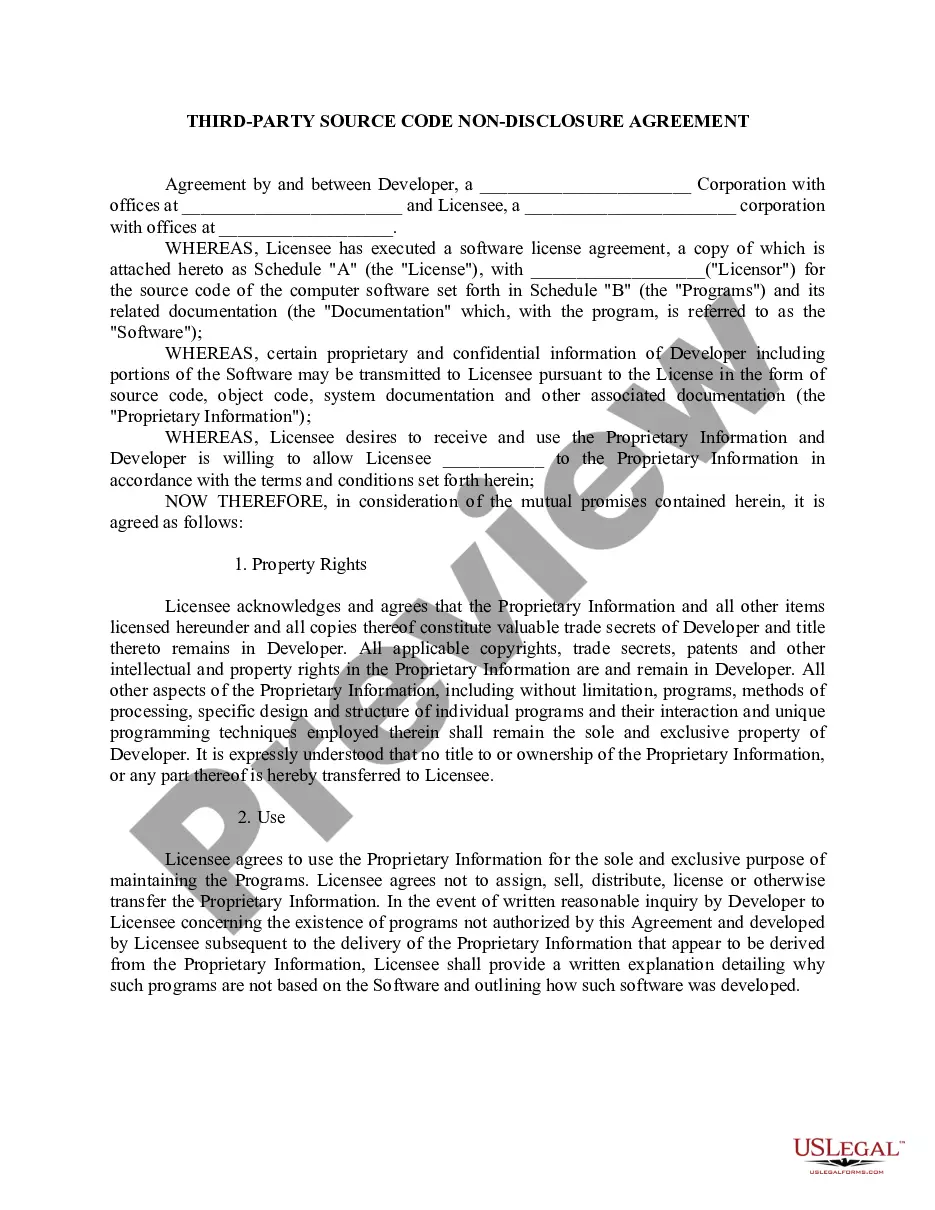
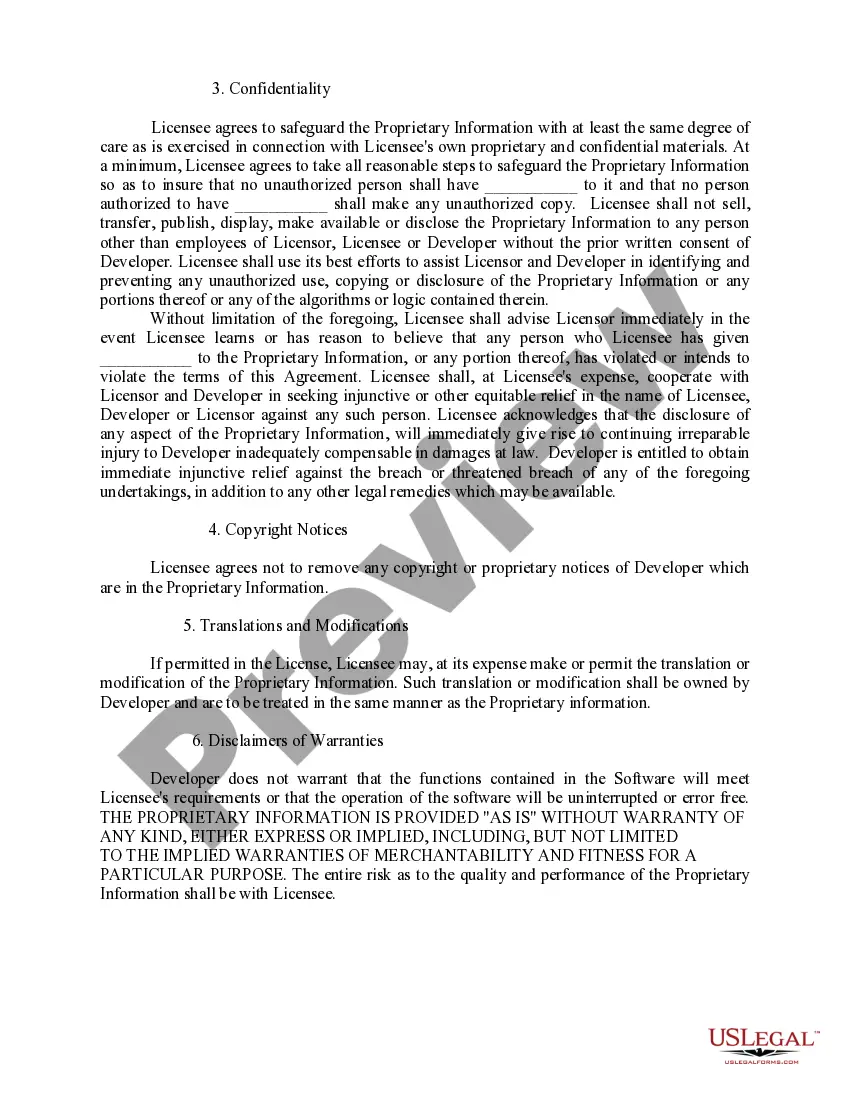
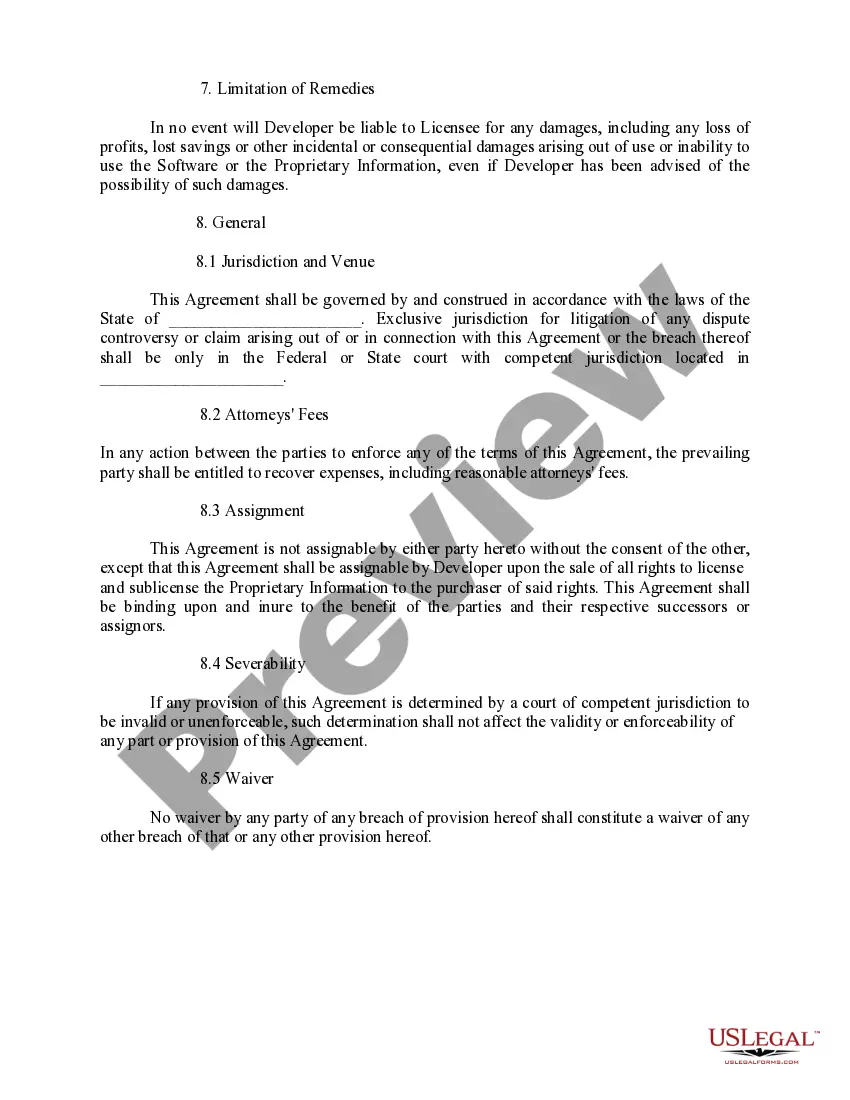
This form is a Third- Party Source Code Non-Disclosure Agreement. The licensee acknowledges and agrees that the proprietary information and all other items licensed under the contract and all copies constitute valuable trade secrets of the developer and title to the information remains in the developer. Also, all applicable copyrights, trade secrets, patents and other intellectual and property rights in the proprietary information are to remain in the developer.
Vermont Third-Party Source Code Nondisclosure Agreement
Category:
State:
Multi-State
Control #:
US-KWP-0001-A
Format:
Word;
Rich Text
Instant download
Description
Free preview
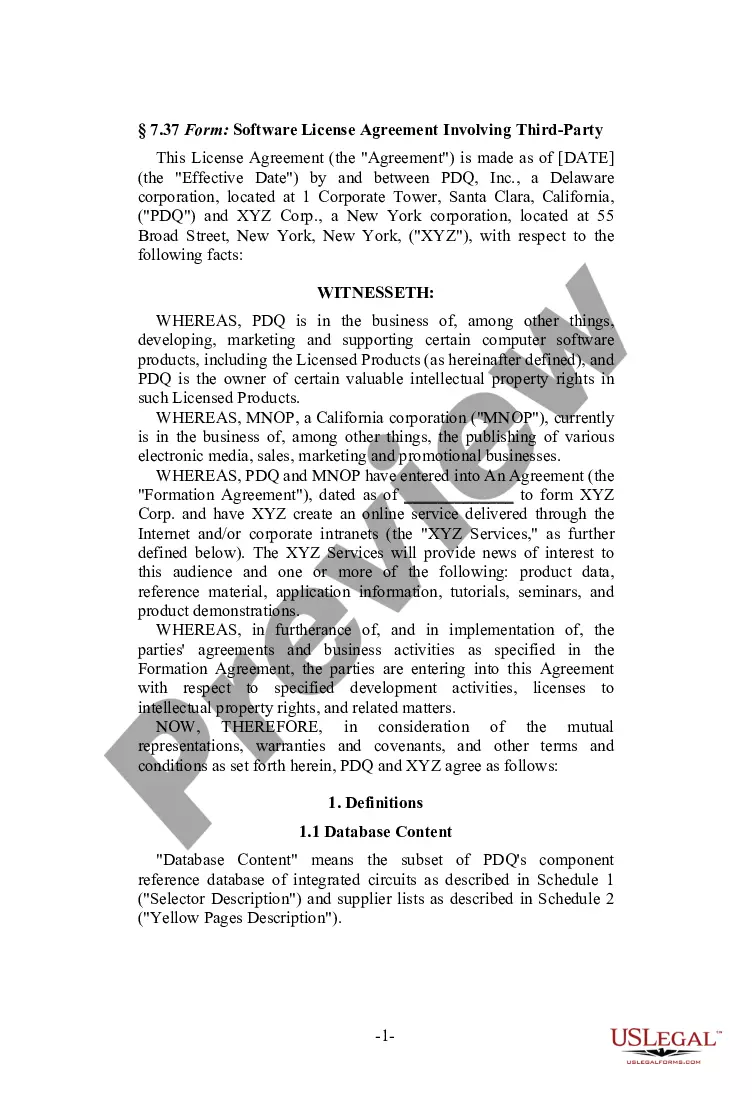
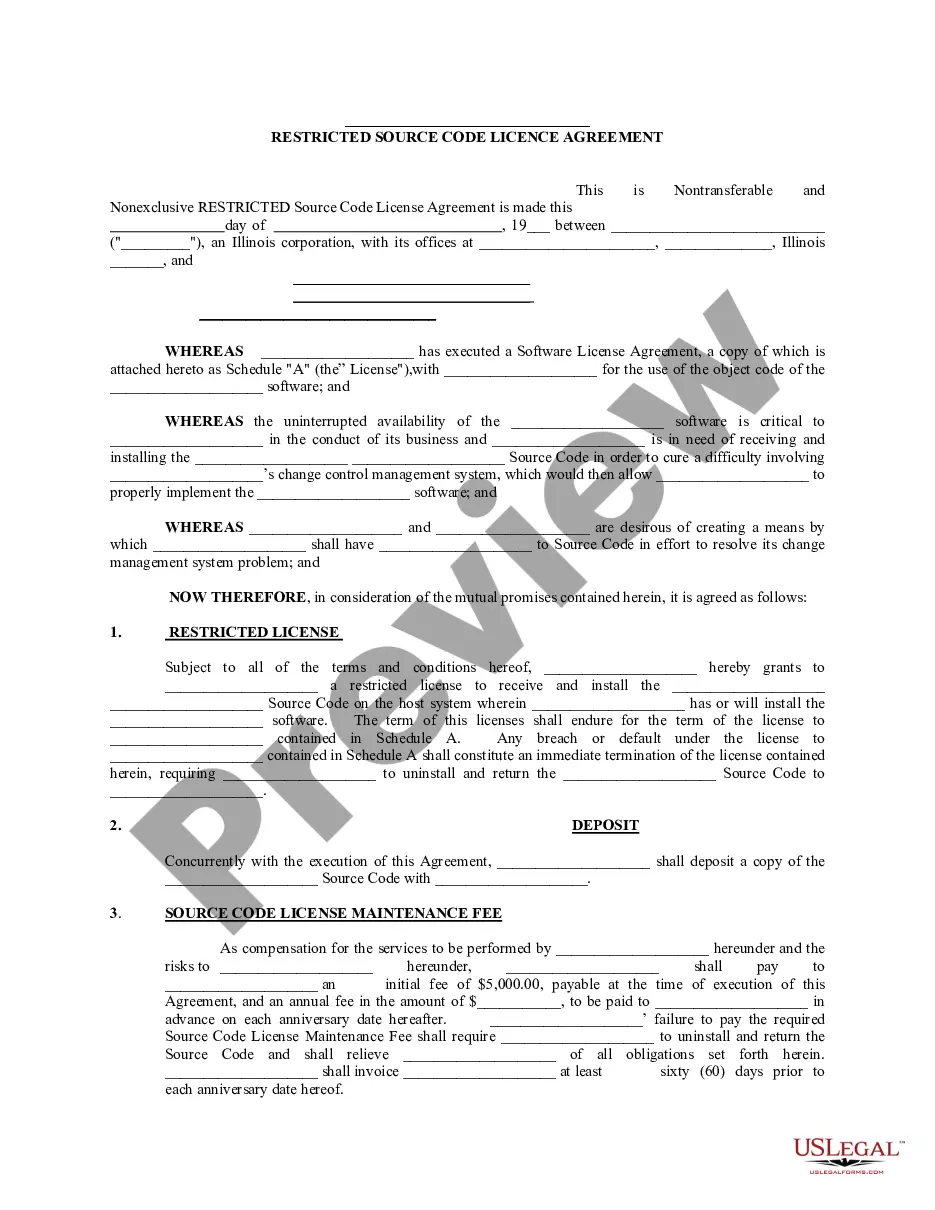
Get your form ready online
Our built-in tools help you complete, sign, share, and store your documents in one place.
Built-in online Word editor
Make edits, fill in missing information, and update formatting in US Legal Forms—just like you would in MS Word.
Export easily
Download a copy, print it, send it by email, or mail it via USPS—whatever works best for your next step.
E-sign your document
Sign and collect signatures with our SignNow integration. Send to multiple recipients, set reminders, and more. Go Premium to unlock E-Sign.
Notarize online 24/7
If this form requires notarization, complete it online through a secure video call—no need to meet a notary in person or wait for an appointment.
Store your document securely
We protect your documents and personal data by following strict security and privacy standards.

Make edits, fill in missing information, and update formatting in US Legal Forms—just like you would in MS Word.

Download a copy, print it, send it by email, or mail it via USPS—whatever works best for your next step.

Sign and collect signatures with our SignNow integration. Send to multiple recipients, set reminders, and more. Go Premium to unlock E-Sign.

If this form requires notarization, complete it online through a secure video call—no need to meet a notary in person or wait for an appointment.

We protect your documents and personal data by following strict security and privacy standards.
Looking for another form?

How to fill out Third-Party Source Code Nondisclosure Agreement?
US Legal Forms - one of the most important repositories of legal documents in the USA - provides a diverse selection of legal document templates that you can obtain or print. By using the website, you can access countless forms for business and personal use, organized by categories, states, or keywords. You can obtain the latest versions of forms like the Vermont Third-Party Source Code Nondisclosure Agreement within moments.
If you already have an account, Log In and obtain the Vermont Third-Party Source Code Nondisclosure Agreement from the US Legal Forms library. The Download option will appear on each form you view. You can access all previously saved forms in the My documents tab of your account.
If you wish to use US Legal Forms for the first time, here are simple steps to get started: Ensure you have selected the correct form for your region. Click on the Preview option to examine the form's contents. Review the form details to confirm that you have chosen the correct document. If the form does not meet your requirements, utilize the Search field at the top of the page to find one that does. When you are satisfied with the form, confirm your selection by clicking on the Acquire now button. Next, choose the pricing option you prefer and provide your details to register for an account. Process the transaction. Use your credit card or PayPal account to complete the transaction. Select the format and download the form to your device. Make changes. Fill out, modify, and print and sign the saved Vermont Third-Party Source Code Nondisclosure Agreement. Every template you added to your account has no expiration date and is yours indefinitely. Therefore, if you want to obtain or print another version, simply visit the My documents section and click on the form you desire.
- Access the Vermont Third-Party Source Code Nondisclosure Agreement with US Legal Forms, one of the largest collections of legal document templates.
- Utilize thousands of professional and state-specific templates that fulfill your business or personal needs and requirements.
Form popularity
FAQ
In the supply chain, NDA stands for Non-Disclosure Agreement, which plays an essential role in protecting trade secrets and sensitive information. A Vermont Third-Party Source Code Nondisclosure Agreement establishes clear boundaries regarding information sharing among supply chain partners. By implementing this agreement, businesses can maintain confidentiality, thus ensuring smooth operations and strong partnerships throughout the supply chain.
In sourcing, NDA represents Non-Disclosure Agreement, a crucial tool for managing confidential information. When companies source materials or services, a Vermont Third-Party Source Code Nondisclosure Agreement ensures that proprietary information remains protected. This agreement allows businesses to collaborate without the fear of sensitive data being disclosed to competitors, fostering a healthier sourcing environment.
NDA stands for Non-Disclosure Agreement. This legal contract is essential for protecting confidential information shared among parties. By utilizing a Vermont Third-Party Source Code Nondisclosure Agreement, you can ensure that your sensitive data is secure during negotiations and collaborations. This proactive approach helps avoid potential disputes and miscommunications.
In the business context, NDA refers to Non-Disclosure Agreement, which safeguards confidential information. When parties engage in discussions or collaborations, a Vermont Third-Party Source Code Nondisclosure Agreement helps prevent unauthorized sharing of sensitive details. This agreement fosters trust and encourages open communication between businesses, vital for successful partnerships.
In procurement, NDA stands for Non-Disclosure Agreement. This legal document protects sensitive information shared between parties during the procurement process. When you enter into a Vermont Third-Party Source Code Nondisclosure Agreement, you ensure that proprietary data remains confidential. This is crucial for maintaining competitive advantages and securing business relationships.
To fill out a Vermont Third-Party Source Code Nondisclosure Agreement, start by entering your name and the other party's name in the designated fields. Next, include a detailed description of the confidential information. Don’t forget to specify how long the agreement lasts and any exceptions to the confidentiality obligations. If you’re using a platform like uslegalforms, you can easily follow guided steps to ensure all necessary information is included.
An example of a statement in a Vermont Third-Party Source Code Nondisclosure Agreement might be: 'The receiving party agrees to protect the confidentiality of the disclosing party's proprietary information and will not disclose it to any third party without written consent.' This statement clearly outlines the responsibility of the receiving party, ensuring they understand the importance of confidentiality.
Filling out a Vermont Third-Party Source Code Nondisclosure Agreement form requires careful attention to detail. Begin by entering the names of the disclosing and receiving parties. Next, provide a description of the confidential information being shared. Make sure to review the terms, including the obligations and duration, before signing the document to ensure it meets your needs.
To write a simple Vermont Third-Party Source Code Nondisclosure Agreement, start by clearly identifying the parties involved. Include a description of the confidential information and the purpose of the agreement. It’s essential to outline the obligations of both parties regarding the handling of the confidential information. Finally, specify the duration of the agreement and any remedies for breach.
The zero tolerance law in Vermont refers to strict policies that prohibit certain behaviors, particularly concerning substance abuse and underage drinking. This law aims to promote safety and accountability within the community. When drafting a Vermont Third-Party Source Code Nondisclosure Agreement, it is important to be aware of such laws, as they can impact the responsibilities and liabilities of the parties involved.