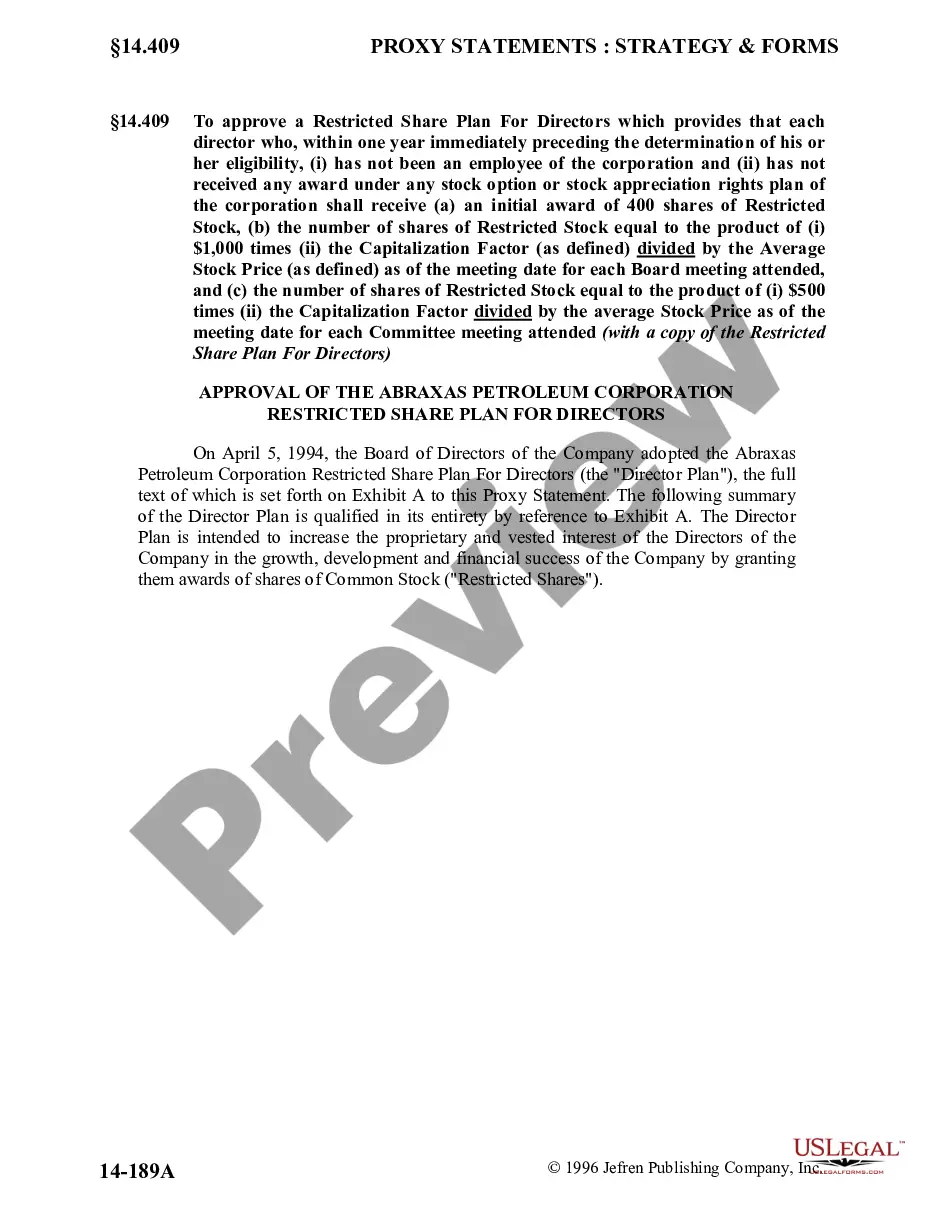
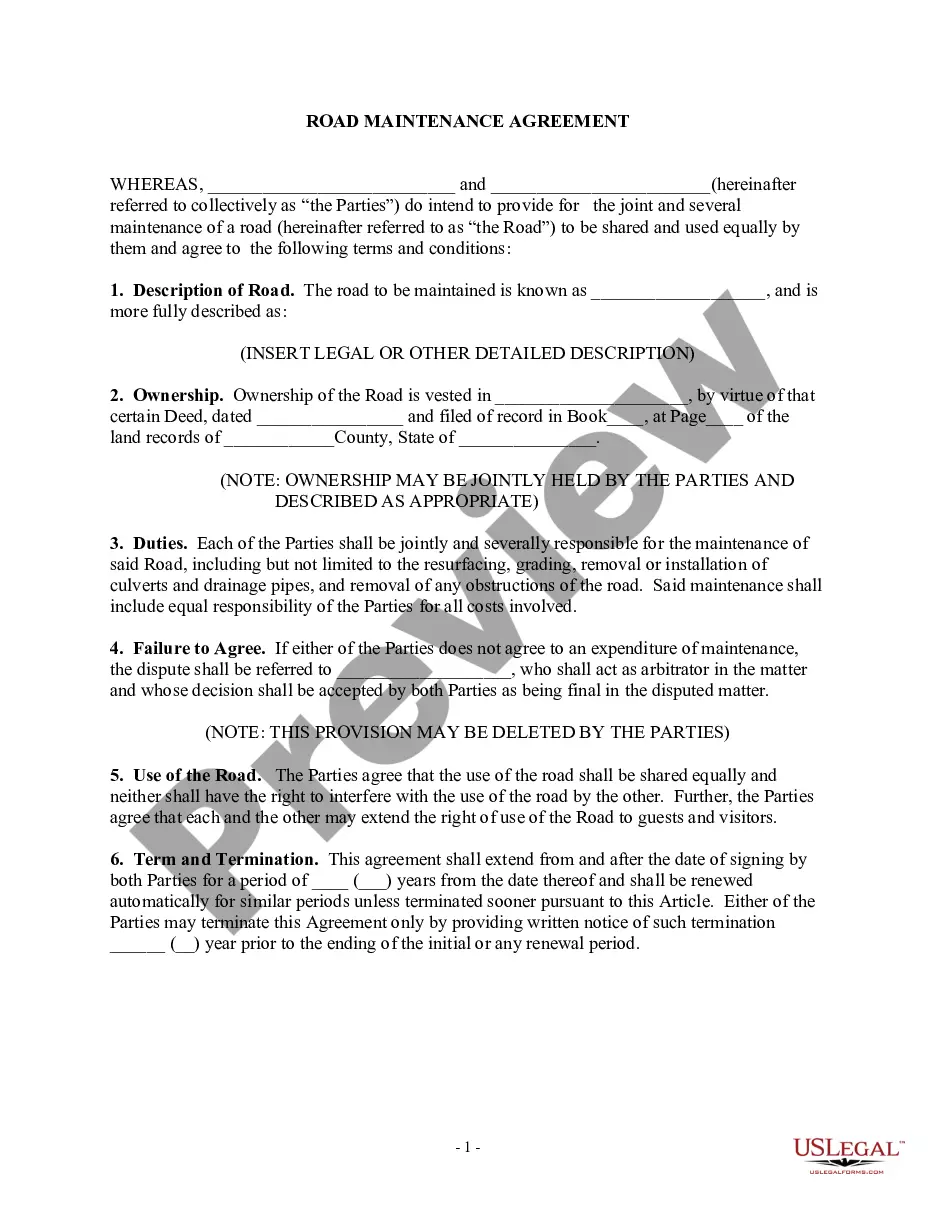
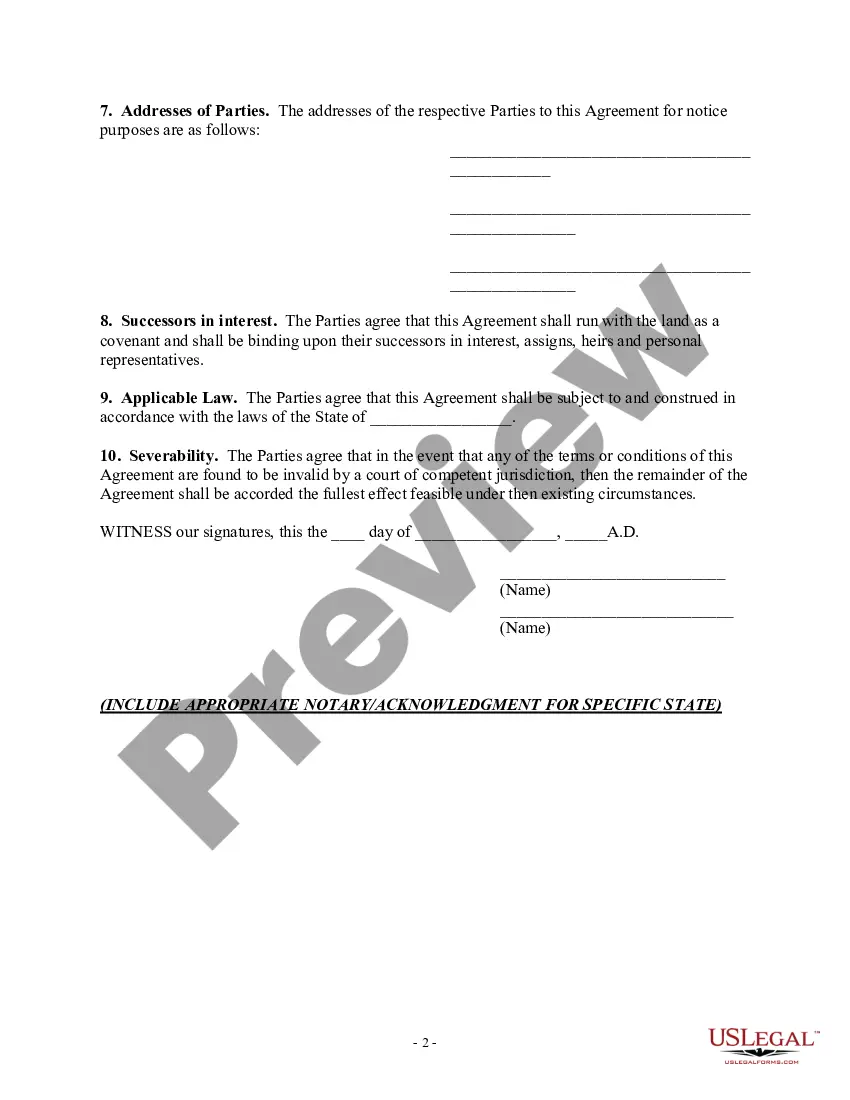
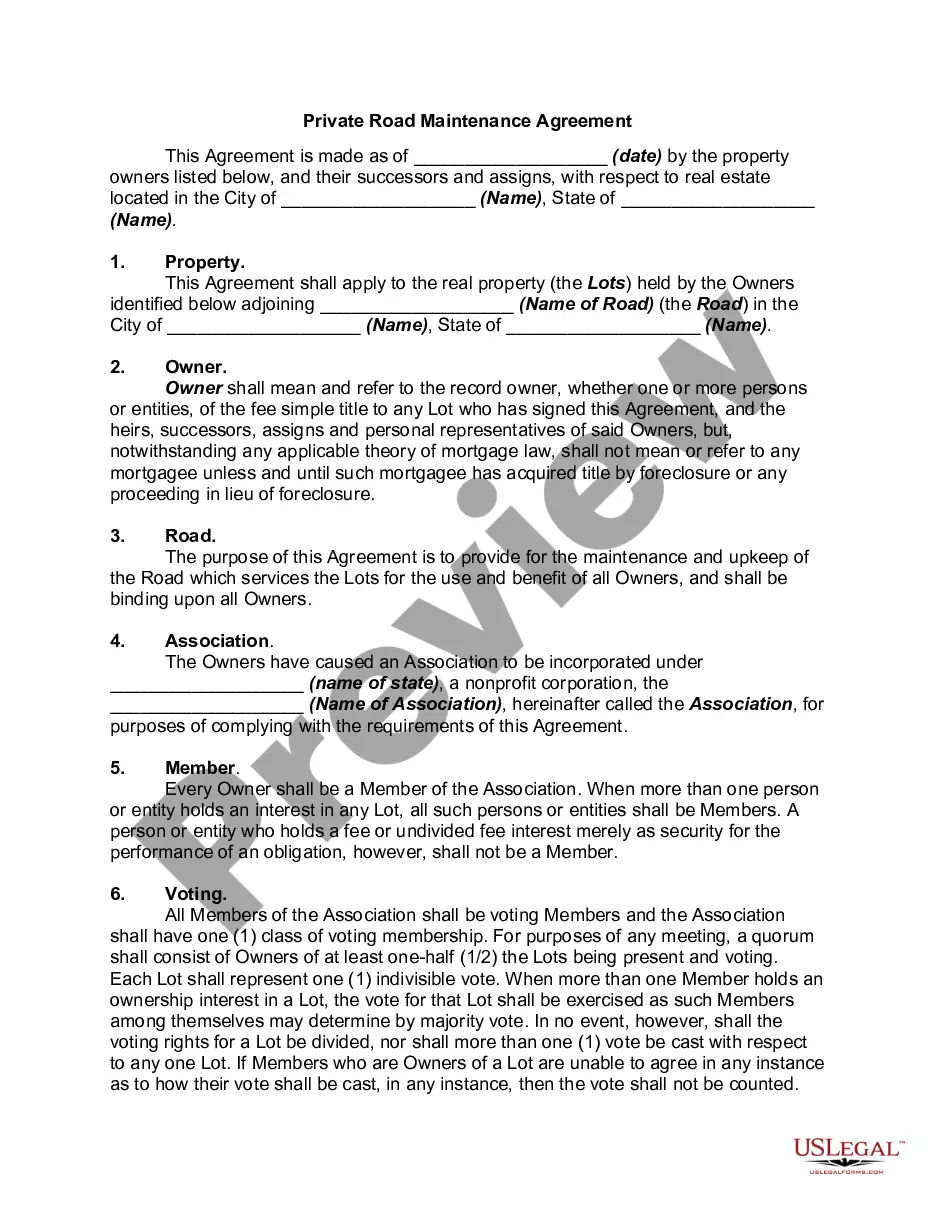
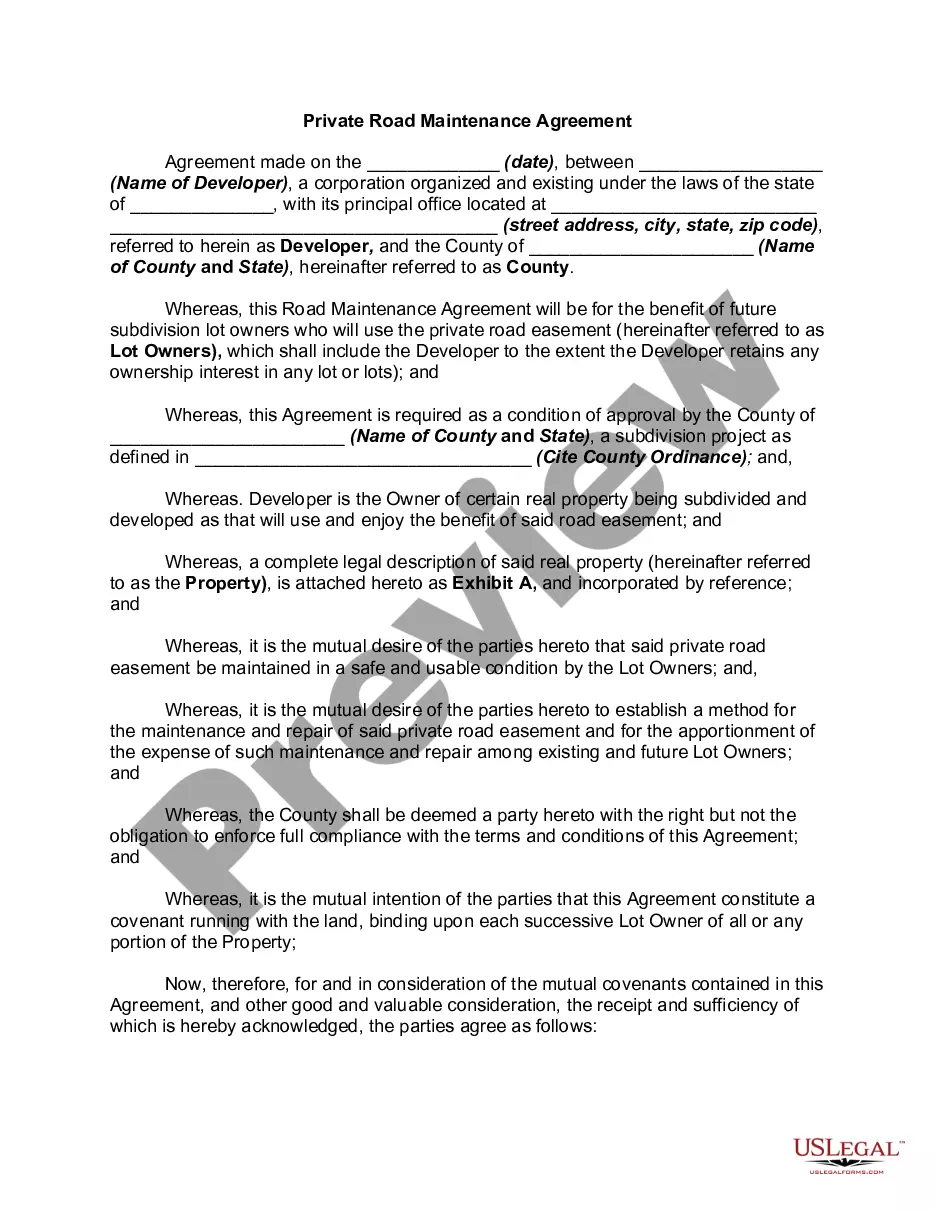
Vermont Road Maintenance Agreement
Description
Get your form ready online
Our built-in tools help you complete, sign, share, and store your documents in one place.
Make edits, fill in missing information, and update formatting in US Legal Forms—just like you would in MS Word.
Download a copy, print it, send it by email, or mail it via USPS—whatever works best for your next step.
Sign and collect signatures with our SignNow integration. Send to multiple recipients, set reminders, and more. Go Premium to unlock E-Sign.
If this form requires notarization, complete it online through a secure video call—no need to meet a notary in person or wait for an appointment.
We protect your documents and personal data by following strict security and privacy standards.

Make edits, fill in missing information, and update formatting in US Legal Forms—just like you would in MS Word.

Download a copy, print it, send it by email, or mail it via USPS—whatever works best for your next step.

Sign and collect signatures with our SignNow integration. Send to multiple recipients, set reminders, and more. Go Premium to unlock E-Sign.

If this form requires notarization, complete it online through a secure video call—no need to meet a notary in person or wait for an appointment.

We protect your documents and personal data by following strict security and privacy standards.
Looking for another form?



How to fill out Road Maintenance Agreement?
If you intend to fill, obtain, or print authentic document templates, utilize US Legal Forms, the most extensive collection of legal forms, accessible online.
Employ the website's simple and efficient search feature to find the documents you require.
Various templates for business and personal purposes are organized by categories and states, or keywords.
Every legal document template you acquire belongs to you for years. You have access to each form you downloaded in your account.
Visit the My documents section and select a form to print or download again.
- Use US Legal Forms to locate the Vermont Road Maintenance Agreement in just a few clicks.
- If you are already a US Legal Forms user, Log In to your account and click the Obtain button to access the Vermont Road Maintenance Agreement.
- You can also find forms you've previously downloaded in the My documents tab of your account.
- If this is your first time using US Legal Forms, follow the steps provided below.
- Step 1. Ensure you have selected the form for the correct state/region.
- Step 2. Use the Review option to go through the details of the form. Remember to read the description.
- Step 3. If you are not satisfied with the form, use the Search box at the top of the screen to discover other versions of the legal document template.
- Step 4. Once you have located the form you need, click the Buy now button. Choose your preferred pricing plan and provide your details to register for an account.
- Step 5. Complete the transaction. You can use your credit card or PayPal account to finalize the payment.
- Step 6. Select the format of the legal document and download it to your device.
- Step 7. Fill out, modify, and print or sign the Vermont Road Maintenance Agreement.
Form popularity
FAQ
A Class 3 road in Vermont is similar to a Class 3 highway, defined as a town-maintained rural road. These roads typically have a lower traffic volume and serve local areas directly. Knowing the classification of roads helps homeowners decide on the best response regarding a Vermont Road Maintenance Agreement to ensure proper maintenance and access.
A Class 3 highway in Vermont is a rural road that is maintained by the town, but may not reach the standards of higher classes. These highways play a crucial role in local connectivity and transport. Understanding these classifications can help homeowners determine the need for a Vermont Road Maintenance Agreement, especially for road upkeep.
Class 4 roads in Vermont are the least maintained and often consist of unpaved and rural paths. These roads may be rarely traveled and are not required to be maintained by the town. Property owners using Class 4 roads might find a Vermont Road Maintenance Agreement helpful to outline responsibilities for upkeep and access.
A Class 2 road in Vermont refers to a state-designated roadway that serves as a link between towns and offers access to local areas. These roads require a certain level of maintenance, which is typically funded by the town. Implementing a Vermont Road Maintenance Agreement can clarify the responsibility for maintenance among property owners using these roads.
The three levels of roadways in Vermont are Class 1, Class 2, and Class 3. Class 1 roads are major roads with significant traffic, often maintained by the state. Class 2 roads are important lesser roads that connect towns, while Class 3 roads are more local roads, often maintained at the town's discretion under a Vermont Road Maintenance Agreement.
Yes, Freddie Mac often requires a Vermont Road Maintenance Agreement for properties located on private roads. This agreement ensures that the maintenance costs of the roads are shared among property owners. Having such an agreement can facilitate the financing process, providing reassurance to lenders and buyers.
If all roads were privately owned, the responsibility for maintenance would fall to individual owners. This could lead to better road conditions if owners actively invest in upkeep. However, it would also require clear agreements, such as a Vermont Road Maintenance Agreement, to ensure shared responsibilities and avoid disputes among owners.
The primary difference lies in maintenance and access. Local roads are typically maintained by the government, providing access to the public, while private roads are managed by individuals or organizations. This exclusivity allows you to create a Vermont Road Maintenance Agreement that suits your specific needs and maintains your privacy.
Yes, as the owner of a private road, you can decide to install a speed bump to enhance safety. However, it's essential to communicate this plan with any other stakeholders who share the road. Incorporating such decisions into a Vermont Road Maintenance Agreement can prevent conflicts and clarify responsibilities.
While private roads are generally not open to the public, they do not automatically imply no trespassing. The owner establishes the rules for access, which may include granting permission to specific individuals. However, to legally restrict access, you should include clear terms in a Vermont Road Maintenance Agreement.