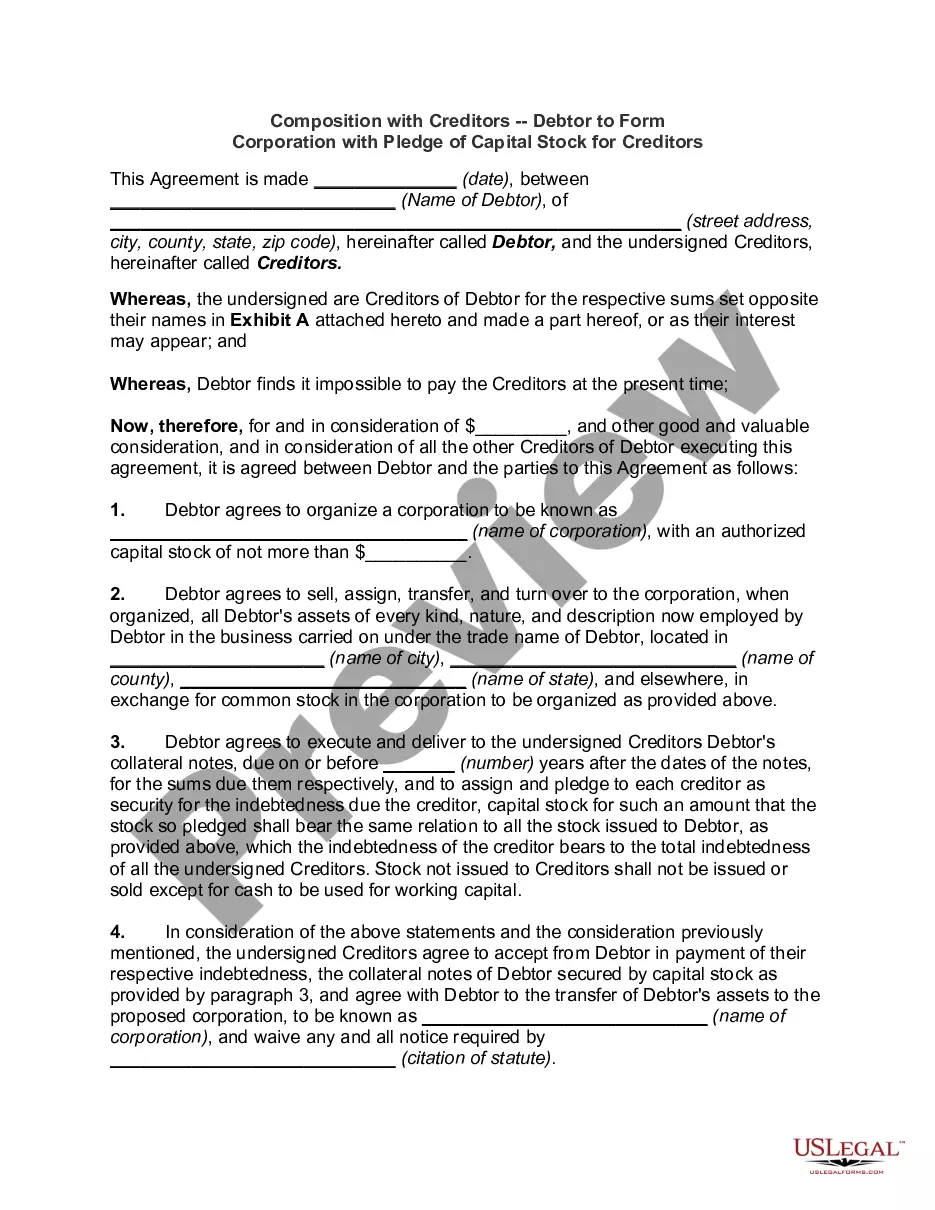
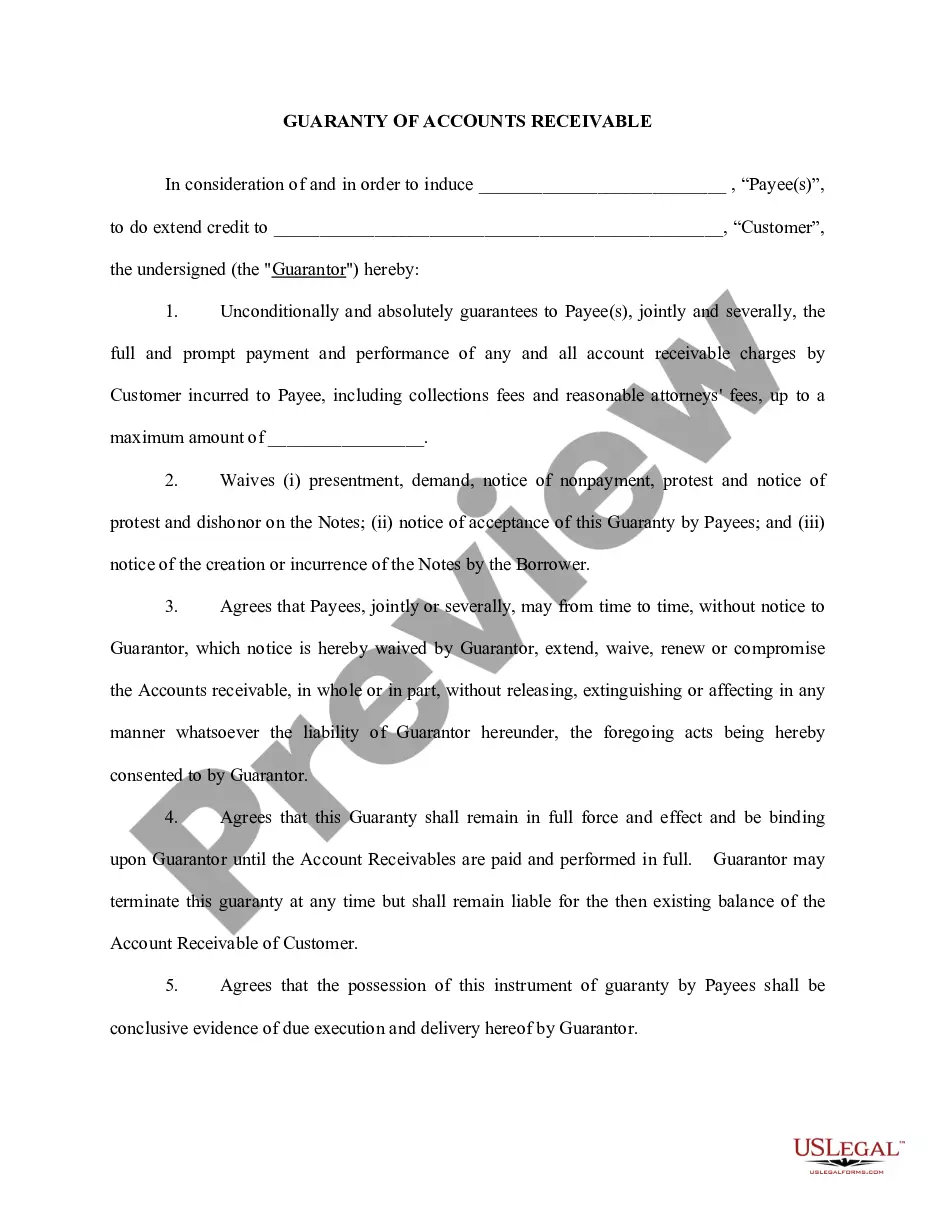
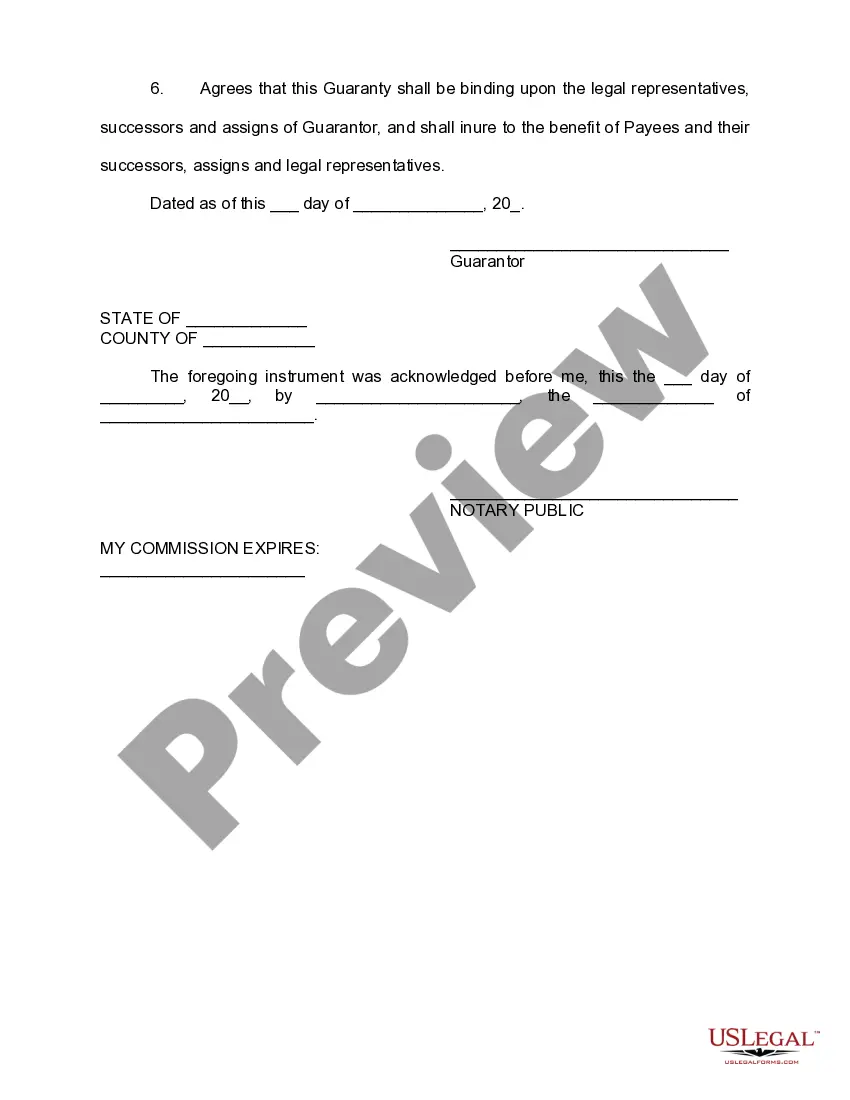
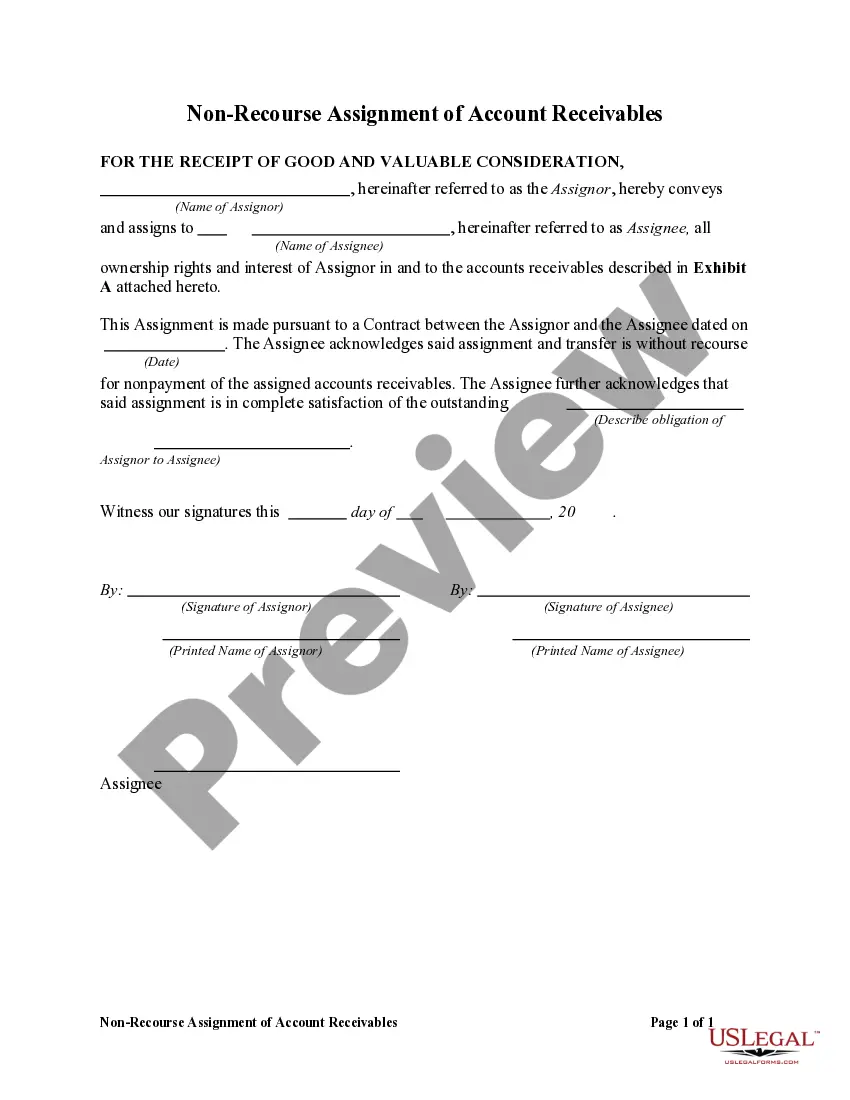
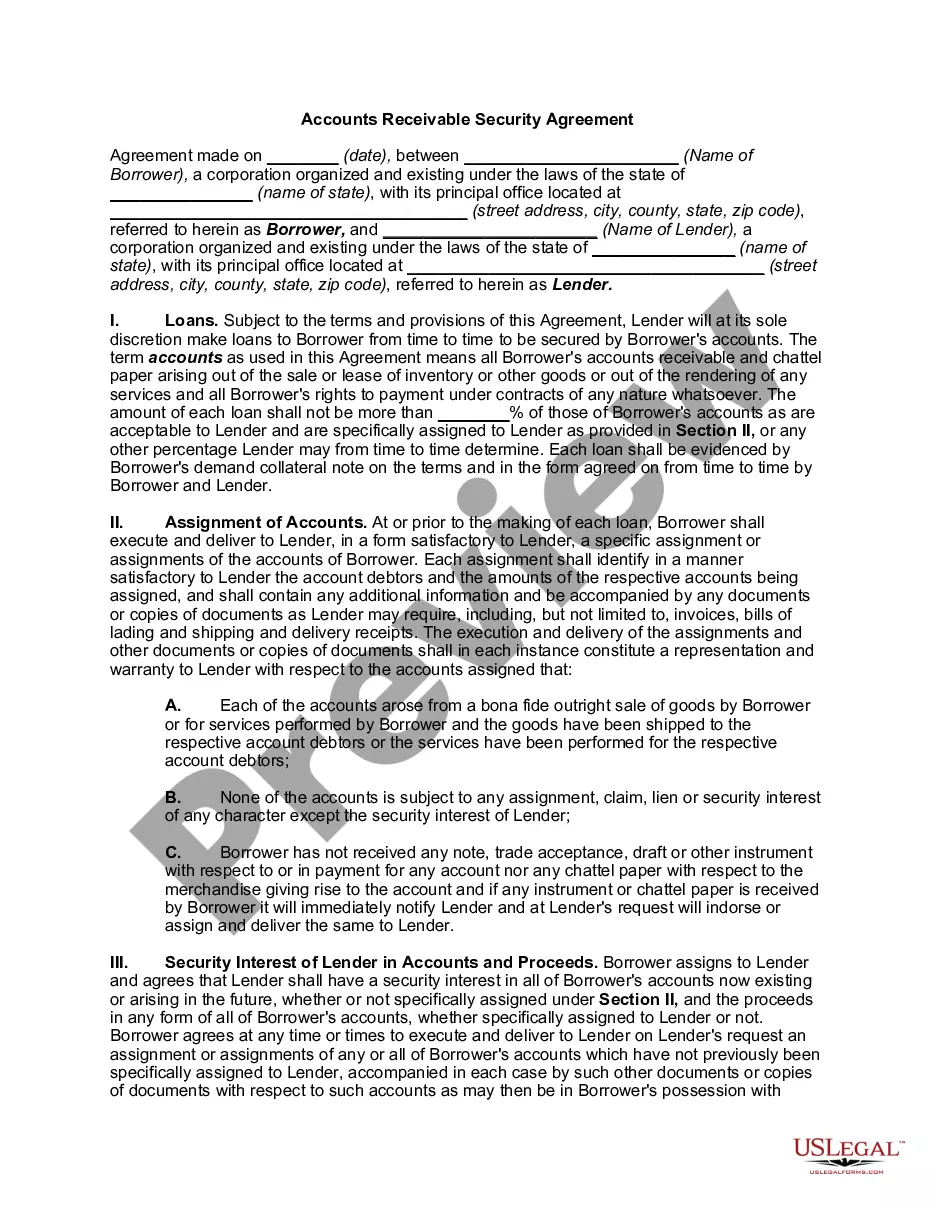
This form states that the guarantor unconditionally and absolutely guarantees to payee(s), jointly and severally, the full and prompt payment and performance of any and all account receivable charges by the customer incurred to the payee, including collections fees and reasonable attorneys' fees, up to a certain maximum amount.
Vermont Accounts Receivable - Guaranty
Category:
State:
Multi-State
Control #:
US-00401
Format:
Word;
Rich Text
Instant download
Description
Free preview


Get your form ready online
Our built-in tools help you complete, sign, share, and store your documents in one place.
Built-in online Word editor
Make edits, fill in missing information, and update formatting in US Legal Forms—just like you would in MS Word.
Export easily
Download a copy, print it, send it by email, or mail it via USPS—whatever works best for your next step.
E-sign your document
Sign and collect signatures with our SignNow integration. Send to multiple recipients, set reminders, and more. Go Premium to unlock E-Sign.
Notarize online 24/7
If this form requires notarization, complete it online through a secure video call—no need to meet a notary in person or wait for an appointment.
Store your document securely
We protect your documents and personal data by following strict security and privacy standards.

Make edits, fill in missing information, and update formatting in US Legal Forms—just like you would in MS Word.

Download a copy, print it, send it by email, or mail it via USPS—whatever works best for your next step.

Sign and collect signatures with our SignNow integration. Send to multiple recipients, set reminders, and more. Go Premium to unlock E-Sign.

If this form requires notarization, complete it online through a secure video call—no need to meet a notary in person or wait for an appointment.

We protect your documents and personal data by following strict security and privacy standards.
Looking for another form?

How to fill out Accounts Receivable - Guaranty?
If you need to completely download or create official document templates, utilize US Legal Forms, the largest collection of legal forms available online. Utilize the site's user-friendly and effective search feature to find the documents you require. Various templates for commercial and personal purposes are organized by categories and states, or keywords. Use US Legal Forms to acquire the Vermont Accounts Receivable - Guaranty in just a few clicks.
If you are already a US Legal Forms user, Log In to your account and click the Download button to retrieve the Vermont Accounts Receivable - Guaranty. You can also access forms you previously downloaded in the My documents section of your account.
If this is your first time using US Legal Forms, follow the instructions below: Step 1. Ensure you have selected the form for the correct city/state. Step 2. Use the Preview option to browse through the form's content. Don't forget to review the details. Step 3. If you are not satisfied with the form, use the Search box at the top of the screen to find alternative versions of the legal form template. Step 4. Once you have located the form you want, select the Purchase now button. Choose the pricing plan you prefer and provide your information to register for an account. Step 5. Complete the transaction. You can use your credit card or PayPal account to finalize the purchase. Step 6. Choose the format of the legal form and download it to your device. Step 7. Complete, modify, and print or sign the Vermont Accounts Receivable - Guaranty.
- Each legal document template you purchase is yours indefinitely.
- You have access to every form you downloaded within your account.
- Click on the My documents section and select a form to print or download again.
- Act now and download, and print the Vermont Accounts Receivable - Guaranty using US Legal Forms.
- There are numerous professional and state-specific forms available for your business or personal needs.
Form popularity
FAQ
Let's dig into the details by examining the eight steps in the accounts receivable process. Step 1: Receive Order. ... Step 2: Approve Credit. ... Step 3: Send Invoices. ... Step 4: Manage Collections. ... Step 5: Address Disputes. ... Step 6: Write off Uncollectible Debt. ... Step 7: Process Payments. ... Step 8: Handle Reporting.
There are two journal entries that are typically used to record bills receivable: When a business receives a bill receivable, it will debits its "Bills Receivable" account and credits its "Cash" account.
Companies record accounts receivable as assets on their balance sheets because there is a legal obligation for the customer to pay the debt. They are considered a liquid asset, because they can be used as collateral to secure a loan to help meet short-term obligations.
While recording the invoice journal entry, you need to debit the accounts receivable account for the amount due from your customer and credit the sales account for the same amount. You also need to post the cost of goods sold journal entry to update your inventory.
Follow these steps to calculate accounts receivable: Add up all charges. You'll want to add up all the amounts that customers owe the company for products and services that the company has already delivered to the customer. ... Find the average. ... Calculate net credit sales. ... Divide net credit sales by average accounts receivable.
Companies use invoices to report accounts receivable transactions. Invoices include information regarding the sale of the products or services, such as a description of the product or service, the total cost and the payment due date. A journal entry may contain: The date of the journal entry.
Account receivable is the amount the company owes from the customer for selling its goods or services. The journal entry to record such credit sales of goods and services is passed by debiting the accounts receivable account with the corresponding credit to the Sales account.
Accounts receivables journal entries are crucial as they are the cornerstone of its finances. The journal entry for account receivables is made by debiting the accounts receivable account and crediting the sales account.