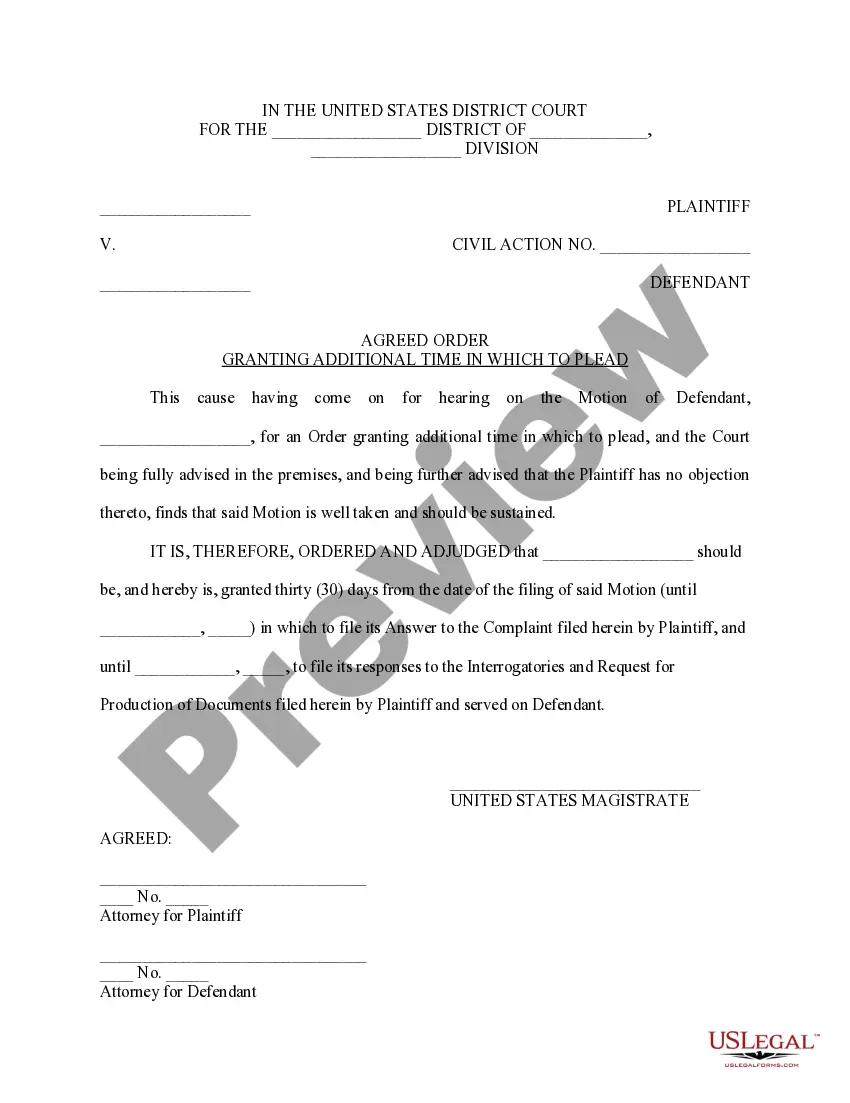
Vermont Agreed Order Granting Additional Time to Plead and Respond to Interrogatories and Requests for Production
Description
Get your form ready online
Our built-in tools help you complete, sign, share, and store your documents in one place.
Make edits, fill in missing information, and update formatting in US Legal Forms—just like you would in MS Word.
Download a copy, print it, send it by email, or mail it via USPS—whatever works best for your next step.
Sign and collect signatures with our SignNow integration. Send to multiple recipients, set reminders, and more. Go Premium to unlock E-Sign.
If this form requires notarization, complete it online through a secure video call—no need to meet a notary in person or wait for an appointment.
We protect your documents and personal data by following strict security and privacy standards.

Make edits, fill in missing information, and update formatting in US Legal Forms—just like you would in MS Word.

Download a copy, print it, send it by email, or mail it via USPS—whatever works best for your next step.

Sign and collect signatures with our SignNow integration. Send to multiple recipients, set reminders, and more. Go Premium to unlock E-Sign.

If this form requires notarization, complete it online through a secure video call—no need to meet a notary in person or wait for an appointment.

We protect your documents and personal data by following strict security and privacy standards.
Looking for another form?

How to fill out Agreed Order Granting Additional Time To Plead And Respond To Interrogatories And Requests For Production?
You can spend numerous hours online attempting to locate the legal document format that satisfies the federal and state criteria you require. US Legal Forms offers thousands of legal templates that are assessed by experts.
It is easy to access or print the Vermont Agreed Order Granting Additional Time to Plead and Respond to Interrogatories and Requests for Production from the service. If you already have a US Legal Forms account, you can Log In and select the Obtain option. After that, you can fill out, modify, print, or sign the Vermont Agreed Order Granting Additional Time to Plead and Respond to Interrogatories and Requests for Production.
Every legal document format you purchase is yours indefinitely. To obtain an additional copy of the purchased form, visit the My documents tab and click the appropriate option. If you are using the US Legal Forms website for the first time, follow the simple instructions below: First, ensure that you have selected the correct format for the state/region you choose. Review the form outline to confirm you have selected the right template. If available, use the Review option to examine the document format as well.
- If you wish to obtain an additional version of the form, use the Lookup field to find the document that suits your needs and requirements.
- Once you have located the format you want, click Purchase now to proceed.
- Select the pricing plan you prefer, provide your details, and register for an account on US Legal Forms.
- Complete the transaction. You can use your credit card or PayPal account to pay for the legal document.
- Choose the format of the document and download it to your device.
- Make modifications to the document if necessary. You can fill out, alter, and sign and print Vermont Agreed Order Granting Additional Time to Plead and Respond to Interrogatories and Requests for Production.
- Access and print thousands of document templates using the US Legal Forms website, which offers the largest selection of legal forms. Utilize professional and state-specific templates to address your business or personal needs.
Form popularity
FAQ
To answer interrogatories, carefully read each question and provide clear, complete responses. For requests for production, gather the documents specified and ensure they are relevant to the case. If you feel overwhelmed, consider using resources like US Legal Forms, which can guide you through the process. Additionally, a Vermont Agreed Order Granting Additional Time to Plead and Respond to Interrogatories and Requests for Production can offer you the breathing room needed to prepare thorough responses.
Rule 74 of the Vermont Rules of Civil Procedure pertains to the discovery process, specifically regarding interrogatories and requests for production. It outlines the procedures for serving and responding to these discovery tools. Understanding this rule is crucial, especially when you may need a Vermont Agreed Order Granting Additional Time to Plead and Respond to Interrogatories and Requests for Production. This ensures you stay aligned with legal requirements while managing your case efficiently.
Typically, parties have 30 days to respond to interrogatories in Vermont. However, this timeframe may vary based on court orders or specific agreements between parties. If you find yourself needing more time, you can seek a Vermont Agreed Order Granting Additional Time to Plead and Respond to Interrogatories and Requests for Production. This order provides a clear path to ensure compliance with the necessary deadlines.
If a party does not respond to interrogatories, the requesting party may file a motion to compel a response. This motion asks the court to order the non-responding party to answer within a specified timeframe. Additionally, failing to respond can lead to sanctions, including potential dismissal of claims or defenses. Therefore, utilizing a Vermont Agreed Order Granting Additional Time to Plead and Respond to Interrogatories and Requests for Production can help prevent such consequences.
Local rule 33.3 interrogatories refer to specific guidelines that govern the use of interrogatories in certain jurisdictions, including limits on the number of questions. These rules help streamline the discovery process and ensure fairness. When dealing with interrogatories, it's beneficial to refer to the Vermont Agreed Order Granting Additional Time to Plead and Respond to Interrogatories and Requests for Production for guidance on compliance.
Common objections to requests for production include claims of irrelevance, overbreadth, and privilege. Parties may argue that the requested documents are not related to the case or that the request is too broad. By understanding these objections, you can better navigate the process, and the Vermont Agreed Order Granting Additional Time to Plead and Respond to Interrogatories and Requests for Production can provide clarity on these matters.
To respond to a request for production, review the documents requested and gather the relevant materials. You should then provide the documents, along with any objections if applicable, within the timeframe specified. The Vermont Agreed Order Granting Additional Time to Plead and Respond to Interrogatories and Requests for Production can assist in managing these timelines effectively.
Interrogatories and requests for production may be used during the discovery process of a legal case. They help parties gather information necessary to build their arguments or prepare for trial. Utilizing the Vermont Agreed Order Granting Additional Time to Plead and Respond to Interrogatories and Requests for Production can ensure that you have the time needed to prepare thorough and comprehensive responses.
Interrogatories are written questions one party sends to another, requiring a written response. On the other hand, requests for production focus on obtaining documents, records, or tangible evidence relevant to the case. Both tools are essential in the discovery phase and can be addressed in the Vermont Agreed Order Granting Additional Time to Plead and Respond to Interrogatories and Requests for Production.