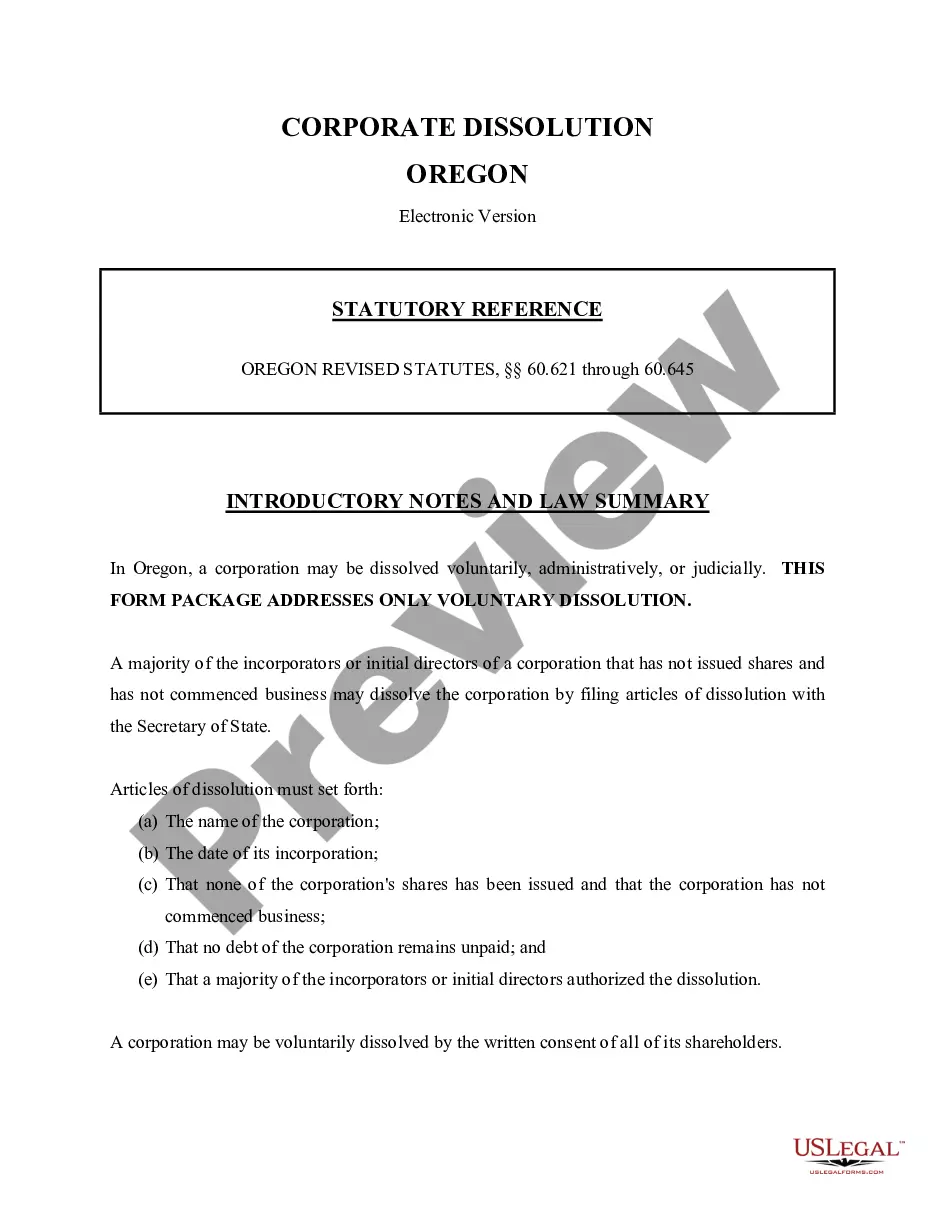
Ratification and Bonus Receipt For Party Not Signing Lease, Or Who Does Not Own Executive Rights
About this form
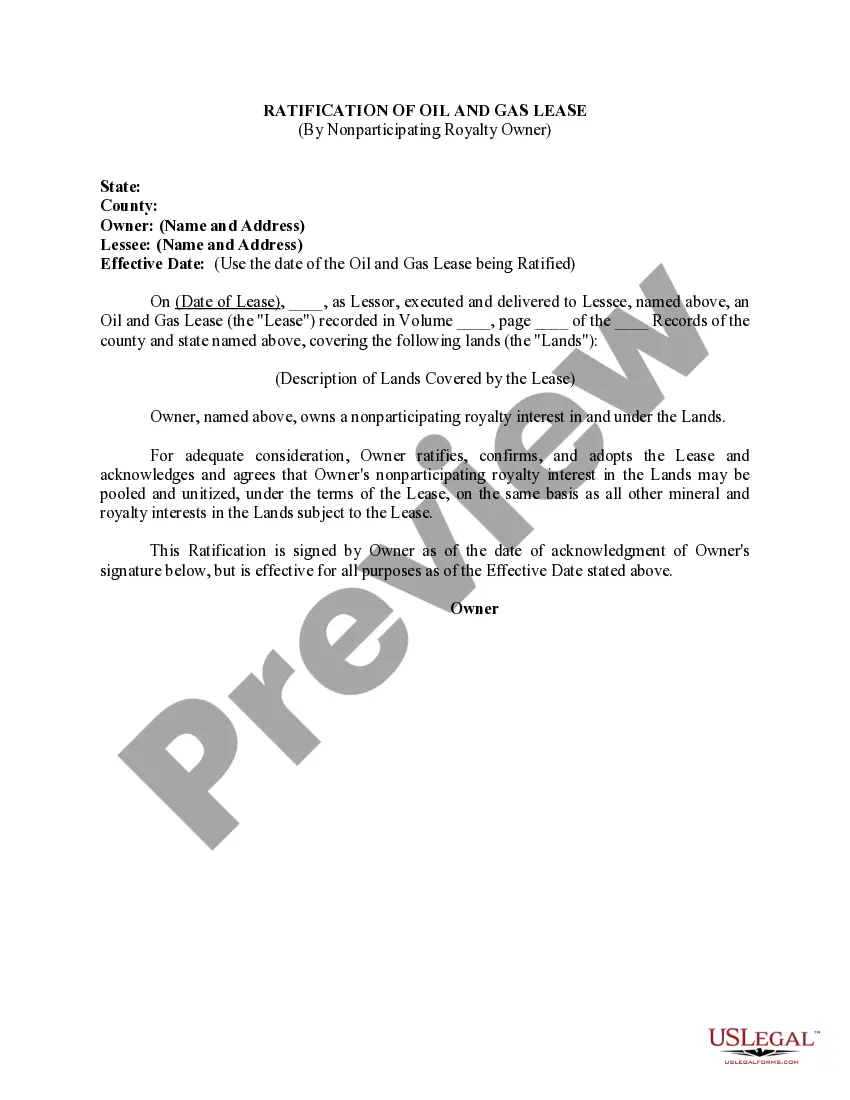
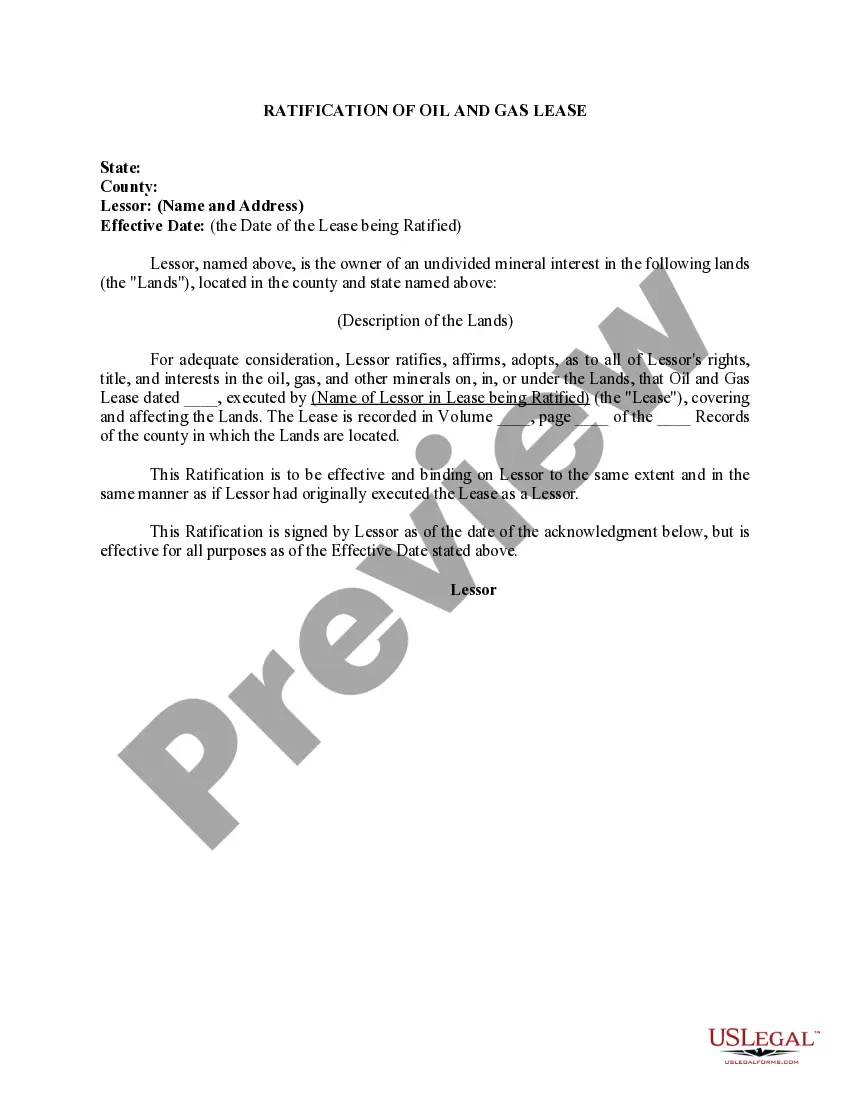
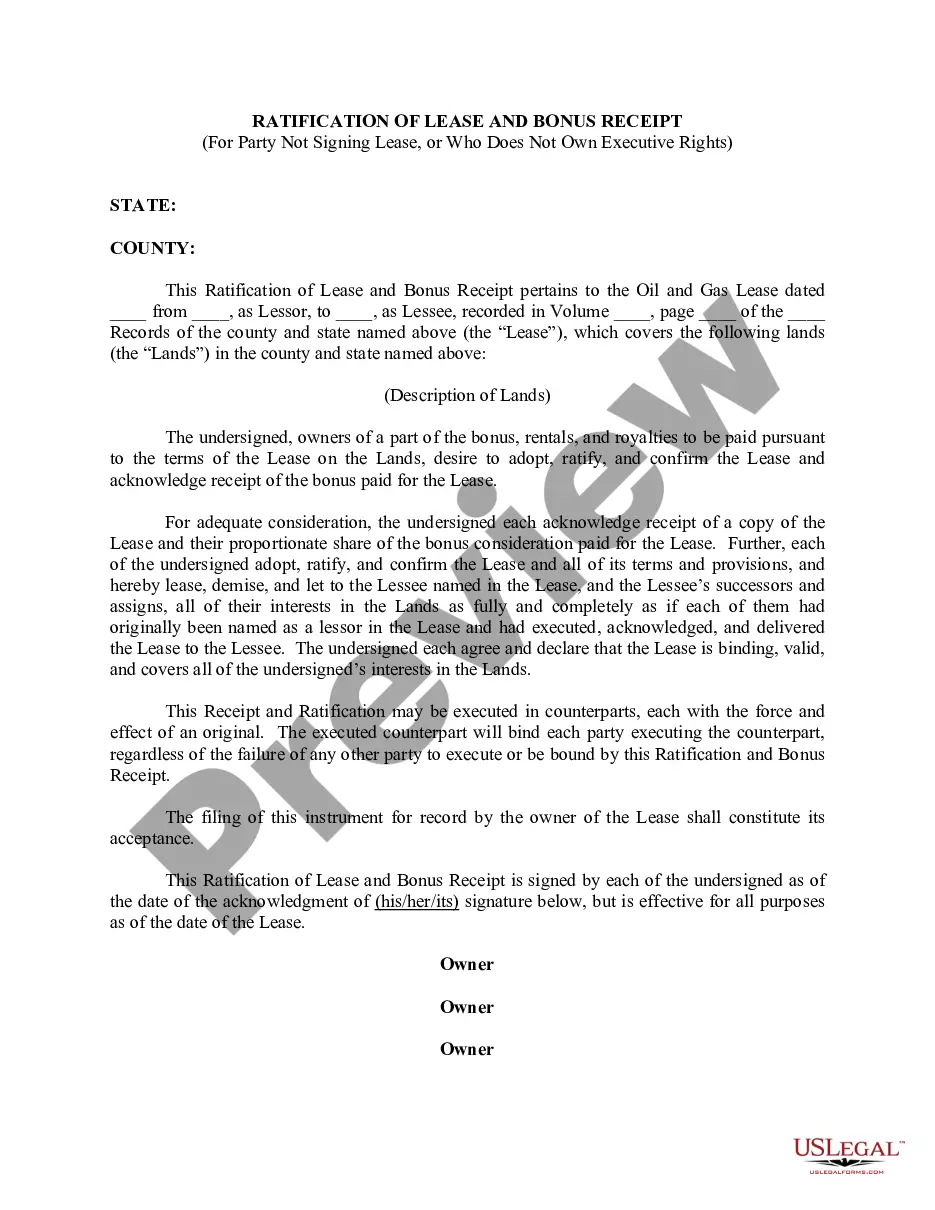
The Ratification and Bonus Receipt for Party Not Signing Lease, or Who Does Not Own Executive Rights is a legal document used to formally confirm and accept an Oil and Gas Lease. This form allows parties who may not have signed the original lease, or who do not own executive rights, to affirm their interest in the lease. It ensures that all parties acknowledge their share of bonuses, rentals, and royalties as defined in the lease agreement, providing clarity and legal certainty regarding their interests in the property.
What’s included in this form
- Identification of the parties involved, including property owners and lessees.
- Reference to the specific Oil and Gas Lease, including recording information.
- Acknowledgment of the receipt of the bonus payment and confirmation of the lease.
- Agreement that the lease terms are binding and valid for all undersigned parties.
- Signatures of all owners with their corresponding social security numbers.

Common use cases
This form should be used in situations where multiple property owners want to confirm their interest in an existing Oil and Gas Lease but did not originally sign it. It is particularly useful when some property owners wish to receive a share of bonuses and royalties without having executive rights or when they need to ratify an agreement post-signature by other parties involved.
Who this form is for
- Property owners who did not sign the original lease agreement.
- Individuals who do not hold executive rights over the property in question.
- Any parties interested in formally acknowledging their share in the lease's financial benefits.
Instructions for completing this form
- Identify the parties involved by listing the property owners and the named lessee.
- Reference the Oil and Gas Lease, including its recording volume and page number.
- Specify the description of the lands covered by the lease.
- Acknowledge the receipt of the bonus payment and confirm acceptance of the lease terms.
- Gather signatures from all parties involved along with their social security numbers for identification purposes.
Notarization requirements for this form
This form does not typically require notarization unless specified by local law. However, having it notarized can provide an additional layer of validation and acceptance of the agreement.
Get your form ready online
Our built-in tools help you complete, sign, share, and store your documents in one place.
Make edits, fill in missing information, and update formatting in US Legal Forms—just like you would in MS Word.
Download a copy, print it, send it by email, or mail it via USPS—whatever works best for your next step.
Sign and collect signatures with our SignNow integration. Send to multiple recipients, set reminders, and more. Go Premium to unlock E-Sign.
If this form requires notarization, complete it online through a secure video call—no need to meet a notary in person or wait for an appointment.
We protect your documents and personal data by following strict security and privacy standards.

Make edits, fill in missing information, and update formatting in US Legal Forms—just like you would in MS Word.

Download a copy, print it, send it by email, or mail it via USPS—whatever works best for your next step.

Sign and collect signatures with our SignNow integration. Send to multiple recipients, set reminders, and more. Go Premium to unlock E-Sign.

If this form requires notarization, complete it online through a secure video call—no need to meet a notary in person or wait for an appointment.

We protect your documents and personal data by following strict security and privacy standards.
Mistakes to watch out for
- Failing to include all necessary signatures from property owners.
- Not referencing the correct recording volume and page for the lease.
- Excluding social security numbers, which may be required for legal identification.
Why use this form online
- Convenience of instant access and download from anywhere.
- Editable fields allow for personalized adjustments without confusion.
- Reliability of professionally drafted forms by licensed attorneys.
Looking for another form?
Form popularity
FAQ
A Non-Participating Royalty Interest (NPRI) is an interest in oil and gas production which is created from the mineral estate.The owner of a NPRI has fewer rights than does the 'regular' royalty owner, who participates in at least one, if not all, of the aforementioned activities.
Oil and gas lease is an agreement between a mineral owner (lessor) and a company (lessee) in which the owner grants the company the right to explore, drill and produce oil, gas, and other minerals below the surface of the earth.
To ratify a lease means that the landowner and oil & gas producer, as current lessor and lessee of the land, agree (or re-agree) to the terms of the existing lease.
A non-executive mineral interest means the owner of the mineral interest has ceded their right to lease the interest. The non-executive mineral owner still reserves the right to receive their share of any bonus or royalty paid in relation to the involved mineral interest lease as granted by the holder.
I am talking about the concept known as executive rights. The executive right, in the context of mineral ownership, is the actual right to negotiate and enter into a mineral lease agreement. This usually lies with the ownership of the minerals, but not always.
Not necessarily. Where your royalty is based on volume of production and your lease is for a period of years and as much longer as oil and gas is produced, or similar language is contained in your lease, your lease may not automatically expire at the end of its primary term.
An executive right is the right to execute oil and gas leases.The sticks that are associated with mineral interests are: the right or lease (the executive right), the right to receive bonus payments, the right to delay rentals, and the right to receive royalties.
When it comes to mineral rights, the standard admonition has long been consistent and emphatic: Avoid selling them. After all, simply owning mineral rights costs you nothing. There are no liability risks, and in most cases, taxes are assessed only on properties that are actively producing oil or gas.
To ratify a lease means that the landowner and oil & gas producer, as current lessor and lessee of the land, agree (or re-agree) to the terms of the existing lease.In all likelihood, the lessee (usually the current producer) believes that you have legitimate grounds to break the existing lease.