3.08 Disparate Impact
Overview of this form
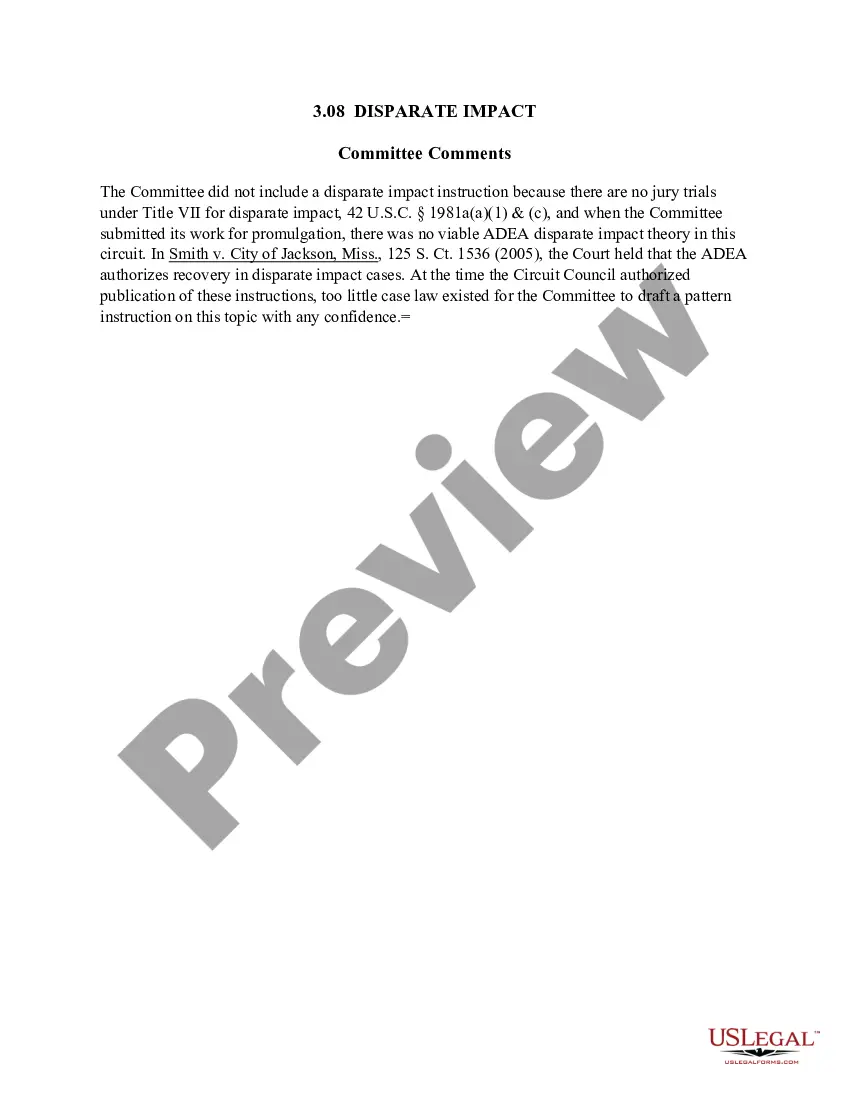
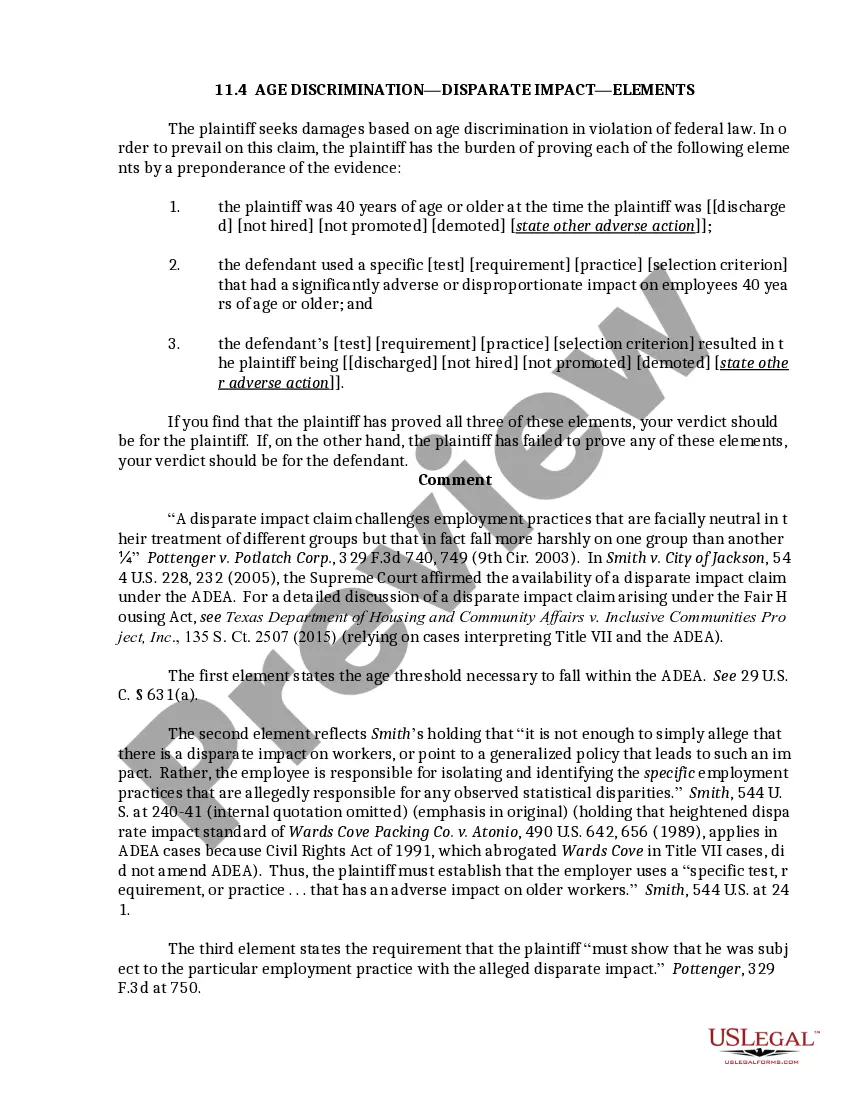
The 3.08 Disparate Impact form is an official pattern jury instruction adopted by the Federal 7th Circuit Court. This form outlines legal standards related to disparate impact claims under employment discrimination laws, specifically Title VII and the Age Discrimination in Employment Act (ADEA). It serves a distinct purpose by providing guidelines for jury instructions related to these complex legal issues, helping juries understand the nuances of disparate impact claims in workplace discrimination cases.
Key components of this form
- Committee Comments: Discusses the absence of a specific instruction for disparate impact cases at the time of publication.
- Legal Standards: Clarifies the legal framework surrounding disparate impact claims, referencing relevant case law.
- Context of Use: Explains the validity of using this instruction in the context of jury trials for discrimination cases.
Situations where this form applies
This form is essential in situations involving allegations of employment discrimination based on policies that disproportionately affect a certain group. It applies particularly when an employer's policies may lead to disparate outcomes affecting protected classes, even if such policies are not inherently discriminatory. This form guides juries in understanding how to assess whether a practice causes significant negative impacts on a subgroup compared to others.
Intended users of this form
Individuals or entities that may need this form include:
- Attorneys representing clients in employment discrimination cases.
- Parties involved in jury trials concerning allegations of disparate impact.
- Employers seeking to understand the legal standards applicable to their employment practices.
Instructions for completing this form
- Review the jury instruction and associated legal standards thoroughly to understand the implications.
- Ensure the form is customized to fit the specific case details being addressed.
- Consult legal counsel if necessary to clarify any complex points related to disparate impact.
- Present the form to the jury during the trial process, ensuring they understand its contents.
- Adjust the language as needed to align with the particular circumstances of the case.
Is notarization required?
This form does not typically require notarization to be legally valid. However, some jurisdictions or document types may still require it. US Legal Forms provides secure online notarization powered by Notarize, available 24/7 for added convenience.
Get your form ready online
Our built-in tools help you complete, sign, share, and store your documents in one place.
Make edits, fill in missing information, and update formatting in US Legal Forms—just like you would in MS Word.
Download a copy, print it, send it by email, or mail it via USPS—whatever works best for your next step.
Sign and collect signatures with our SignNow integration. Send to multiple recipients, set reminders, and more. Go Premium to unlock E-Sign.
If this form requires notarization, complete it online through a secure video call—no need to meet a notary in person or wait for an appointment.
We protect your documents and personal data by following strict security and privacy standards.

Make edits, fill in missing information, and update formatting in US Legal Forms—just like you would in MS Word.

Download a copy, print it, send it by email, or mail it via USPS—whatever works best for your next step.

Sign and collect signatures with our SignNow integration. Send to multiple recipients, set reminders, and more. Go Premium to unlock E-Sign.

If this form requires notarization, complete it online through a secure video call—no need to meet a notary in person or wait for an appointment.

We protect your documents and personal data by following strict security and privacy standards.
Mistakes to watch out for
- Failing to contextualize the form to the specific circumstances of a case.
- Overlooking the significance of federal case law impacting disparate impact claims.
- Not consulting legal counsel to ensure all relevant legal arguments are properly articulated.
Why use this form online
- Convenient access to professionally drafted legal forms at any time.
- Editable formats allow for customization based on specific case needs.
- Reliable guidance from legal experts ensures compliance with legal standards.
Legal use & context
- Disparate impact claims are evaluated differently from intentional discrimination claims.
- Underscores the importance of statistical evidence in proving disparate impact.
- This form reflects evolving legal standards, emphasizing the need for accurate jury instructions in trial contexts.
Looking for another form?
Form popularity
FAQ
Disparate impact claims can be filed by employees working for public or private employers. For example, a 2006 case implicated the practices of a private employer involving pre-employment strength tests. These tests were discriminatory and resulted in a disparate impact on women.
The disparate impact test ? the 80% rule The 80% rule was first published in the State of California Guidelines on Employee Selection Procedures in October 1972. Ever since it became a common rule in companies to ensure fair representation of protected minorities.
To establish an adverse disparate impact, the investigating agency must (1) identify the specific policy or practice at issue; (2) establish adversity/harm; (3) establish significant disparity; 9 and (4) establish causation.
Example of disparate impact: hiring more men than women as construction workers as a result of physical height or strength (unintentional discrimination).
A common and simple example of ?disparate impact? discrimination is when an employer has a policy that it will only hire individuals who are a certain minimum height or who can lift a certain minimum weight. Courts have found height restrictions disproportionately impact women and certain races.
For an applicant to say they were a victim of intentional discrimination ? disparate treatment ? he or she has to show they were treated unfairly based on race, color, religion, sex or national origin. If the applicant can't show there was intent, it would be disparate impact.
Disparate impact occurs when seemingly neutral policy or practice negatively impacts people of a protected class. Unlike disparate treatment, disparate impact can be unintentional, but that doesn't mean it isn't unlawful employment discrimination.
So, what is disparate treatment discrimination then? Simply put, disparate treatment discrimination is when an employer outright treats an employee or a potential employee differently because of that person's race, religion, color, sex, national origin, etc.