Armed Postal/U.S. Property Robbery 18 U.S.C. Sec. 2114(a)
About this form
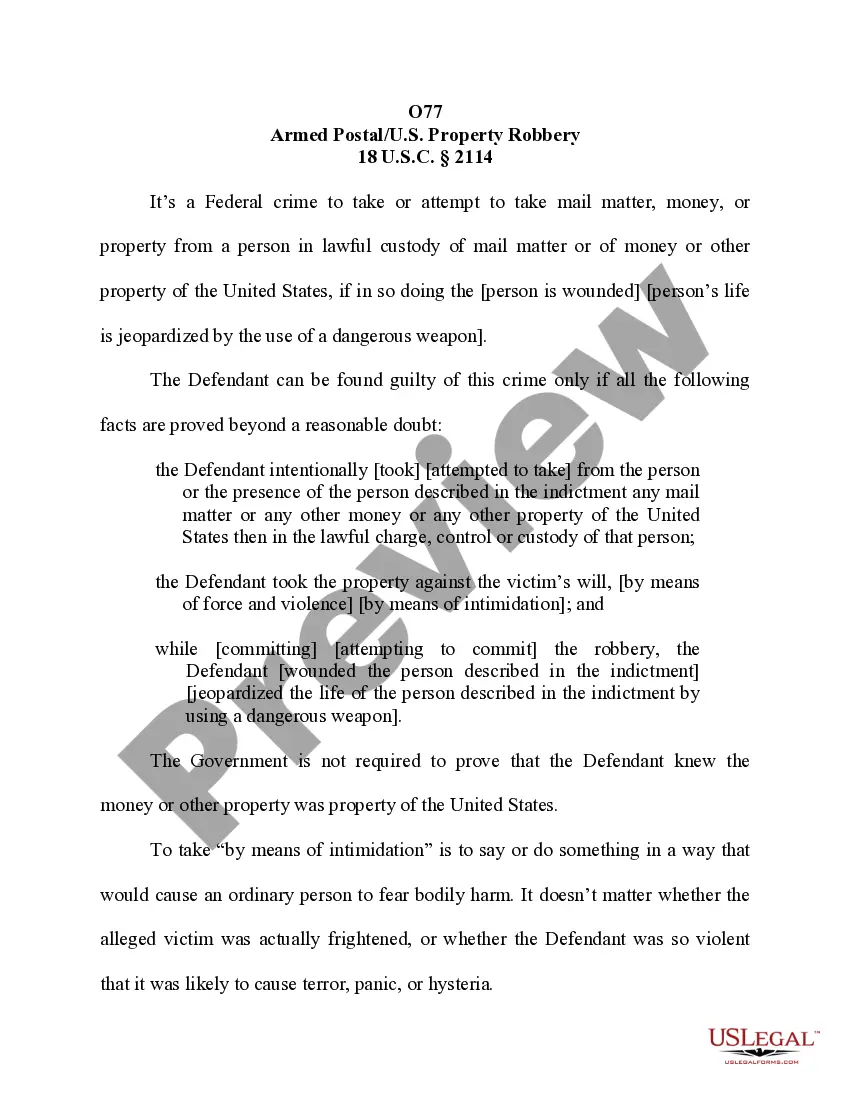
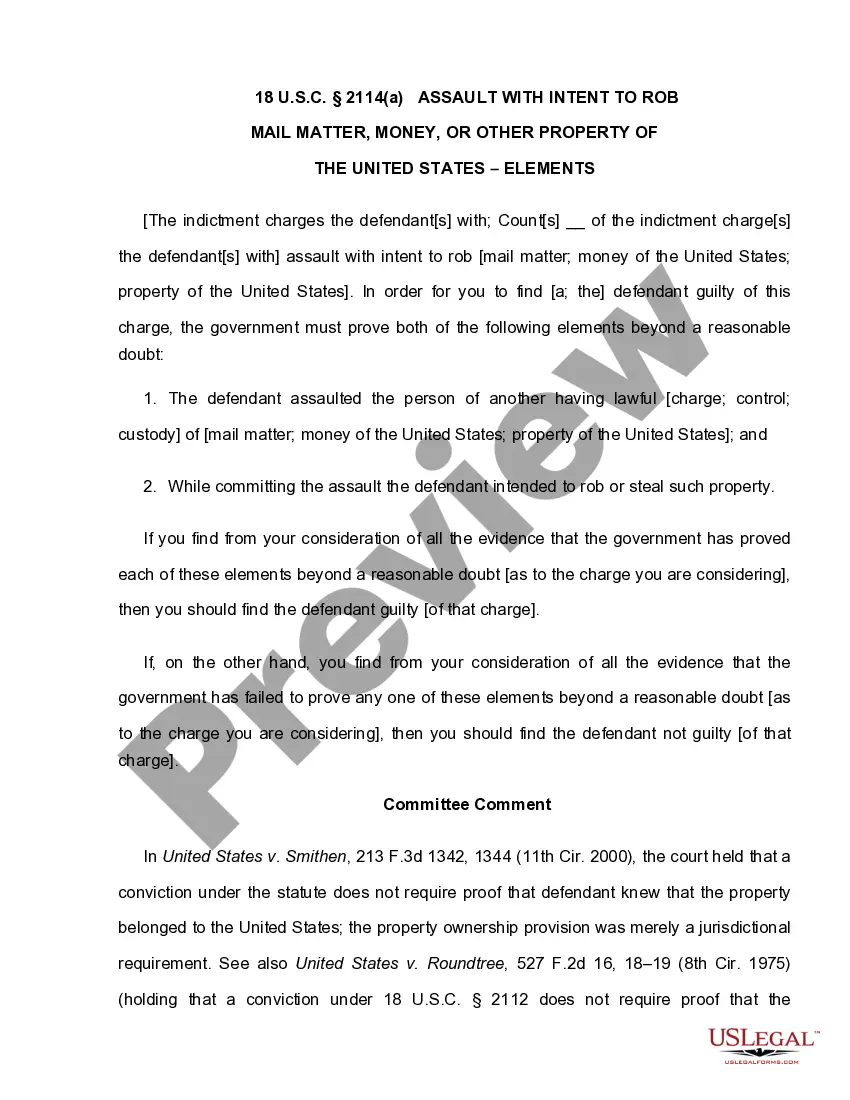
The Armed Postal/U.S. Property Robbery form, based on 18 U.S.C. Sec. 2114(a), is a legal document outlining the federal crime of taking or attempting to take property from a person in lawful custody of U.S. mail, money, or other government property. This form specifically addresses the circumstances under which a defendant can be found guilty of this crime, distinguishing it from other robbery statutes by focusing on the use of intimidation or dangerous weapons in the commission of the offense.
Key parts of this document
- Definition of the crime: details about taking property under intimidation or by force.
- Criteria for guilt: outlines what must be proved beyond a reasonable doubt to convict the defendant.
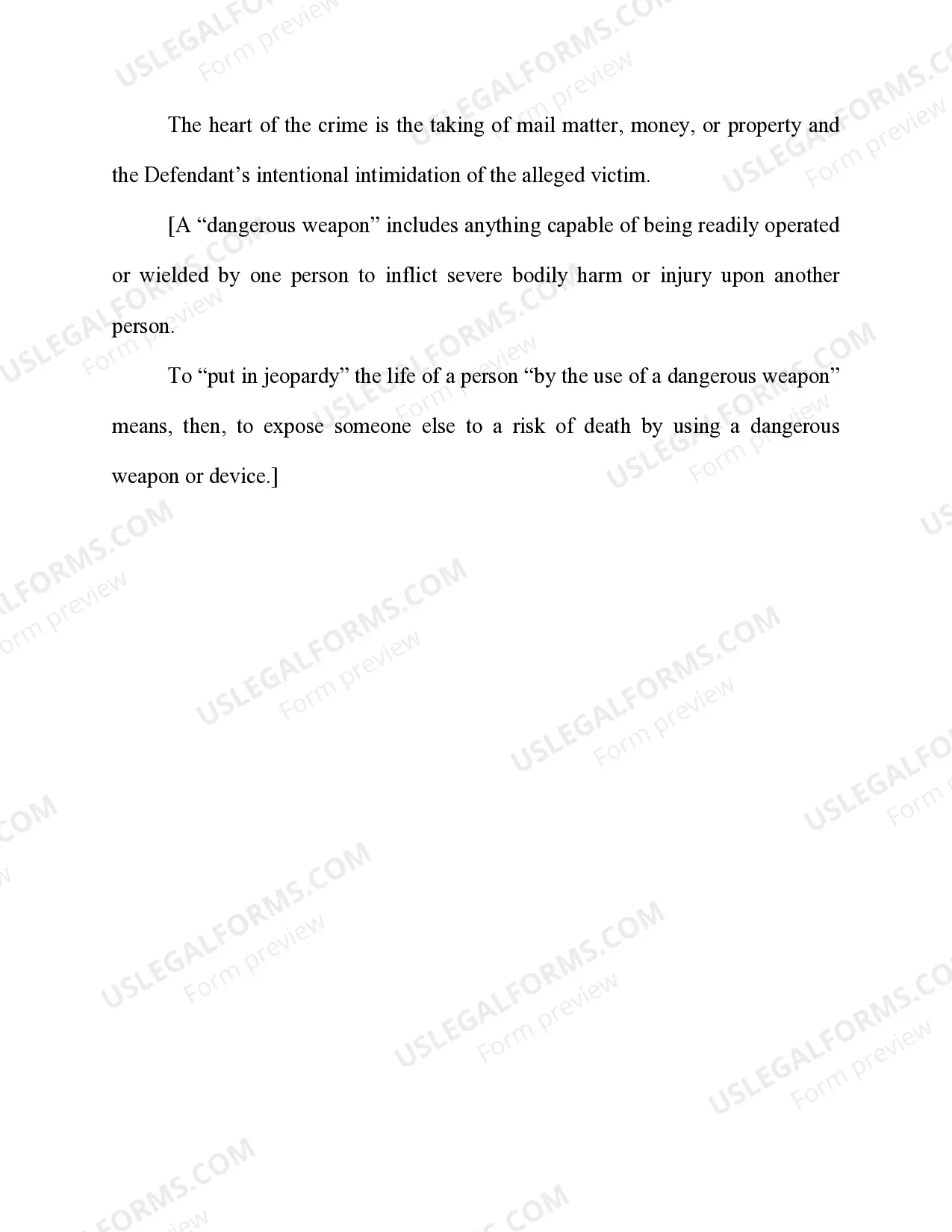
- Terms defined: explanations of key terms like "dangerous weapon" and "intimidation."
- Recipient of property: specifies that the property must be in the lawful custody of the victim.
- Intent requirement: clarifies the need for the defendant to act intentionally during the crime.
When to use this document
This form is used in cases where a federal offense of robbery involving U.S. postal property or funds has occurred. It may be necessary during criminal proceedings to clarify the charges against a defendant and to outline the necessary elements that must be proven for a conviction. This form serves as a guide for juries during trials involving such charges.
Who this form is for
This form should be used by:
- Legal professionals involved in federal criminal cases.
- Judges seeking to provide jury instructions in robbery cases involving U.S. mail or property.
- Prosecutors aiming to present clear and comprehensive charges related to armed robbery of federal property.
- Defendants and their attorneys examining the legal framework of robbery charges against them.
Instructions for completing this form
- Review the specific charges against the defendant for clarity.
- Ensure all elements of the crime are clearly defined as outlined in the key components.
- Gather evidence proving the crime, including circumstances of intimidation or use of a dangerous weapon.
- Prepare detailed jury instructions that incorporate the definitions and requirements from this form.
- Submit the form in a legal document for use in the courtroom during jury instructions.
Is notarization required?
This form does not typically require notarization to be legally valid. However, some jurisdictions or document types may still require it. US Legal Forms provides secure online notarization powered by Notarize, available 24/7 for added convenience.
Get your form ready online
Our built-in tools help you complete, sign, share, and store your documents in one place.
Make edits, fill in missing information, and update formatting in US Legal Forms—just like you would in MS Word.
Download a copy, print it, send it by email, or mail it via USPS—whatever works best for your next step.
Sign and collect signatures with our SignNow integration. Send to multiple recipients, set reminders, and more. Go Premium to unlock E-Sign.
If this form requires notarization, complete it online through a secure video call—no need to meet a notary in person or wait for an appointment.
We protect your documents and personal data by following strict security and privacy standards.

Make edits, fill in missing information, and update formatting in US Legal Forms—just like you would in MS Word.

Download a copy, print it, send it by email, or mail it via USPS—whatever works best for your next step.

Sign and collect signatures with our SignNow integration. Send to multiple recipients, set reminders, and more. Go Premium to unlock E-Sign.

If this form requires notarization, complete it online through a secure video call—no need to meet a notary in person or wait for an appointment.

We protect your documents and personal data by following strict security and privacy standards.
Typical mistakes to avoid
- Failing to clearly define "intimidation," which can lead to jury confusion.
- Not ensuring all elements of the crime are supported by evidence presented.
- Overlooking the requirement for proof beyond a reasonable doubt in jury instructions.
- Using terms incorrectly or failing to define key concepts adequately.
Benefits of completing this form online
- Convenience: Access the form from anywhere at any time without the need for in-person visits.
- Editability: Customize the form to fit the specific needs of your case.
- Reliability: Ensure you are using a template based on current legal standards and practices.
- Easy download: Get a copy that you can print and keep for your records.
Looking for another form?

Form popularity
FAQ
Sale or Receipt of Stolen Goods ? 18 U.S.C. 18 U.S.C. §2315 makes it unlawful to knowingly receive, possess, conceal, sell, or dispose of stolen property which has a value of $5,000 or more and which is a part of interstate commerce.
Section 1832 of Title 18 of the United States Code legally defines the federal crime of theft of trade secrets, including some of the most valuable intellectual property owned by a company or person. In 1997, the Economic Espionage Act took effect.
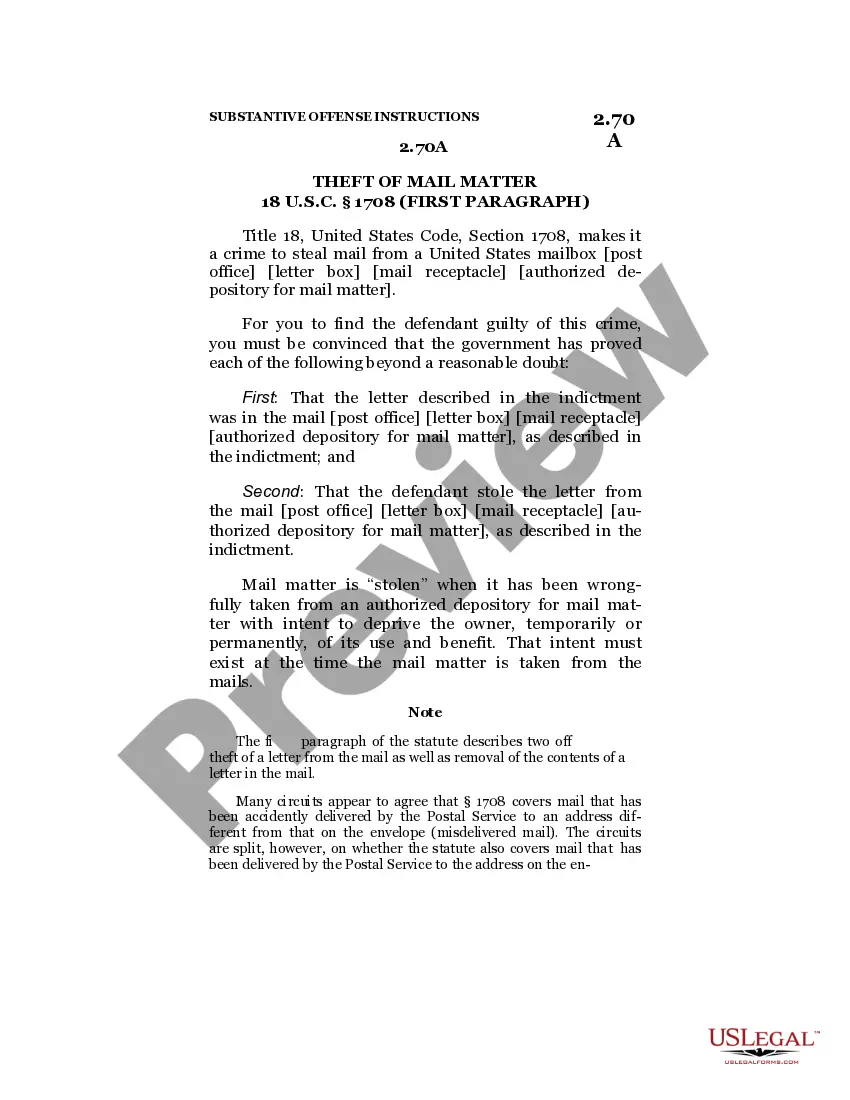
Robbery Or Theft Of Mail, Money Or Property Of The U.S. -- 18 U.S.C. 2114. Section 2114 of Title 18 prohibits assaulting with intent to rob "any person having lawful charge, control, or custody of any mail matter or of any money or other property of the United States..." and the robbing of such a person.
Whatever the motivation, the act is classified as a violent crime, because armed robberies can result in injury and sometimes death to victims.
Theft of government property under 18 U.S.C. § 641 makes it a crime to steal, embezzle, or knowing convert with intent for your own personal gain the property, or to sell, convey, or dispose of any record, voucher, money, or something of value issued by a department of the United States government.
18 USC Ch. 103: ROBBERY AND BURGLARY.
If you're convicted of violating 18 U.S.C. 666, you face up to 10 years in prison and a fine of up to $250,000 per count of embezzlement. While the agencies most often prosecute alleged fraud violations under 18 U.S. Code 666, they can also use other statutes, such as; 18 U.S.C.
Section 242 of Title 18 makes it a crime for a person acting under color of any law to willfully deprive a person of a right or privilege protected by the Constitution or laws of the United States.