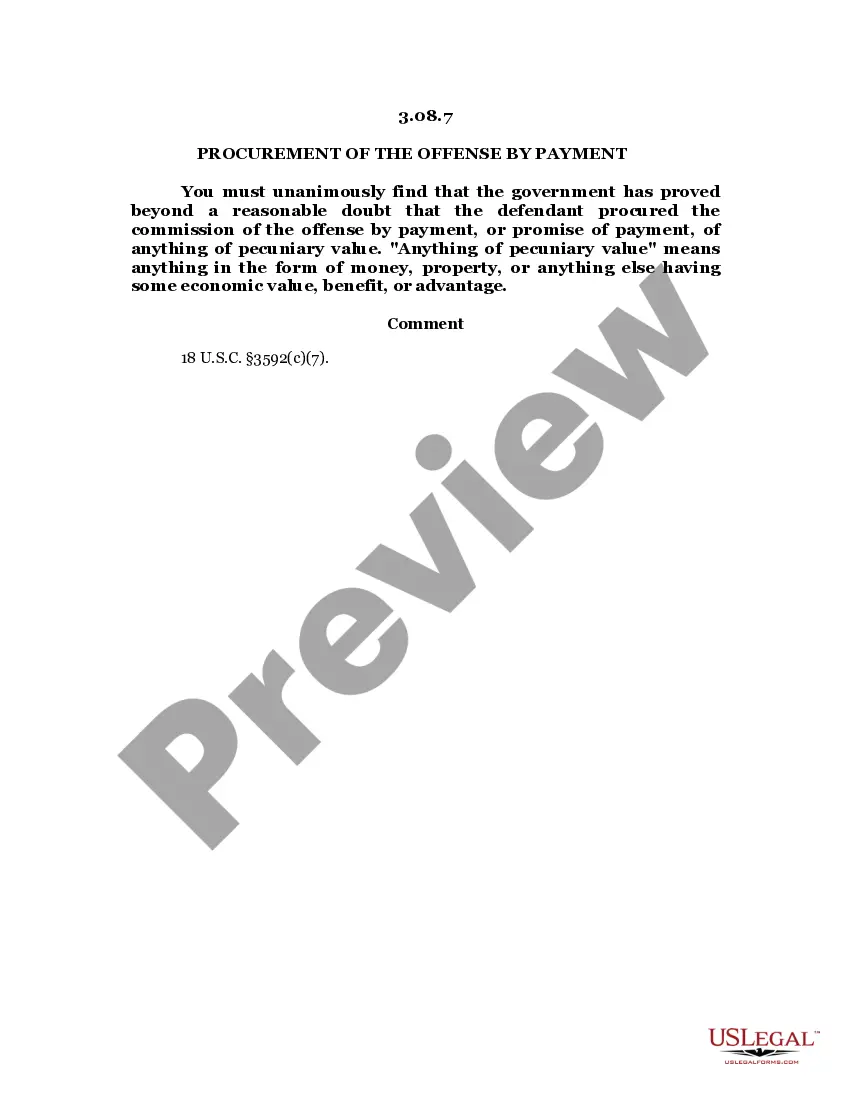
PROCUREMENT OF THE OFFENSE BY PAYMENT
Understanding this form
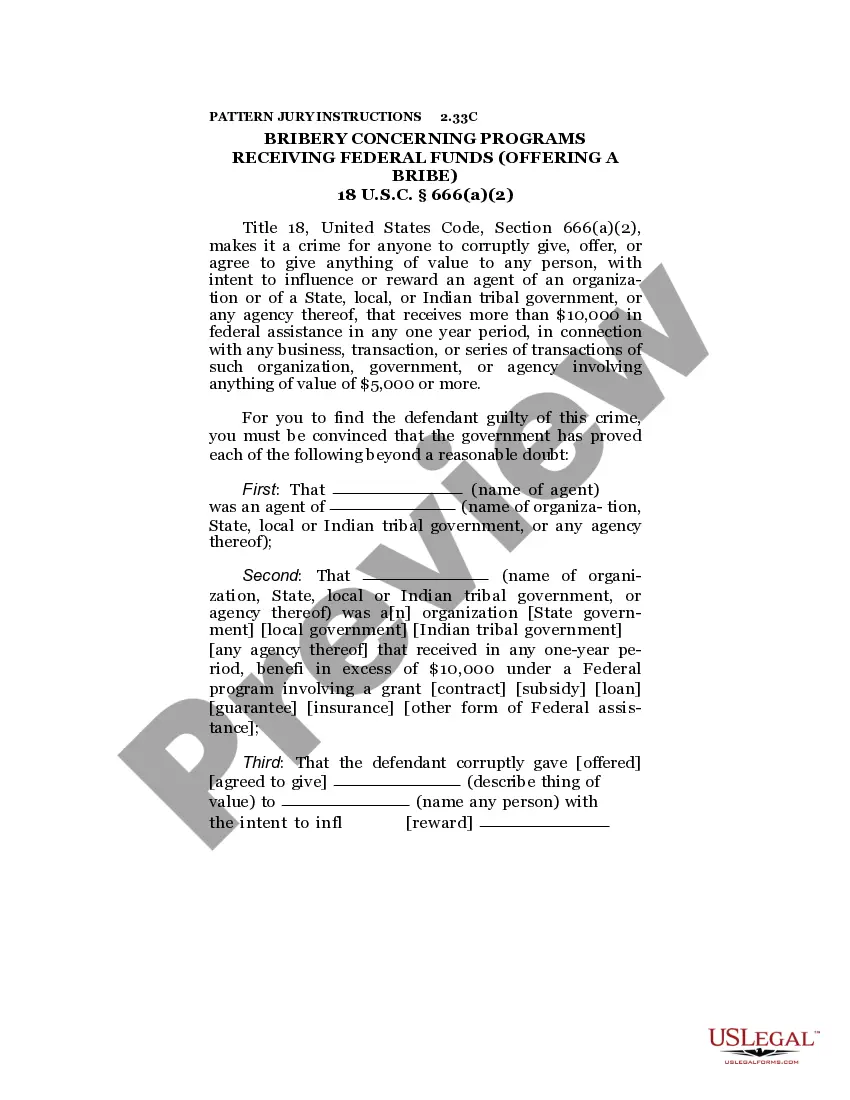
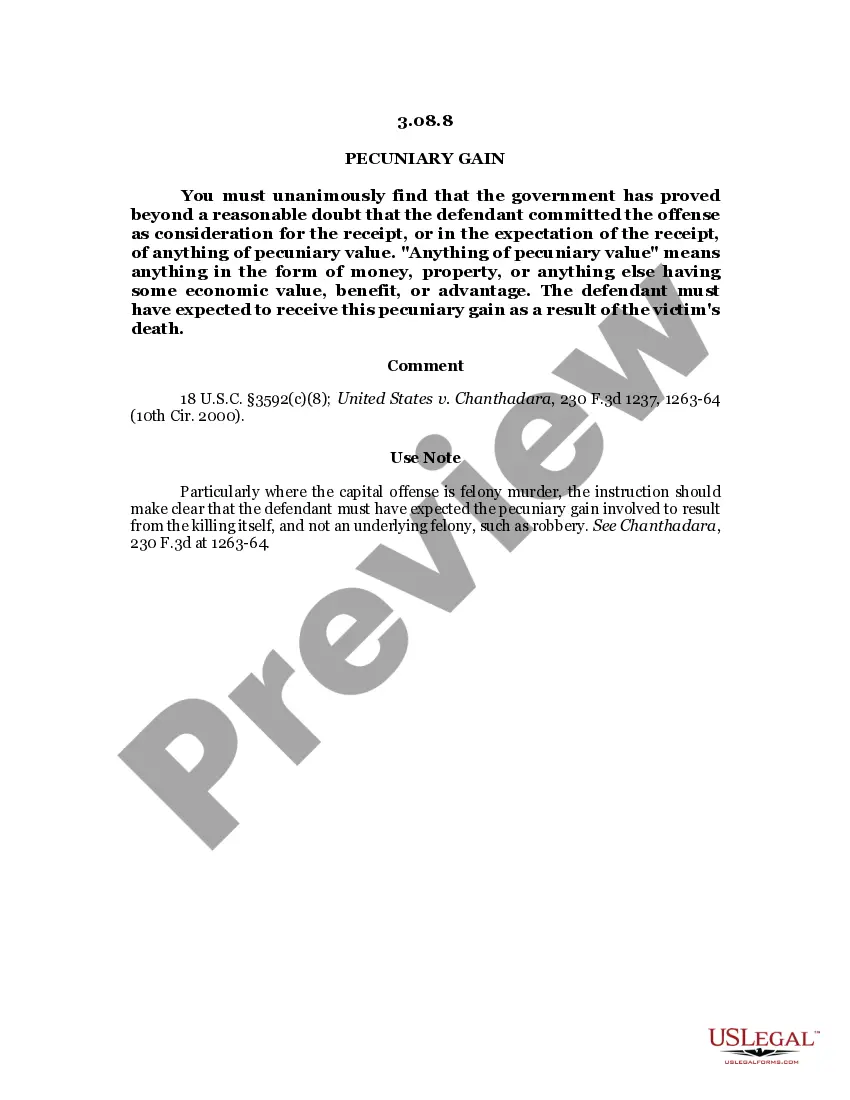
The Procurement of the Offense by Payment form serves as a legal framework to determine if a defendant has unlawfully secured an offense through payment or a promise of payment. It specifically addresses actions involving transactions that provide economic value or benefit, making it distinct from other legal forms that may not focus on the financial aspects of crime procurement.
Form components explained
- Definition of "procured" in the context of offense commission.
- Criteria for determining "anything of pecuniary value" involved in the offense.
- Requirement for unanimous agreement on the proof of payment or promise.
Common use cases
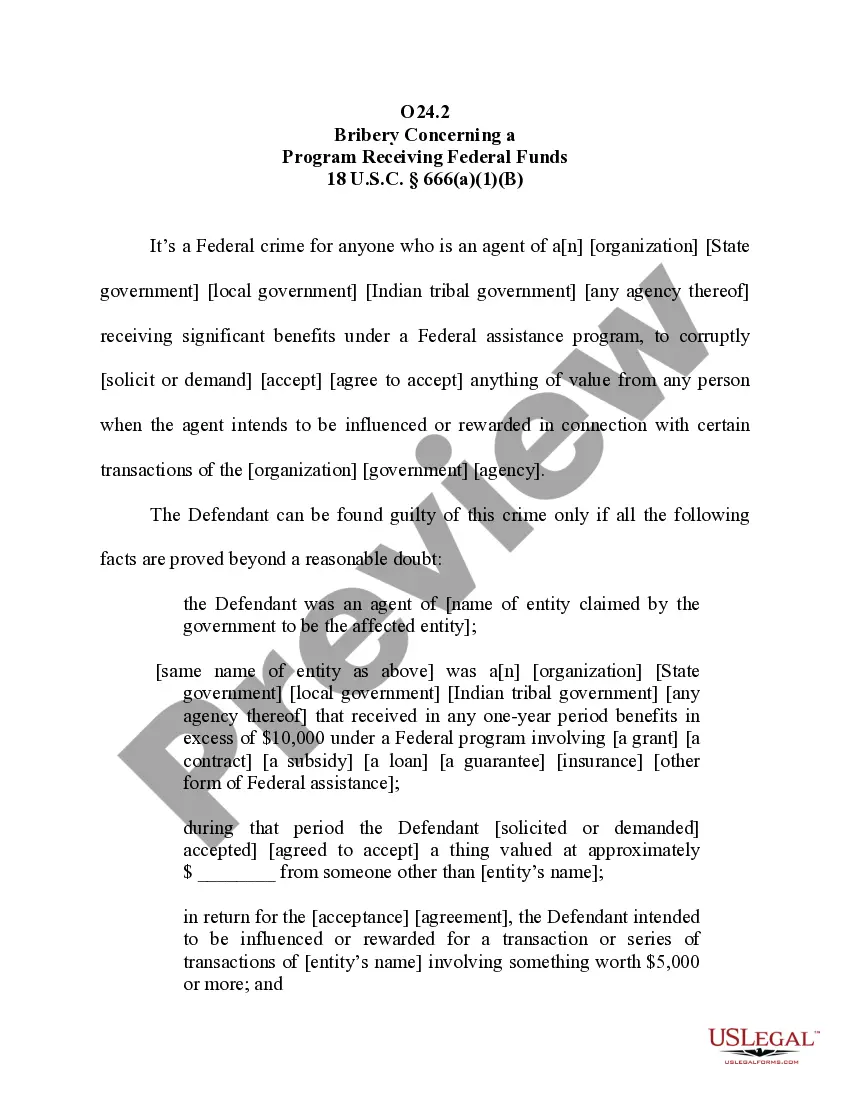
This form is typically used in cases where a government entity is prosecuting an individual for offenses related to bribery, extortion, or other crimes involving financial transactions. It is essential when the prosecution needs to establish that the defendant gained an offense through financial means, ensuring that the legal proceedings are grounded on adequate financial evidence.
Who this form is for
- Prosecutors aiming to prove financial gain in a criminal case.
- Defense attorneys responding to accusations of procurement through payment.
- Legal professionals handling cases of fraud or similar financial crimes.
Instructions for completing this form
- Identify the defendant and the specific charge of the offense.
- Outline the circumstances under which the payment or promise was made.
- Detail the nature of the pecuniary value involved.
- Gather evidence to support the claims of procurement through financial means.
- Ensure unanimous agreement from jurors on the evidence provided.
Notarization guidance
This form usually doesn’t need to be notarized. However, local laws or specific transactions may require it. Our online notarization service, powered by Notarize, lets you complete it remotely through a secure video session, available 24/7.
Get your form ready online
Our built-in tools help you complete, sign, share, and store your documents in one place.
Make edits, fill in missing information, and update formatting in US Legal Forms—just like you would in MS Word.
Download a copy, print it, send it by email, or mail it via USPS—whatever works best for your next step.
Sign and collect signatures with our SignNow integration. Send to multiple recipients, set reminders, and more. Go Premium to unlock E-Sign.
If this form requires notarization, complete it online through a secure video call—no need to meet a notary in person or wait for an appointment.
We protect your documents and personal data by following strict security and privacy standards.

Make edits, fill in missing information, and update formatting in US Legal Forms—just like you would in MS Word.

Download a copy, print it, send it by email, or mail it via USPS—whatever works best for your next step.

Sign and collect signatures with our SignNow integration. Send to multiple recipients, set reminders, and more. Go Premium to unlock E-Sign.

If this form requires notarization, complete it online through a secure video call—no need to meet a notary in person or wait for an appointment.

We protect your documents and personal data by following strict security and privacy standards.
Common mistakes to avoid
- Failing to provide clear definitions of terms such as "pecuniary value."
- Neglecting to gather sufficient evidence to prove the financial transaction.
- Not ensuring unanimous juror agreement on the evidence presented.
Why complete this form online
- Convenience of accessing the form from anywhere at any time.
- Ability to edit and customize the form according to specific case needs.
- Access to reliable templates drafted by licensed attorneys, ensuring legal accuracy.
Looking for another form?
Form popularity
FAQ
Procurement contract payment terms Typically, the buyer will receive the goods, parts, or materials first, and then the buyer will pay for it, sometimes much later. Buyers will always try to negotiate to push out payments for 30, 60, 90, 120 days after receiving goods or services.
1 - Establishing a transparent and fair tendering. 2 - Having in place a well-defined and transparent. 4 - Setting in place fair procedures for communicating. 5 - Establishing in advance the criteria for the evaluation of. 6 - Establishing effective mechanisms or procedures for.
Corruption can be defined and categorized in different ways. The most common types or categories of corruption are supply versus demand corruption, grand versus petty corruption, conventional versus unconventional corruption and public versus private corruption.
Procurement law is the area of law that deals with the purchasing of goods, services, or project construction. Typically, it regulates private companies or government departments. In common law jurisdictions, there are two primary sources of law. First are the statutes and other legislations.
Procurement corruption may occur as a result of a conflict of interest situation where a public official wants to secure for him- or herself and related parties, the benefits which rightly belong to the public, by bypassing the formal requirements for the awarding of these privileges.
They come with Unlawful manipulation and dishonestly obtaining an advantage in the process to acquire goods or service. Types of Procurement Fraud: Collusion between employees and vendors. Vendors defrauding the company. Collusion among vendors within an industry.
Procurement of goods and services as a process is confronted with irregularities emanating from weak control measures. The root causes of corruption in procurement emanate from various weaknesses in the system, the application of policies and the inability to operational anti-corruption measures.
Procurement rules can be violated by limiting the call for bids, or designing tenders and providing confidential information to favour the bribing company.