Summons in a Civil Case-FOIA (30-day answer deadline)
What this document covers
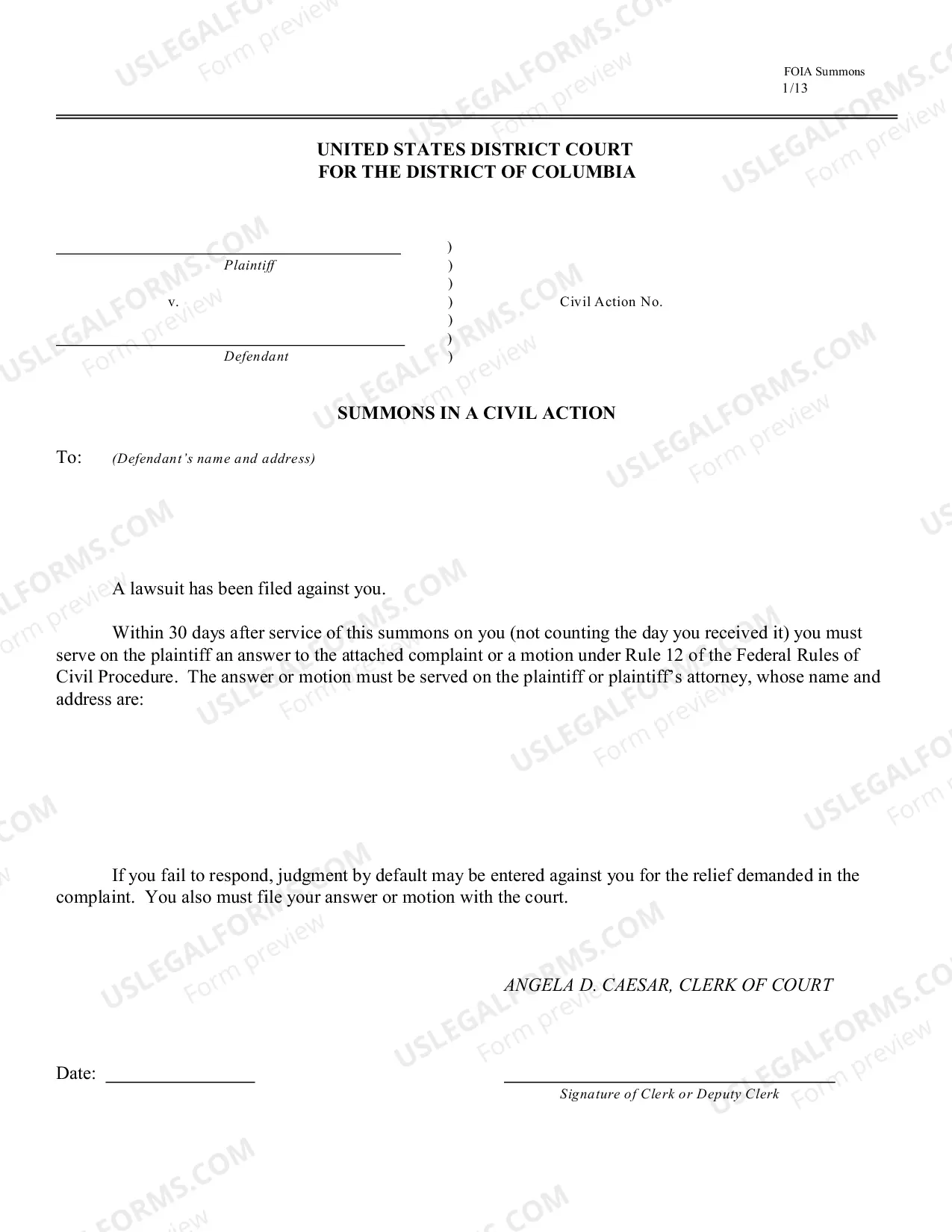
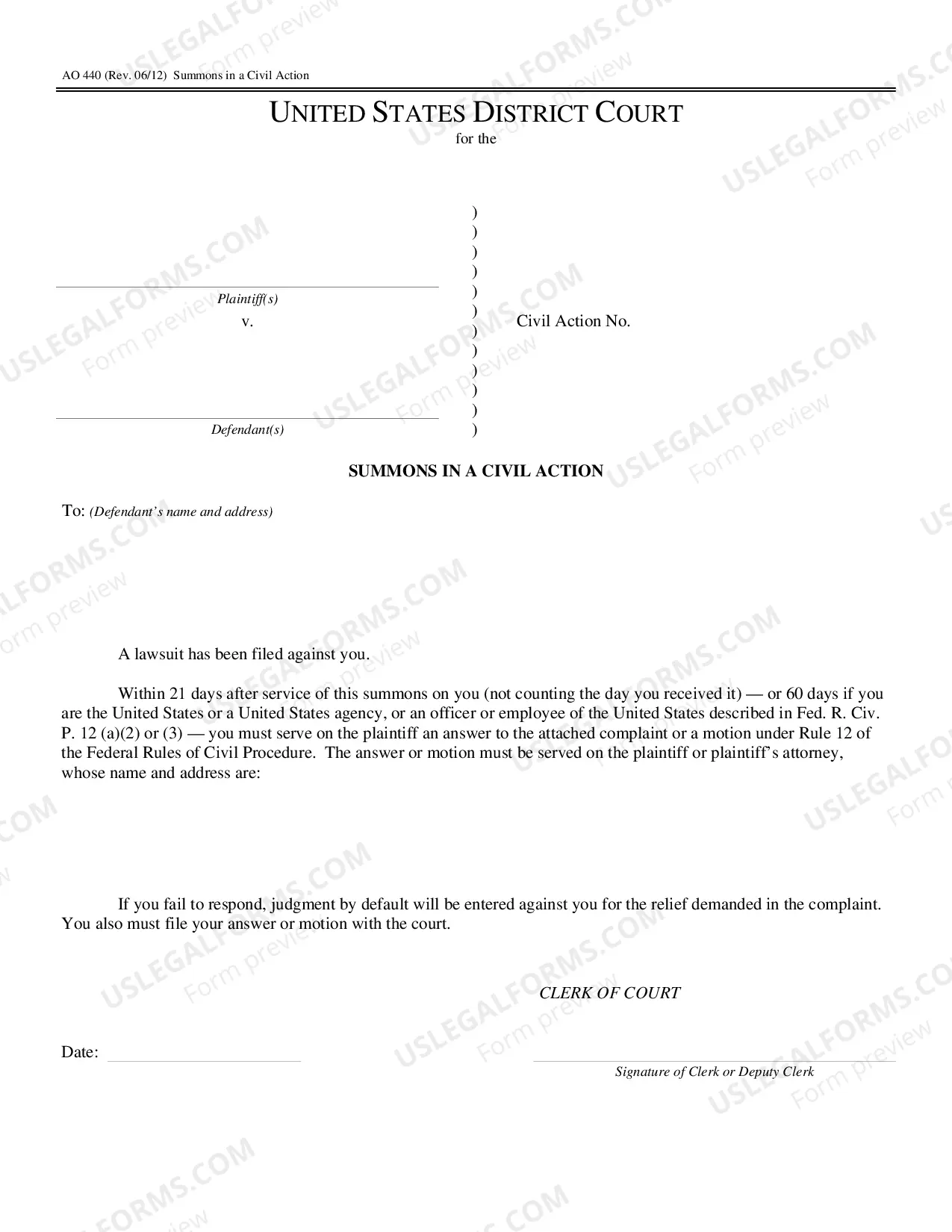
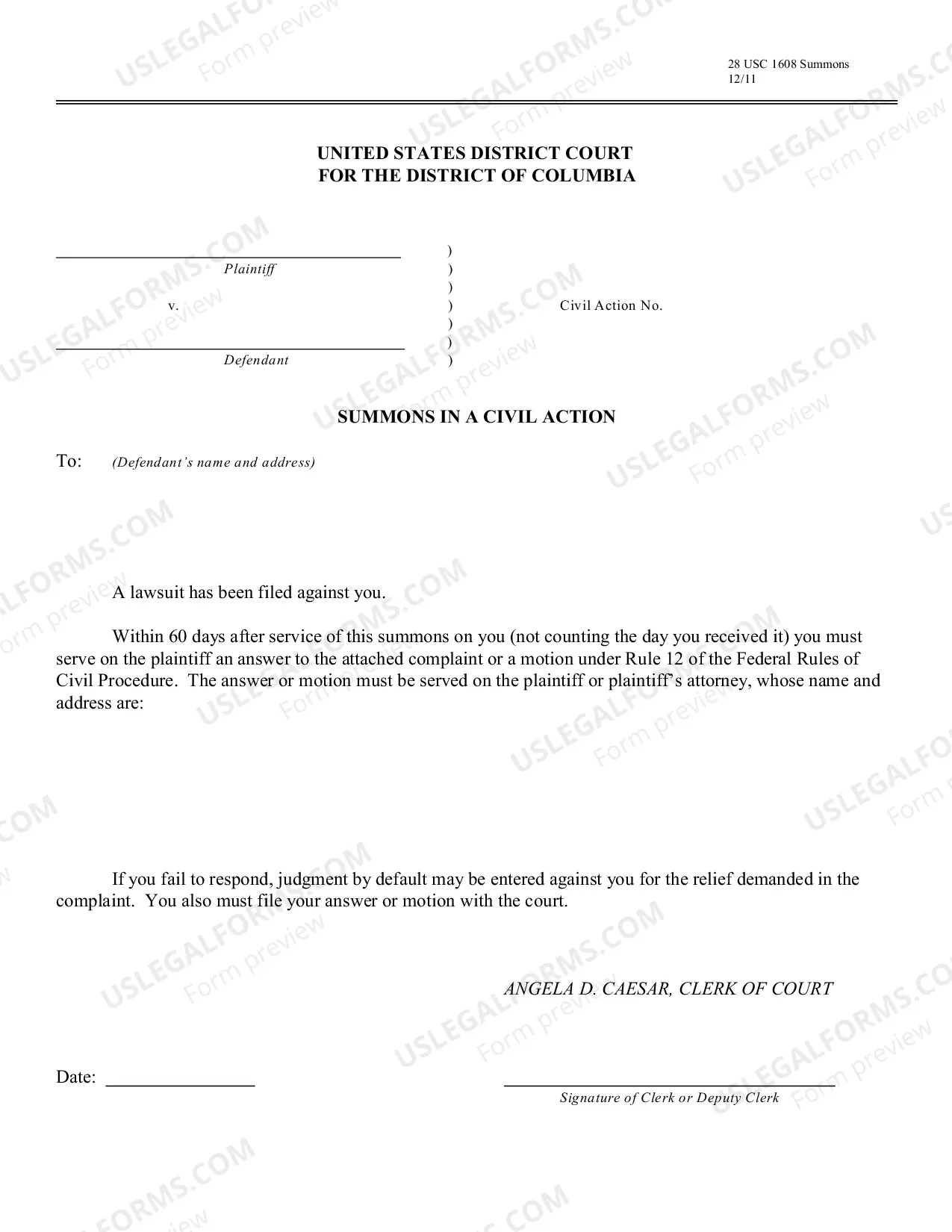
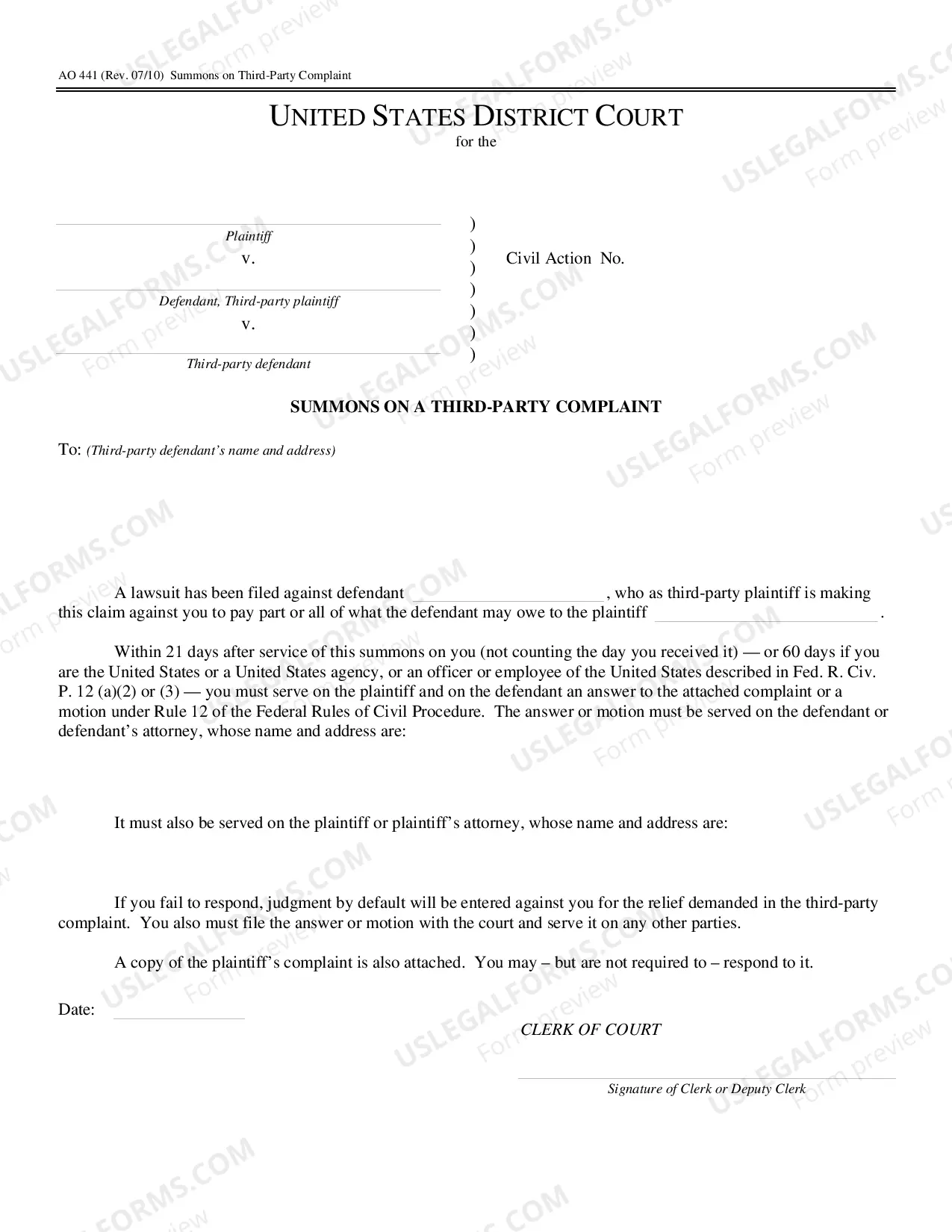
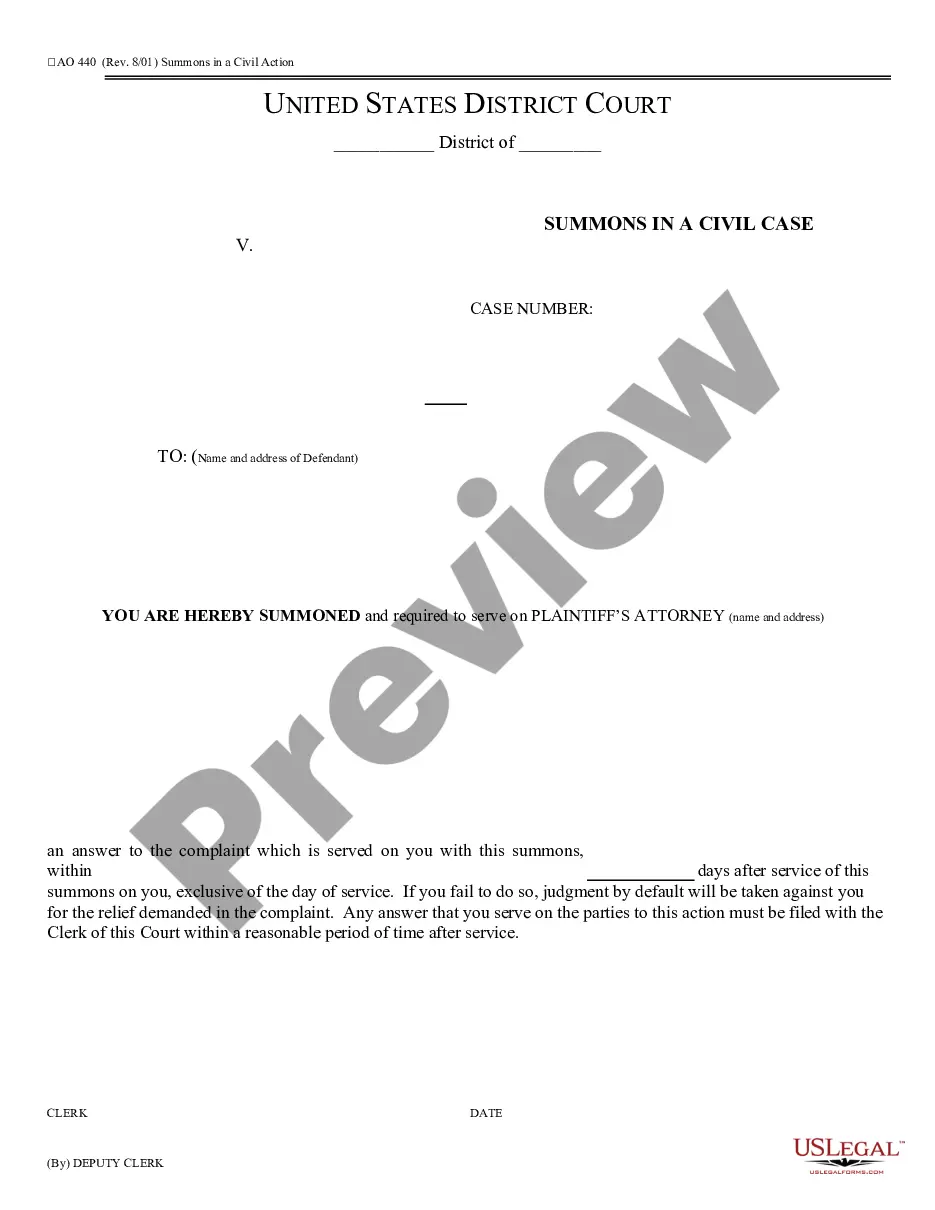
The Summons in a Civil Case-FOIA is a legal document issued by the United States District Court for the District of Columbia. It formally notifies a defendant that a lawsuit has been filed against them under the Freedom of Information Act (FOIA). Unlike general civil summonses, this form specifically includes a 30-day response deadline, whereby the defendant must either answer the complaint or file a motion in court.
What’s included in this form
- Case information: Includes the plaintiff and defendant's names and the civil action number.
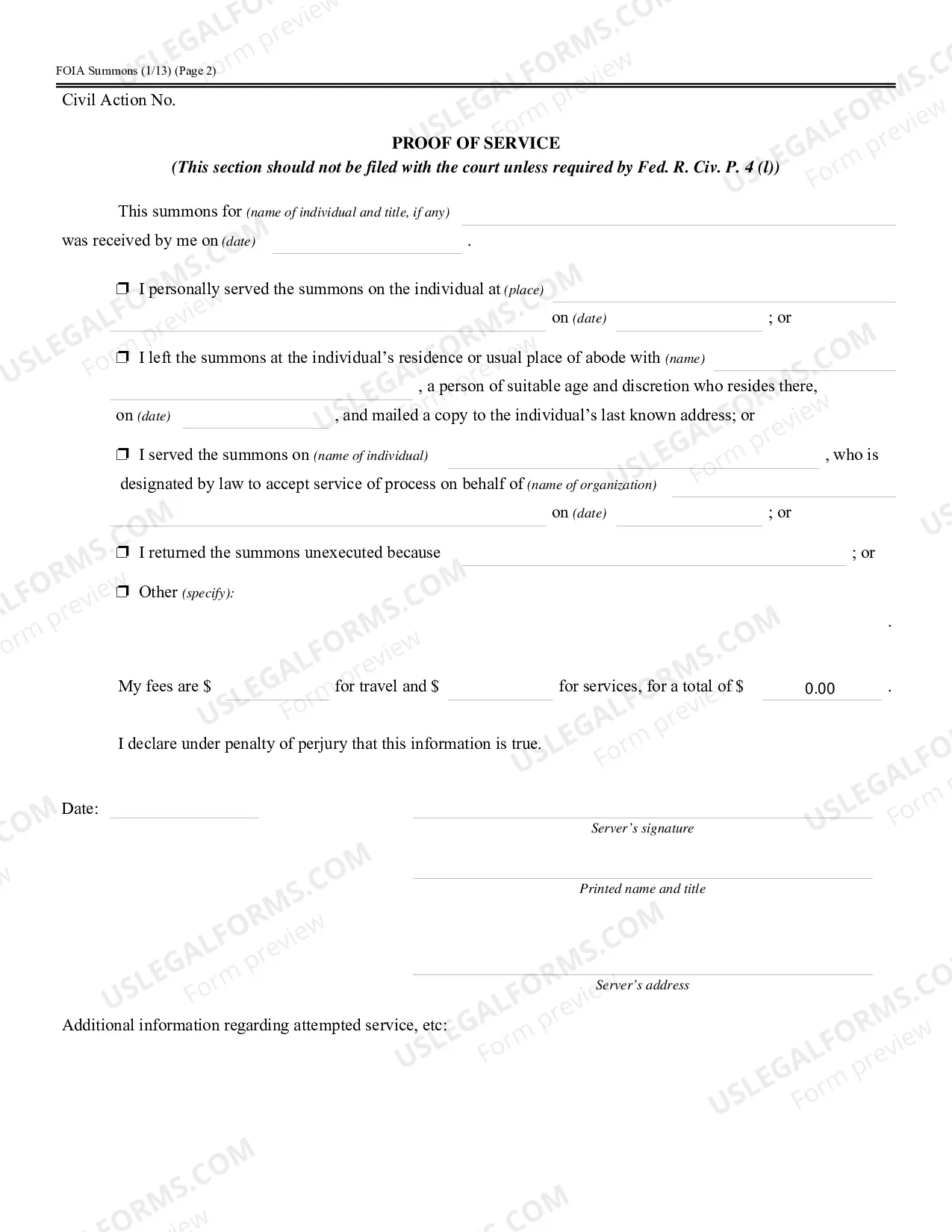
- Service instructions: Details on how and when the summons should be served to the defendant.
- Response deadline: Clearly states that the defendant has 30 days to respond to the summons.
- Clerkâs signature: The form must bear the signature of the Clerk of Court to be valid.
- Proof of service: A section for the server to complete, indicating how the summons was delivered.
When to use this form
This form is utilized when a plaintiff initiates a civil lawsuit related to FOIA requests, requiring the defendant to respond to the allegations in a set timeline. It is essential in ensuring the defendant is formally and legally informed about the lawsuit, prompting them to take appropriate action within the specified timeframe.
Who should use this form
- Individuals or organizations filing a civil suit under the Freedom of Information Act.
- Legal representatives acting on behalf of a plaintiff in a FOIA case.
- Defendants who have been served with this summons and need guidance on responding.
How to prepare this document
- Identify the parties: Fill in the names of the plaintiff and defendant at the top of the form.
- Enter case information: Include the civil action number assigned by the court.
- Provide the defendant's information: Clearly write the defendant's name and address for service.
- Specify the service details: Complete the proof of service section after delivering the summons.
- Obtain necessary signatures: Make sure the Clerk of Court signs the form to validate it.
Is notarization required?
Notarization is not commonly needed for this form. However, certain documents or local rules may make it necessary. Our notarization service, powered by Notarize, allows you to finalize it securely online anytime, day or night.
Get your form ready online
Our built-in tools help you complete, sign, share, and store your documents in one place.
Make edits, fill in missing information, and update formatting in US Legal Forms—just like you would in MS Word.
Download a copy, print it, send it by email, or mail it via USPS—whatever works best for your next step.
Sign and collect signatures with our SignNow integration. Send to multiple recipients, set reminders, and more. Go Premium to unlock E-Sign.
If this form requires notarization, complete it online through a secure video call—no need to meet a notary in person or wait for an appointment.
We protect your documents and personal data by following strict security and privacy standards.

Make edits, fill in missing information, and update formatting in US Legal Forms—just like you would in MS Word.

Download a copy, print it, send it by email, or mail it via USPS—whatever works best for your next step.

Sign and collect signatures with our SignNow integration. Send to multiple recipients, set reminders, and more. Go Premium to unlock E-Sign.

If this form requires notarization, complete it online through a secure video call—no need to meet a notary in person or wait for an appointment.

We protect your documents and personal data by following strict security and privacy standards.
Common mistakes to avoid
- Failing to serve the summons within the required timeline.
- Not including the civil action number in the summons.
- Omitting the defendantâs correct name and address.
- Not obtaining the Clerk's signature, making the summons invalid.
- Neglecting to complete the proof of service section.
Benefits of using this form online
- Immediate access: Downloadable formats allow quick retrieval when needed.
- Editability: Customize the form electronically to ensure all information is accurate.
- Convenience: Complete the form at your own pace without traditional office visits.
- Reliability: Forms are drafted by licensed attorneys, ensuring legal accuracy.
Main things to remember
- The Summons in a Civil Case-FOIA provides formal notice of a lawsuit.
- Defendants have 30 days to respond after being served.
- Proper completion and filing are essential to maintain the suit's validity.
- Users must adhere to specific jurisdictional requirements, particularly in the District of Columbia.
Looking for another form?
Form popularity
FAQ
Generally, there are two ways to make service: (1) personal service, or (2) service by email, mail, or hand delivery. A third method for service is called constructive service; however, the relief a court may grant may be limited in a case where constructive service has been used.
Rule 4 of the Federal Rules of Civil Procedure provides that service on a defendant can be accomplished either through ?personal service? of a complaint and summons or mail service through a procedure called ?waiver of service of summons.?
To serve a United States agency or corporation, or a United States officer or employee sued only in an official capacity, a party must serve the United States and also send a copy of the summons and of the complaint by registered or certified mail to the agency, corporation, officer, or employee.
The most common and appropriate way of being served is by hand delivery through a process server. A process server can be any of the following in Texas: A Person Authorized By the State Of Texas To Deliver Lawsuits And Legal Documents. A Constable Or Officer.
How is an Individual Served in the United States? Personally delivering a copy of the summons and complaint to the defendant(s) Leaving a copy of the summons and complaint at the defendant's residence with someone of suitable age who also resides at the residence.
U.S. citizens have the right to sue both the state and federal government. This means you can earn compensation if you were hurt or harmed by a government agency or employee. While taking the government to court is possible, it's not always straightforward.