Employee Non-Disclosure Agreement
About this form
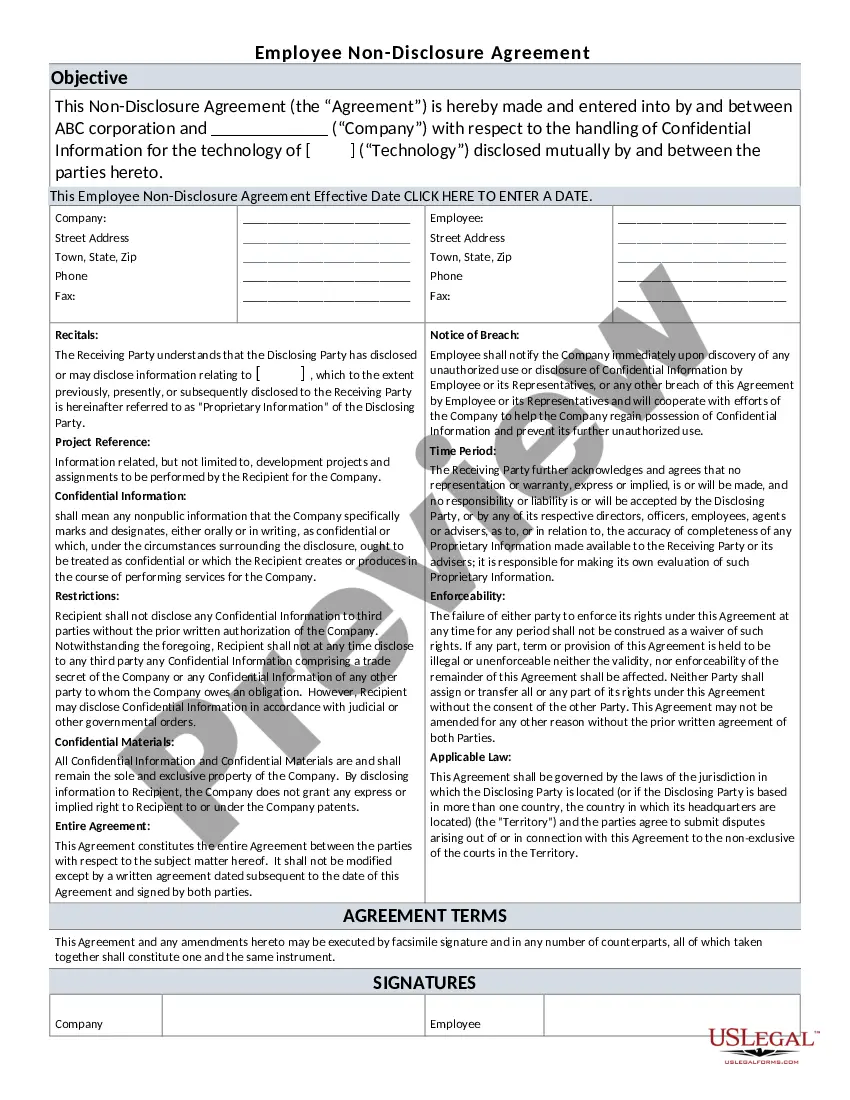
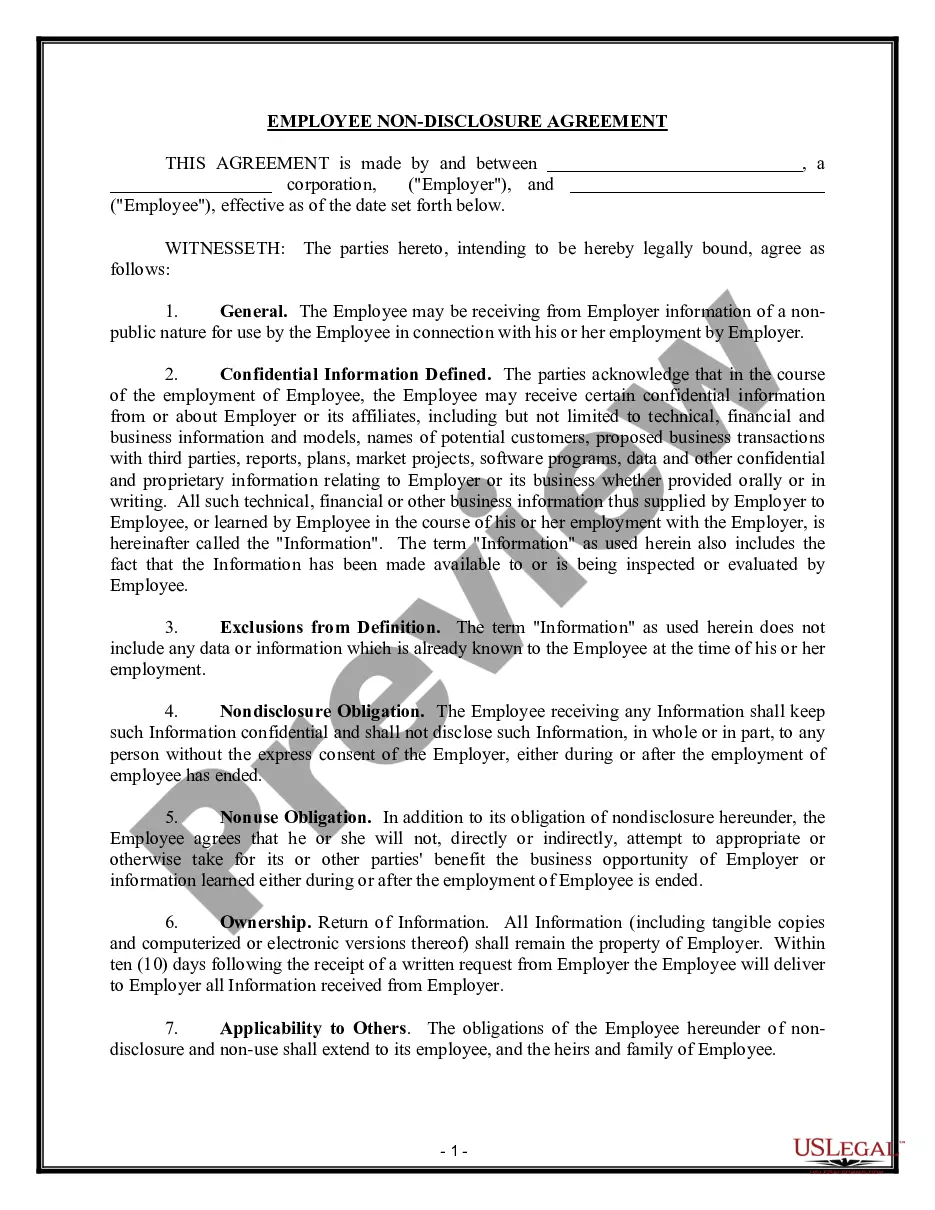
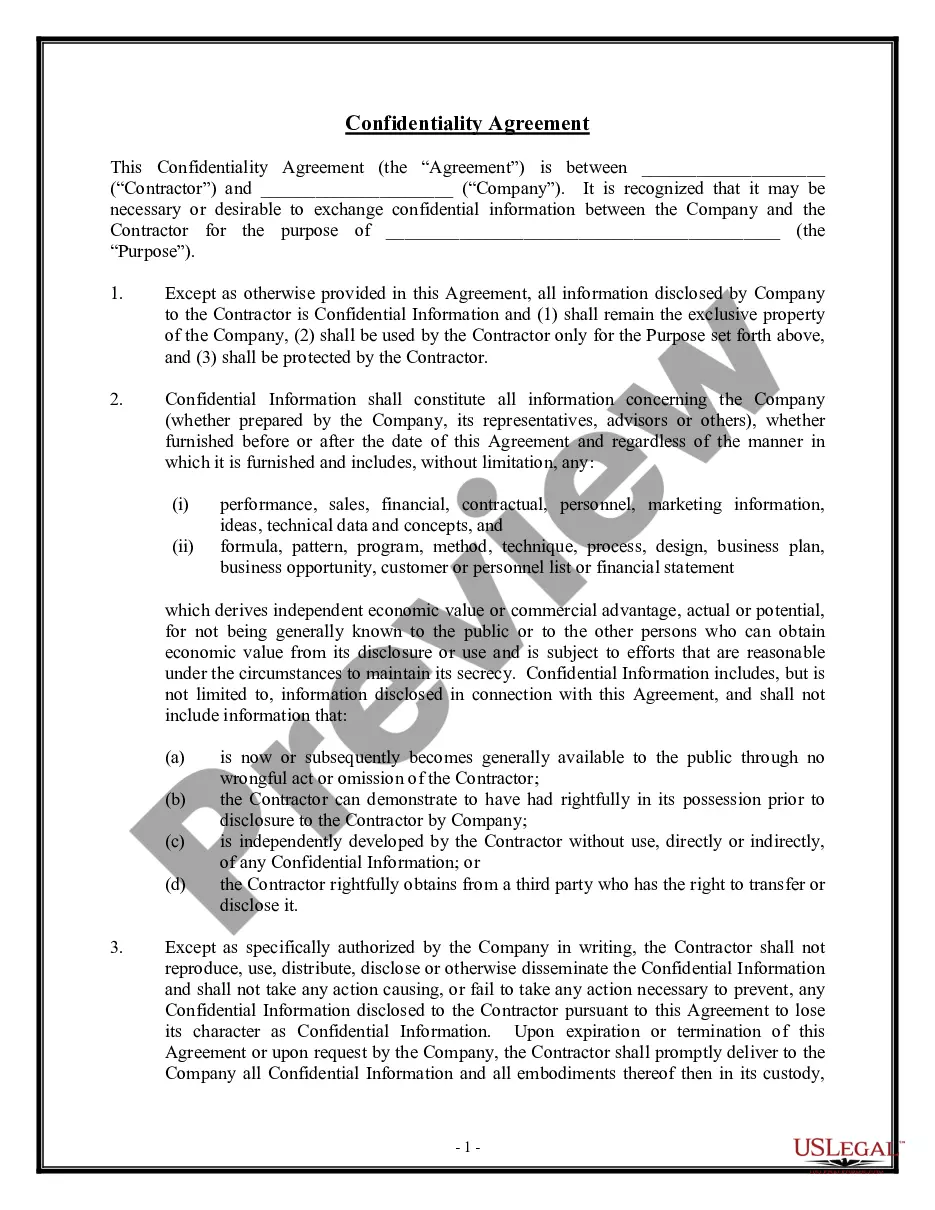
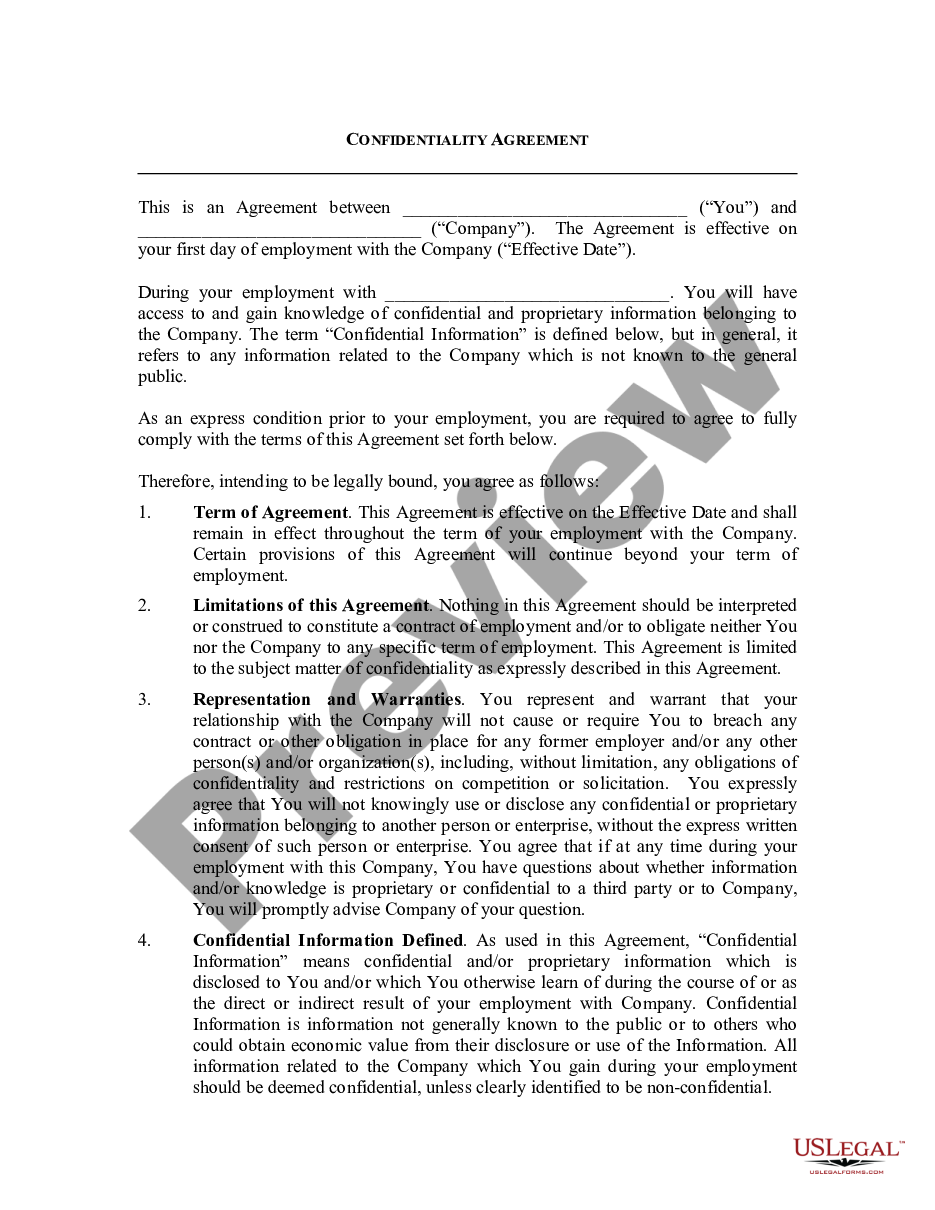
An Employee Non-Disclosure Agreement (NDA) is a legal document designed to protect a company's confidential information shared with an employee. This form outlines the obligations of the employee regarding the use and disclosure of proprietary information gained during their employment. Unlike similar agreements, this NDA explicitly focuses on the relationship between an employer and an employee, ensuring that sensitive information remains protected throughout and after the employment period.
Form components explained
- Effective Date: The date when the agreement becomes legally binding.
- Company and Employee Information: Sections to include details regarding the parties involved.
- Confidential Information Definition: Specifies what qualifies as proprietary or confidential information.
- Restrictions on Disclosure: Outlines the limitations on sharing confidential information with third parties.
- Notification of Breach: Requires the employee to report unauthorized disclosures immediately.
- Governing Law: Defines the jurisdiction that will govern the agreement.
When to use this document
This Employee Non-Disclosure Agreement should be utilized when hiring new employees who will have access to sensitive company information. It is particularly important for technology firms, research and development companies, and any business that deals with proprietary information that could impact its competitive edge if disclosed. Additionally, this form is useful when a company seeks to establish clear expectations regarding confidentiality to protect its intellectual property.
Who can use this document
- Employers who require their employees to maintain confidentiality about company information.
- Businesses in sectors where proprietary knowledge is essential, such as technology, finance, and healthcare.
- Employers looking to safeguard trade secrets and sensitive information from unauthorized disclosures.
How to complete this form
- Identify the parties: Enter the name and address of the company and the employee.
- Specify the effective date: Indicate the date when the agreement takes effect.
- Define confidential information: Clearly outline what constitutes proprietary information for your specific context.
- Include necessary signatures: Both the company representative and the employee must sign and date the agreement.
- Review the entire agreement: Ensure all sections are completed accurately and conform to both parties' understanding.
Does this document require notarization?
This form does not typically require notarization unless specified by local law. It remains valid and enforceable once completed and signed by both parties without the need for a notary stamp.
Get your form ready online
Our built-in tools help you complete, sign, share, and store your documents in one place.
Make edits, fill in missing information, and update formatting in US Legal Forms—just like you would in MS Word.
Download a copy, print it, send it by email, or mail it via USPS—whatever works best for your next step.
Sign and collect signatures with our SignNow integration. Send to multiple recipients, set reminders, and more. Go Premium to unlock E-Sign.
If this form requires notarization, complete it online through a secure video call—no need to meet a notary in person or wait for an appointment.
We protect your documents and personal data by following strict security and privacy standards.

Make edits, fill in missing information, and update formatting in US Legal Forms—just like you would in MS Word.

Download a copy, print it, send it by email, or mail it via USPS—whatever works best for your next step.

Sign and collect signatures with our SignNow integration. Send to multiple recipients, set reminders, and more. Go Premium to unlock E-Sign.

If this form requires notarization, complete it online through a secure video call—no need to meet a notary in person or wait for an appointment.

We protect your documents and personal data by following strict security and privacy standards.
Typical mistakes to avoid
- Failing to define what constitutes confidential information, leading to ambiguity.
- Not ensuring that both parties sign and date the document.
- Overlooking state-specific requirements that may affect enforceability.
- Failing to review the agreement periodically, especially in cases of changes in business operations or personnel.
Benefits of completing this form online
- Convenience of accessing and completing the form at any time.
- Editability allows for quick customization based on specific needs.
- Reliability from professionally drafted templates ensuring legal compliance.
Looking for another form?
Form popularity
FAQ
I hereby agree that I will not discuss with or reveal to any representative of any governmental entity, business organization, other entity, or any individual person (except persons specifically authorized by the Procuring Contracting Officer (PCO)), either within or outside the U.S. Government, any aspect of the
Non-disclosure agreements, or NDAs as they are sometimes called, are legally enforceable agreements between parties that are used to ensure that certain information will remain confidential.
Under an employee non disclosure agreement, both parties are bound by confidentiality provisions, such as preventing the employee from disclosing certain specified information relating to the conduct of the employer or the termination of the employment contract.
If you are terminated, you may be asked to sign an NDA in exchange for a severance payment. Since employers are generally under no legal obligation to provide a severance agreement, this strategy is designed to prevent you from disclosing the terms of the severance and possibly that you received one at all.
NDAs, or non-disclosure agreements, are legally enforceable contracts that create a confidential relationship between a person who has sensitive information and a person who will gain access to that information. A confidential relationship means one or both parties has a duty not to share that information.
Since NDAs are civil contracts, breaking one isn't technically a crime. However, it could come with severe financial penalties. Violating an NDA leaves you open to lawsuits from your employer, and you could be required to pay financial damages and possibly associated legal costs.
The red flag of misuse is when you ask for an NDA for a pitch meeting, a meet and greet, or a job interview. If your idea can be stolen after meeting someone for an hour for the first time, causing you irreparable harm in market, it's probably not a very good idea, or you're a terrible business person.
Here are the two types of NDAs to choose from: Unilateral (NDA) Unilateral nondisclosure agreements are the most common NDAs available.Mutual (MNDA) Mutual nondisclosure agreements (MNDA), also known as bilateral agreements, are used when two parties disclose confidential information to each other.