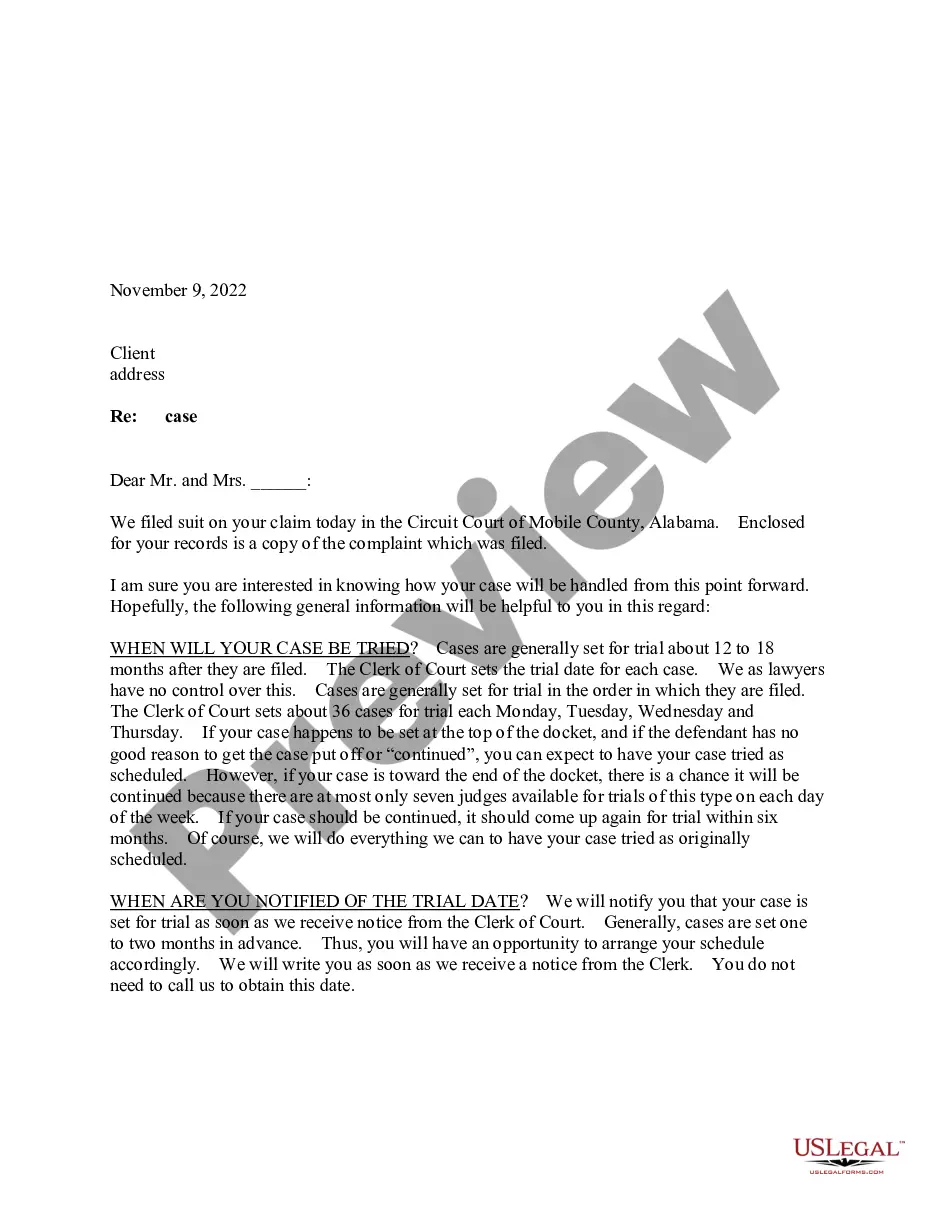
Petition or Application to Compel Approval of Matters Submitted After Arbitrary Disapproval by Administrative Agency
What this document covers
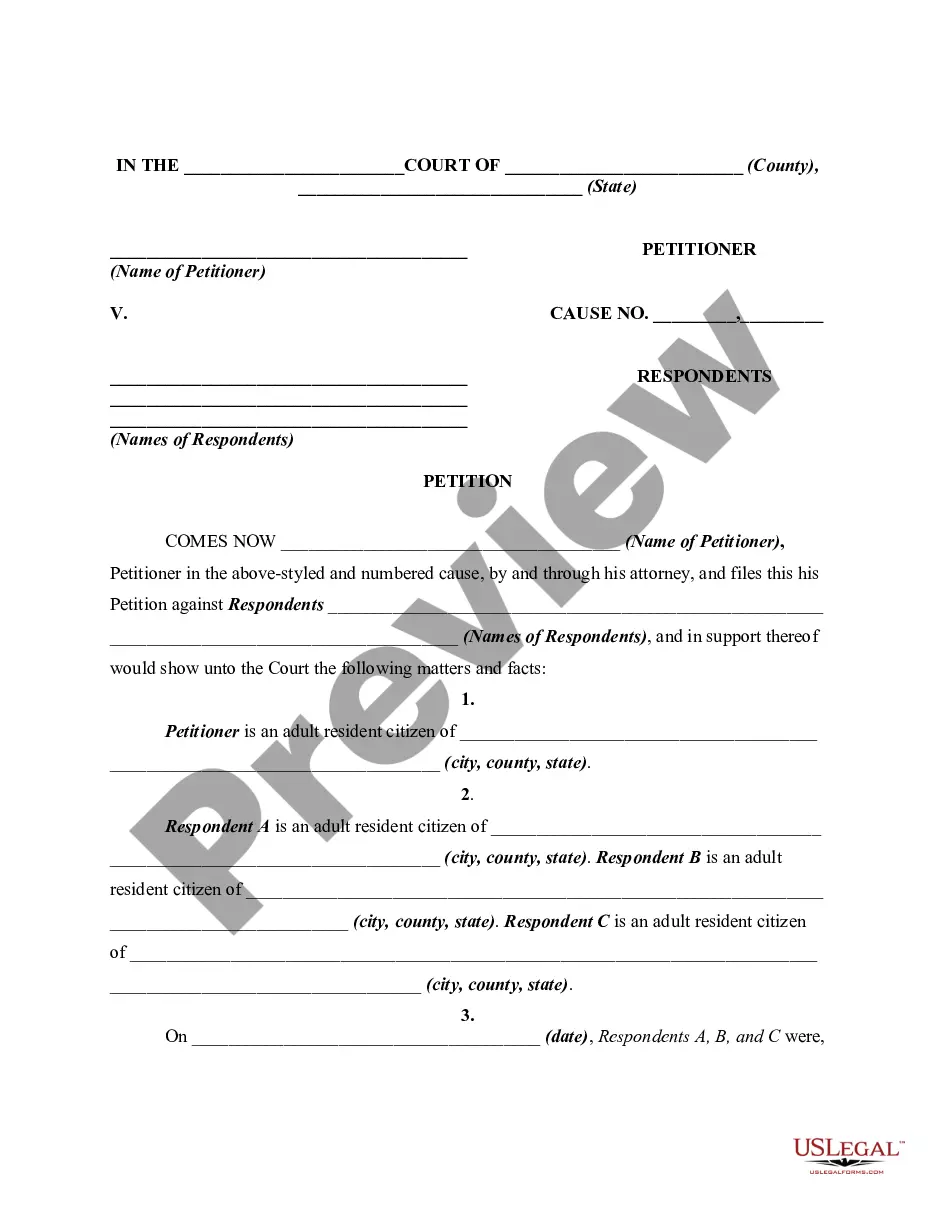
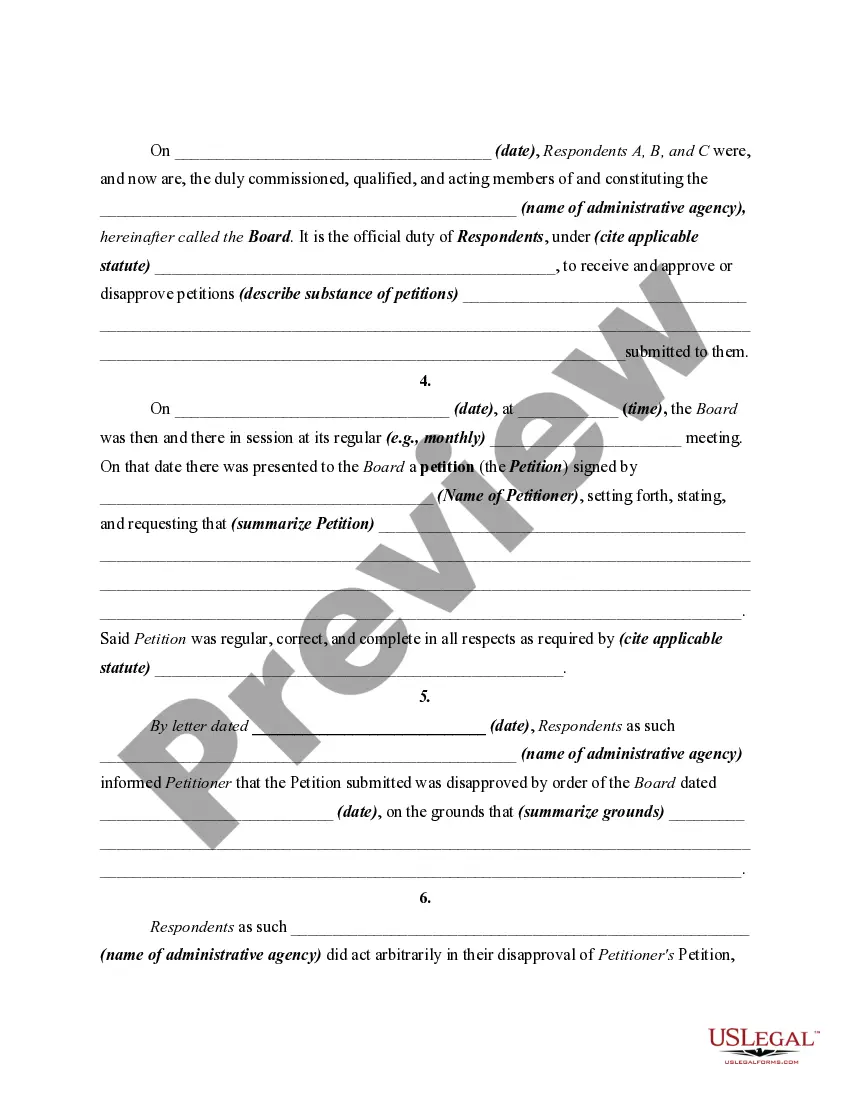
The Petition or Application to Compel Approval of Matters Submitted After Arbitrary Disapproval by Administrative Agency is a legal document used to request a writ of mandamus. This form compels a governmental body or public agency to fulfill a legal duty when it has failed to do so arbitrarily. It is essential to understand that this form is specifically designed to address situations where an agency's disapproval of a petition is deemed unjust and not in line with legal requirements.
Key parts of this document
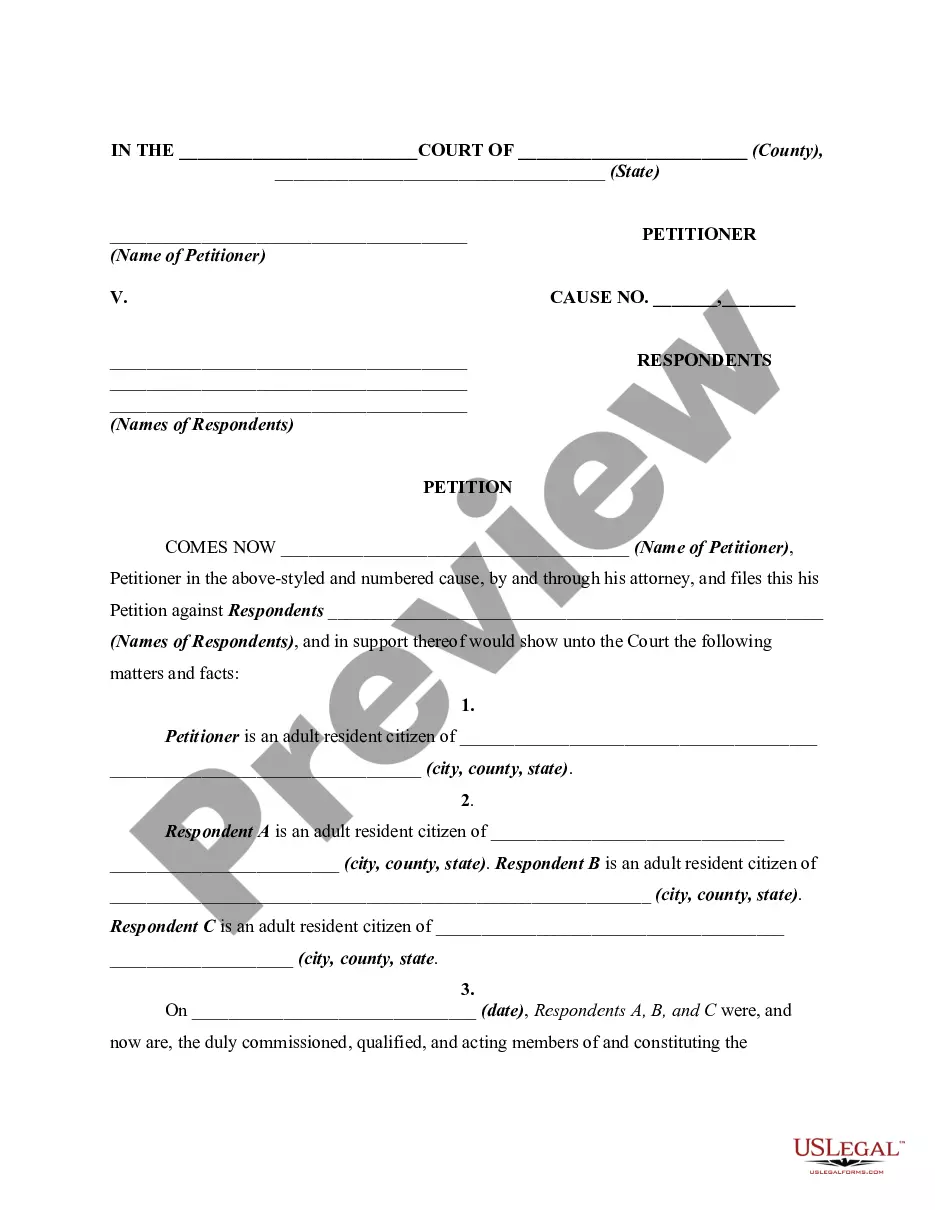
- Names of the petitioner and respondents involved in the case.
- Details of the petition submitted to the administrative agency.
- Summarization of the grounds for disapproval issued by the respondents.
- Assertions of arbitrary actions taken by the respondents regarding the petition.
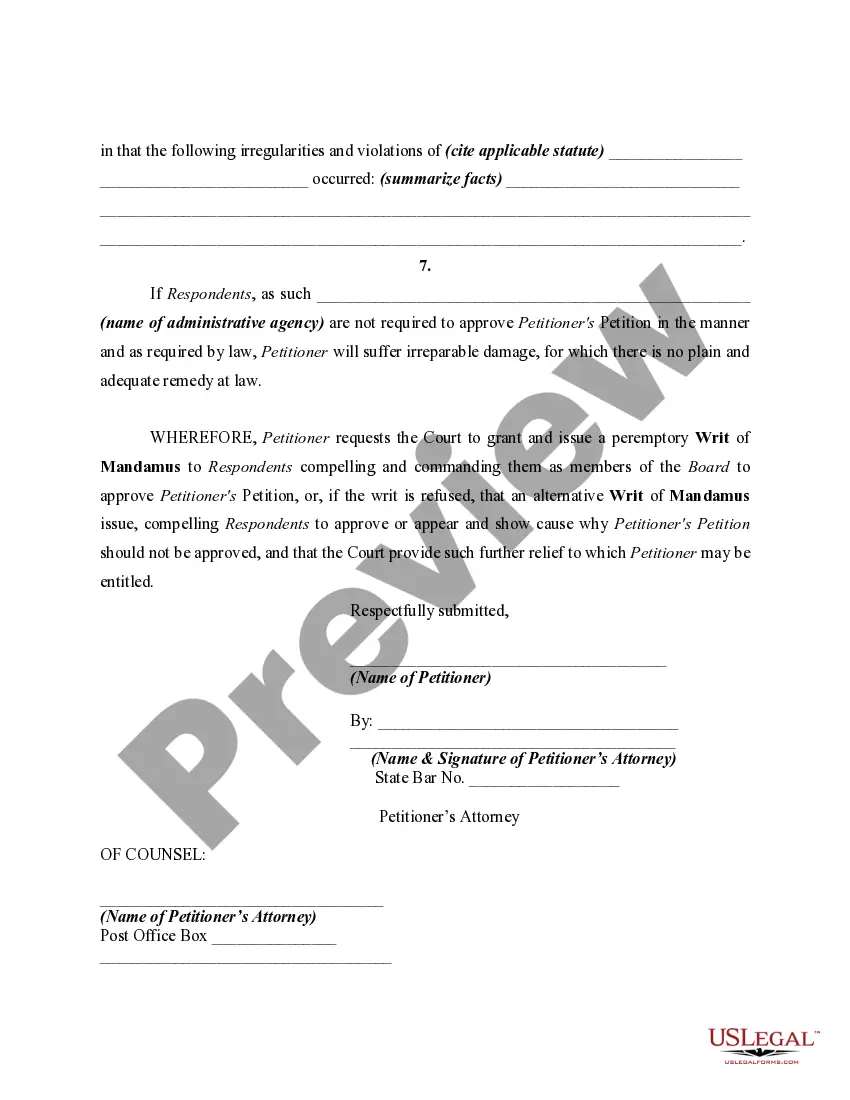
- Request for the court to issue a writ of mandamus compelling the respondents to act.
- Signature and contact information of the petitioner's attorney.

Common use cases
You should use this form when an administrative agency has disapproved your petition or application without justified reasons, and you believe that their decision was arbitrary. This applies to various situations, like seeking the release of public records, applying for permits, or other formal requests where legal obligations are neglected by the agency.
Who needs this form
- Individuals who have submitted a petition to an administrative agency.
- Petitioners who believe their submission was disapproved arbitrarily.
- Residents seeking legal recourse against governmental bodies.
- Attorneys assisting clients with administrative disputes.
Completing this form step by step
- Identify and list the names of the petitioner and respondents accurately.
- Provide relevant dates and session information related to the petition submission.
- Summarize the petition's contents clearly to highlight its purpose.
- Describe the reasons given by the agency for disapproval.
- State specific arbitrary actions taken by the agency that warrant the mandamus.
- Include the signature and contact details of your legal representative, ensuring all necessary information is provided.
Notarization guidance
This form does not typically require notarization to be legally valid. However, some jurisdictions or document types may still require it. US Legal Forms provides secure online notarization powered by Notarize, available 24/7 for added convenience.
Get your form ready online
Our built-in tools help you complete, sign, share, and store your documents in one place.
Make edits, fill in missing information, and update formatting in US Legal Forms—just like you would in MS Word.
Download a copy, print it, send it by email, or mail it via USPS—whatever works best for your next step.
Sign and collect signatures with our SignNow integration. Send to multiple recipients, set reminders, and more. Go Premium to unlock E-Sign.
If this form requires notarization, complete it online through a secure video call—no need to meet a notary in person or wait for an appointment.
We protect your documents and personal data by following strict security and privacy standards.

Make edits, fill in missing information, and update formatting in US Legal Forms—just like you would in MS Word.

Download a copy, print it, send it by email, or mail it via USPS—whatever works best for your next step.

Sign and collect signatures with our SignNow integration. Send to multiple recipients, set reminders, and more. Go Premium to unlock E-Sign.

If this form requires notarization, complete it online through a secure video call—no need to meet a notary in person or wait for an appointment.

We protect your documents and personal data by following strict security and privacy standards.
Mistakes to watch out for
- Failing to accurately identify all parties involved in the petition.
- Neglecting to provide a clear summary of the grounds for disapproval.
- Omitting essential dates or details regarding the agency's meeting.
- Not providing enough evidence to support claims of arbitrary disapproval.
- Ignoring local legal requirements that may affect the petition's validity.
Benefits of using this form online
- Immediate access to professionally drafted templates, ensuring legal compliance.
- Conveniently fill out and customize the form to meet your specific needs.
- Save time and reduce stress with straightforward instructions for completion.
- Downloadable forms that allow for easy storage and referencing later.
Legal use & context
- This form is filed in a court of law to challenge the decision of an administrative agency.
- A writ of mandamus is a judicial remedy compelling an agency to act in accordance with the law.
- The effectiveness of this form is contingent upon the proper citing of applicable statutes and evidence of arbitrary decision-making.
Key takeaways
- The form allows petitioners to seek legal intervention when agencies disapprove petitions without just cause.
- Completing the form accurately is essential for facilitating legal proceedings.
- Understanding local laws is crucial for applying this form effectively.
Looking for another form?

Form popularity
FAQ
A government body authorized to implement legislative directives by developing more precise and technical rules than possible in a legislative setting. Many administrative agencies also have law enforcement responsibilities.
There are two principal ways that administrative agencies can be created: executive agencies and legislative agencies. Executive agencies are created by the president, while legislative agencies are established by an act of Congress.
California's administrative agencies play a key role in state government and in public policy development in this state.Administrative agencies also interpret statutes, they enforce laws, and again, they adopt regulations to interpret and administer those statutes.
What are the four primary ways in which an administrative agency functions? Making rules, conducting formal adjudications, taking informal discretionary actions, and conducting investigations.
Administrative agencies can be basically defined as official government bodies that have the power and authority to direct, supervise, and implement certain legislative acts or statutes. Not all administrative agencies have the term agency in the title.
Administrative agencies have three functions: legislative, adjudicatory and administrative.
Administrative agencies are created by the federal Constitution, the U.S. Congress, state legislatures, and local lawmaking bodies.Central Intelligence Agency, Environmental Protection Agency, the national labor relations board, and the Securities and Exchange Commission are the examples of administrative agencies.
Executive Agencies. Independent Regulatory Agencies.