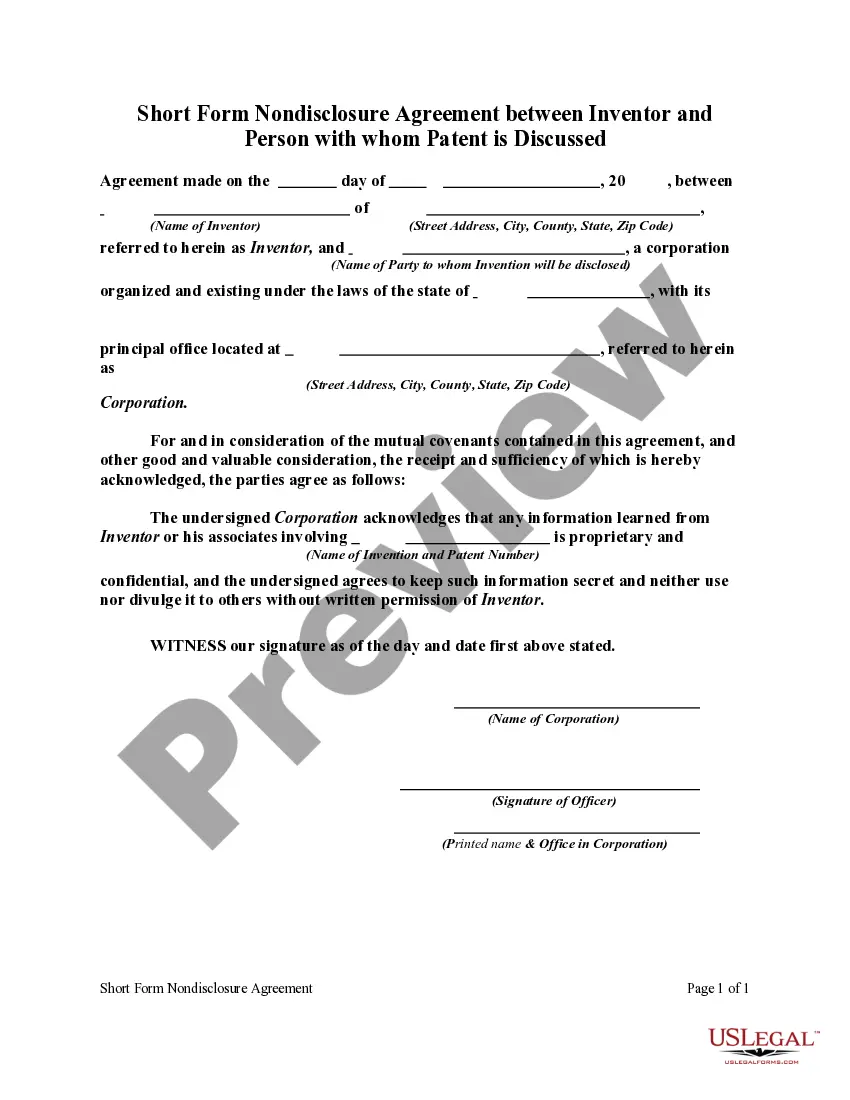
Short Form Nondisclosure Agreement between Inventor and Person with whom Patent is Discussed
Overview of this form
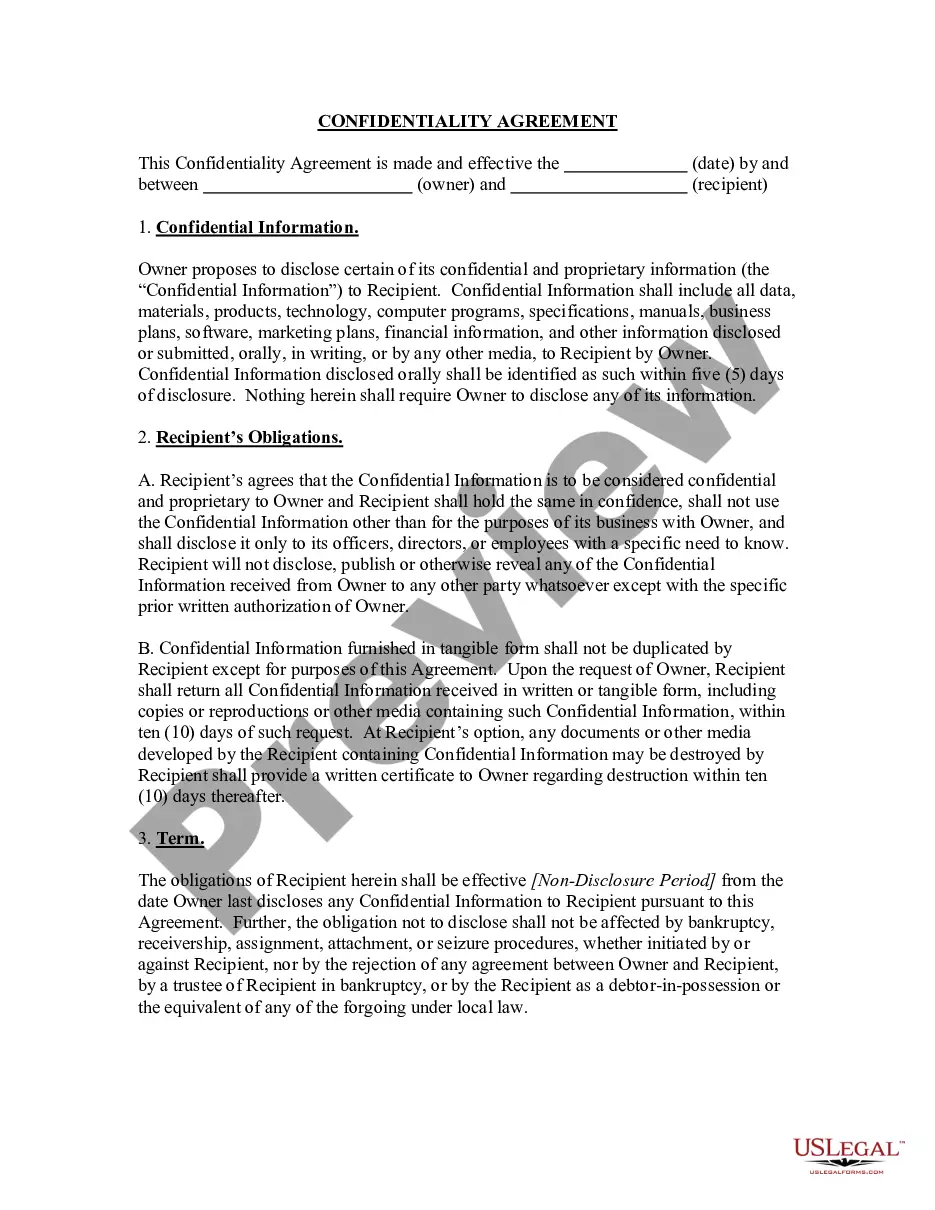
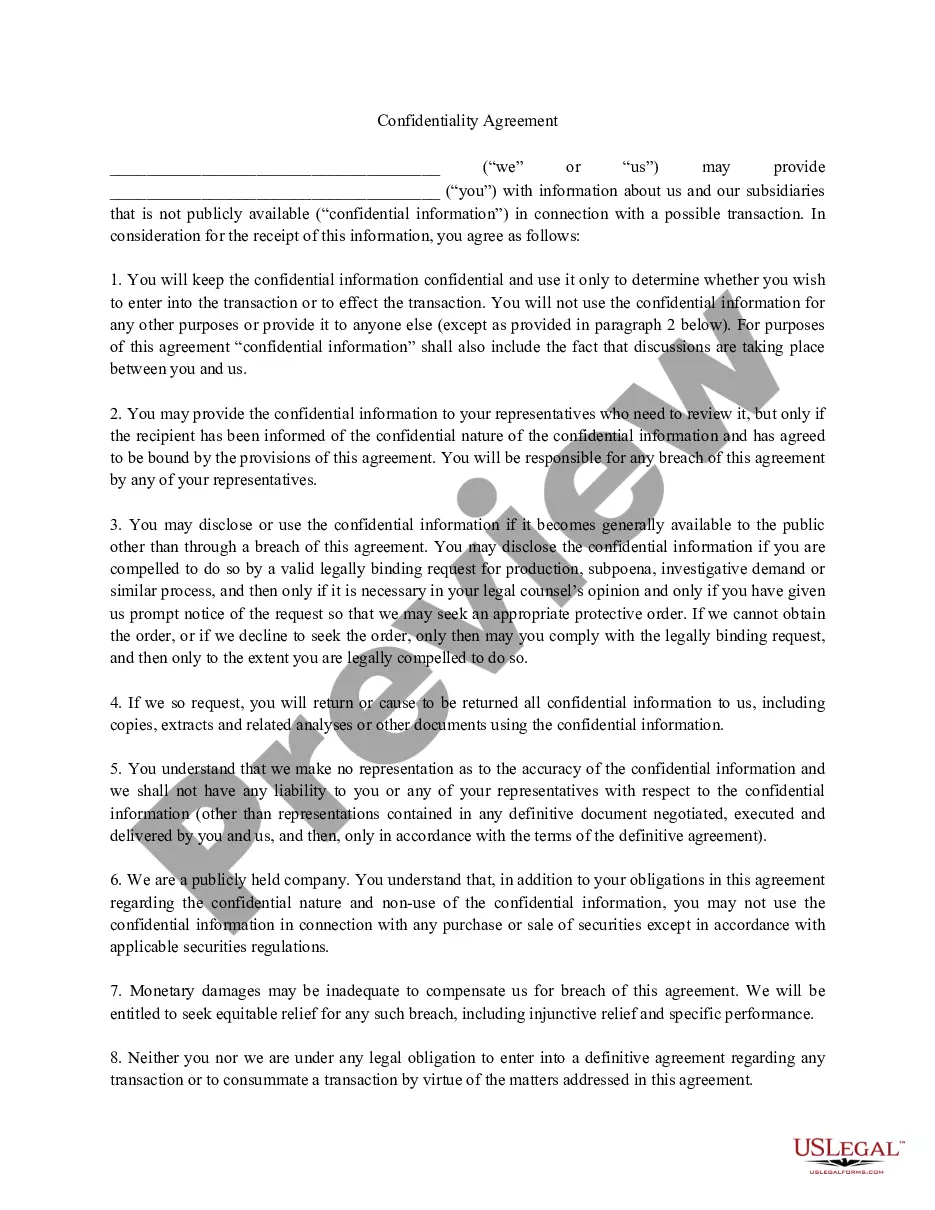
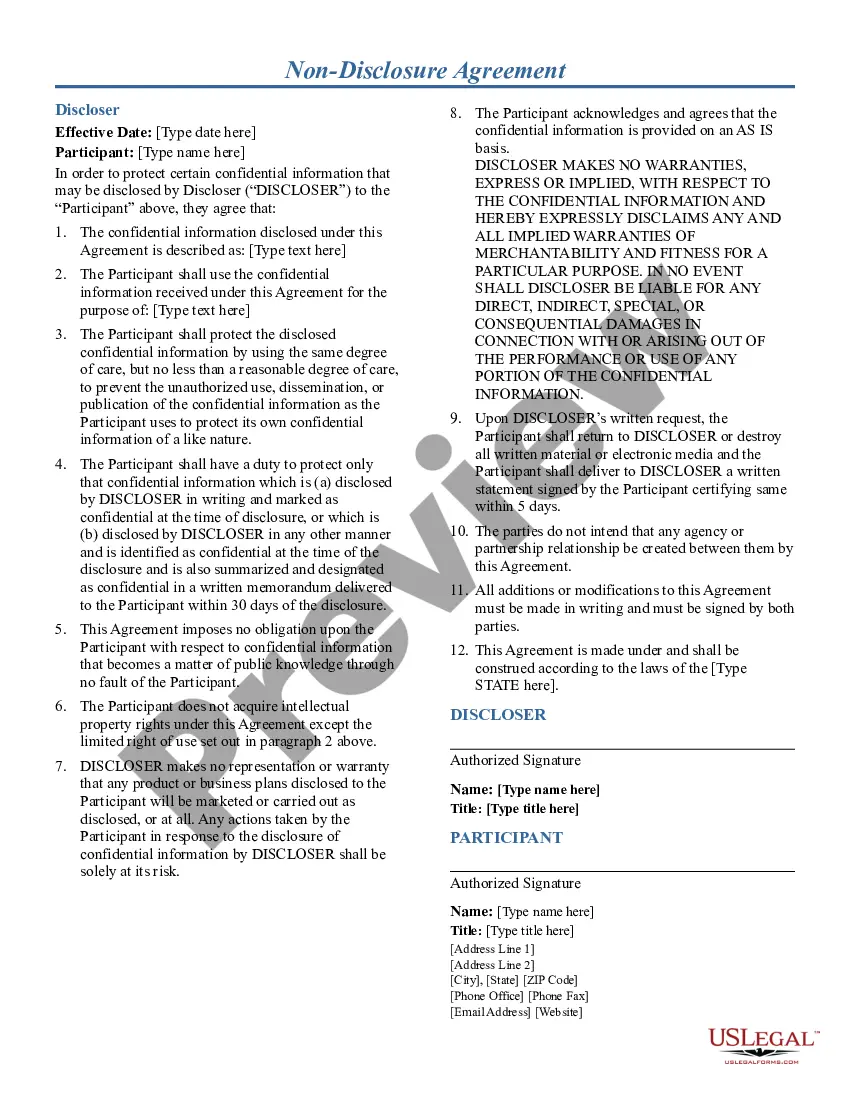
This Short Form Nondisclosure Agreement is a legal document that establishes a confidential relationship between an inventor and a person with whom the inventor discusses patentable ideas. This form is specifically designed to protect sensitive information related to inventions during conversations that may lead to patent applications. Unlike a standard nondisclosure agreement, this form is concise, making it ideal for informal discussions that still require protection of intellectual property.
What’s included in this form
- Identification of the parties involved in the agreement.
- Definition of the confidential information to be protected.
- Limitations on the use of the disclosed information.
- Duration of the confidentiality obligation.
- Consequences of breach of agreement.
When this form is needed
This form should be used whenever an inventor intends to discuss their invention with an individual or entity that is not authorized to disclose or use the invention without permission. This includes discussions with potential partners, investors, or consultants who may have access to proprietary information while exploring potential collaborations.
Intended users of this form
- Inventors seeking to protect their inventions from unauthorized disclosure.
- Businesses involved in research and development requiring discussions of sensitive ideas.
- Individuals or companies in the startup phase looking for investment or partnerships.
Completing this form step by step
- Identify the parties by entering their names and addresses at the beginning of the form.
- Clearly define the confidential information to ensure clarity on what is protected.
- Set the duration of the confidentiality obligation, specifying how long the information will remain confidential.
- Review the limitations on the use of the confidential information.
- Both parties should sign and date the agreement to solidify the terms.
Does this form need to be notarized?
This form does not typically require notarization unless specified by local law.
Get your form ready online
Our built-in tools help you complete, sign, share, and store your documents in one place.
Make edits, fill in missing information, and update formatting in US Legal Forms—just like you would in MS Word.
Download a copy, print it, send it by email, or mail it via USPS—whatever works best for your next step.
Sign and collect signatures with our SignNow integration. Send to multiple recipients, set reminders, and more. Go Premium to unlock E-Sign.
If this form requires notarization, complete it online through a secure video call—no need to meet a notary in person or wait for an appointment.
We protect your documents and personal data by following strict security and privacy standards.

Make edits, fill in missing information, and update formatting in US Legal Forms—just like you would in MS Word.

Download a copy, print it, send it by email, or mail it via USPS—whatever works best for your next step.

Sign and collect signatures with our SignNow integration. Send to multiple recipients, set reminders, and more. Go Premium to unlock E-Sign.

If this form requires notarization, complete it online through a secure video call—no need to meet a notary in person or wait for an appointment.

We protect your documents and personal data by following strict security and privacy standards.
Common mistakes
- Failing to clearly define the confidential information.
- Not including the duration of confidentiality, leading to ambiguity.
- Forgetting to obtain signatures from both parties.
Benefits of completing this form online
- Convenience of immediate access to a legally vetted document.
- Easy customization to suit individual needs.
- Reliable format that ensures protection of sensitive information.
Legal use & context
- This agreement is legally binding as long as it meets the essential contract requirements.
- It helps protect the inventor's intellectual property rights during negotiations.
- The enforceability may vary depending on the jurisdiction and specific terms agreed upon.
Main things to remember
- This Short Form Nondisclosure Agreement is essential for protecting inventor disclosures.
- Clearly defining confidentiality terms is critical to enforceability.
- Proper execution, including signatures, is essential for the agreement's validity.
Looking for another form?

Form popularity
FAQ
Not exactly. You cannot make the Patent Office apply your disclosure as prior art to the patent application filed by the investor or licensee. Your disclosure may not be prior art to their patent application.
Owning a patent or pending patent application is usually a condition for licensing.In order to obtain a patent for your invention, the invention must constitute patentable subject matter and be novel, non-obvious and useful.
The party to be charged must have signed the contract. Since the NDAs benefit you, so long as the other party has signed, that ishould be sufficient.
A product or process secures patent pending when a patent application has been filed but is not yet granted.A patent pending is a clear demonstration of an inventor's intent to pursue protection of an idea. However, the full scope of protection or indeed whether a patent will even be issued is far from certain.
If you determine that the invention is probably not patentable, the most effective way to protect yourself is to have prospective licensees sign a nondisclosure agreement before you reveal your invention. This document is sometimes called an "NDA" or a "confidentiality agreement," but the terms are similar.
Get a patent because companies generally won't sign your NDA anyway. No, a patent is a waste of moneyuse an NDA. Not everyone is out to steal your invention, so go ahead and discuss the idea with the proposed manufacturer. If you have a patent you don't need an NDA.
As soon as you file a patent application with the U.S. Patent and Trademark Office (USPTO), your invention is "Patent Pending." Once your application is submitted, nobody can steal, sell, or use your invention without your permission.
15 WAYS TO STOP YOUR INVENTION FROM BEING STOLEN.2File a provisional patent application. Protect your idea before receiving a patent.3Put the public on notice of your ownership.4Keep accurate communication records.5Create an IP culture.6Vet your partners and investors.
Once your provisional patent application is published, you won't need confidentiality for information related to your invention any longer because the information would have entered the public domain. Because of this, it's vital that you include this as an exception in your confidentiality requirements.