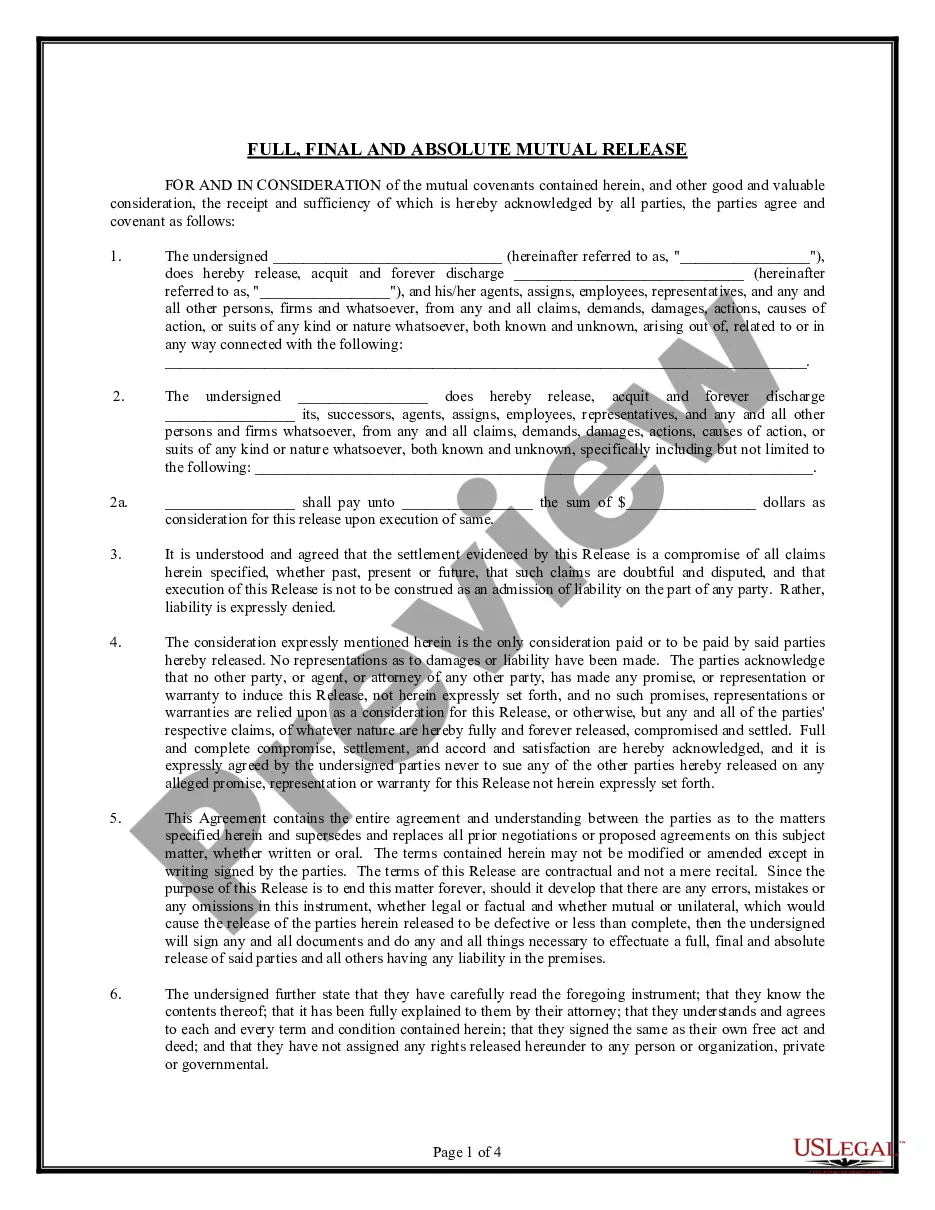
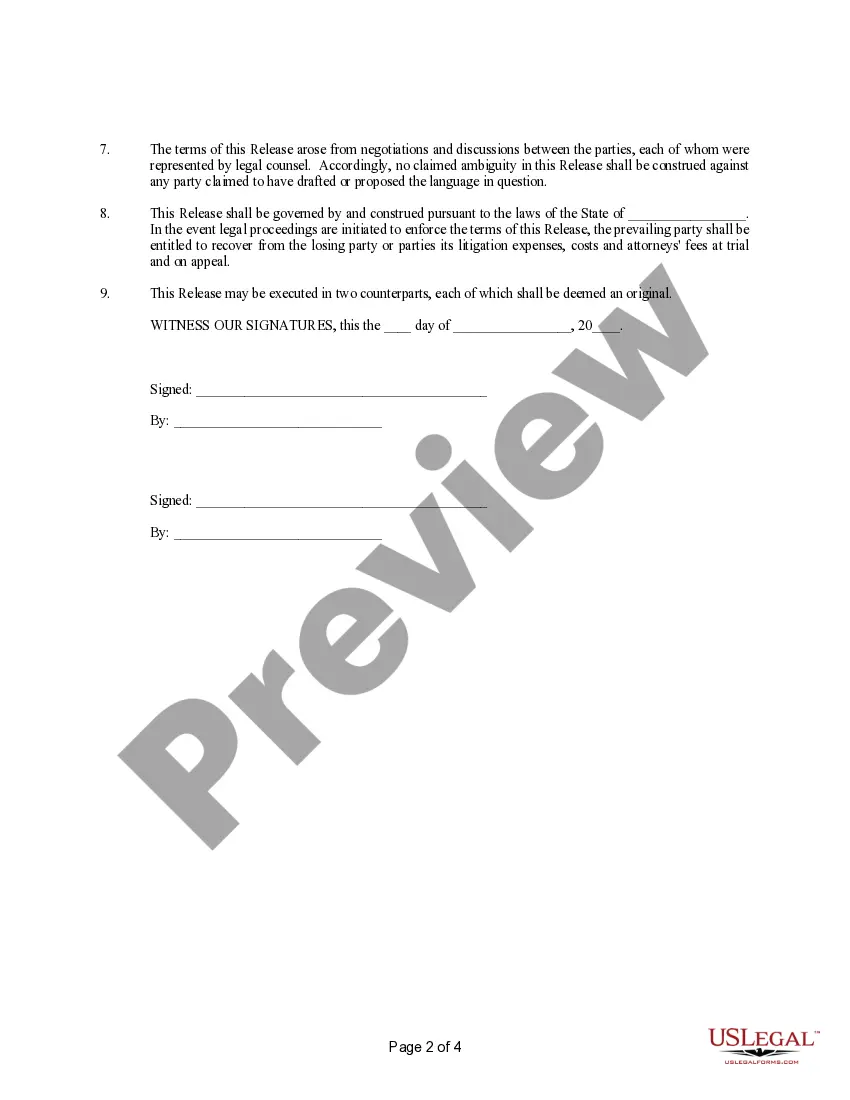
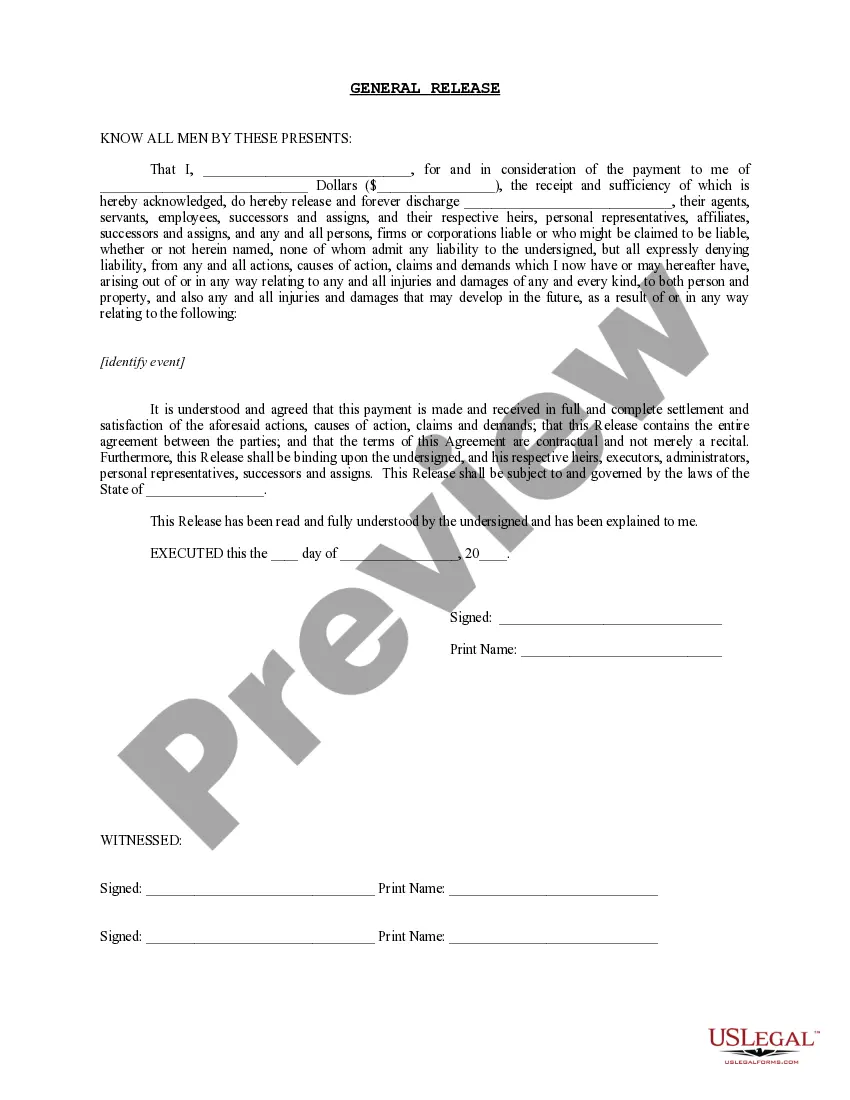
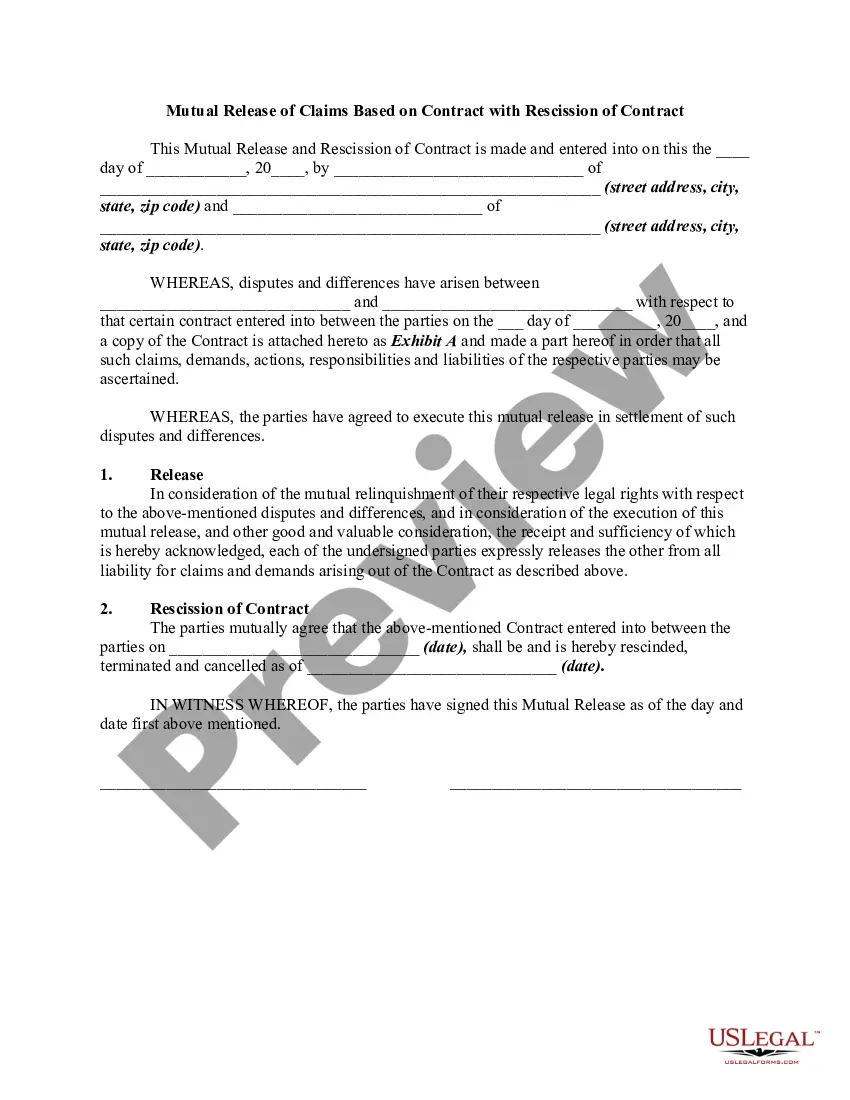
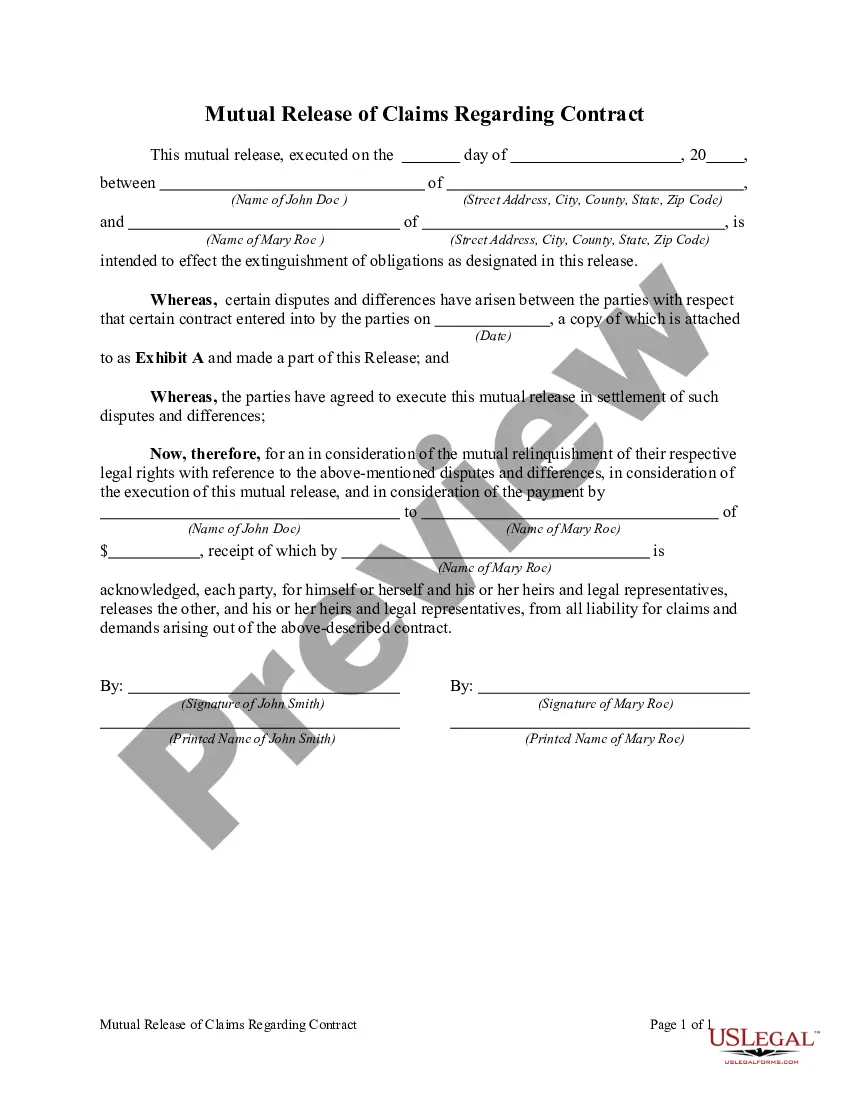
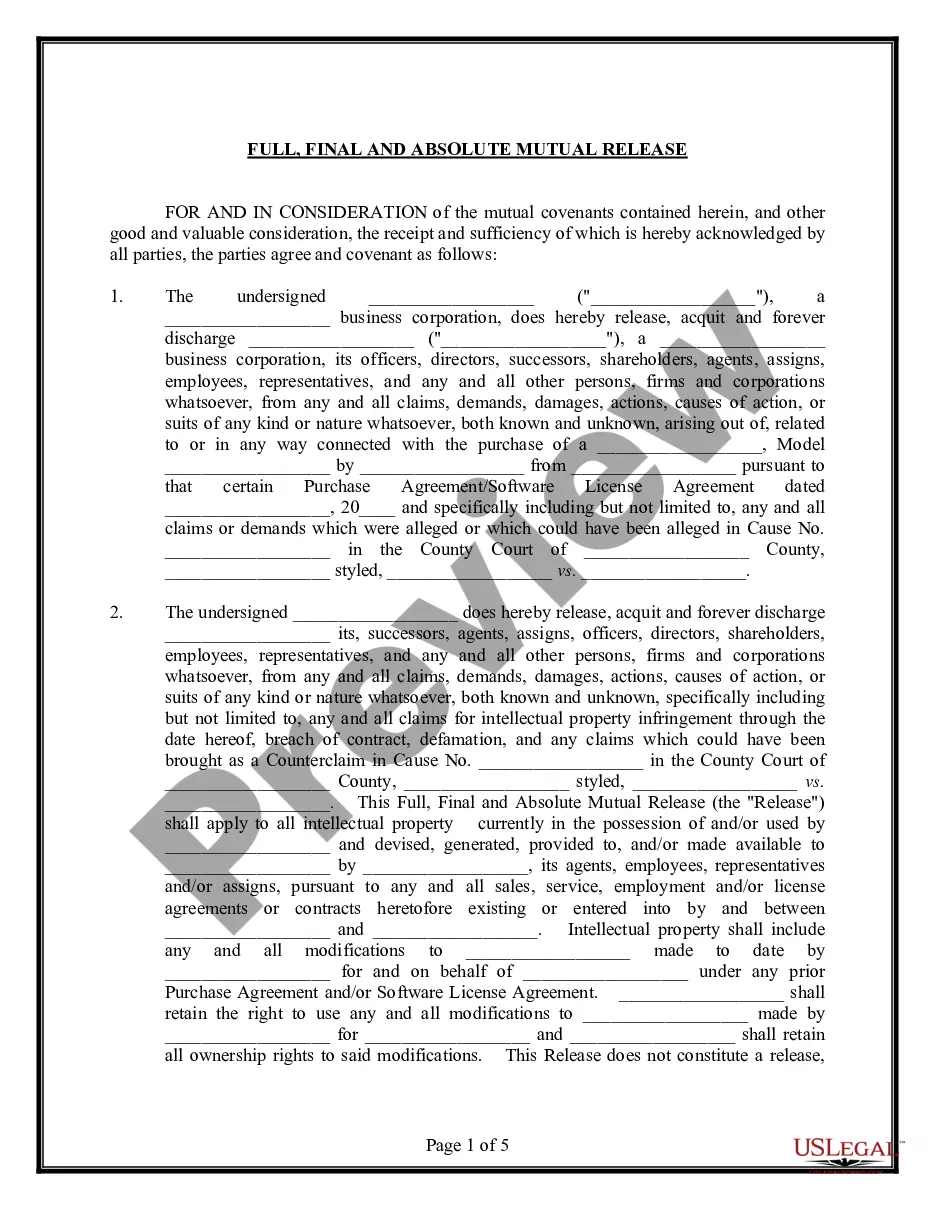
This form is a final, full and absolute mutual release for use in general circumstances. The releasor acquits and forever discharges the releasee from any and all claims pertaining to a certain occurrence. The form also provides that the release is the product of negotiations and discussions between the parties, each of whom were represented by legal counsel.
Texas Mutual Release of Claims
State:
Multi-State
Category:
Control #:
US-00566
Format:
Word;
Rich Text
231 downloads
Description
Free preview
Get your form ready online
Our built-in tools help you complete, sign, share, and store your documents in one place.
Built-in online Word editor
Make edits, fill in missing information, and update formatting in US Legal Forms—just like you would in MS Word.
Export easily
Download a copy, print it, send it by email, or mail it via USPS—whatever works best for your next step.
E-sign your document
Sign and collect signatures with our SignNow integration. Send to multiple recipients, set reminders, and more. Go Premium to unlock E-Sign.
Notarize online 24/7
If this form requires notarization, complete it online through a secure video call—no need to meet a notary in person or wait for an appointment.
Store your document securely
We protect your documents and personal data by following strict security and privacy standards.

Make edits, fill in missing information, and update formatting in US Legal Forms—just like you would in MS Word.

Download a copy, print it, send it by email, or mail it via USPS—whatever works best for your next step.

Sign and collect signatures with our SignNow integration. Send to multiple recipients, set reminders, and more. Go Premium to unlock E-Sign.

If this form requires notarization, complete it online through a secure video call—no need to meet a notary in person or wait for an appointment.

We protect your documents and personal data by following strict security and privacy standards.
Looking for another form?

How to fill out Mutual Release Of Claims?
Discovering the appropriate legal document template can be somewhat challenging. Naturally, there are countless templates accessible online, but how can you secure the appropriate version you require? Utilize the US Legal Forms platform. The service offers thousands of templates, including the Texas Mutual Release of Claims, that can be employed for both business and personal needs. All forms are reviewed by professionals and comply with federal and state regulations.
If you are already registered, Log In to your account and select the Acquire option to locate the Texas Mutual Release of Claims. Use your account to browse the legal forms you have obtained previously. Visit the My documents section of your account to download another copy of the document you need.
If you are a new user of US Legal Forms, here are simple steps that you can follow: First, make sure you have selected the correct form for your locality. You can preview the form using the Review option and review the form details to ensure it is suitable for you. If the form does not meet your needs, use the Search field to find the right form. Once you are confident that the form is suitable, click the Buy now option to obtain the form.
US Legal Forms is the largest repository of legal templates where you can explore a variety of document templates. Use the service to obtain professionally crafted documents that adhere to state regulations.
- Choose the payment plan you prefer and enter the required information.
- Create your account and pay for the transaction using your PayPal account or credit card.
- Select the file format and download the legal document template to your device.
- Complete, modify, print, and sign the downloaded Texas Mutual Release of Claims.
Form popularity
FAQ
To check the status of your workers’ comp claim in Texas, you can visit the Texas Department of Insurance's website or contact your insurance carrier directly. Both options provide updates on the progress of your claim. If you experience delays, consider discussing your concerns with a legal expert. A well-drafted Texas Mutual Release of Claims can smoothen the conclusion of your case if you reach a settlement.
The 4-year statute of limitations in Texas applies to various civil claims, including personal injury and breach of contract cases. This means you have four years from the date of the incident to file a lawsuit. Failing to act within this timeframe could forfeit your right to seek compensation. Understanding how a Texas Mutual Release of Claims fits into this timeline is vital for effective legal planning.
A bad faith claim in Texas occurs when an insurance company fails to uphold its end of a contract or unjustly denies a legitimate claim. This claim serves to protect individuals from unscrupulous policies and practices by insurers. If you believe you've been subjected to bad faith tactics, seek legal advice promptly. A Texas Mutual Release of Claims may also be involved if a settlement is reached under such circumstances.
Texas law does not universally mandate a release of liability, but it does allow parties to waive their rights to sue in many situations. This is particularly common in contracts involving recreational activities, waiving certain risks. Having a Texas Mutual Release of Claims can protect you from future liabilities, reinforcing clarity in these agreements. Be sure to draft such releases carefully.
The validity of a release in Texas hinges on specific criteria, including mutual consent, capacity to contract, and clarity of terms. Both parties must understand and agree to the release without any coercion. A properly executed release can serve as a strong defense in legal disputes. Ensure that you consider a Texas Mutual Release of Claims to enhance the effectiveness of your agreements.
In Texas, the Texas Department of Insurance oversees the management of workers' compensation claims. Employers often work with insurance carriers who specialize in these claims to ensure compliance with laws. If you encounter issues, consulting a legal professional can guide you. Utilizing platforms like US Legal Forms can help streamline the Texas Mutual Release of Claims process in your dealings.
A release of unknown claims in Texas refers to an agreement where a party relinquishes any future claims that were not known at the time of signing. This means you release all potential legal rights without knowing what they might be. It is crucial in settlements and helps avoid future disputes. Understanding a Texas Mutual Release of Claims can provide peace of mind in this process.
Releasing a claim involves agreeing not to pursue legal action for the claim in question. In a Texas Mutual Release of Claims, this serves as a protective measure for both parties, preventing possible future disputes. By understanding the implications of releasing a claim, you can better navigate your legal options and protect your interests.
To release a case means that the involved parties have decided to forgo any further legal proceedings related to that case. This release often follows a Texas Mutual Release of Claims, where both parties mutually agree to resolve their issues outside the courtroom. Effectively releasing a case can save time and legal expenses, providing peace of mind to all parties involved.
A release is not necessarily the same as a settlement, though they are often connected. A settlement is an agreement that often involves compensation or other terms, while a Texas Mutual Release of Claims specifically functions as a formal declaration to relinquish legal rights. Understanding these distinctions can help you make informed decisions when navigating legal matters.