Texas Motion to Stay
About this form
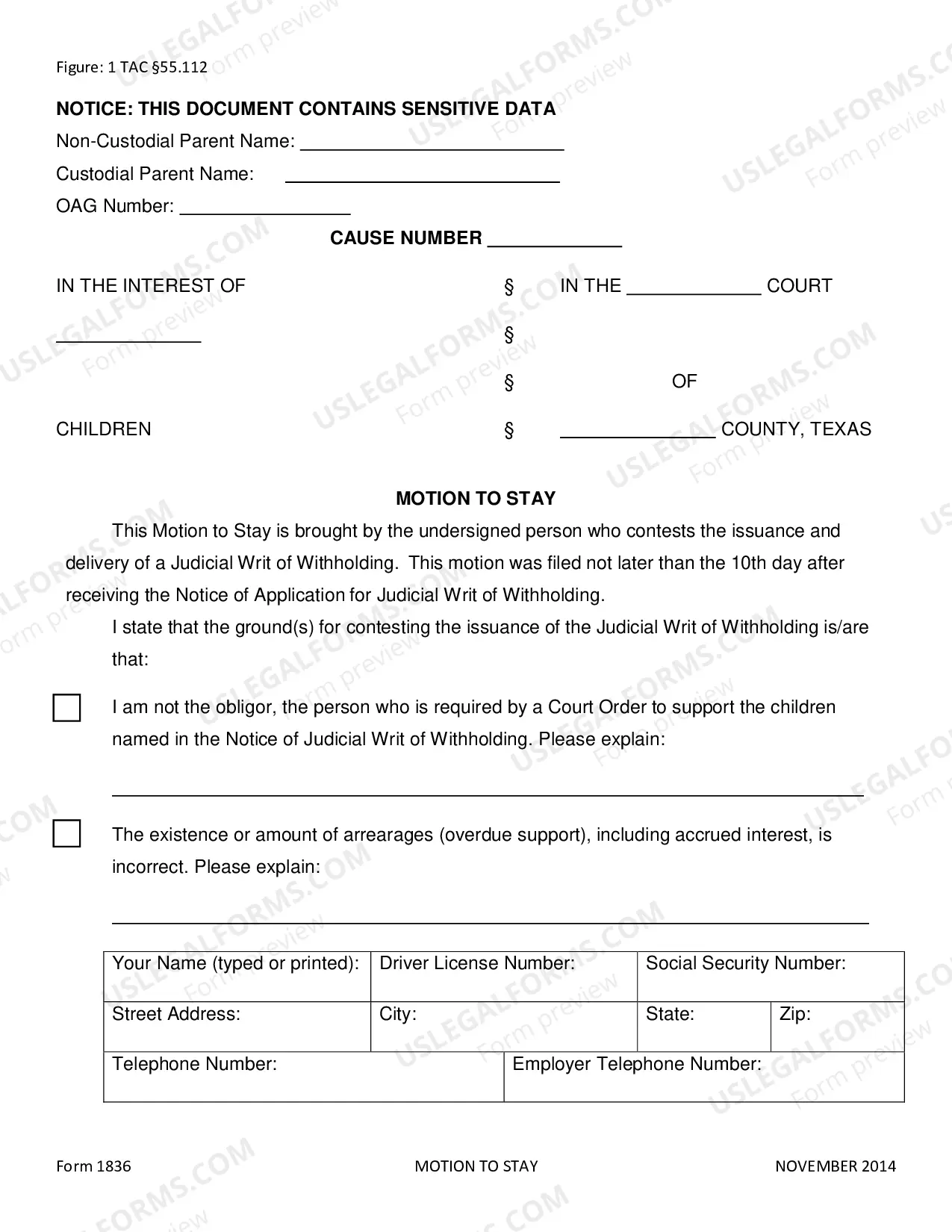
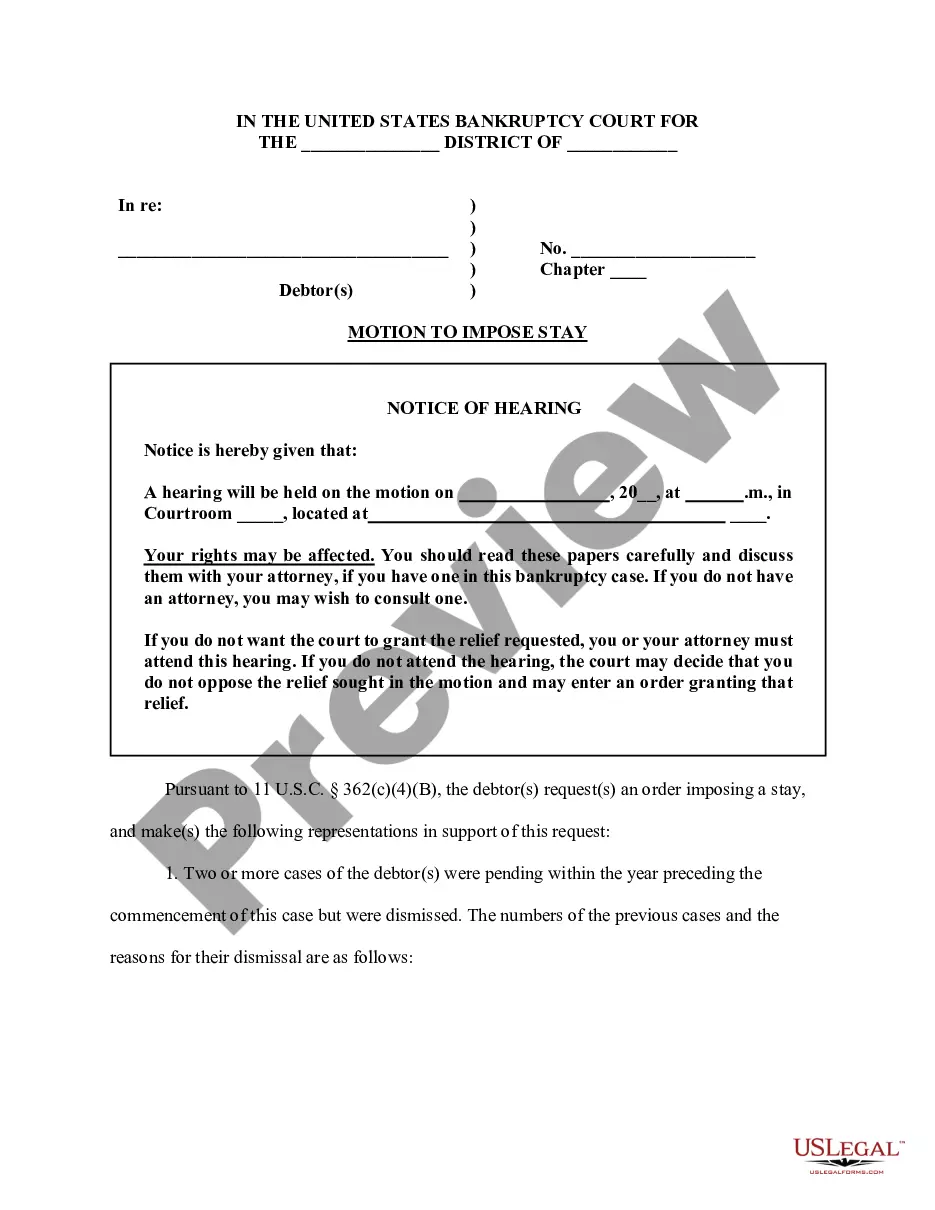
The Motion to Stay is a legal document that allows a person to contest the issuance of a Judicial Writ of Withholding. This motion is typically used when a non-custodial parent believes they have valid reasons to prevent their employer from withholding child support payments. It differs from other legal motions as it specifically targets actions regarding wage withholding related to child support obligations.
Main sections of this form
- Names of the non-custodial and custodial parents.
- OAG number and cause number associated with the child support case.
- Grounds for contesting the Judicial Writ of Withholding.
- Personal information of the non-custodial parent, including address and contact details.
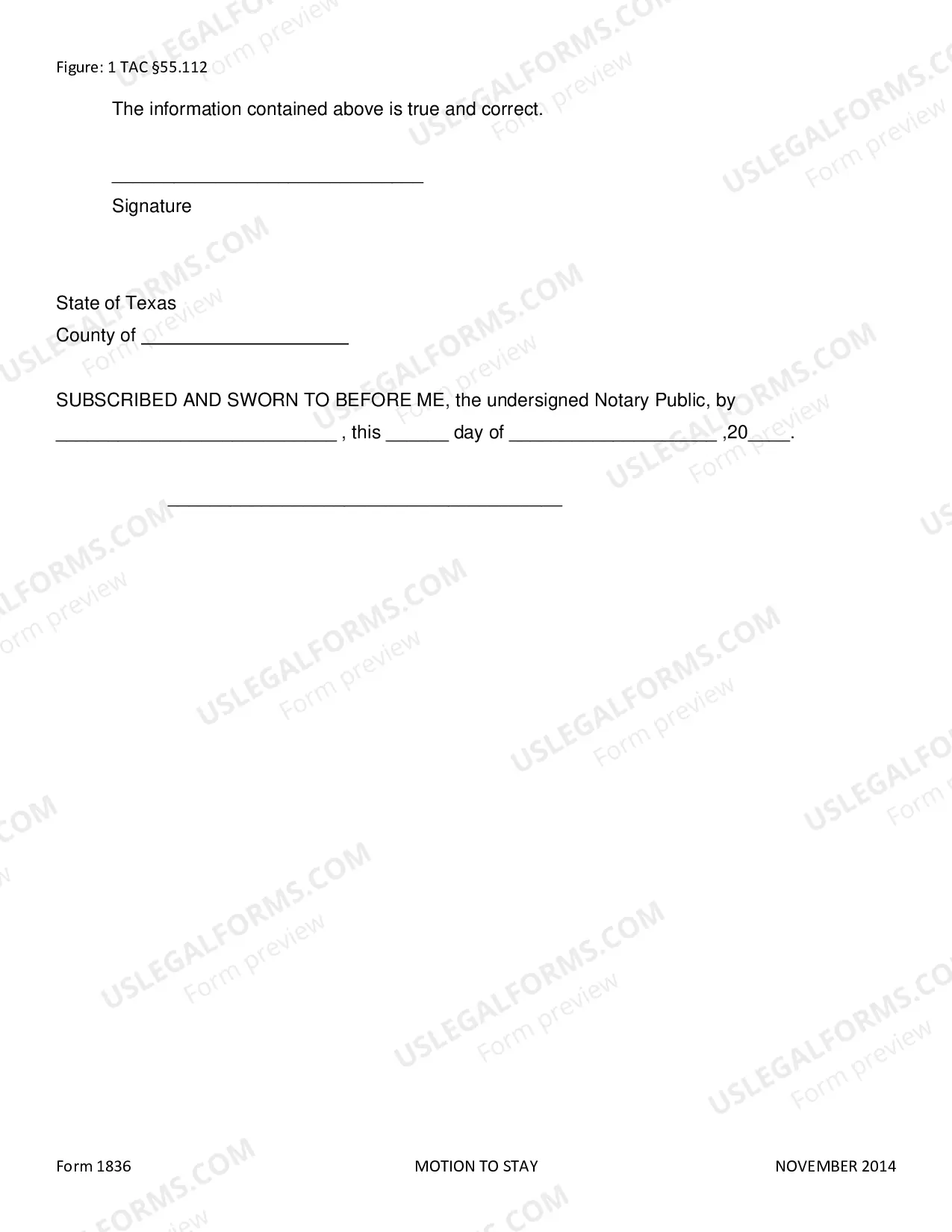
- Signature area and notary section to verify the motion.
Situations where this form applies
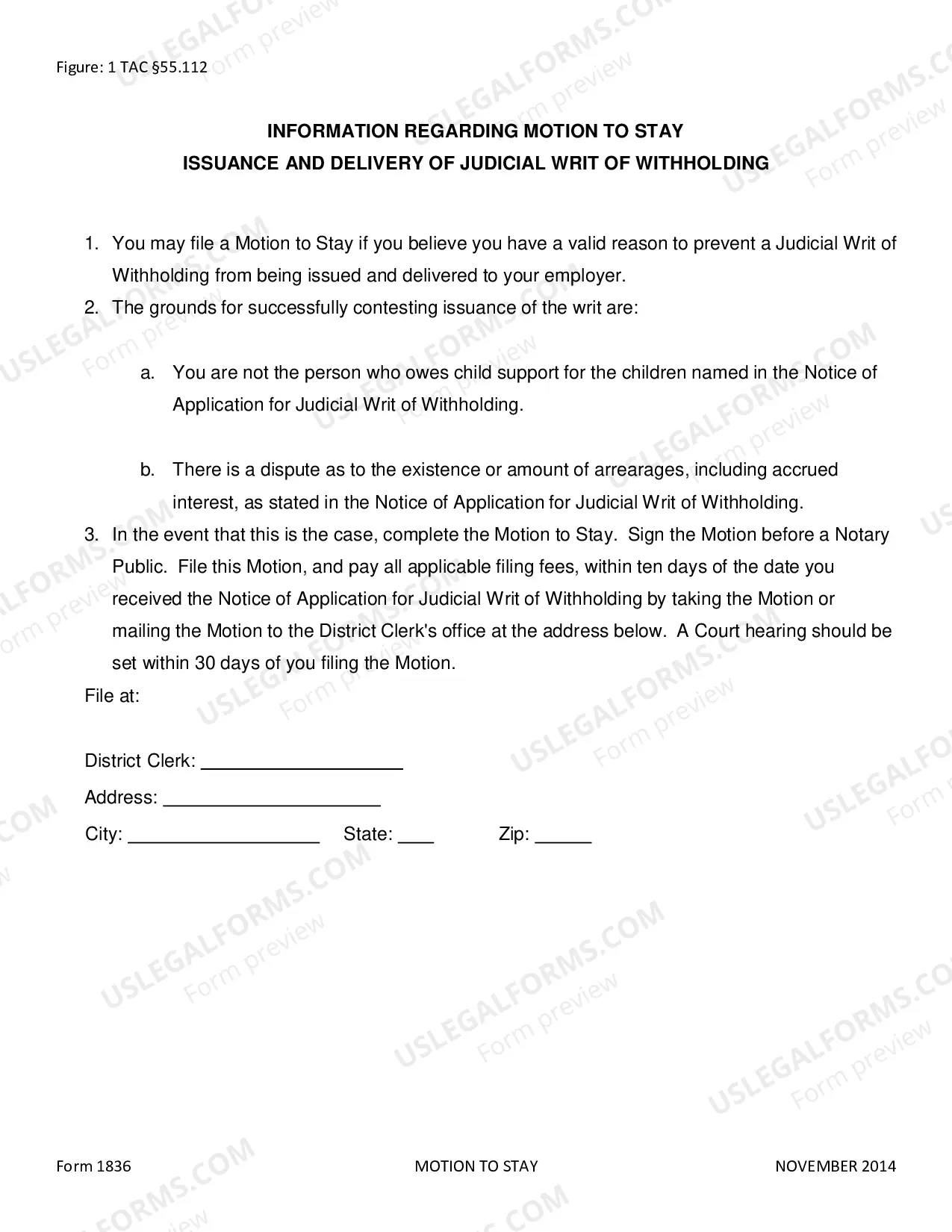
This form should be used when a non-custodial parent receives a Notice of Application for Judicial Writ of Withholding and believes that they are not the person obligated to pay child support, or there is a dispute regarding the amount of overdue support payments. It is critical to file this motion within ten days of receiving the notice to avoid automatic enforcement of wage withholding.
Who should use this form
- Non-custodial parents who have been served with a Notice of Application for Judicial Writ of Withholding.
- Individuals who believe they do not owe the child support as indicated in the notice.
- Those who wish to dispute the amount of arrears stated in the notice.
Steps to complete this form
- Fill in the names of the non-custodial and custodial parents at the beginning of the form.
- Provide the OAG number and cause number associated with your child support case.
- Clearly outline the grounds for contesting the writ, including necessary explanations.
- Complete your personal information, including your address and contact details.
- Sign the form in front of a notary public, who will then complete their part of the documentation.
Does this document require notarization?
This form usually doesn’t need to be notarized. However, local laws or specific transactions may require it. Our online notarization service, powered by Notarize, lets you complete it remotely through a secure video session, available 24/7.
Get your form ready online
Our built-in tools help you complete, sign, share, and store your documents in one place.
Make edits, fill in missing information, and update formatting in US Legal Forms—just like you would in MS Word.
Download a copy, print it, send it by email, or mail it via USPS—whatever works best for your next step.
Sign and collect signatures with our SignNow integration. Send to multiple recipients, set reminders, and more. Go Premium to unlock E-Sign.
If this form requires notarization, complete it online through a secure video call—no need to meet a notary in person or wait for an appointment.
We protect your documents and personal data by following strict security and privacy standards.

Make edits, fill in missing information, and update formatting in US Legal Forms—just like you would in MS Word.

Download a copy, print it, send it by email, or mail it via USPS—whatever works best for your next step.

Sign and collect signatures with our SignNow integration. Send to multiple recipients, set reminders, and more. Go Premium to unlock E-Sign.

If this form requires notarization, complete it online through a secure video call—no need to meet a notary in person or wait for an appointment.

We protect your documents and personal data by following strict security and privacy standards.
Common mistakes to avoid
- Failing to file the motion within the required ten-day period.
- Not providing sufficient details to support the grounds for contesting the writ.
- Neglecting to sign the motion in the presence of a notary public.
Why use this form online
- Convenient access to legally compliant forms from anywhere.
- Editable templates ensure you can customize the form to your specific circumstances.
- Reliable legal guidance drafted by licensed attorneys for peace of mind.
Summary of main points
- The Motion to Stay is crucial for contesting a Judicial Writ of Withholding effectively.
- Timeliness and accuracy are essential when completing and filing the form.
- Notarization is a mandatory step to ensure the form's validity.
Looking for another form?

Form popularity
FAQ
Each party is entitled to at least 14 days' notice of the hearing on the motion to dismiss. The court may, but is not required to, conduct an oral hearing on the motion. Except as required by 91a.
Texas Rules of Civil Procedure 91a offers a way to ask the court to dismiss a frivolous lawsuit. Also, defendants who are being sued for exercising their First Amendment rights can file anti-SLAPP motions to dismiss.
A judicial officer or a presiding officer of a judicial agency who receives a request for a judicial record not in his or her custody as defined by this rule must promptly attempt to ascertain who the custodian of the record is.
Rule 12 - Attorney to Show Authority. A party in a suit or proceeding pending in a court of this state may, by sworn written motion stating that he believes the suit or proceeding is being prosecuted or defended without authority, cause the attorney to be cited to appear before the court and show his authority to act.
Sec. 51.001. APPEAL FROM JUSTICE COURT TO COUNTY OR DISTRICT COURT. (a) In a case tried in justice court in which the judgment or amount in controversy exceeds $250, exclusive of costs, or in which the appeal is expressly provided by law, a party to a final judgment may appeal to the county court.
File the Motion with the Clerk of the County Court at the Court where the case was filed. You must also hand-deliver a copy of the Motion to the Judge assigned to your case. If you do not know who the Judge is in your case or the Court, call Court Docketing at 305-275-1155. Give them your case number.
Rule 12 of the Texas Rules of Judicial Administration provides for public access to certain records made or maintained by a judicial agency in its regular course of business but not pertaining to its adjudicative function.
FRCP Rule 12(b) pertains to pretrial motions, and 12(b)(6) specifically deals with motions to dismiss for failure to state a claim upon which relief can be granted. As a practical matter, Rule 12(b)(6) motions are rarely successful, and when they are, their success usually has more to do with the judge than the law.