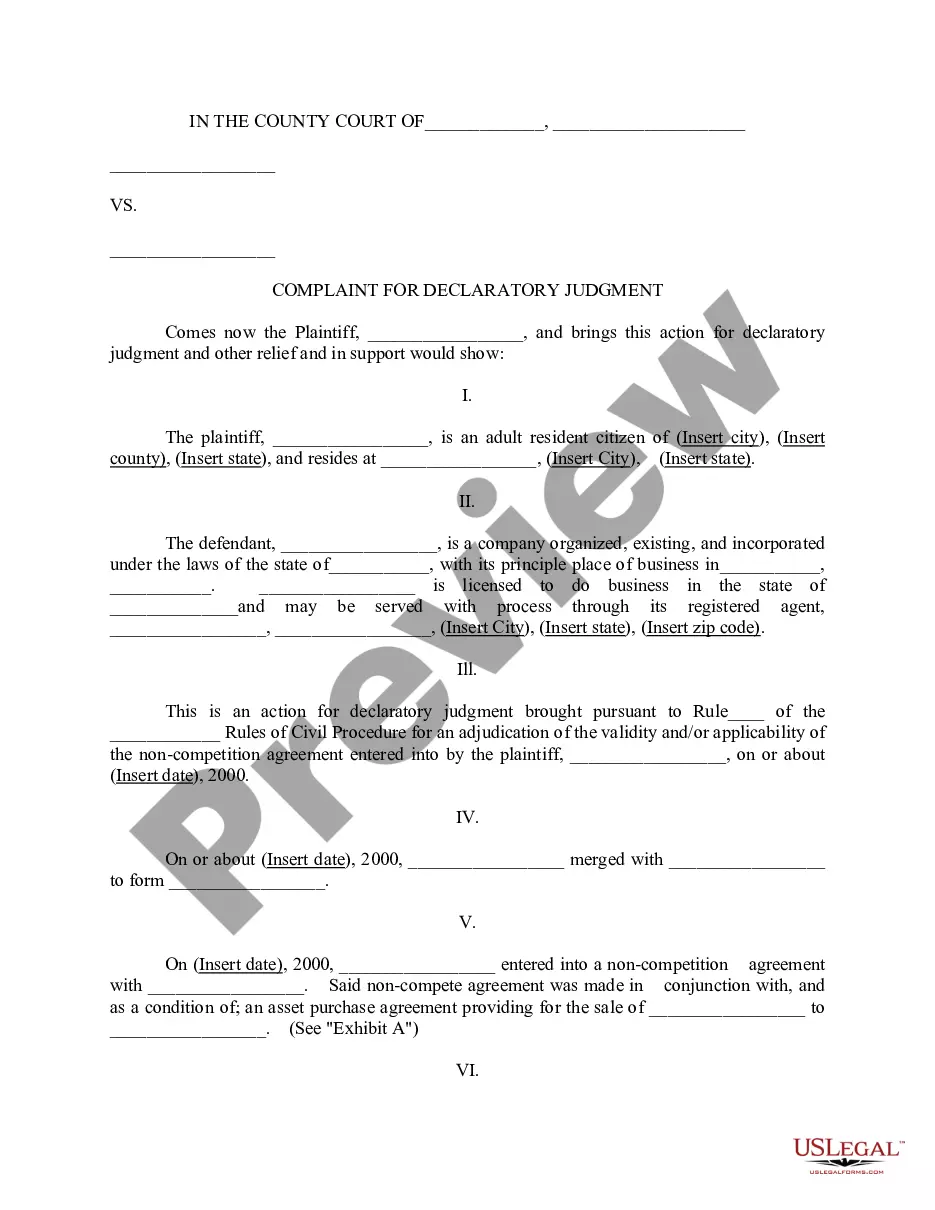
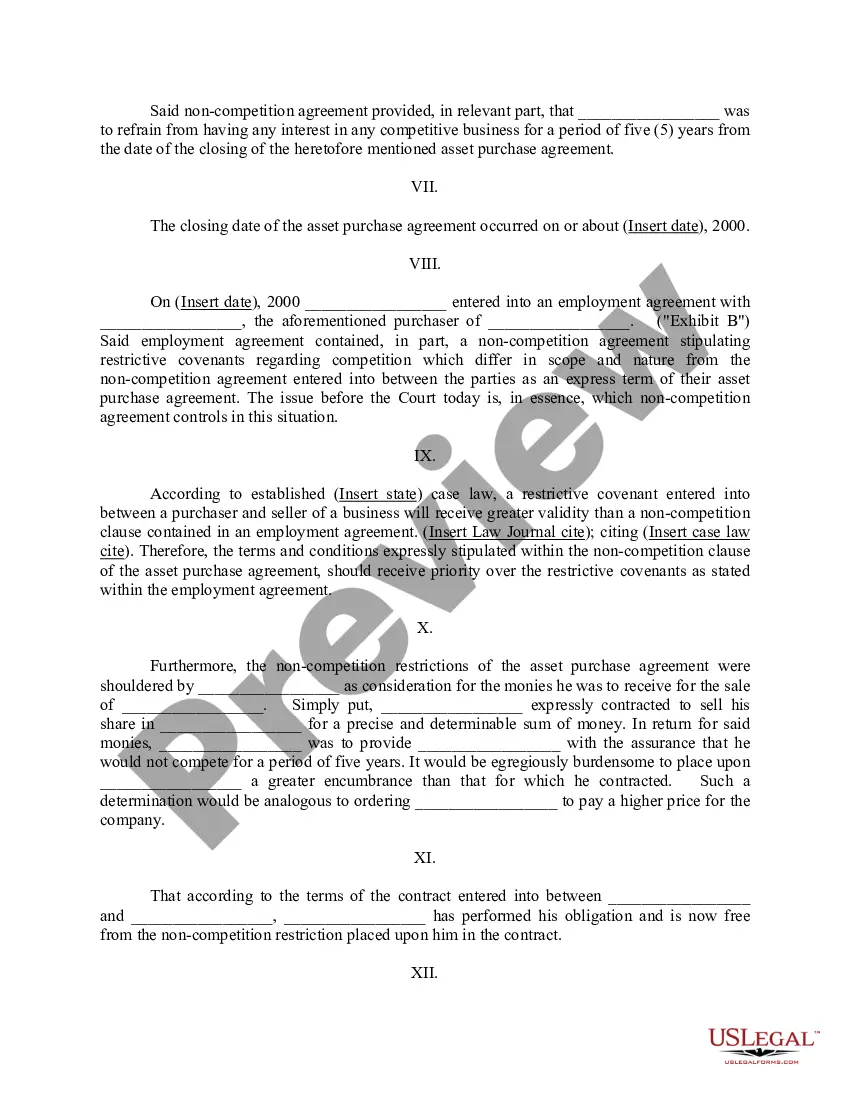
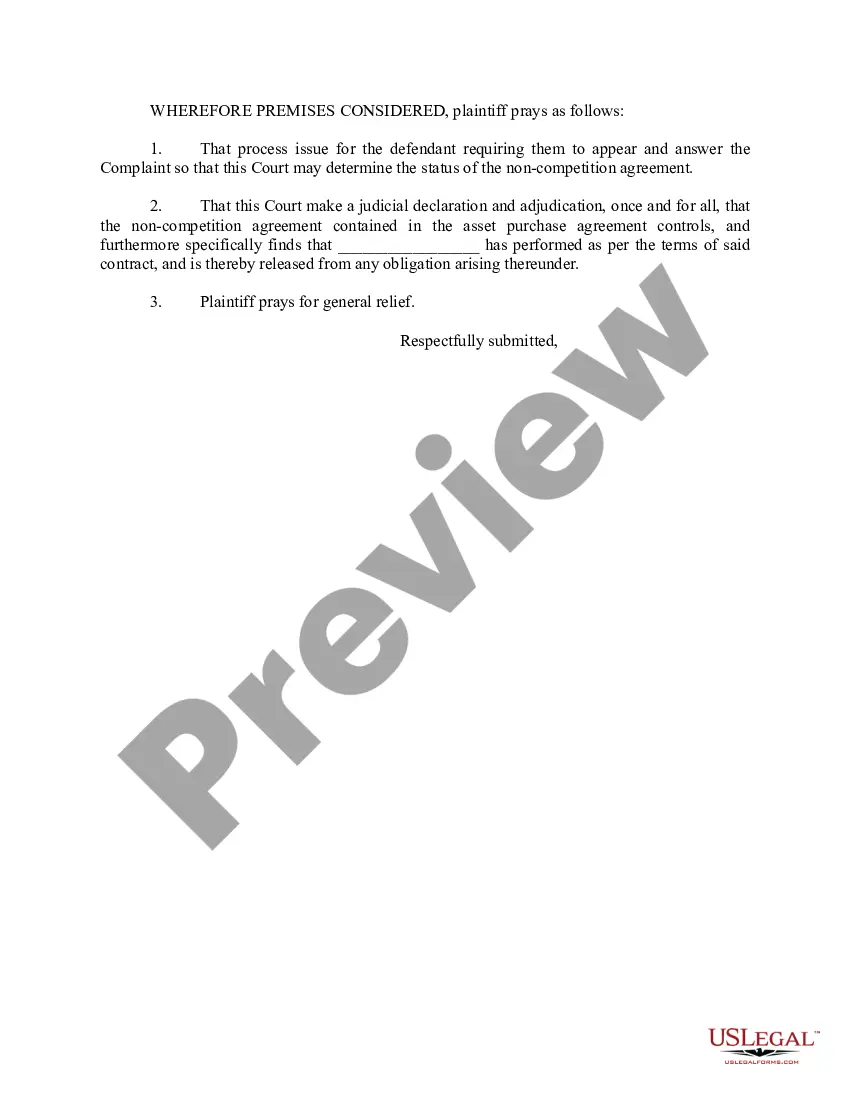
Plaintiff brings an action for a declaratory judgment arguing that he/she has fulfilled certain contractual duties and is now free from a non-competition restriction placed upon him/her in the contract.
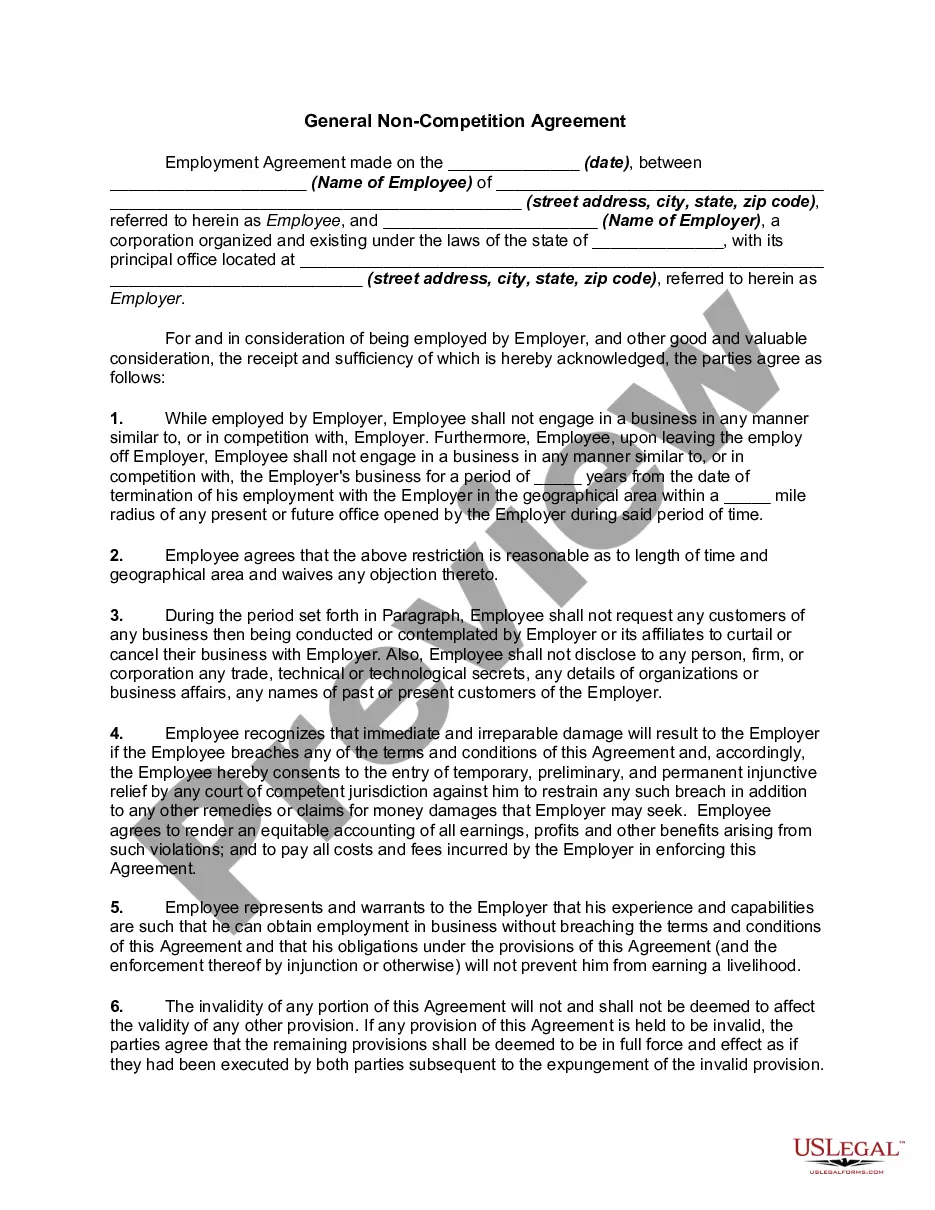
Tennessee Complaint For Declaratory Judgment Of Validity of Separate Noncompetition Agreements
State:
Multi-State
Category:
Control #:
US-000288
Format:
Word;
Rich Text
47 downloads
Description
Free preview



Get your form ready online
Our built-in tools help you complete, sign, share, and store your documents in one place.
Built-in online Word editor
Make edits, fill in missing information, and update formatting in US Legal Forms—just like you would in MS Word.
Export easily
Download a copy, print it, send it by email, or mail it via USPS—whatever works best for your next step.
E-sign your document
Sign and collect signatures with our SignNow integration. Send to multiple recipients, set reminders, and more. Go Premium to unlock E-Sign.
Notarize online 24/7
If this form requires notarization, complete it online through a secure video call—no need to meet a notary in person or wait for an appointment.
Store your document securely
We protect your documents and personal data by following strict security and privacy standards.

Make edits, fill in missing information, and update formatting in US Legal Forms—just like you would in MS Word.

Download a copy, print it, send it by email, or mail it via USPS—whatever works best for your next step.

Sign and collect signatures with our SignNow integration. Send to multiple recipients, set reminders, and more. Go Premium to unlock E-Sign.

If this form requires notarization, complete it online through a secure video call—no need to meet a notary in person or wait for an appointment.

We protect your documents and personal data by following strict security and privacy standards.
Looking for another form?
How to fill out Complaint For Declaratory Judgment Of Validity Of Separate Noncompetition Agreements?
You can spend hours online searching for the authentic legal document template that meets the federal and state requirements you need.
US Legal Forms offers numerous legal forms that are vetted by experts.
You can easily obtain or create the Tennessee Complaint For Declaratory Judgment Of Validity of Separate Noncompetition Agreements through our services.
- If you already have a US Legal Forms account, you can Log In and click the Download option.
- Then, you can complete, modify, print, or sign the Tennessee Complaint For Declaratory Judgment Of Validity of Separate Noncompetition Agreements.
- Every legal document template you acquire is yours forever.
- To obtain another copy of the acquired form, go to the My documents tab and click the corresponding option.
- If you are using the US Legal Forms site for the first time, follow the simple instructions below.
- First, ensure that you have selected the correct document template for the county/city of your choice.
- Check the form description to confirm you have chosen the right document.
- If available, use the Preview option to review the document template as well.
- If you wish to find another version of the form, use the Lookup field to locate the template that suits your needs and requirements.
- Once you have identified the template you want, click Purchase now to proceed.
- Select the pricing plan you desire, enter your information, and create an account on US Legal Forms.
- Complete the transaction. You can use your Visa or Mastercard or PayPal account to pay for the legal document.
- Choose the format of the document and download it to your device.
- Make edits to your document if necessary.
- You can complete, modify, sign, and print the Tennessee Complaint For Declaratory Judgment Of Validity of Separate Noncompetition Agreements.
- Download and print countless document templates using the US Legal Forms website, which provides the largest collection of legal forms.
- Utilize professional and state-specific templates to address your business or personal needs.
Form popularity
FAQ
To file a complaint with the Tennessee Bar Association, you need to gather all relevant information and documentation that supports your claim against a lawyer. The complaint process typically involves filling out a specific form and detailing the issues you encountered. This process is essential, especially if you believe that a lawyer's actions have affected a Tennessee Complaint For Declaratory Judgment Of Validity of Separate Noncompetition Agreements. You can find resources and assistance on the USLegalForms platform to guide you through filing your complaint effectively.
A Rule 35 motion in Tennessee allows a party to request a mental or physical examination of another party when their condition is in controversy. This motion is often relevant in cases involving personal injury or other claims where the condition of a party needs evaluation. Understanding how to navigate this process can be crucial, especially in cases involving a Tennessee Complaint For Declaratory Judgment Of Validity of Separate Noncompetition Agreements, where the validity of agreements may hinge on the mental state of the parties involved.
A Rule 59 motion in Tennessee allows a party to request the court to alter or amend its judgment. This motion can be particularly useful after a Tennessee Complaint For Declaratory Judgment Of Validity of Separate Noncompetition Agreements has been issued, as it provides an opportunity to address any perceived errors. The motion must be filed within 30 days of the judgment, and it serves as a way to ensure that all relevant issues are considered before the case is finalized. Legal assistance can be invaluable in navigating this process effectively.
The actual controversy of a declaratory judgment refers to a real and substantial dispute that requires resolution. In the realm of a Tennessee Complaint For Declaratory Judgment Of Validity of Separate Noncompetition Agreements, this means that there must be an existing conflict between parties regarding the interpretation or enforcement of their agreements. Courts typically require this controversy to be concrete and not hypothetical, ensuring that judicial resources are used effectively. By establishing an actual controversy, you can pursue a declaratory judgment with confidence.
Yes, a declaratory judgment is recognized as a form of equitable relief. In the context of a Tennessee Complaint For Declaratory Judgment Of Validity of Separate Noncompetition Agreements, it allows parties to resolve disputes without resorting to traditional litigation. This type of judgment can clarify legal rights and obligations, providing certainty for those involved. By seeking a declaratory judgment, you can effectively address potential conflicts regarding noncompetition agreements.
Declaratory relief refers to a court's declaratory judgment stating the rights of parties without ordering any specific action or listing awards for damages.
Thus, a declaratory judgment action that is nothing more than an anticipatory defense to a breach of contract claim may be an inappropriate use of the declaratory judgment mechanism. Given that courts have discretion whether to entertain a declaratory judgment action, they may decline to do so under such circumstances.
"Limitations statutes do not apply to declaratory judgment suits, as such, because a declaratory judgment action is a mere procedural device by which various types of substantive claims may be asserted." Dehoff v. Attorney General, 564 S.W. 2d 361, 362 (Tenn.
Declaratory judgments are conclusive and legally binding, but do not have preclusive effect if: A later lawsuit involves issues other than those specifically litigated and ruled on in the declaratory judgment action.
A counterclaim of infringement is a compulsory counterclaim to a claim for declaratory judgment of non-infringement. If a patent owner fails to assert an infringement counterclaim in a declaratory-judgment non-infringement suit, the patent infringement claim will be deemed waived.