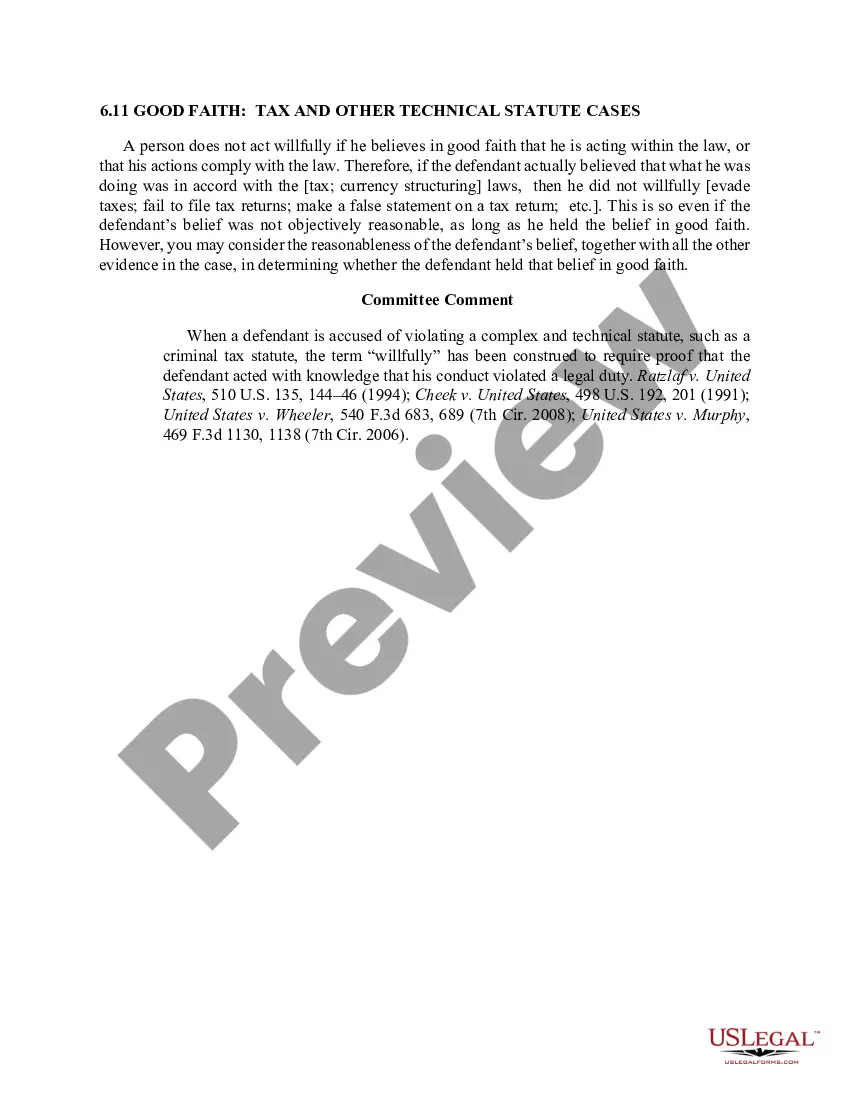
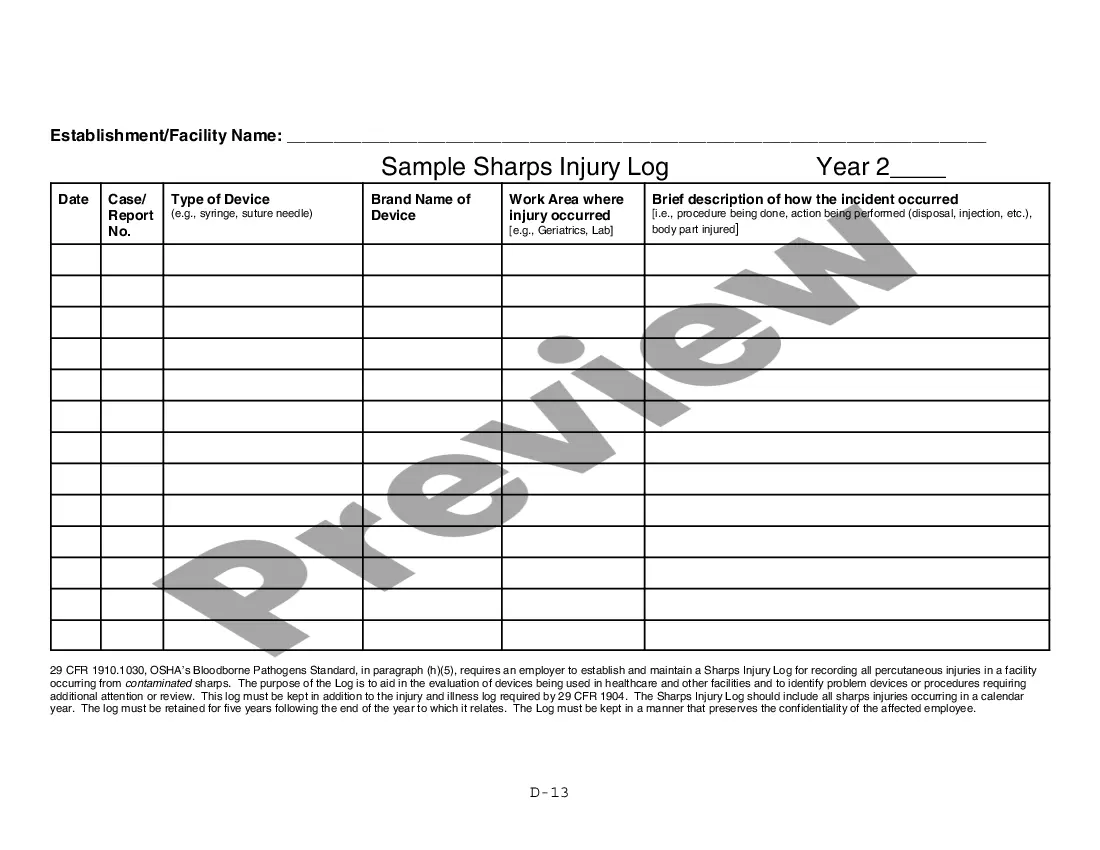
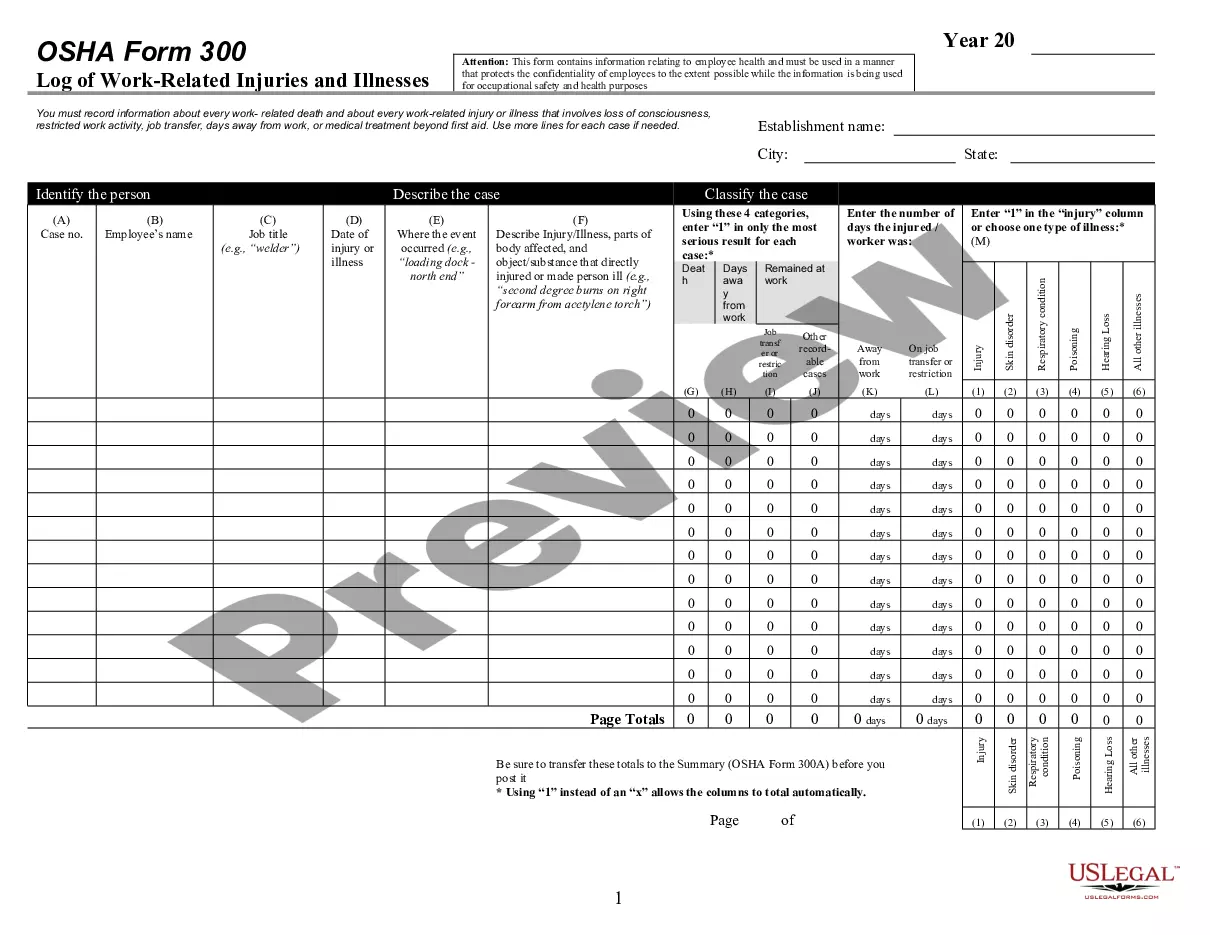
South Dakota Sample Sharps Injury Log
Description
Get your form ready online
Our built-in tools help you complete, sign, share, and store your documents in one place.
Make edits, fill in missing information, and update formatting in US Legal Forms—just like you would in MS Word.
Download a copy, print it, send it by email, or mail it via USPS—whatever works best for your next step.
Sign and collect signatures with our SignNow integration. Send to multiple recipients, set reminders, and more. Go Premium to unlock E-Sign.
If this form requires notarization, complete it online through a secure video call—no need to meet a notary in person or wait for an appointment.
We protect your documents and personal data by following strict security and privacy standards.

Make edits, fill in missing information, and update formatting in US Legal Forms—just like you would in MS Word.

Download a copy, print it, send it by email, or mail it via USPS—whatever works best for your next step.

Sign and collect signatures with our SignNow integration. Send to multiple recipients, set reminders, and more. Go Premium to unlock E-Sign.

If this form requires notarization, complete it online through a secure video call—no need to meet a notary in person or wait for an appointment.

We protect your documents and personal data by following strict security and privacy standards.
Looking for another form?

How to fill out Sample Sharps Injury Log?
You can spend countless hours online trying to locate the official document template that meets your state and national requirements.
US Legal Forms offers a vast array of legal templates that can be reviewed by professionals.
It is easy to download or print the South Dakota Sample Sharps Injury Log from their services.
If available, utilize the Preview feature to glance through the document template as well.
- If you already possess a US Legal Forms account, you can Log In and click the Obtain button.
- After that, you can complete, modify, print, or sign the South Dakota Sample Sharps Injury Log.
- Every legal document template you purchase is yours forever.
- To obtain another copy of any purchased document, go to the My documents section and click the corresponding option.
- If you are using the US Legal Forms website for the first time, follow the simple instructions below.
- First, ensure you have selected the correct document template for the region/area of your choice.
- Review the document details to confirm you have chosen the appropriate form.
Form popularity
FAQ
A tetanus shot is generally not recordable by OSHA unless it is part of medical treatment for a recordable injury. In other words, if the shot is given following a workplace injury, it may contribute to the recordability of that incident. The South Dakota Sample Sharps Injury Log can help clarify the circumstances surrounding these incidents. Keeping accurate records assists in maintaining workplace safety and compliance.
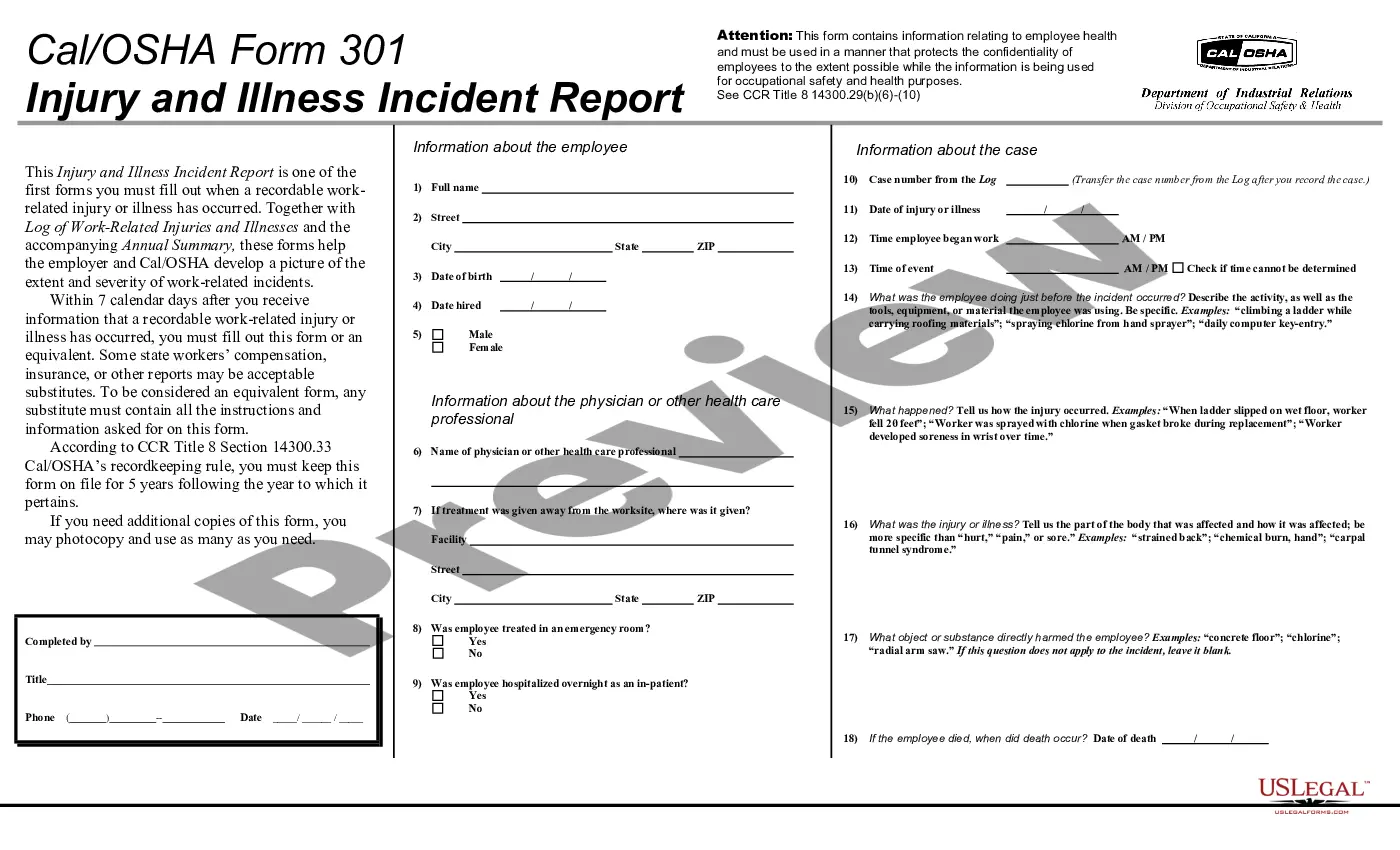
The sharps injury log shall contain, at a minimum: (A) The type and brand of device involved in the incident, (B) the department or work area where the exposure incident occurred, and (C) an explanation of how the incident occurred." The sharps injury log must be maintained for the period required by 29 CFR 1904.
The sharps injury log must contain, at a minimum, the type and brand of device involved in the injury (if known), the department or work area where the exposure incident occurred, and an explanation of how the incident occurred.
What to do if you receive a sharps injuryEncourage the wound to gently bleed, ideally holding it under running water.Wash the wound using running water and plenty of soap.Don't scrub the wound while you are washing it.Don't suck the wound.Dry the wound and cover it with a waterproof plaster or dressing.More items...?
(D) Each exposure incident shall be recorded on the Sharps Injury Log within 14 working days of the date the incident is reported to the employer.
Brief description of how the incident occurred The Sharps Injury Log should include all sharps injuries occurring in a calendar year. The log must be retained for five years following the end of the year to which it relates. The Log must be kept in a manner that preserves the confidentiality of the affected employee.
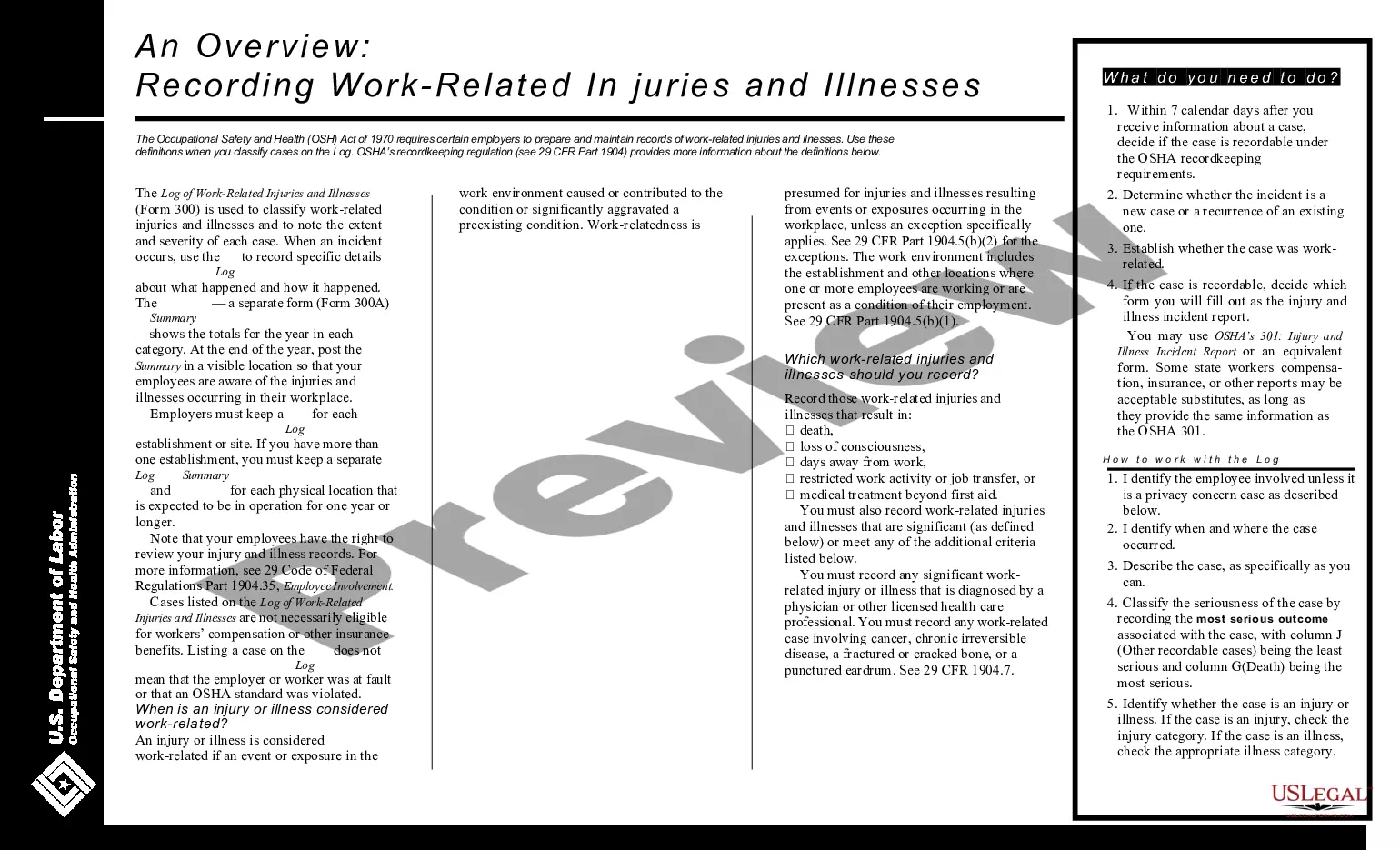
OSHA's Recordkeeping regulation, 29 CFR 1904.8(a), requires employers to record all work-related needlestick injuries and cuts from sharp objects that are contaminated with another person's blood or other potentially infectious material (OPIM).
To be recordable, the needlestick injury must be work-related and result in either (a) a fatality or (b) lost workdays, or (c) the need for medical treatment beyond first aid, loss of consciousness, restriction of work or motion, or transfer to another job.
You must record all work-related needlestick injuries and cuts from sharp objects that are contaminated with another person's blood or other potentially infectious material (as defined by 29 CFR 1910.1030). You must enter the case on the OSHA 300 Log as an injury.
The sharps injury log shall contain, at a minimum: (A) The type and brand of device involved in the incident, (B) the department or work area where the exposure incident occurred, and (C) an explanation of how the incident occurred." The sharps injury log must be maintained for the period required by 29 CFR 1904.