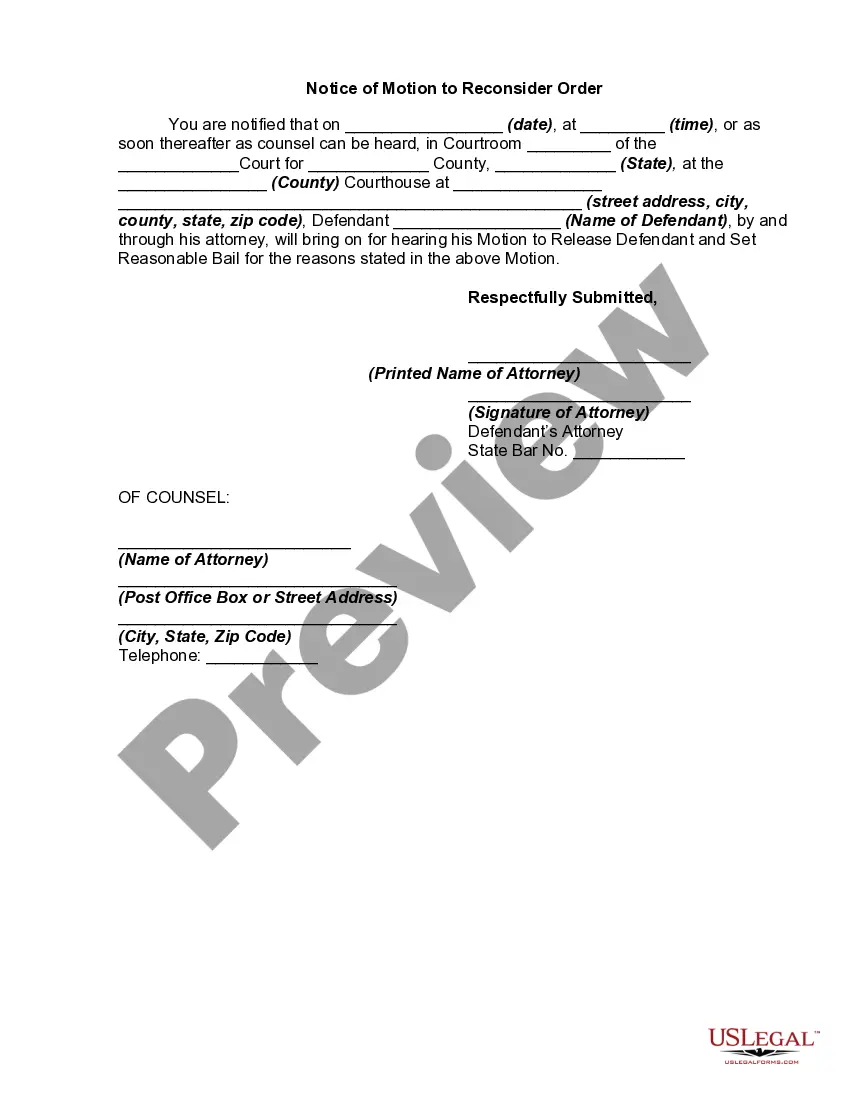
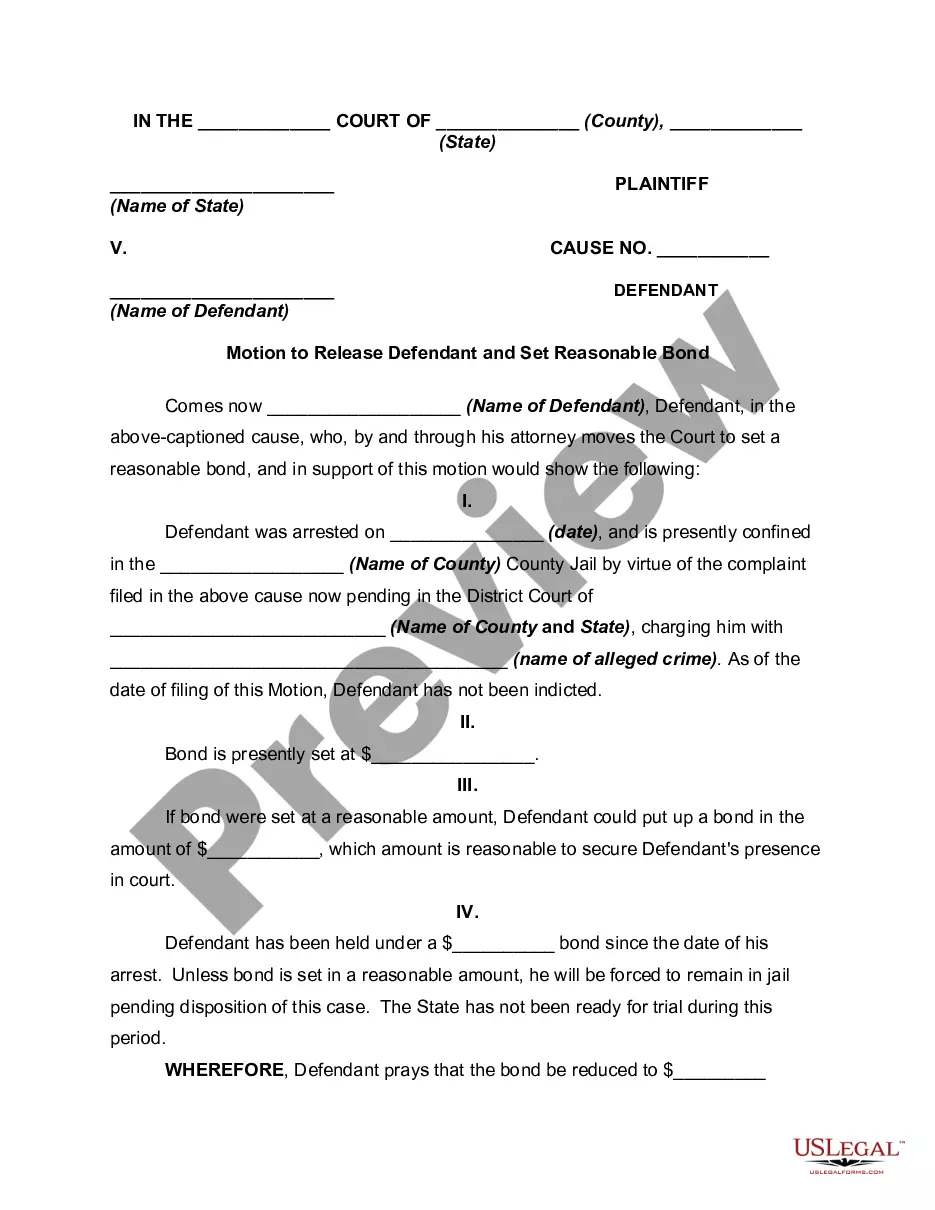
South Dakota Motion to Release Defendant and Set Reasonable Bail

Category:
State:
Multi-State
Control #:
US-02728BG
Format:
Word; 
Rich Text
Instant download

Description

A bail bond is a bond provided by an insurance company through a bail bondsman acting as agent for the company, to allow an accused defendant to be released before trial. A bail bond is designed to ensure the appearance of the defendant in court at the scheduled time. Prior to the posting of a bail bond, the defendant or a co-signer must guarantee that they will pay the full amount of bail if the defendant does not appear in court. The bail bond company usually charges 10 percent of the amount of the bond and often requires the defendant to put up some collateral like a second deed of trust or mortgage on one's house.


The following form is a complaint that adopts the "notice pleadings" format of the Federal Rules of Criminal Procedure, which have been adopted by most states in one form or another.
Free preview
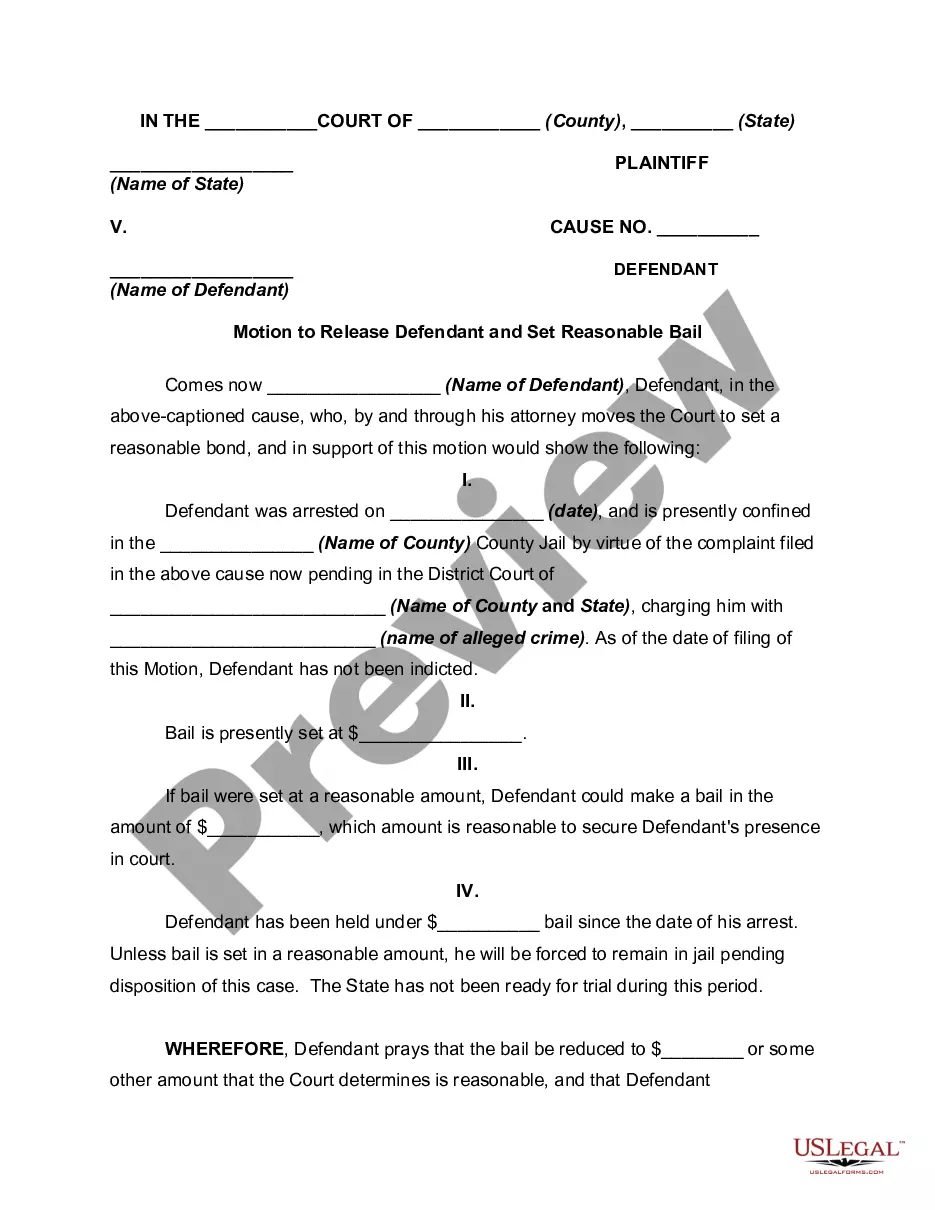
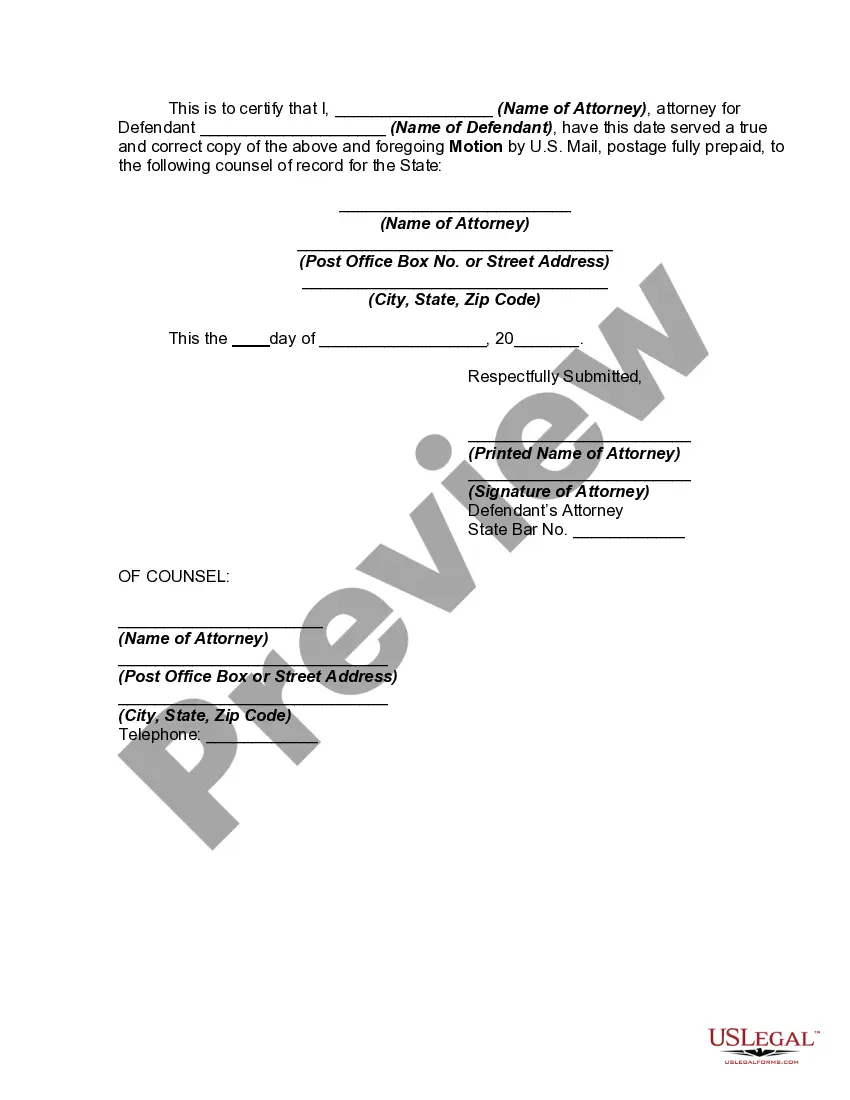
  • Preview Motion to Release Defendant and Set Reasonable Bail
  • Preview Motion to Release Defendant and Set Reasonable Bail
  • Preview Motion to Release Defendant and Set Reasonable Bail

Get your form ready online

Our built-in tools help you complete, sign, share, and store your documents in one place.

Built-in online Word editor

Make edits, fill in missing information, and update formatting in US Legal Forms—just like you would in MS Word.

Export easily

Download a copy, print it, send it by email, or mail it via USPS—whatever works best for your next step.

E-sign your document

Sign and collect signatures with our SignNow integration. Send to multiple recipients, set reminders, and more. Go Premium to unlock E-Sign.

Notarize online 24/7

If this form requires notarization, complete it online through a secure video call—no need to meet a notary in person or wait for an appointment.

Store your document securely

We protect your documents and personal data by following strict security and privacy standards.

Form selector

Make edits, fill in missing information, and update formatting in US Legal Forms—just like you would in MS Word.

Form selector

Download a copy, print it, send it by email, or mail it via USPS—whatever works best for your next step.

Form selector

Sign and collect signatures with our SignNow integration. Send to multiple recipients, set reminders, and more. Go Premium to unlock E-Sign.

Form selector

If this form requires notarization, complete it online through a secure video call—no need to meet a notary in person or wait for an appointment.

Form selector

We protect your documents and personal data by following strict security and privacy standards.

Looking for another form?

This field is required
Ohio
Select state

How to fill out Motion To Release Defendant And Set Reasonable Bail?

Finding the right legitimate record web template might be a struggle. Obviously, there are plenty of templates available on the net, but how can you find the legitimate form you need? Use the US Legal Forms website. The service provides a large number of templates, like the South Dakota Motion to Release Defendant and Set Reasonable Bail, which you can use for business and personal requires. All of the forms are examined by professionals and meet state and federal needs.

When you are already listed, log in to the account and click the Down load key to get the South Dakota Motion to Release Defendant and Set Reasonable Bail. Utilize your account to check from the legitimate forms you possess bought previously. Check out the My Forms tab of your own account and have one more copy from the record you need.

When you are a fresh consumer of US Legal Forms, listed below are basic guidelines that you can stick to:

  • Initial, ensure you have chosen the correct form for the area/state. You may look through the shape making use of the Preview key and study the shape information to guarantee this is the right one for you.
  • When the form does not meet your preferences, utilize the Seach discipline to get the right form.
  • When you are certain the shape would work, go through the Get now key to get the form.
  • Choose the pricing prepare you would like and enter the required information. Create your account and pay money for your order utilizing your PayPal account or Visa or Mastercard.
  • Opt for the document formatting and acquire the legitimate record web template to the device.
  • Full, revise and produce and sign the received South Dakota Motion to Release Defendant and Set Reasonable Bail.

US Legal Forms will be the most significant library of legitimate forms for which you can see different record templates. Use the company to acquire expertly-created papers that stick to express needs.

Form popularity

FAQ

The Eighth Amendment provides: Excessive bail shall not be required, nor excessive fines imposed, nor cruel and unusual punishments inflicted.

Although the Eighth Amendment protects against excessive bail, there is not an absolute right to bail, as noted in The Bail Reform Act, 18 USC Chapter 207. Section 3142 of the Act denies bail to certain defendants pending trial, specifically denying bail to defendants likely to flee or pose a danger to society.

The bond ensures that the estate's beneficiaries and creditors will receive compensation for financial harm if the personal representative fails to abide by the regulations outlined in South Dakota Statute 29A-3-606.

Bail is a sum of money placed with the court whose purpose is to ensure the appearance of the accused at trial. If paid in full or secured by a deposit (depending on the statutory regulations) it enables the accused to remain at liberty pending trial.

The California Supreme Court ruled that it is illegal to jail a person solely because they cannot pay cash bail.

States typically have a constitutional provision mirroring the federal Eighth Amendment prohibition on excessive bail. There also are constitutional or statutory provisions that provide the ?right to bail??the right to be released from jail before trial after a defendant agrees to return for court.

The Eighth Amendment to the United States Constitution states: ?Excessive bail shall not be required, nor excessive fines imposed, nor cruel and unusual punishments inflicted.? This amendment prohibits the federal government from imposing unduly harsh penalties on criminal defendants, either as the price for obtaining ...

The eighth amendment in the American Bill of Rights was adopted from the English Bill of Rights of 1689 and provides that excessive bail or fines shall not be imposed. Interpretations of the U.S. Constitution and State constitutions have consistently upheld the right to deny bail in capital cases.

Trusted and secure by over 3 million people of the world’s leading companies

South Dakota Motion to Release Defendant and Set Reasonable Bail