South Dakota Forest Products Timber Sale Contract
Overview of this form
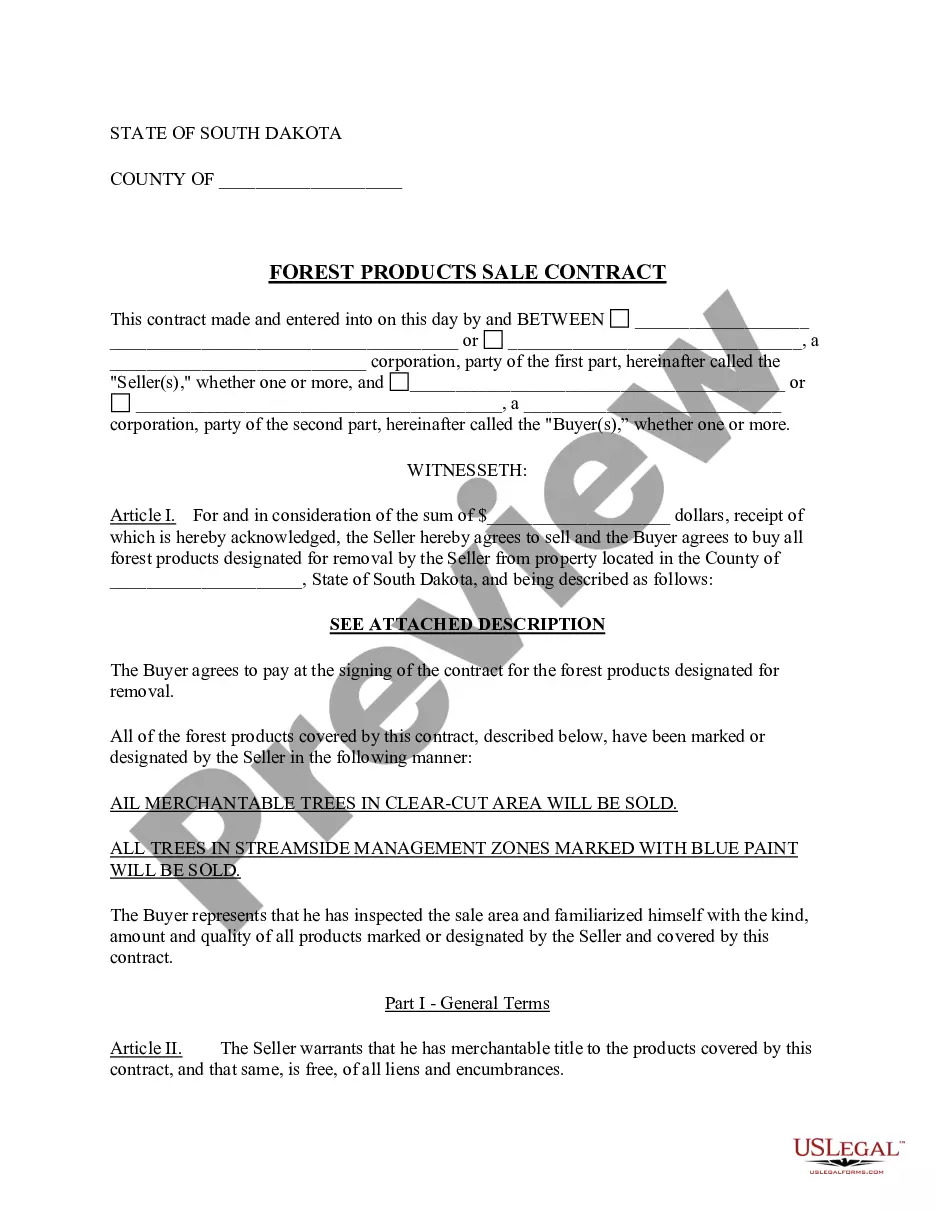
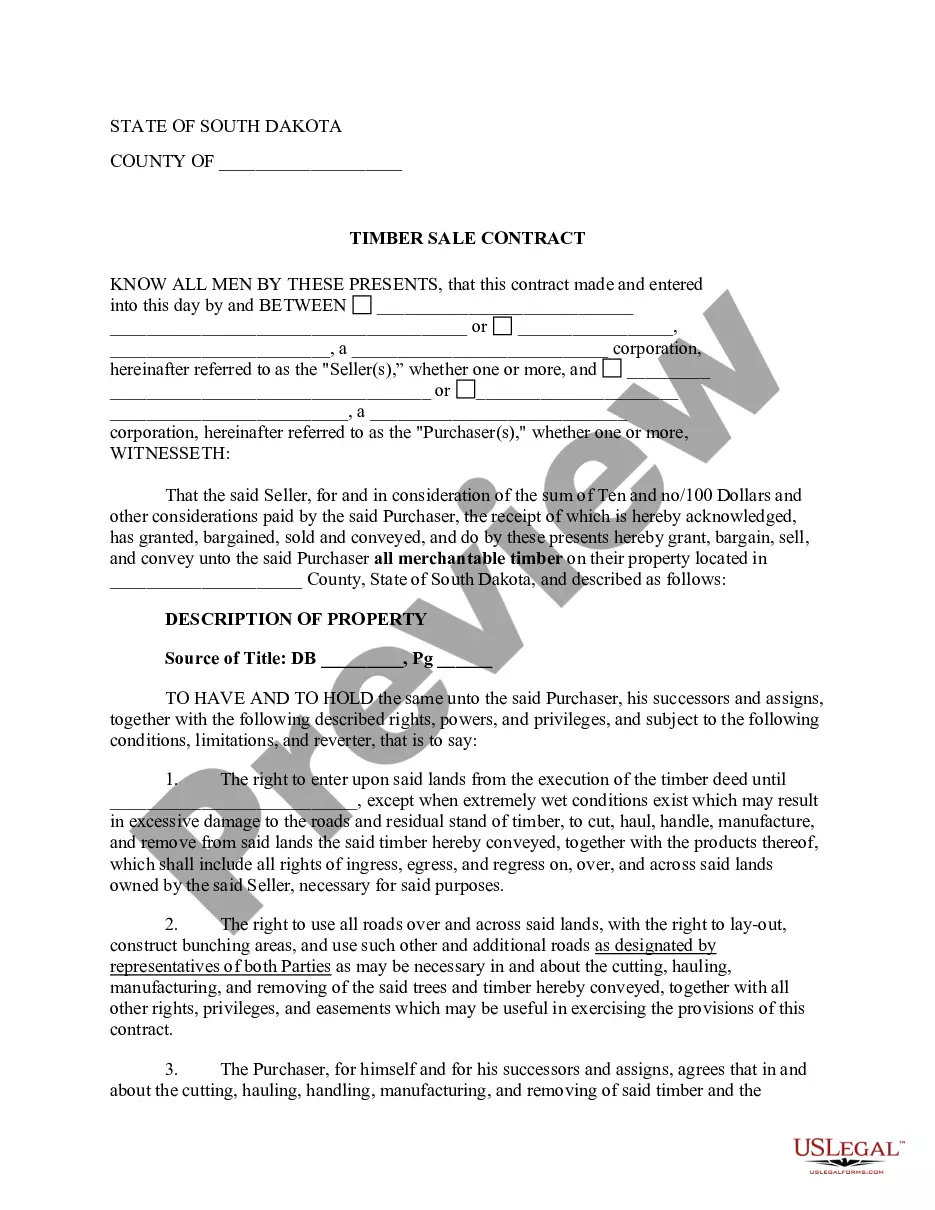
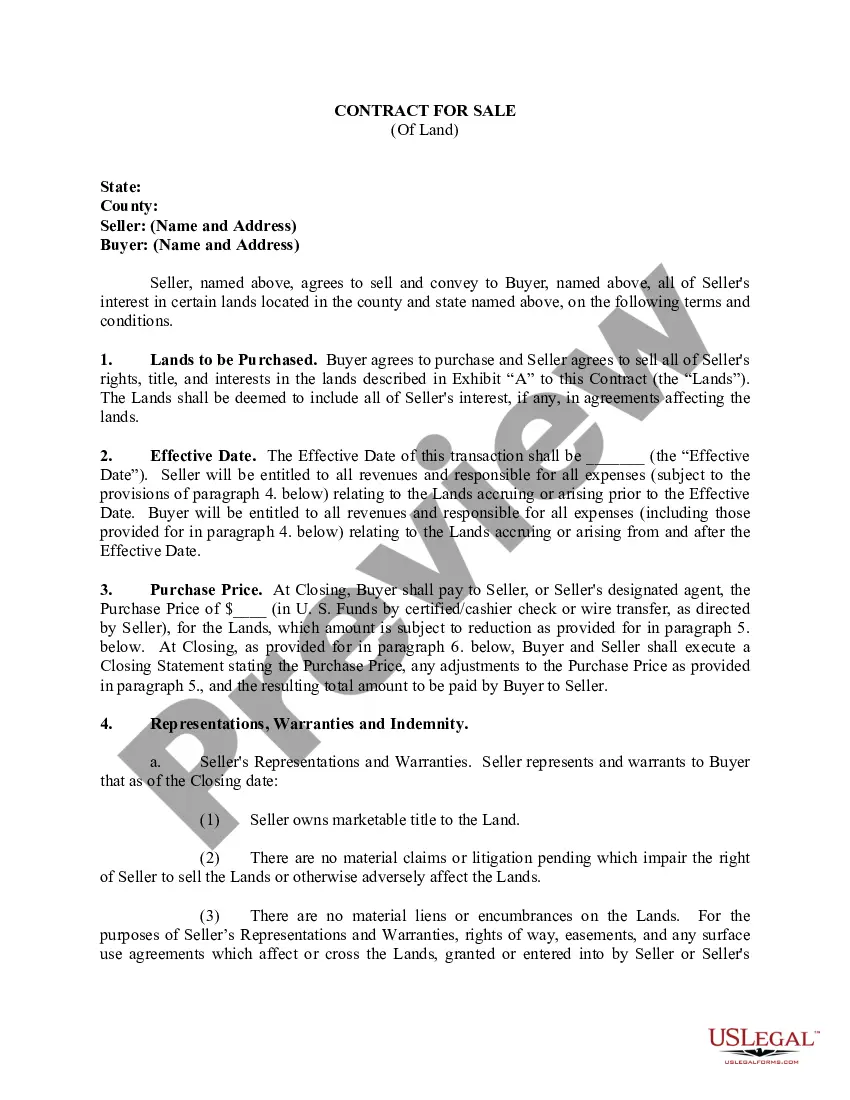
The South Dakota Forest Products Timber Sale Contract is a legal document that formalizes the agreement between a seller and a buyer for the sale of timber from a specified property. This contract outlines the rights and responsibilities of both parties, including payment terms, timber specifications, and access rights. It differs from other timber sale agreements by incorporating specific terms related to South Dakota's regulations and timber management practices.
Main sections of this form
- Identification of parties: Names and details of both seller and buyer.
- Timber specifications: Description of the timber to be sold, including marked trees and areas.
- Payment terms: Details on the payment amount and schedule.
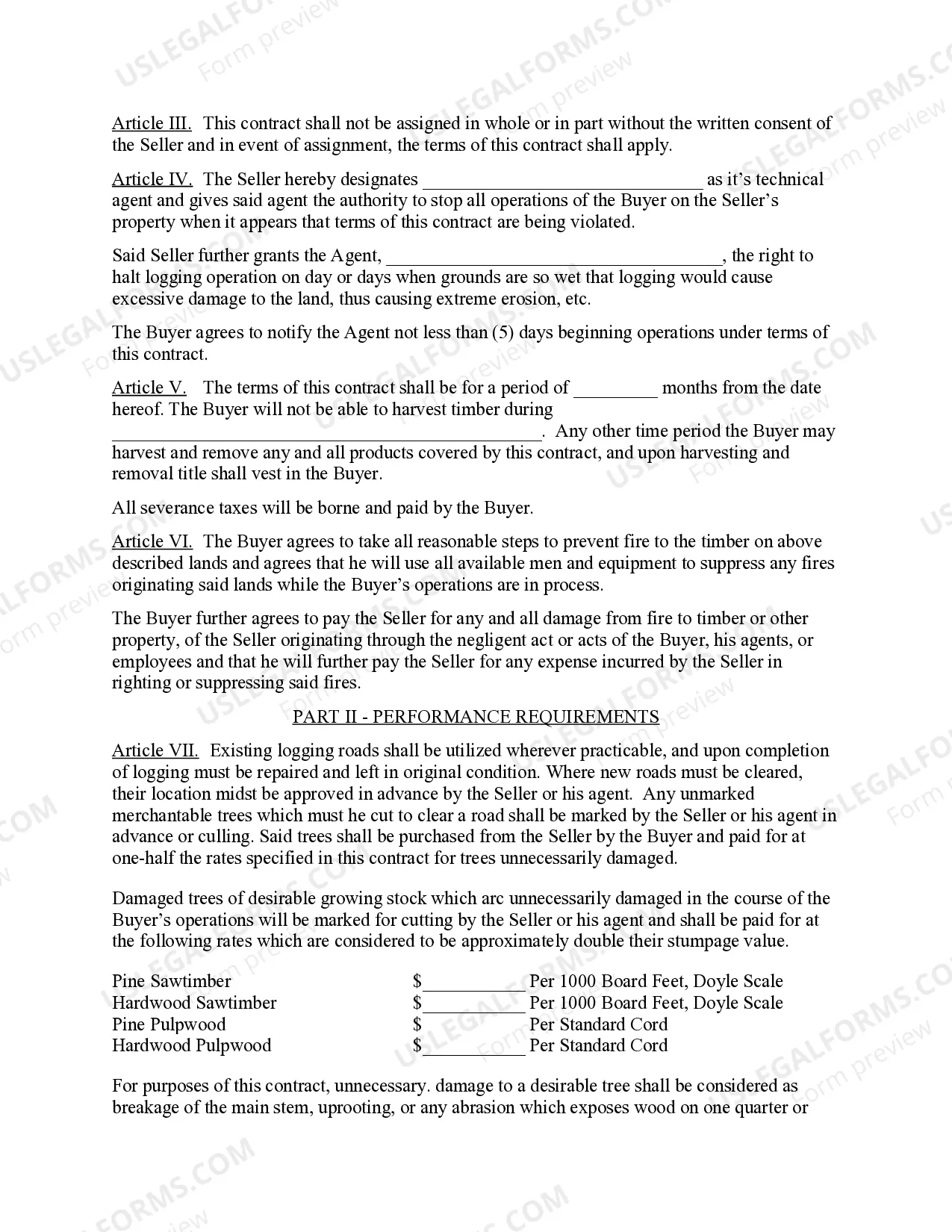
- Ingress and egress rights: The buyerâs right to access the sellerâs property for timber removal.
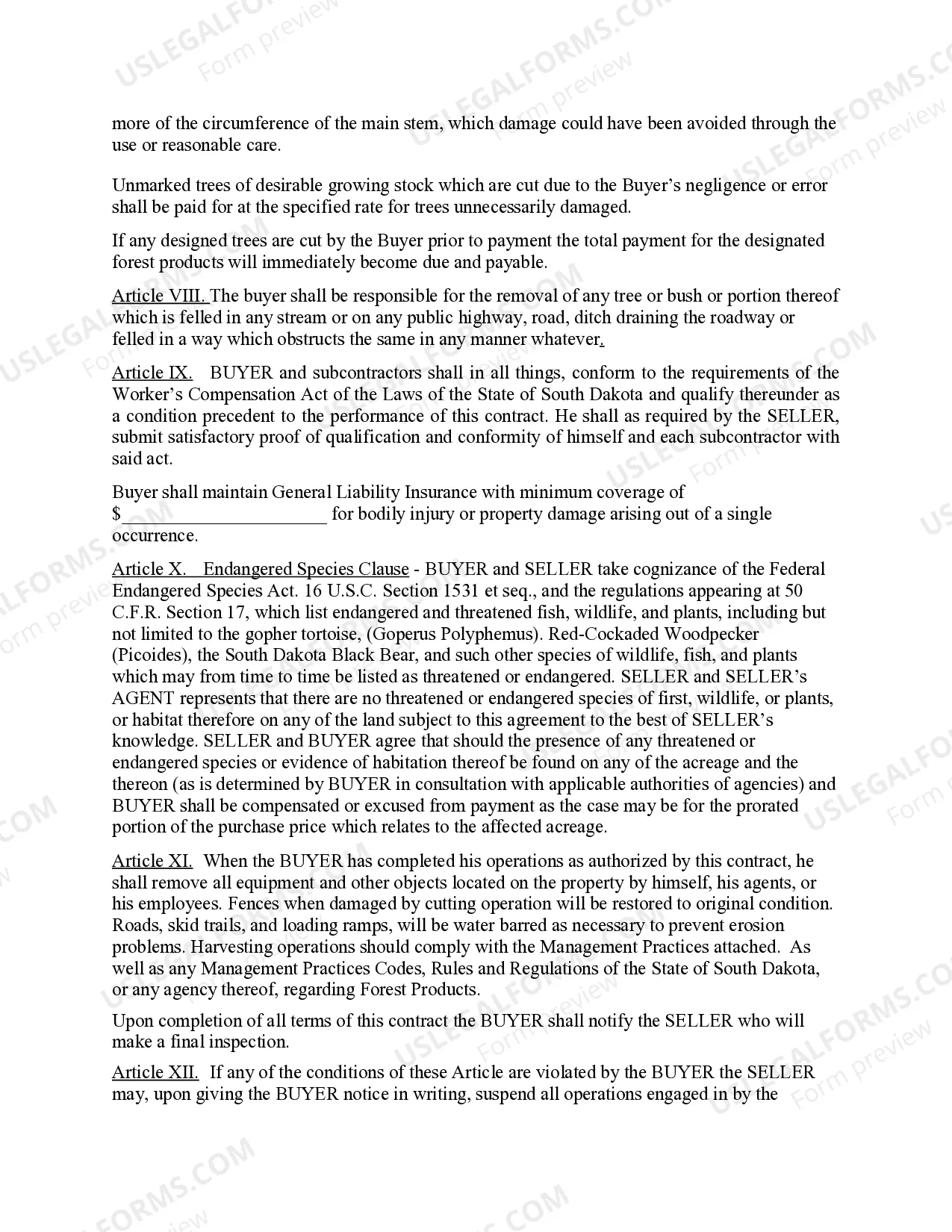
- Insurance requirements: Buyer's obligation to maintain adequate liability insurance.
- Endangered species clause: Acknowledgment of federal laws protecting certain species.
When to use this document
This form should be used when a landowner (seller) wants to sell specific timber on their property to a buyer. It is particularly useful when the seller needs to ensure compliance with local laws and regulations regarding timber sale, as well as to protect their rights and property during and after the sale process.
Intended users of this form
- Landowners: Individuals or corporations looking to sell timber from their land.
- Timber buyers: Individuals or businesses interested in purchasing timber for logging or other purposes.
- Forestry professionals: Agents or consultants involved in timber sales and management who need a formal contract.
How to complete this form
- Identify the parties by entering the names and details of the seller and buyer.
- Specify the property by including details about the land where the timber is located.
- Detail the timber being sold, including how it will be marked or designated for removal.
- Enter the payment amount and schedule for the timber sale.
- Include any insurance details and acknowledgments of federal regulations as required.
Notarization guidance
This form does not typically require notarization unless specified by local law. However, it is advisable to consult legal guidelines to ensure all parties' signatures are properly authenticated.
Get your form ready online
Our built-in tools help you complete, sign, share, and store your documents in one place.
Make edits, fill in missing information, and update formatting in US Legal Forms—just like you would in MS Word.
Download a copy, print it, send it by email, or mail it via USPS—whatever works best for your next step.
Sign and collect signatures with our SignNow integration. Send to multiple recipients, set reminders, and more. Go Premium to unlock E-Sign.
If this form requires notarization, complete it online through a secure video call—no need to meet a notary in person or wait for an appointment.
We protect your documents and personal data by following strict security and privacy standards.

Make edits, fill in missing information, and update formatting in US Legal Forms—just like you would in MS Word.

Download a copy, print it, send it by email, or mail it via USPS—whatever works best for your next step.

Sign and collect signatures with our SignNow integration. Send to multiple recipients, set reminders, and more. Go Premium to unlock E-Sign.

If this form requires notarization, complete it online through a secure video call—no need to meet a notary in person or wait for an appointment.

We protect your documents and personal data by following strict security and privacy standards.
Avoid these common issues
- Failing to accurately mark or specify the timber being sold.
- Not understanding ingress and egress restrictions on the property.
- Omitting details about compliance with environmental regulations.
- Ignoring insurance requirements or deadlines for payment.
Advantages of online completion
- Convenience of downloading and completing the form from anywhere.
- Editability allows customization to fit specific sale conditions.
- Reliable templates drafted by licensed attorneys ensure legal compliance.
What to keep in mind
- The South Dakota Forest Products Timber Sale Contract formalizes timber sales between buyers and sellers.
- Important sections include payment terms, timber specifications, and access rights.
- This form is tailored to comply with South Dakota's forestry regulations.
Looking for another form?


Form popularity
FAQ
The Timber Harvesting Plan (THP) is the environmental review documents submitted by landowners to CAL FIRE outlining what timber he or she wants to harvest, how it will be harvested, and the steps that will be taken to prevent damage to the environment.
There are three major groups of timber harvest practices; clearcutting, shelterwood and selection systems. While each are different and are applied to specific forest types, they have three things in common: They provide wood fiber for thousands of every-day products.
To estimate the value of your timber, take the volume, divided by 1,000, and multiply it by the price quoted in your states standing timber stumpage report.
Logging companies rarely have the specialized equipment, not to mention proper insurances, to remove trees from an Urban setting. But even if they did, the cost associated with hauling equipment to a location and removing the bulk of an entire tree including its top is usually far greater than the value of the tree.
The total volume of the tree would be 225 board feet. The value of this tree would be $195.00 for an average of $866.00 per thousand board feet. A fourteen inch Red Oak with a grade 3 rating would be worth $12.00 for an average price per thousand board feet of $265.00.
The harvest plans provide crews with clear instructions that ensure each operation meets the strict environmental guidelines and any other considerations identified during the planning process. The plans are comprised of maps, site specific information and instruction on issues like: safety.
Timber harvesting involves planning harvest and reforestation; cutting trees and moving them to a landing; processing, sorting and loading; and transporting materials.
The term "timber sale" is used to refer to any significant harvest of wood products involving an exchange of monies. Timber sales may involve sales of trees used to make lumber (sawtimber), fuelwood, whole tree chips, pulp, or any combination of these products.
Salaries for loggers depend on the task in which they specialize. Fallers cut down trees using mobile felling machines and powered chainsaws. They earned a median $21.46 per hour or $44,650 per year as of May 2019, according to the Bureau of Labor Statistics.