South Carolina Agreement to Toll Statute of Limitations
Description
How to fill out Agreement To Toll Statute Of Limitations?
If you wish to finish, acquire, or create authorized document templates, utilize US Legal Forms, the largest assortment of legal forms available online.
Employ the site's simple and convenient search to find the documents you require. A selection of templates for business and personal uses are organized by categories and states, or keywords.
Utilize US Legal Forms to obtain the South Carolina Agreement to Toll Statute of Limitations with just a few clicks.
Step 5. Process the transaction. You can use your Visa or MasterCard or PayPal account to complete the transaction.
Step 6. Select the format of your legal form and download it to your device. Step 7. Complete, edit, and print or sign the South Carolina Agreement to Toll Statute of Limitations. Each legal document template you purchase is yours forever. You have access to every form you downloaded in your account. Click on the My documents section and select a form to print or download again. Compete and download, and print the South Carolina Agreement to Toll Statute of Limitations with US Legal Forms. There are millions of professional and state-specific forms available for your business or personal needs.
- If you are already a US Legal Forms user, Log In to your account and click on the Download button to locate the South Carolina Agreement to Toll Statute of Limitations.
- You can also access forms you previously submitted electronically in the My documents tab of your account.
- If you are using US Legal Forms for the first time, follow the steps below.
- Step 1. Ensure you have selected the form for the correct city/state.
- Step 2. Utilize the Preview option to review the form's content. Always remember to read the description.
- Step 3. If you are not satisfied with the form, use the Search box at the top of the screen to find other types of your legal form template.
- Step 4. Once you have found the form you need, click the Buy now button. Choose the pricing plan you prefer and enter your information to register for an account.
Form popularity
FAQ
South Carolina's statute of limitations varies depending on the type of claim, typically ranging from three to ten years. For example, personal injury claims generally have a three-year limit, while written contracts may allow up to six years. Understanding these timelines is crucial for protecting your rights. Utilizing resources like USLegalForms can help you navigate these complexities effectively.
At the conclusion of a South Carolina Agreement to Toll Statute of Limitations, the statute of limitations resumes its course. This means that any pending claims must be filed before the original deadline lapses. If no resolution has been reached during the tolling period, you may need to take legal action promptly. It’s wise to be prepared and seek guidance from legal experts during this time.
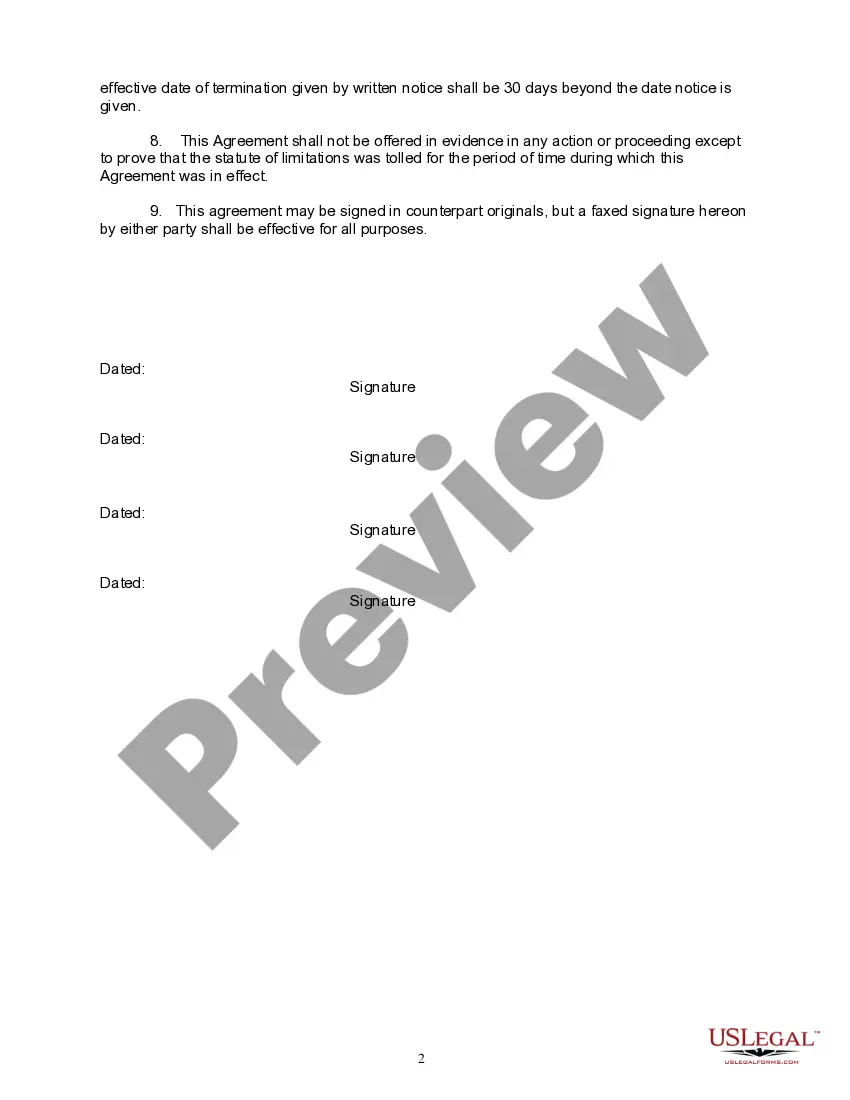
Yes, a South Carolina Agreement to Toll Statute of Limitations effectively pauses the countdown on the statute of limitations for a specified period. This allows both parties to negotiate without the pressure of an impending deadline. However, it is crucial to understand the terms outlined in the agreement, as the tolling period will eventually end and the statute will resume. Consider consulting legal resources to ensure clarity on your specific situation.
While a South Carolina Agreement to Toll Statute of Limitations can provide time for negotiations, it may also have disadvantages. For instance, it does not guarantee a resolution and may prolong uncertainty regarding your claim. Additionally, if one party is unwilling to cooperate, the agreement can become a source of frustration. Therefore, it is essential to weigh the pros and cons before entering into such an agreement.
Unlike many states, South Carolina has no statute of limitations on criminal cases, meaning prosecutors can file criminal charges at any time after a crime has been committed. Click on the links below for more on the Palmetto State's statutes of limitations.
South Carolina's statute of repose is found at S.C. Code Ann. §15-3-640. South Carolina's statute of repose provides that a lawsuit for damages based upon a defective or unsafe condition of an improvement to real property must be brought within eight years after substantial completion of the improvement.
Normally, the statute of limitations in South Carolina is three years for personal injuries. However, it doesn't start for three more years until the boy is 18 years old. Therefore, he has until he is 21 years old to sue the person who hit him with a car. Another reason the time limit may be extended is disability.
Statute of Repose a law that cuts off a right of action after a specified time period has elapsed, regardless of when the cause of action accrues.
In South Carolina, there is no statute of limitations on crime. However, in the context of personal injury or wrongful death cases, the clock usually starts on the day of the incident (exp. car accident). In most cases you have 3 years to file suit against a non-governmental defendant.
A statute of limitations is the deadline for filing a lawsuit. Most lawsuits MUST be filed within a certain amount of time. In general, once the statute of limitations on a case runs out, the legal claim is not valid any longer.