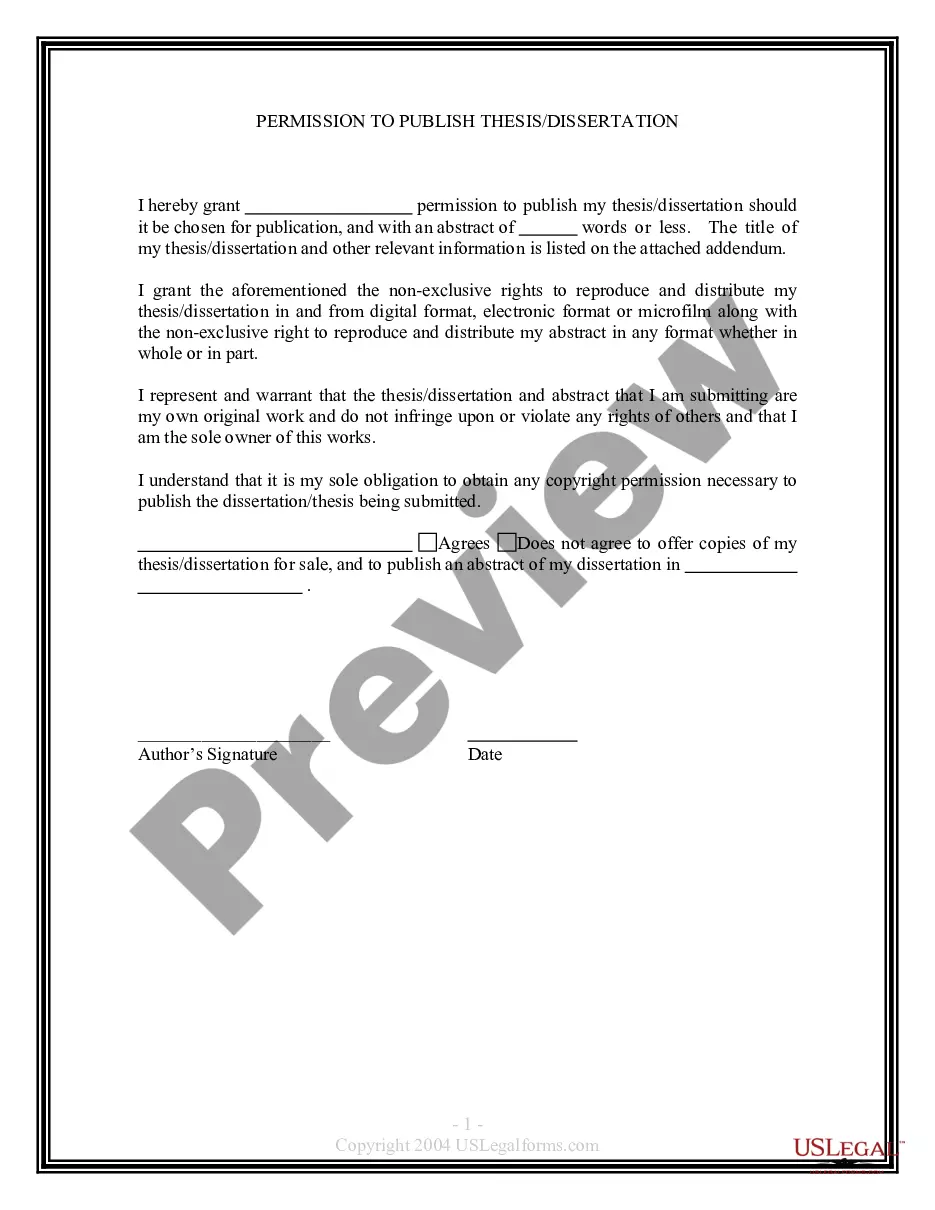
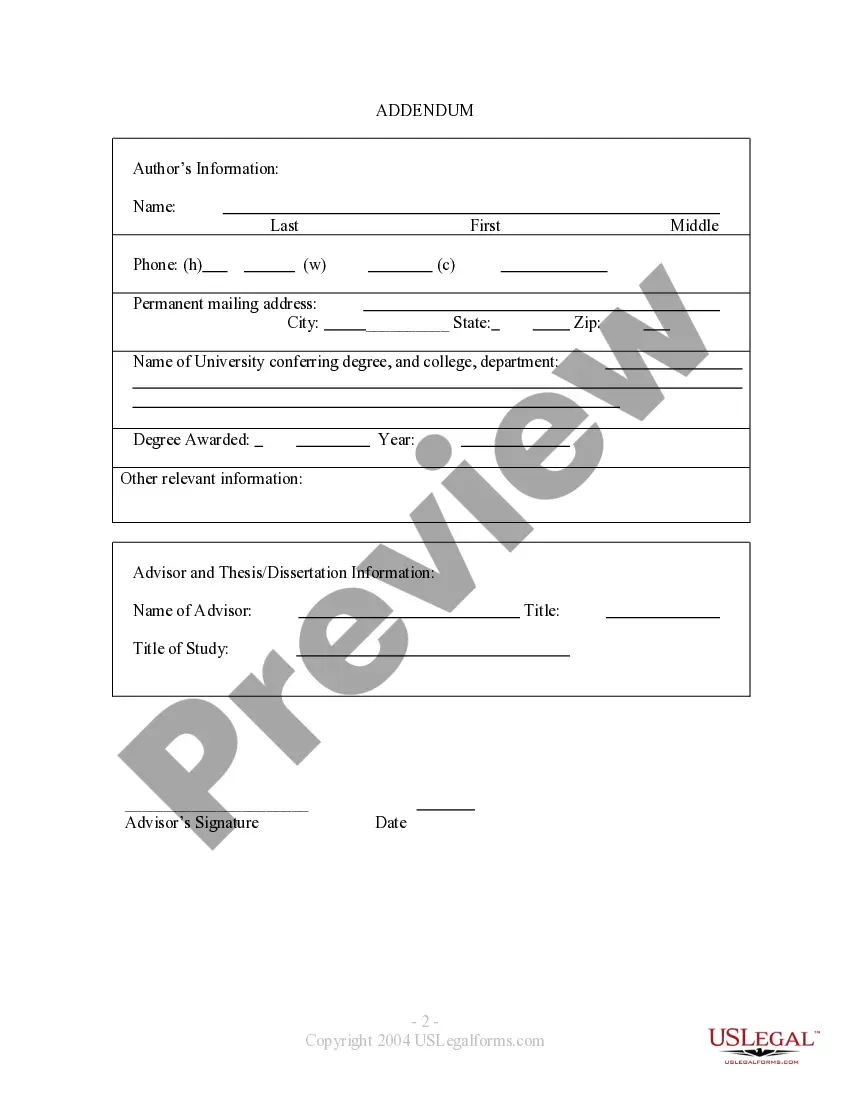
This is a form granting permission to publish a thesis/dissertation after submitting it to the publisher. An addendum is attached for the author to fill out as well as the academic advisor.
South Carolina Permission To Publish Thesis or Dissertation
State:
Multi-State
Category:
Control #:
US-PRM-17
Format:
Word;
Rich Text
52 downloads
Description
Free preview
Get your form ready online
Our built-in tools help you complete, sign, share, and store your documents in one place.
Built-in online Word editor
Make edits, fill in missing information, and update formatting in US Legal Forms—just like you would in MS Word.
Export easily
Download a copy, print it, send it by email, or mail it via USPS—whatever works best for your next step.
E-sign your document
Sign and collect signatures with our SignNow integration. Send to multiple recipients, set reminders, and more. Go Premium to unlock E-Sign.
Notarize online 24/7
If this form requires notarization, complete it online through a secure video call—no need to meet a notary in person or wait for an appointment.
Store your document securely
We protect your documents and personal data by following strict security and privacy standards.

Make edits, fill in missing information, and update formatting in US Legal Forms—just like you would in MS Word.

Download a copy, print it, send it by email, or mail it via USPS—whatever works best for your next step.

Sign and collect signatures with our SignNow integration. Send to multiple recipients, set reminders, and more. Go Premium to unlock E-Sign.

If this form requires notarization, complete it online through a secure video call—no need to meet a notary in person or wait for an appointment.

We protect your documents and personal data by following strict security and privacy standards.
Looking for another form?

How to fill out Permission To Publish Thesis Or Dissertation?
You can take time on the web looking for the official document template that meets the state and federal requirements you desire.
US Legal Forms offers a vast selection of legal documents that are reviewed by professionals.
You can easily access or print the South Carolina Permission To Publish Thesis or Dissertation from the service.
If available, use the Preview option to review the document template as well. If you wish to find another version of the form, utilize the Search feature to locate the template that suits your needs and requirements. Once you have found the template you desire, click Get now to proceed. Choose the pricing plan you prefer, enter your details, and create an account on US Legal Forms. Complete the transaction. You can use your credit card or PayPal account to pay for the legal form. Select the format of the document and download it to your device. Make modifications to your document if needed. You can complete, edit, sign, and print the South Carolina Permission To Publish Thesis or Dissertation. Access and print a wide range of document templates using the US Legal Forms website, which offers the largest collection of legal forms. Utilize professional and state-specific templates to address your business or personal needs.
- If you already have a US Legal Forms account, you may sign in and select the Obtain option.
- Then, you may complete, modify, print, or sign the South Carolina Permission To Publish Thesis or Dissertation.
- Every legal document template you obtain is yours indefinitely.
- To get another copy of any acquired form, visit the My documents tab and click the appropriate option.
- If you are using the US Legal Forms website for the first time, follow the simple steps below.
- First, ensure you have chosen the correct document template for the county/town of your preference.
- Review the document description to confirm you have selected the right form.
Form popularity
FAQ
Answer. Dissertations and theses may be considered scholarly sources since they are closely supervised by a dissertation committee made up of scholars, are directed at an academic audience, are extensively researched, follow research methodology, and are cited in other scholarly work.
But without a publication, or two or three, the dissertation is not technically a total success. You'd be amazed at how many people don't get a publication out of their dissertation. Without advanced planning, a publication likely won't happen, because, once again, there are often unanticipated roadblocks.
To the best of my knowledge, in all of the high-ranked U.S. universities, a Ph. D. dissertation is required to be entirely public, as a matter of scientific principle and integrity. This wasn't always the case, particularly during the convergence of scientific research and military funding around World War II.
A dissertation or thesis is considered published when it is available from a database such as ProQuest Dissertations and Theses Global or PDQT Open, an institutional repository, or an archive.
Results showed that only one-quarter (25.6% 95% CI: 23.0, 28.4) of dissertations were ultimately published in peer-reviewed journals, with significant variations across subfields (range: 10.1 to 59.4%).
But without a publication, or two or three, the dissertation is not technically a total success. You'd be amazed at how many people don't get a publication out of their dissertation. Without advanced planning, a publication likely won't happen, because, once again, there are often unanticipated roadblocks.
The simple answer is yes at the heart of many successful academic books lies research conducted as part of a PhD. In the majority of cases, PhD research is published in the form of journal articles. In some cases, the research is published in a book.
A thesis is not published, under that definition. Nonetheless, an unpublished thesis needn't be private, e.g., it may appear online and it may be available in university library.
Once available through any form of open access, be it ProQuest or a university library's public access materials, that dissertation is functionally published, though this does not constitute refereed publication.
No thesis or dissertation may be classified or otherwise restricted in circulation except in time of national emergency on specific authorization of the General Committee. There may be times when the content of a thesis or dissertation will be fully or partially published elsewhere, or includes patentable technology.