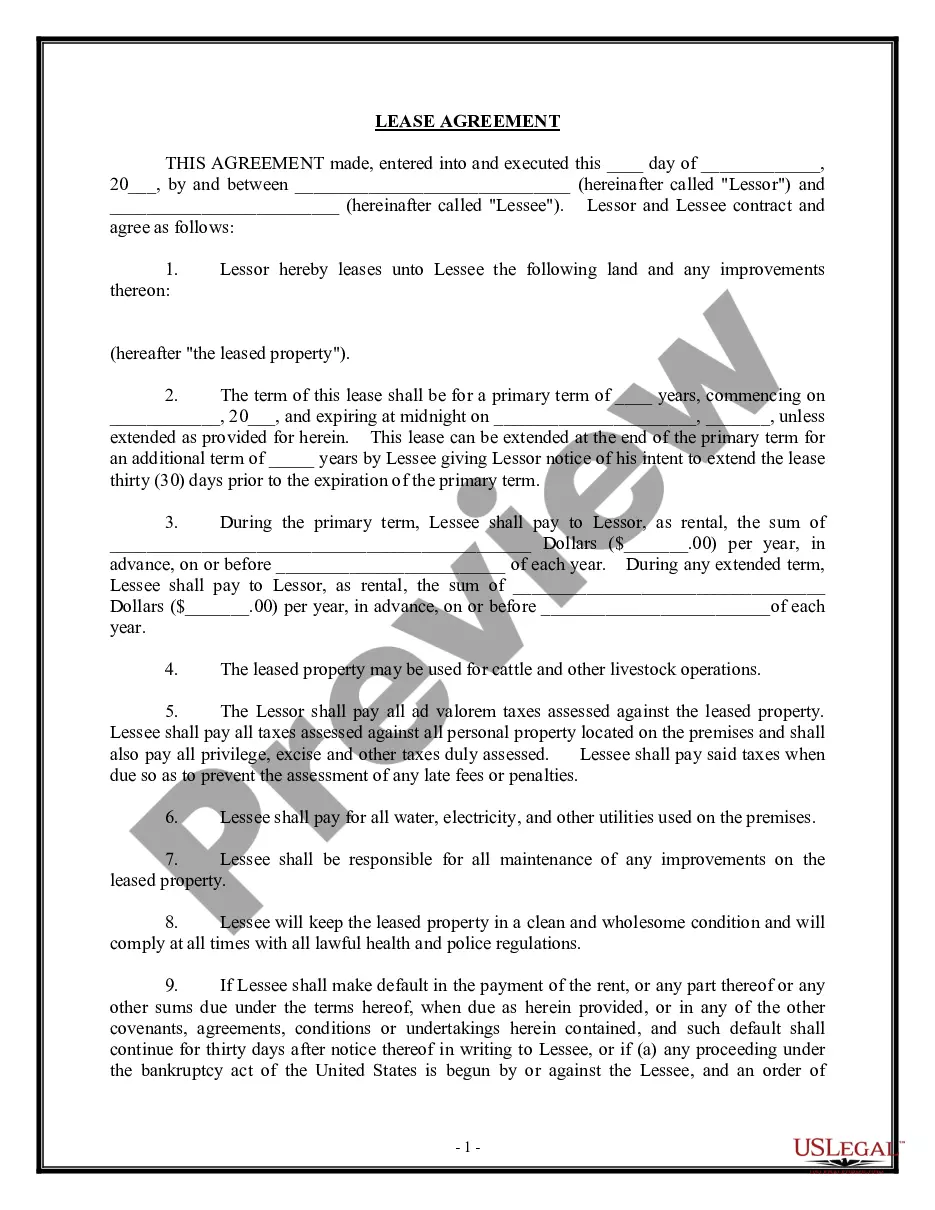
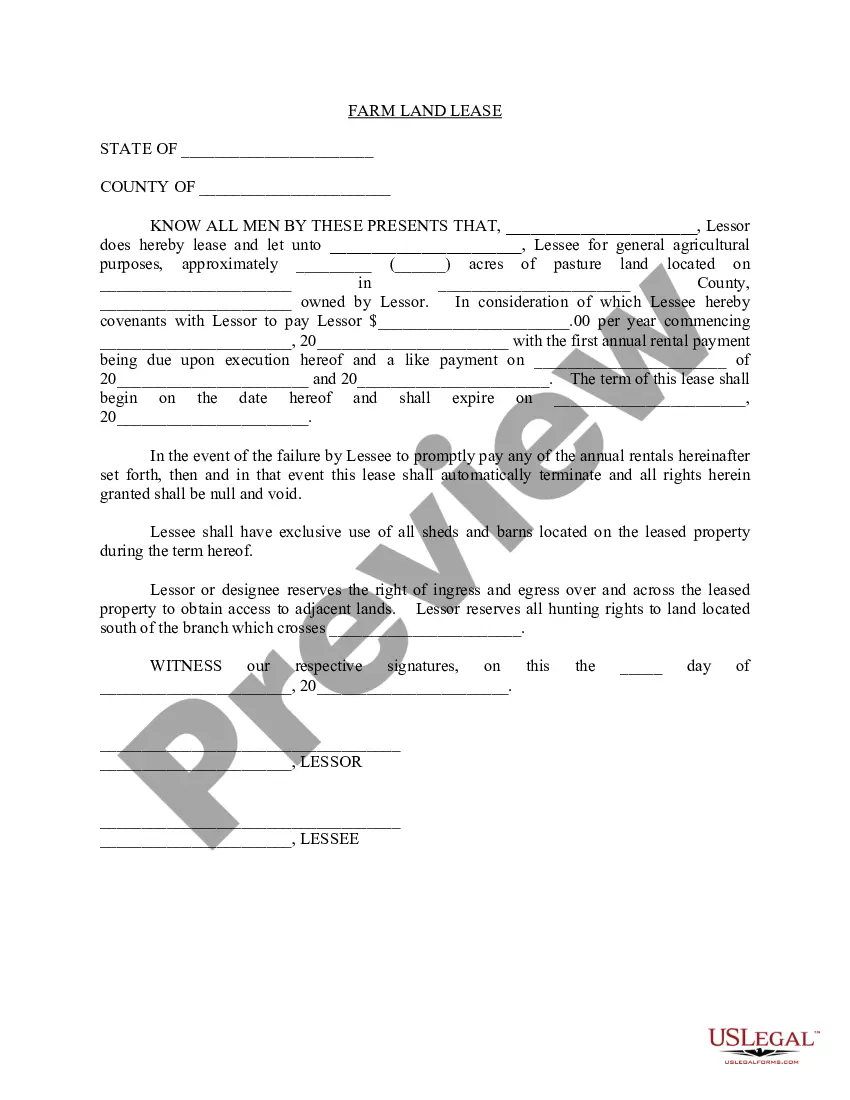
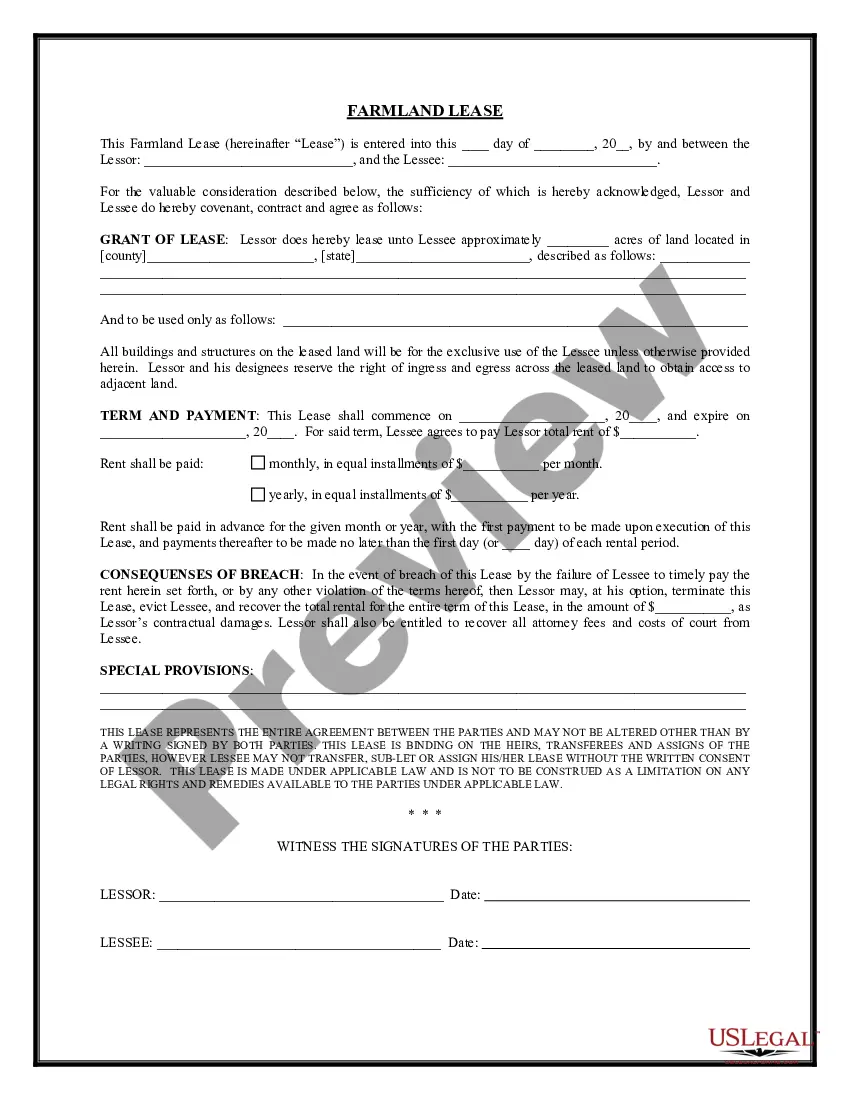
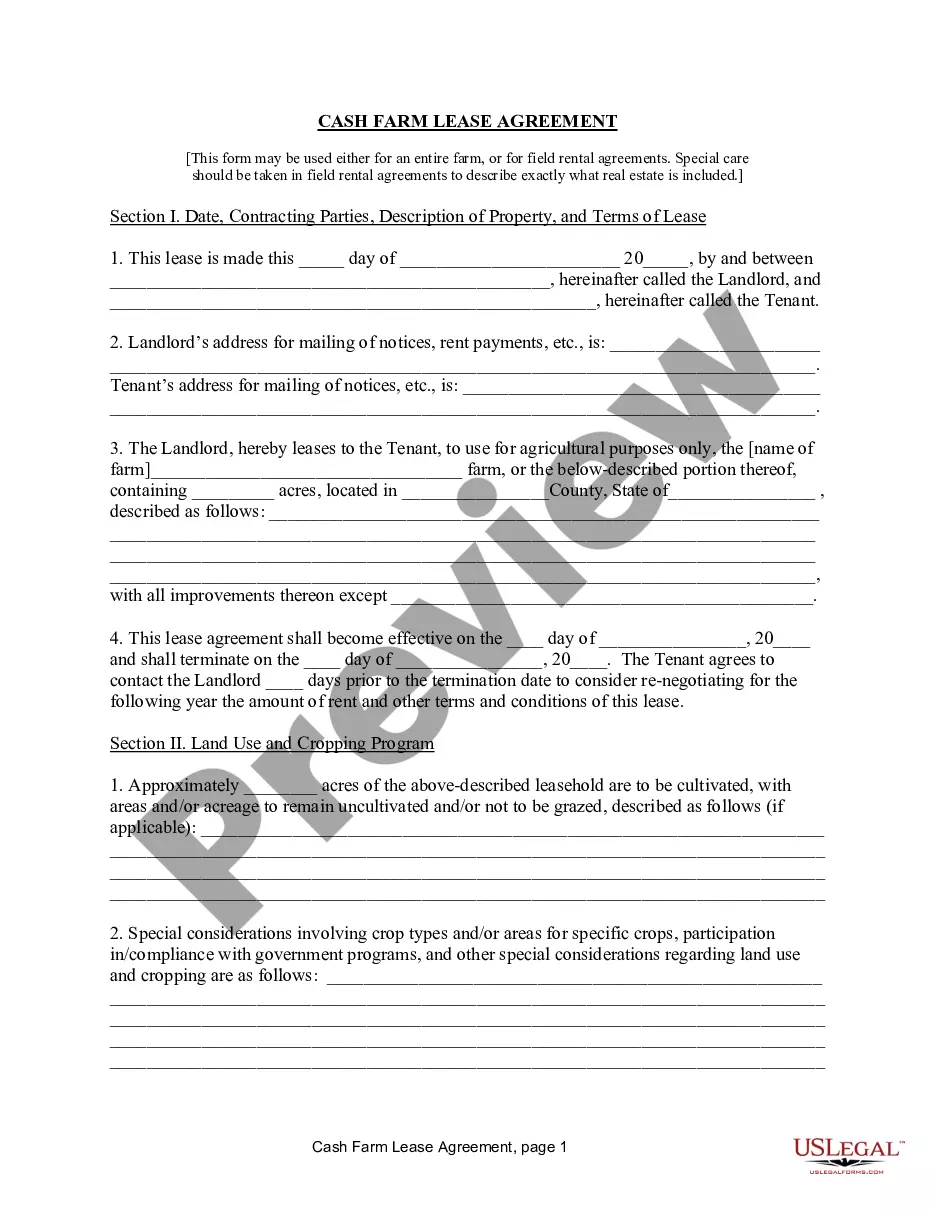
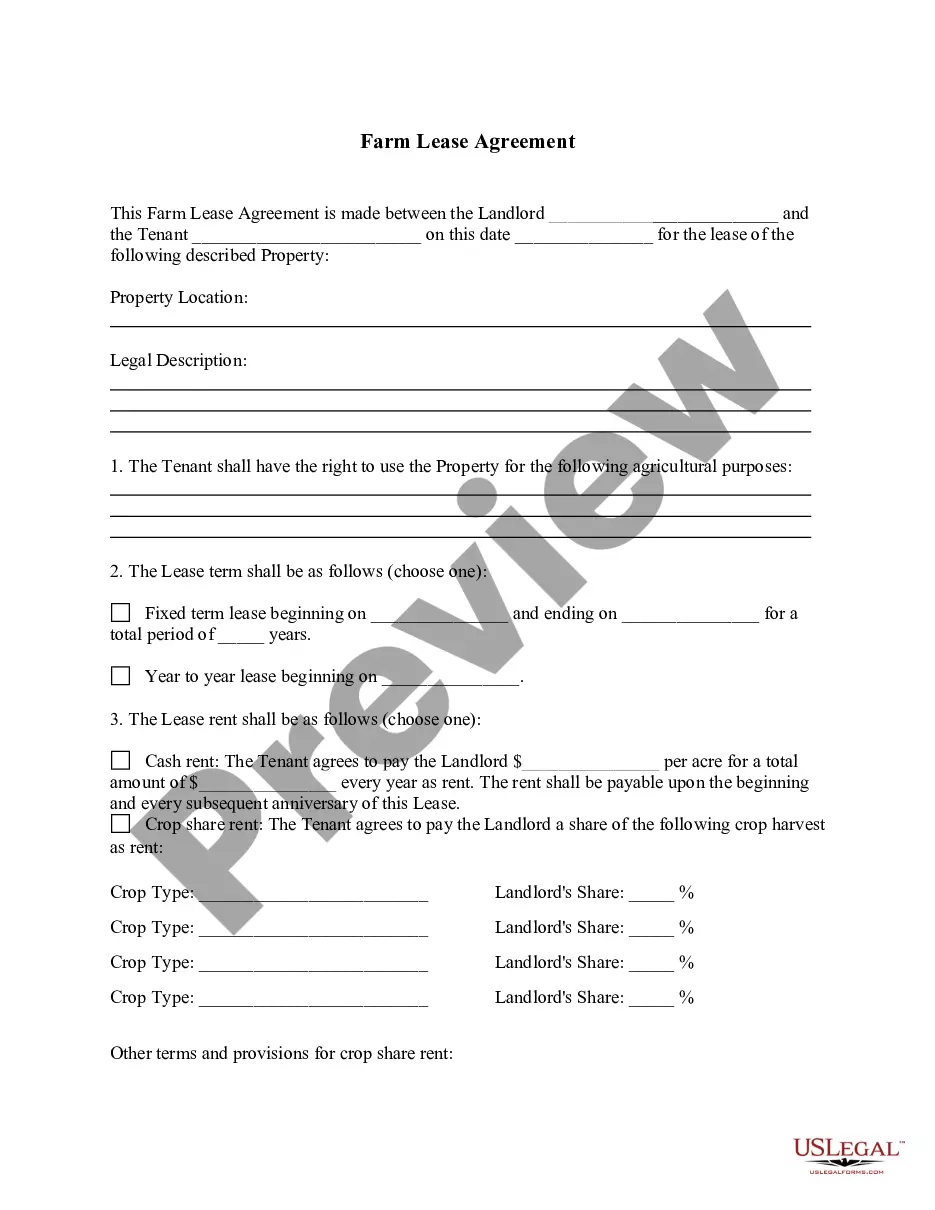
This form is a lease agreement for farm land. The lessor will pay all ad valorem taxes assessed against the leased property. The lessee shall pay all taxes assessed against all personal property located on the premises and will also pay all privilege, excise and other taxes duly assessed. The lessee will pay the taxes when due so as to prevent the assessment of any late fees or penalties.
South Carolina Farm Lease or Rental - General
State:
Multi-State
Category:
Control #:
US-60961
Format:
Word;
Rich Text
140 downloads
Description
Free preview


Get your form ready online
Our built-in tools help you complete, sign, share, and store your documents in one place.
Built-in online Word editor
Make edits, fill in missing information, and update formatting in US Legal Forms—just like you would in MS Word.
Export easily
Download a copy, print it, send it by email, or mail it via USPS—whatever works best for your next step.
E-sign your document
Sign and collect signatures with our SignNow integration. Send to multiple recipients, set reminders, and more. Go Premium to unlock E-Sign.
Notarize online 24/7
If this form requires notarization, complete it online through a secure video call—no need to meet a notary in person or wait for an appointment.
Store your document securely
We protect your documents and personal data by following strict security and privacy standards.

Make edits, fill in missing information, and update formatting in US Legal Forms—just like you would in MS Word.

Download a copy, print it, send it by email, or mail it via USPS—whatever works best for your next step.

Sign and collect signatures with our SignNow integration. Send to multiple recipients, set reminders, and more. Go Premium to unlock E-Sign.

If this form requires notarization, complete it online through a secure video call—no need to meet a notary in person or wait for an appointment.

We protect your documents and personal data by following strict security and privacy standards.
Looking for another form?
How to fill out Farm Lease Or Rental - General?
If you need to aggregate, download, or generate legal document templates, utilize US Legal Forms, the largest collection of legal forms available online.
Use the website's straightforward and convenient search to locate the documents you require. Many templates for business and personal purposes are organized by categories and states, or keywords.
Utilize US Legal Forms to find the South Carolina Farm Lease or Rental - General with just a few clicks.
Every legal document format you acquire is yours permanently. You have access to every form you saved in your account. Go to the My documents section and select a form to print or download again.
Complete and download, and print the South Carolina Farm Lease or Rental - General with US Legal Forms. There are millions of professional and state-specific forms you can use for your business or personal needs.
- If you are currently a US Legal Forms user, Log In to your account and click the Download button to retrieve the South Carolina Farm Lease or Rental - General.
- You can also access forms you previously saved in the My documents section of your account.
- If you are using US Legal Forms for the first time, follow the steps outlined below.
- Step 1. Ensure you have selected the form for the appropriate city/state.
- Step 2. Make use of the Review option to examine the form’s details. Don’t forget to read through the summary.
- Step 3. If you are not satisfied with the form, utilize the Search field at the top of the screen to find different types of the legal form format.
- Step 4. Once you have found the form you need, click the Get now button. Choose the payment plan you prefer and enter your details to create an account.
- Step 5. Complete the transaction. You can use your Visa or MasterCard or PayPal account to finalize the payment.
- Step 6. Select the format of the legal form and download it to your device.
- Step 7. Fill out, edit, and print or sign the South Carolina Farm Lease or Rental - General.
Form popularity
FAQ
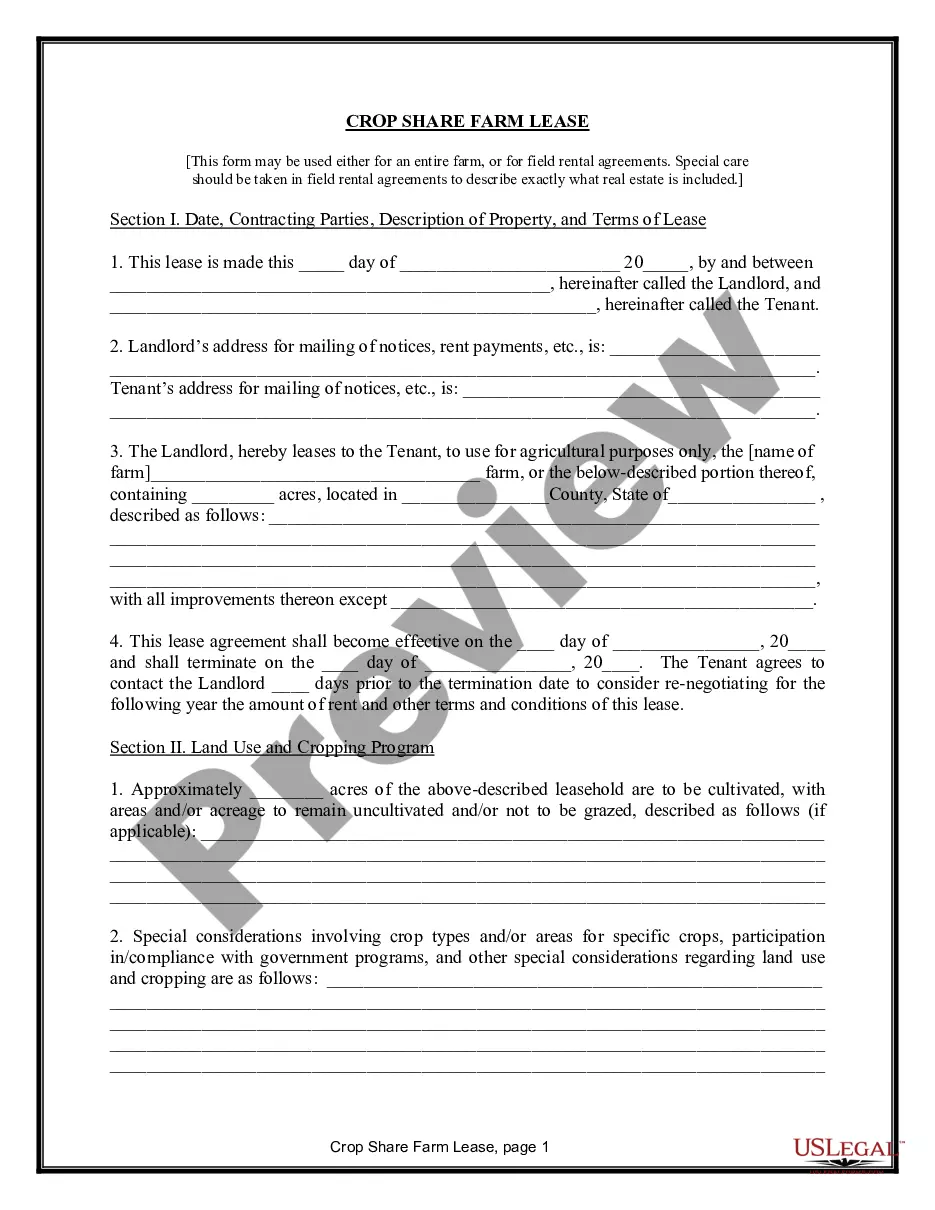
With a crop-share lease, the landlord receives a share of the crops produced in exchange for the use of the land by the tenant. The amount of the share typically depends on local custom. The landlord usually agrees to pay a portion of the input costs under a crop-share lease.
With a land lease agreement (also known as a ground lease), you purchase the home but rent the land. One of the main advantages is the lower price of this unique arrangement. One of the main disadvantages is that you will not be able to build valuable equity in the land on which you live.
Farmland has historically been a good investment. Unfortunately, not many investors have been able to benefit from this asset class, given the high upfront costs of buying farmland.
Over the last 20 years, the price of farmland per acre in south carolina has risen by an average of 3.5% per year to $2,830 per acre as of 2019. This represents an increase of $1,480 per acre of farmland over this time period.
The advantages of the first are that the tenant in many cases is free to manage the farm as he pleases, and as a long-time proposition he may pay less rent than under crop-sharing arrangements. The chief disadvantage is that the tenant agrees to pay a definite sum before he knows what his income will be.
In South Carolina, cash rent for cropland for 2019 decreased $1.50 to $48.50 per acre.
Most farmers find that a combination of both ownership and leasing is desirable, especially when capital is limited. For many new farmers, especially in areas where land is quite expensive, leasing land is often the best option.
Georgia cash rent for cropland was unchanged for 2020 at $126 per acre. In South Carolina, cash rent for cropland increased $0.50 to $47.50 per acre.
Eligible properties must comprise at least 10 acres. Christmas tree farms are an exception, with a minimum of five acres and $1,000 of farm income reported for three of the prior five years. The land must be used to raise crops, manage or breed livestock, or produce nursery stock or useful plants.