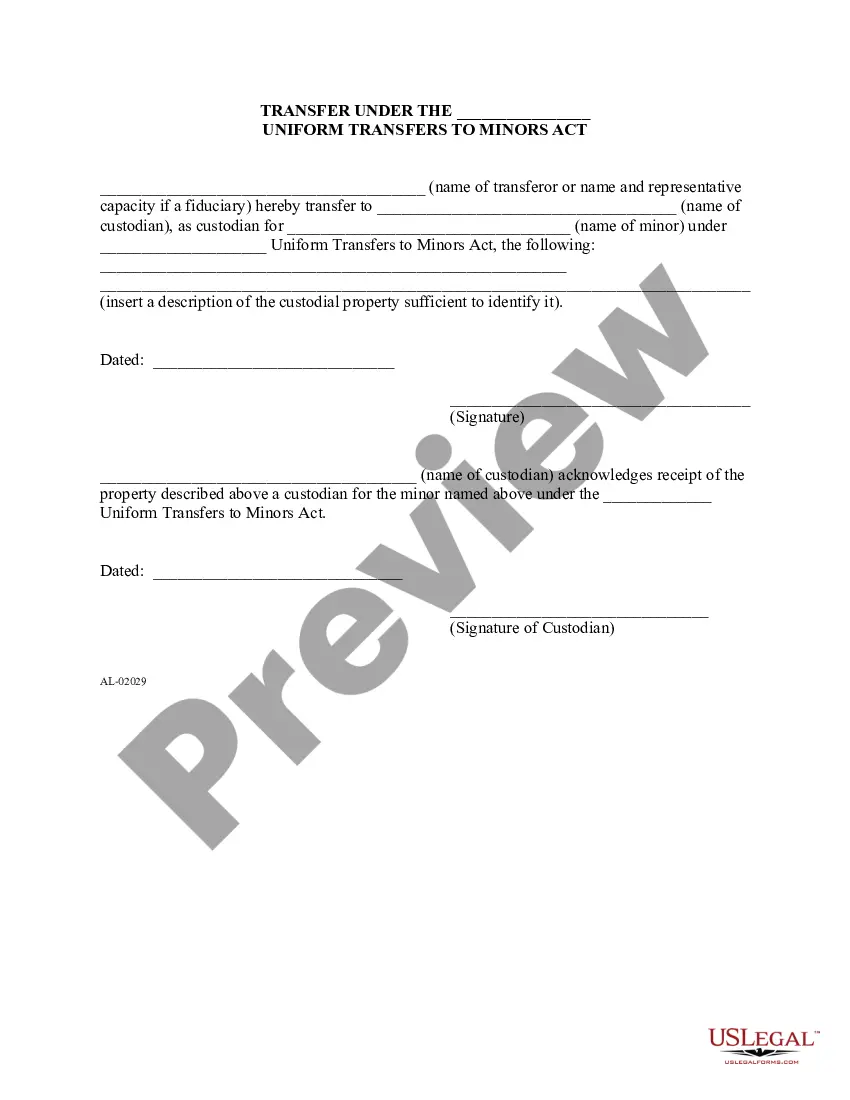
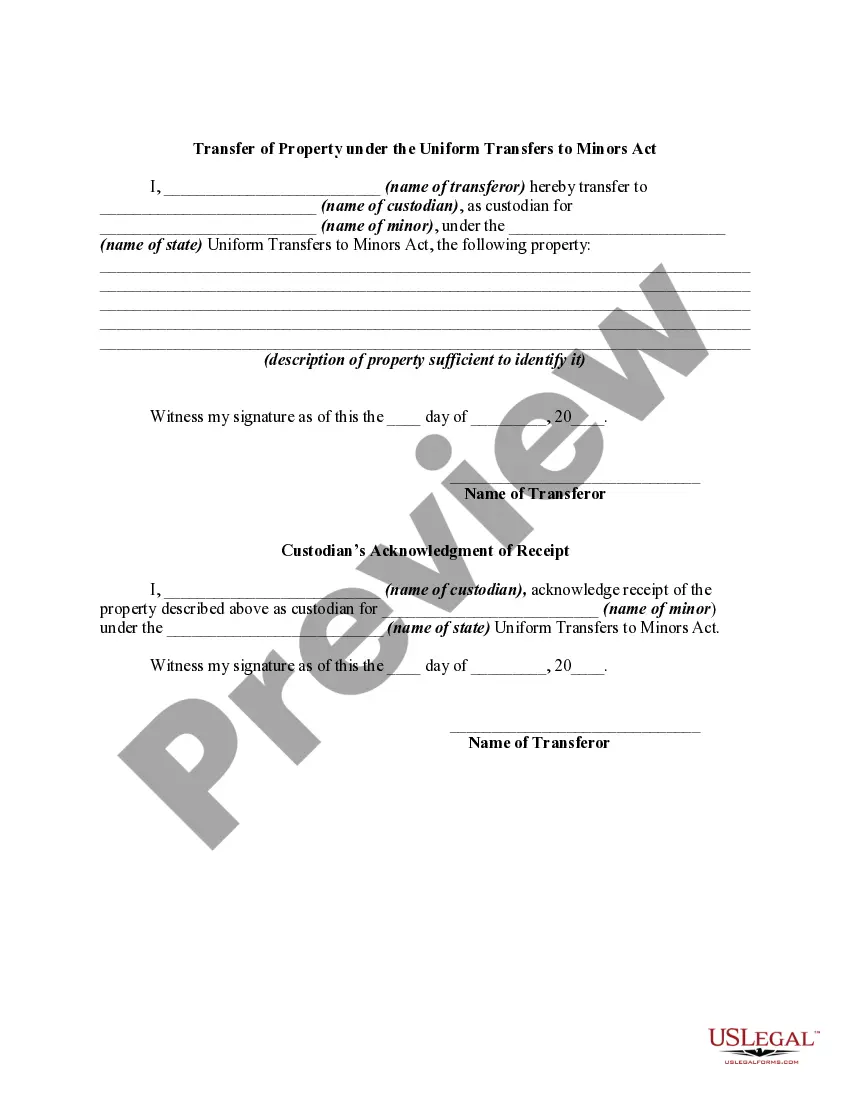
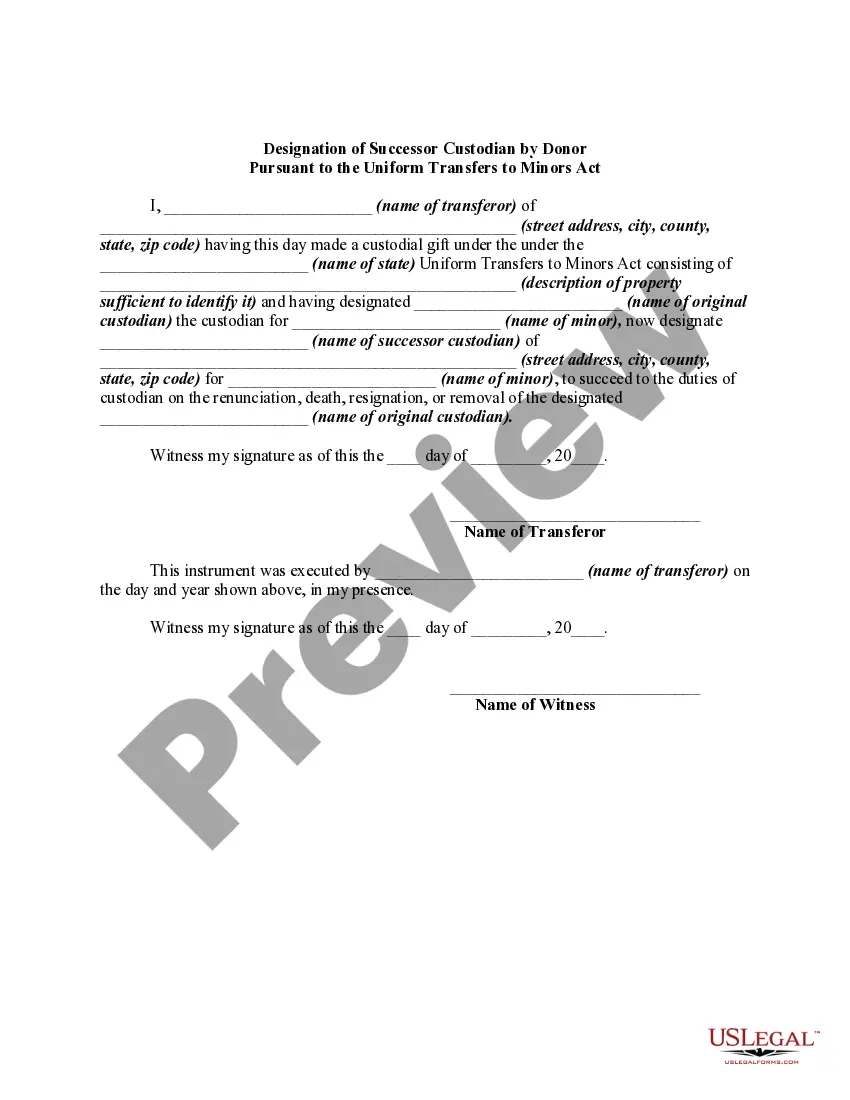
South Carolina Transfer under the Uniform Transfers to Minors Act - Multistate Form
Description
Get your form ready online
Our built-in tools help you complete, sign, share, and store your documents in one place.
Make edits, fill in missing information, and update formatting in US Legal Forms—just like you would in MS Word.
Download a copy, print it, send it by email, or mail it via USPS—whatever works best for your next step.
Sign and collect signatures with our SignNow integration. Send to multiple recipients, set reminders, and more. Go Premium to unlock E-Sign.
If this form requires notarization, complete it online through a secure video call—no need to meet a notary in person or wait for an appointment.
We protect your documents and personal data by following strict security and privacy standards.

Make edits, fill in missing information, and update formatting in US Legal Forms—just like you would in MS Word.

Download a copy, print it, send it by email, or mail it via USPS—whatever works best for your next step.

Sign and collect signatures with our SignNow integration. Send to multiple recipients, set reminders, and more. Go Premium to unlock E-Sign.

If this form requires notarization, complete it online through a secure video call—no need to meet a notary in person or wait for an appointment.

We protect your documents and personal data by following strict security and privacy standards.
Looking for another form?
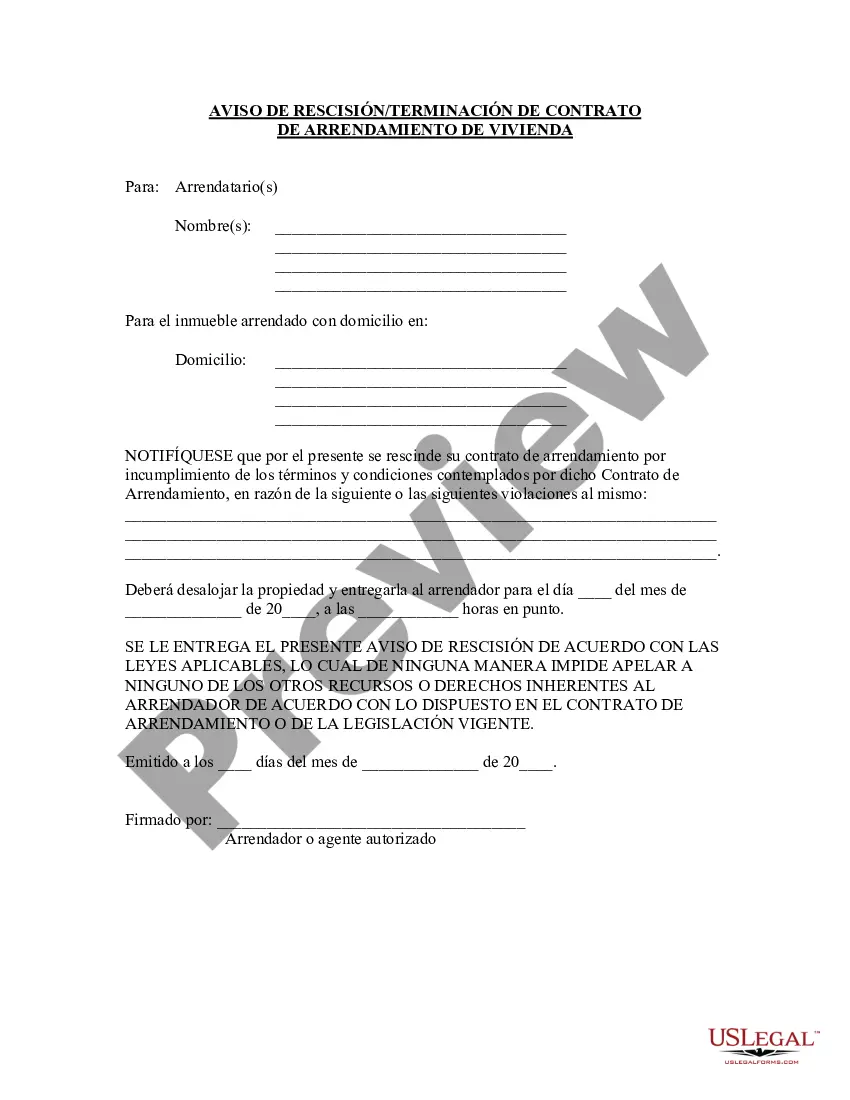
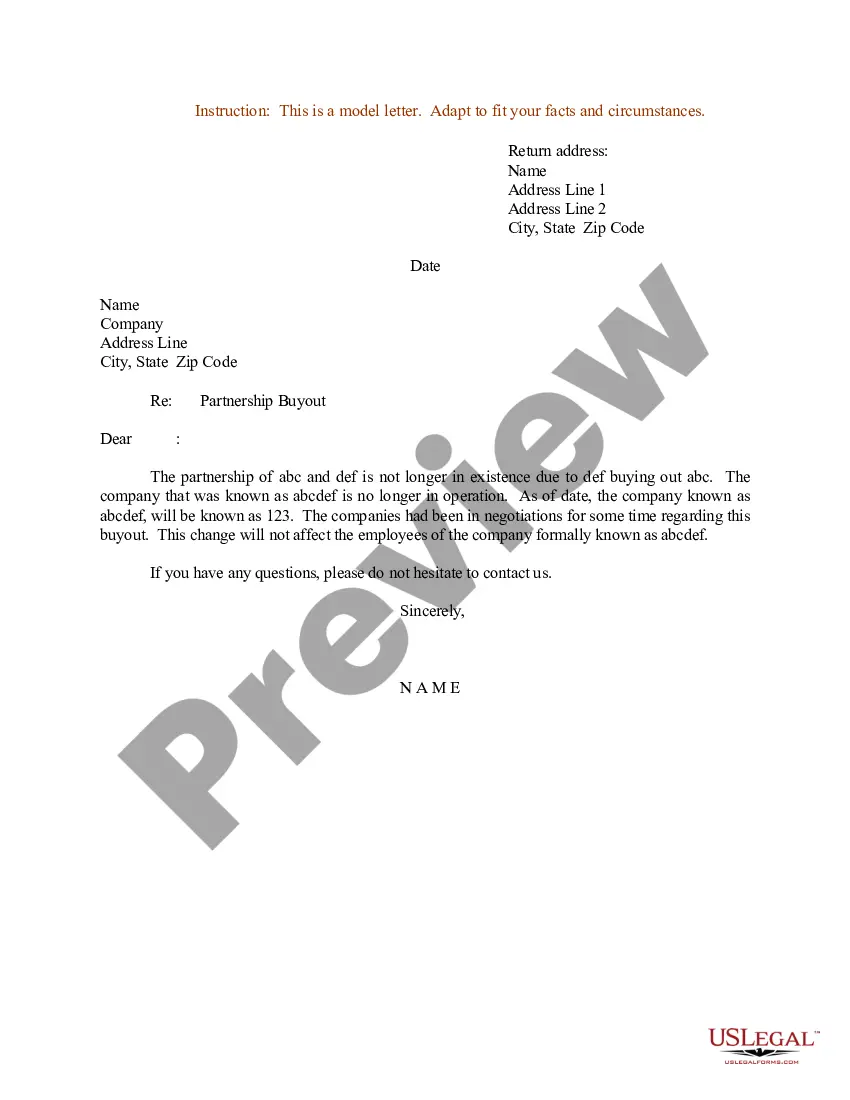

How to fill out Transfer Under The Uniform Transfers To Minors Act - Multistate Form?
If you need to obtain, acquire, or print valid document templates, utilize US Legal Forms, the largest collection of legal forms available online.
Take advantage of the site's user-friendly and convenient search feature to find the documents you need.
Many templates for business and personal purposes are categorized by groups and states, or keywords. Use US Legal Forms to access the South Carolina Transfer under the Uniform Transfers to Minors Act - Multistate Form with just a few clicks.
Each legal document template you purchase is yours indefinitely. You will have access to every form you saved in your account. Click the My documents section and select a form to print or download again.
Be proactive and download, and print the South Carolina Transfer under the Uniform Transfers to Minors Act - Multistate Form with US Legal Forms. There are millions of professional and state-specific forms you can utilize for your business or personal needs.
- If you are already a US Legal Forms user, Log In to your account and click the Download option to obtain the South Carolina Transfer under the Uniform Transfers to Minors Act - Multistate Form.
- You can also access forms you have previously saved in the My documents section of your account.
- If you are using US Legal Forms for the first time, follow the steps below.
- Step 1. Ensure you have selected the form for the correct city/state.
- Step 2. Utilize the Review option to examine the form's content. Don't forget to check the summary.
- Step 3. If you are not satisfied with the form, use the Search box at the top of the screen to find other variations of the legal form template.
- Step 4. Once you have found the form you need, click the Get now button. Choose the payment plan you prefer and enter your details to register for the account.
- Step 5. Complete the transaction. You can use your credit card or PayPal account to finalize the transaction.
- Step 6. Select the format of the legal form and download it to your device.
- Step 7. Fill out, edit, and print or sign the South Carolina Transfer under the Uniform Transfers to Minors Act - Multistate Form.
Form popularity
FAQ
UTMA withdrawals and tax rules UTMA accounts have no withdrawal limits. However, the funds belong to the minor from the moment of transfer, so the funds can only be used for the direct benefit of the minor.
It is interesting to note that South Carolina is presently the only state in the United States to continue to have on its books a version of the Uniform Gifts to Minors Act (the ?UGMA?) ? as every other state in the country has enacted a version of the more modern Uniform Transfers to Minors Act (UTMA).
In the United States, a child's money does not belong to the child's parents or guardians. Once the paperwork is in order, as a custodian of a UTMA you become a fiduciary or you owe a fiduciary duty to the beneficiary of that account. "Fiduciary duty" means you can only use the money in their best interest.
Also, since UGMA and UTMA accounts are in the name of a single child, the funds are not transferrable to another beneficiary. For financial aid purposes, custodial accounts are considered assets of the student. This means that custodial bank and brokerage accounts have a high impact on financial aid eligibility.
(a) A person having the right to designate the recipient of property transferable upon the occurrence of a future event may revocably nominate a custodian to receive the property for a minor beneficiary upon the occurrence of the event by naming the custodian followed in substance by the words: 'as custodian for ...
Cons Of Uniform Gift to Minors Act & Uniform Transfers to Minors Act Account No tax advantages for contributions. UGMA and UTMA plans offer no tax advantages for ?contributions?. ... No oversight for the use of funds. ... Limited tax advantages on income.
Under the laws that govern custodial accounts, including the Uniform Transfers to Minors Act (UTMA), account custodianship ends and the beneficiary becomes eligible to assume control of the account at a specified age?typically 18 or 21, depending on the state.
Once the minor on a UGMA/UTMA account reaches the applicable state's age of termination, the custodian or the former minor may transfer the shares in the account(s) to the former minor's sole name. Instructions are acceptable from either the custodian or the former minor.