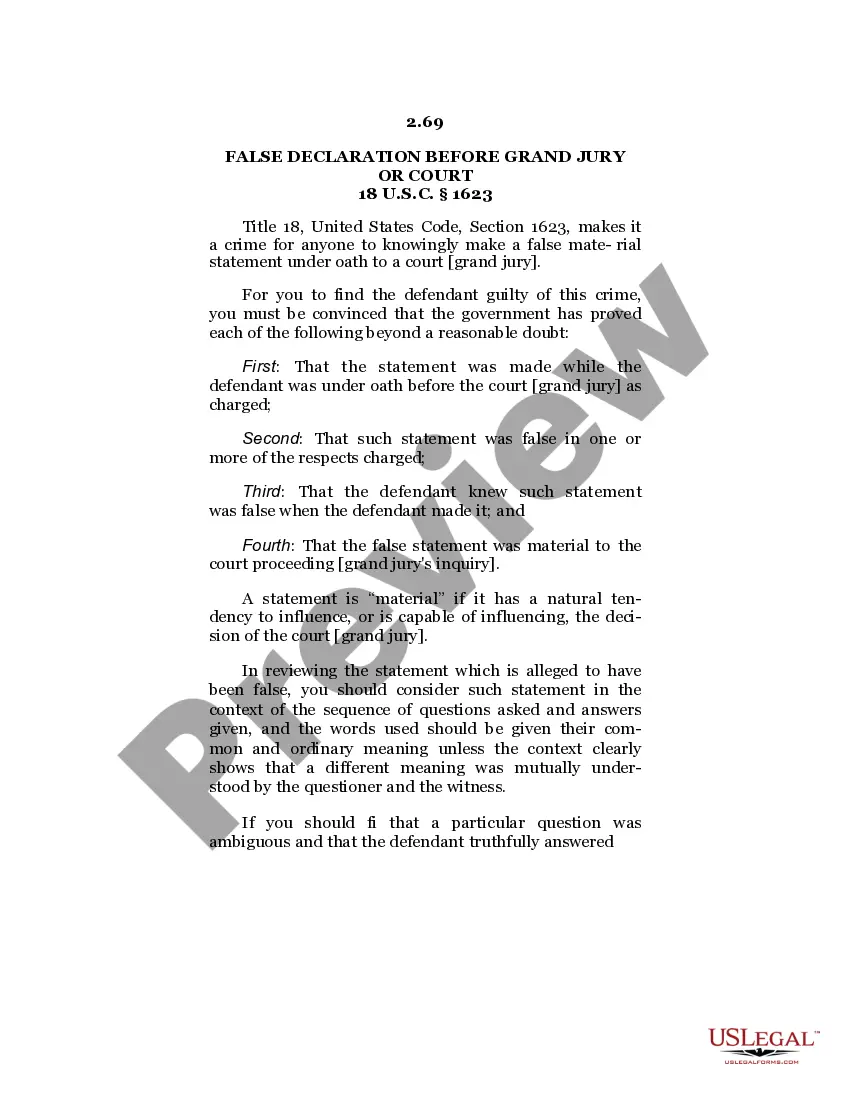
Pennsylvania Jury Instruction - Presenting False Declaration Or Certification
Description
Get your form ready online
Our built-in tools help you complete, sign, share, and store your documents in one place.
Make edits, fill in missing information, and update formatting in US Legal Forms—just like you would in MS Word.
Download a copy, print it, send it by email, or mail it via USPS—whatever works best for your next step.
Sign and collect signatures with our SignNow integration. Send to multiple recipients, set reminders, and more. Go Premium to unlock E-Sign.
If this form requires notarization, complete it online through a secure video call—no need to meet a notary in person or wait for an appointment.
We protect your documents and personal data by following strict security and privacy standards.

Make edits, fill in missing information, and update formatting in US Legal Forms—just like you would in MS Word.

Download a copy, print it, send it by email, or mail it via USPS—whatever works best for your next step.

Sign and collect signatures with our SignNow integration. Send to multiple recipients, set reminders, and more. Go Premium to unlock E-Sign.

If this form requires notarization, complete it online through a secure video call—no need to meet a notary in person or wait for an appointment.

We protect your documents and personal data by following strict security and privacy standards.
Looking for another form?
How to fill out Jury Instruction - Presenting False Declaration Or Certification?
Are you in a placement the place you need to have documents for possibly enterprise or person uses nearly every time? There are a lot of authorized record web templates accessible on the Internet, but locating types you can trust is not easy. US Legal Forms gives thousands of form web templates, such as the Pennsylvania Jury Instruction - Presenting False Declaration Or Certification, which are composed to satisfy federal and state demands.
When you are already acquainted with US Legal Forms site and possess a merchant account, just log in. Afterward, you may obtain the Pennsylvania Jury Instruction - Presenting False Declaration Or Certification web template.
Unless you come with an accounts and wish to start using US Legal Forms, abide by these steps:
- Obtain the form you require and ensure it is for the right area/county.
- Take advantage of the Review option to analyze the form.
- Read the description to ensure that you have selected the right form.
- If the form is not what you`re looking for, make use of the Look for industry to get the form that meets your requirements and demands.
- Once you find the right form, click Buy now.
- Select the pricing prepare you need, submit the specified information to generate your money, and pay for the transaction with your PayPal or bank card.
- Choose a practical paper formatting and obtain your backup.
Discover each of the record web templates you possess purchased in the My Forms food list. You can get a further backup of Pennsylvania Jury Instruction - Presenting False Declaration Or Certification any time, if needed. Just select the needed form to obtain or printing the record web template.
Use US Legal Forms, by far the most comprehensive assortment of authorized kinds, to conserve efforts and steer clear of mistakes. The service gives skillfully made authorized record web templates that can be used for an array of uses. Make a merchant account on US Legal Forms and start generating your way of life a little easier.
Form popularity
FAQ
Another example of reasonable doubt in a DUI case is if the arresting officer failed to follow proper procedure or they didn't have probable cause. If the defense can demonstrate that there were flaws or any form of negligence in the arrest, this may be enough to cast reasonable doubt on the guilt of the accused.
In a criminal case, the prosecution bears the burden of proving that the defendant is guilty beyond all reasonable doubt. This means that the prosecution must convince the jury that there is no other reasonable explanation that can come from the evidence presented at trial.
It is not required that the government prove guilt beyond all possible doubt. A reasonable doubt is a doubt based upon reason and common sense and is not based purely on speculation. It may arise from a careful and impartial consideration of all the evidence, or from lack of evidence.
If the case is being tried before a jury, the judge instructs the jury on how to apply the law to the case. Jurors deliberate privately to determine the outcome of a case. In criminal cases, a jury determines whether a defendant is guilty or not guilty and, in some cases, determines a penalty.
Reasonable doubt exists when you are not firmly convinced of the Defendant's guilt, after you have weighed and considered all the evidence. A Defendant must not be convicted on suspicion or speculation. It is not enough for the State to show that the Defendant is probably guilty.
If you are not convinced beyond a reasonable doubt that the defendant is guilty of a charged crime, you must find the defendant not guilty of that crime. If you are convinced beyond a reasonable doubt that the defendant is guilty of a charged crime, you must find the defendant guilty of that crime. CPL 300.10(2).