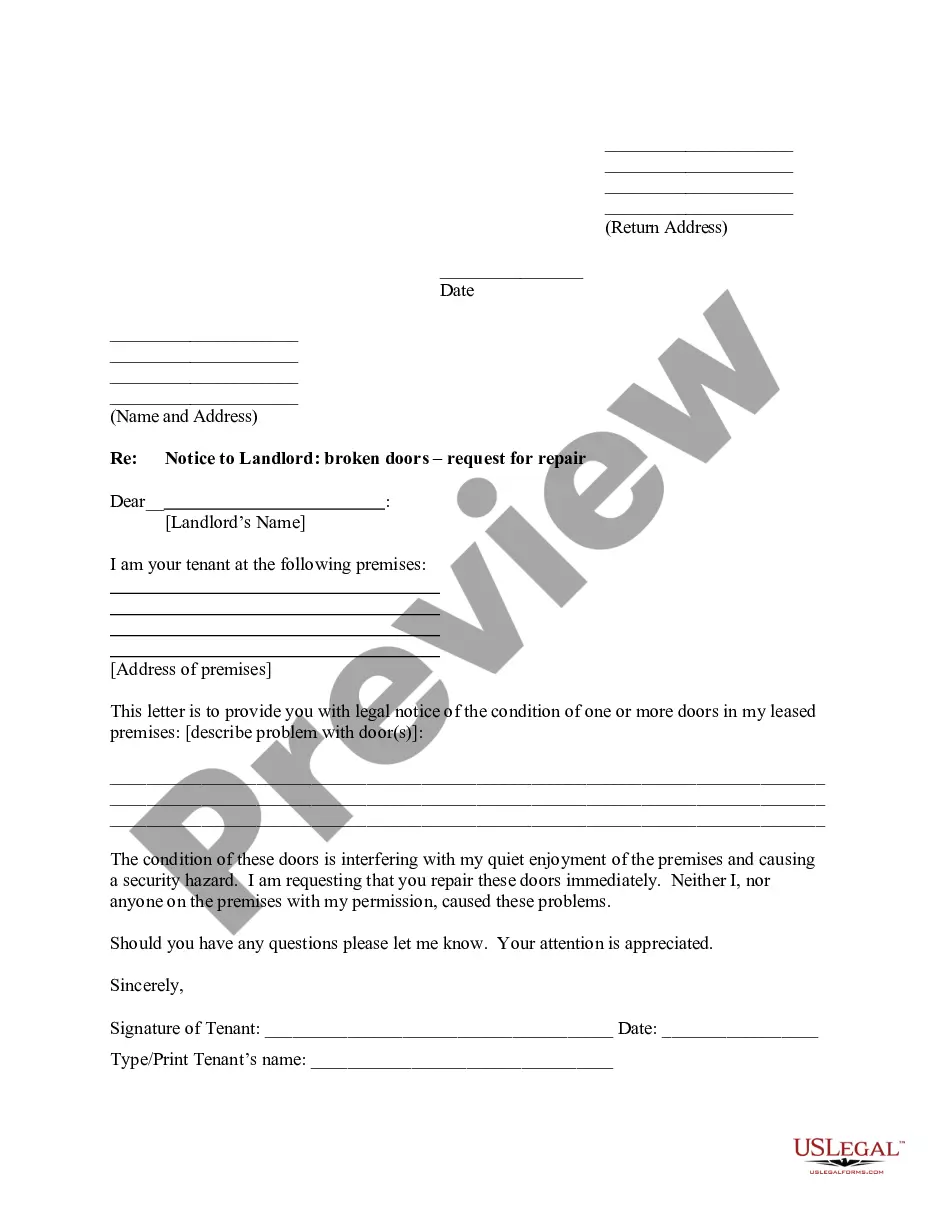
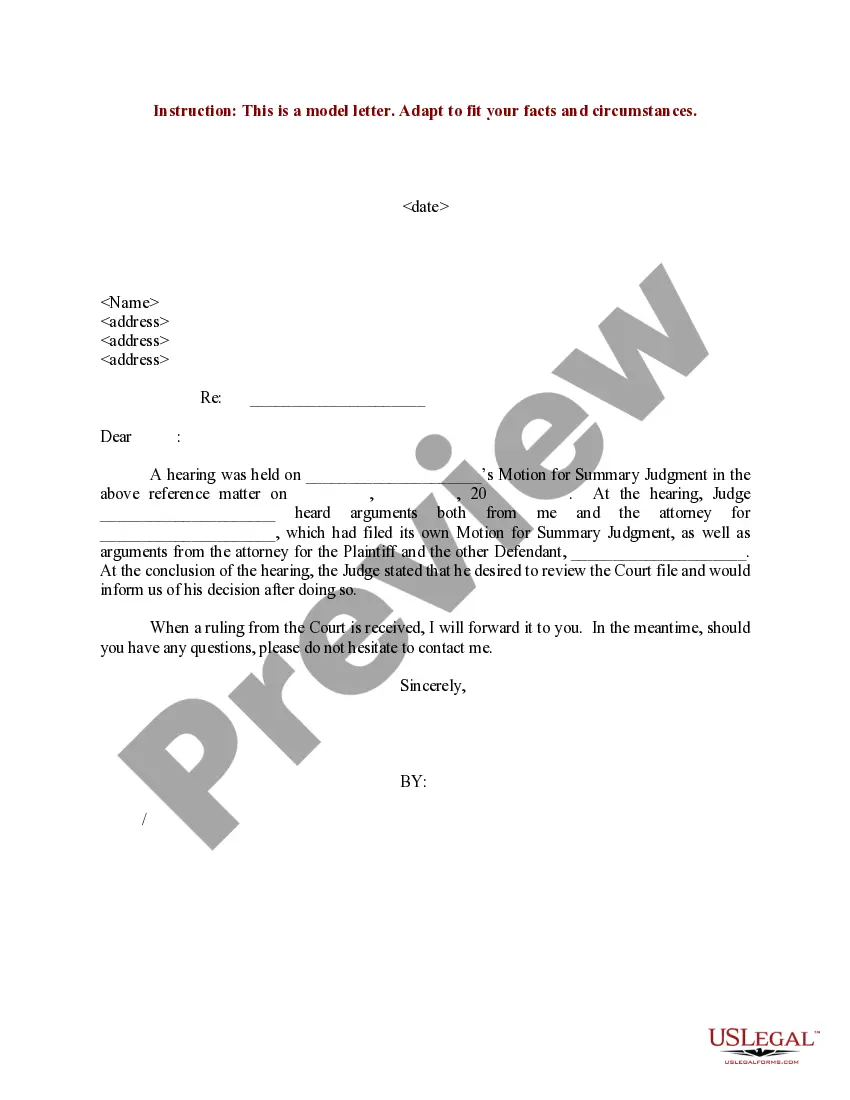
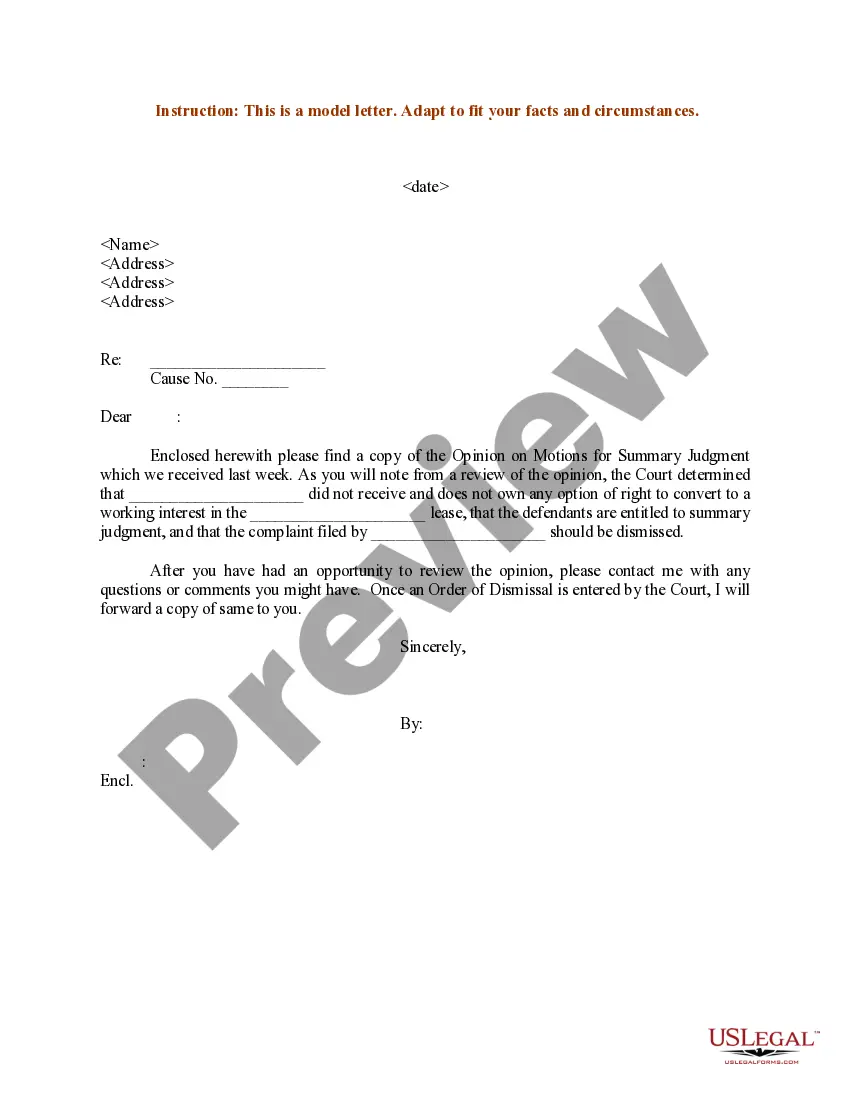
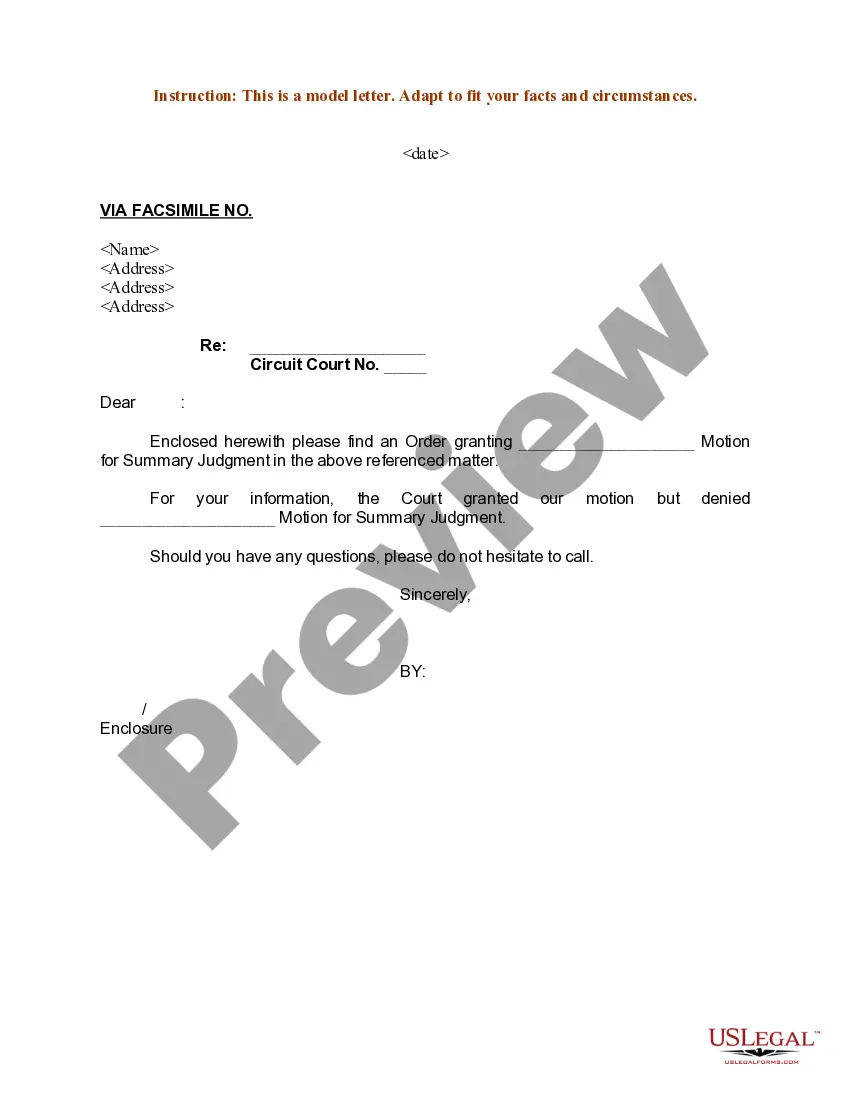
This form is a sample letter in Word format covering the subject matter of the title of the form.
Pennsylvania Sample Letter to Client concerning Hearing on Motion of Summary Judgment
Category:
State:
Multi-State
Control #:
US-0007LTR
Format:
Word;
Rich Text
Instant download
Description
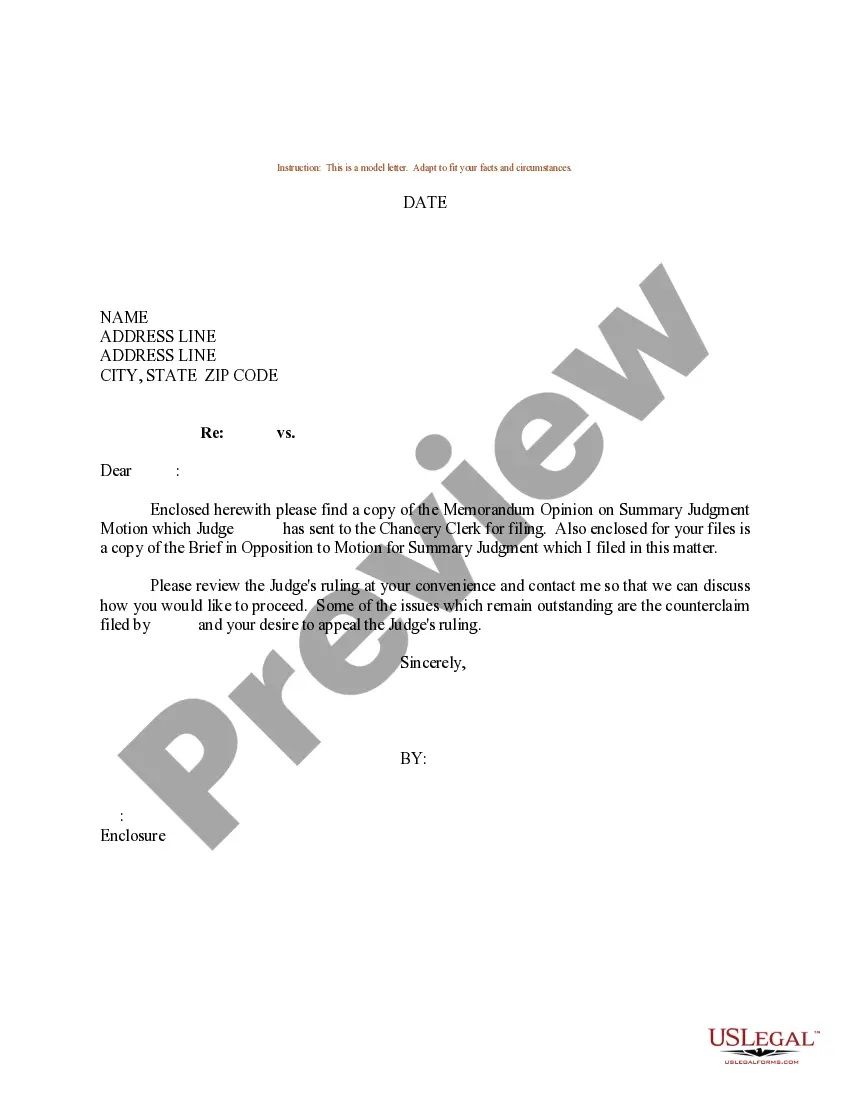
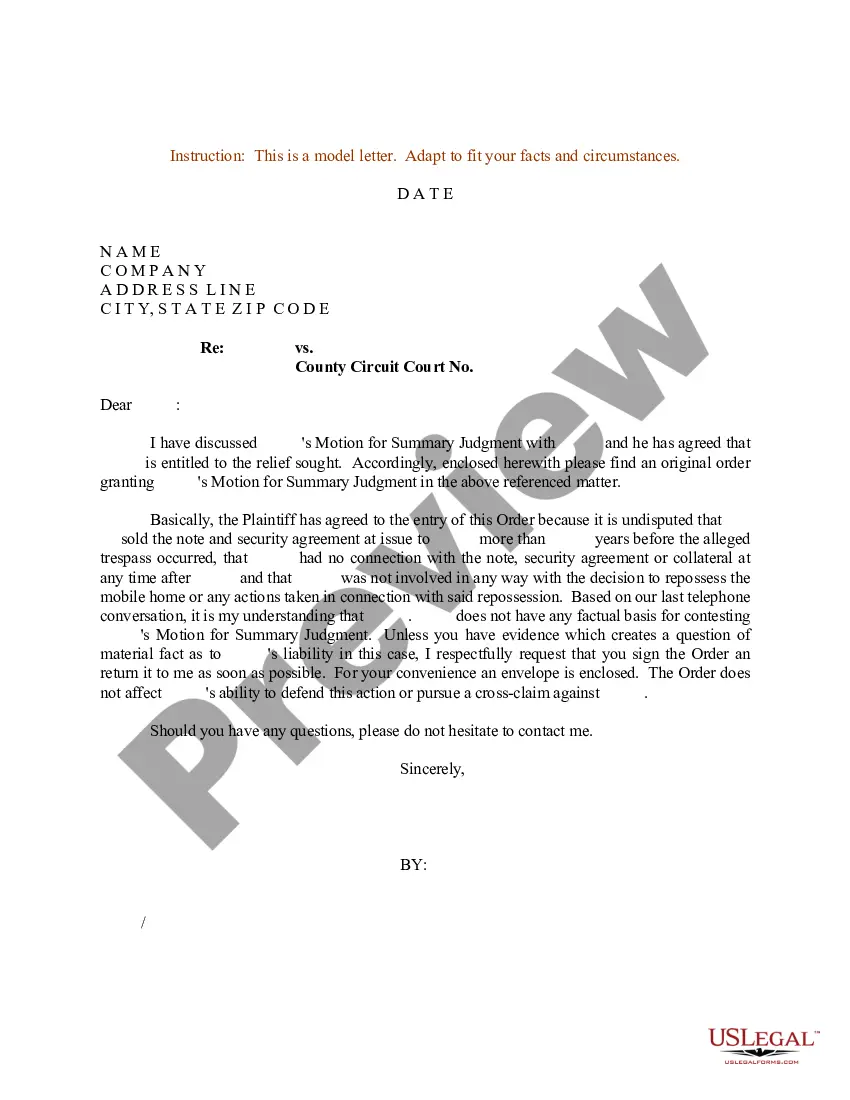
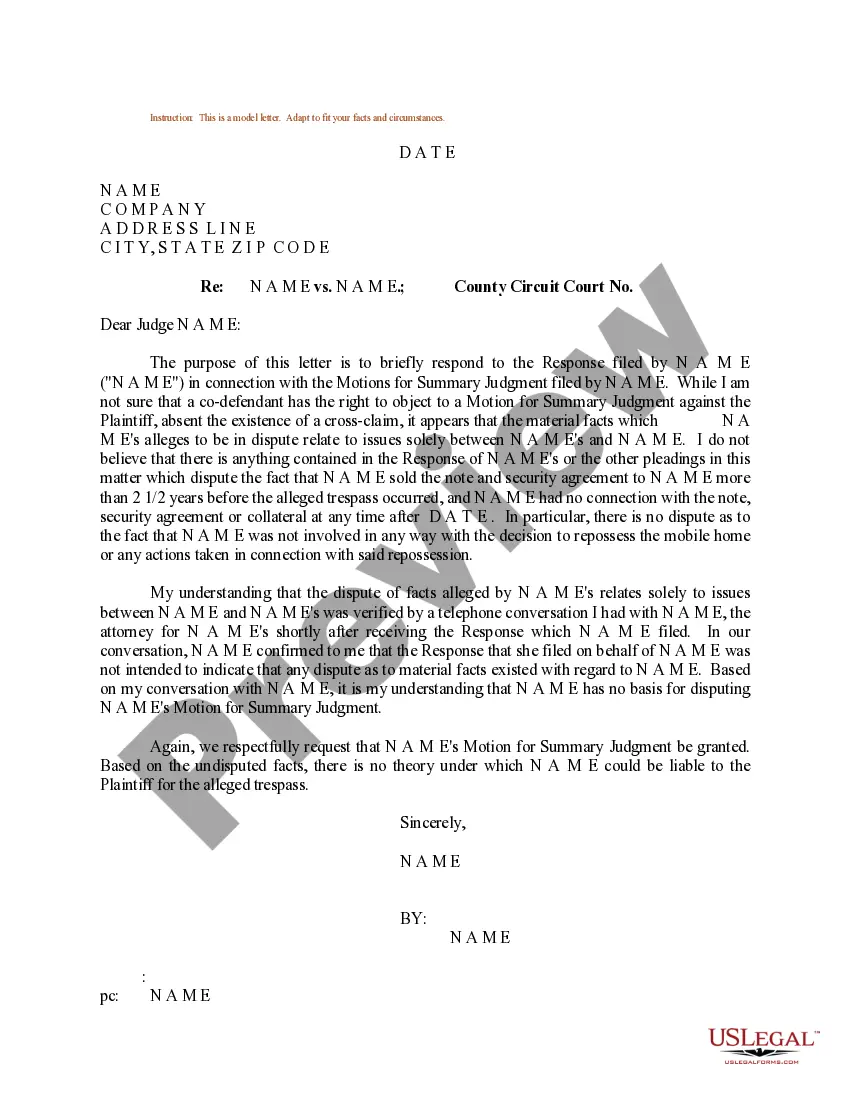
Get your form ready online
Our built-in tools help you complete, sign, share, and store your documents in one place.
Built-in online Word editor
Make edits, fill in missing information, and update formatting in US Legal Forms—just like you would in MS Word.
Export easily
Download a copy, print it, send it by email, or mail it via USPS—whatever works best for your next step.
E-sign your document
Sign and collect signatures with our SignNow integration. Send to multiple recipients, set reminders, and more. Go Premium to unlock E-Sign.
Notarize online 24/7
If this form requires notarization, complete it online through a secure video call—no need to meet a notary in person or wait for an appointment.
Store your document securely
We protect your documents and personal data by following strict security and privacy standards.

Make edits, fill in missing information, and update formatting in US Legal Forms—just like you would in MS Word.

Download a copy, print it, send it by email, or mail it via USPS—whatever works best for your next step.

Sign and collect signatures with our SignNow integration. Send to multiple recipients, set reminders, and more. Go Premium to unlock E-Sign.

If this form requires notarization, complete it online through a secure video call—no need to meet a notary in person or wait for an appointment.

We protect your documents and personal data by following strict security and privacy standards.
Looking for another form?
How to fill out Sample Letter To Client Concerning Hearing On Motion Of Summary Judgment?
Selecting the appropriate legal document template can be quite a challenge. Obviously, there are numerous templates accessible online, but how can you locate the legal form you require? Make use of the US Legal Forms website. The service offers a large number of templates, including the Pennsylvania Sample Letter to Client regarding Hearing on Motion of Summary Judgment, that can be utilized for both business and personal needs. All of the forms are reviewed by experts and comply with federal and state regulations.
If you are already registered, Log In to your account and click the Download button to access the Pennsylvania Sample Letter to Client regarding Hearing on Motion of Summary Judgment. Use your account to search for the legal forms you have acquired previously. Navigate to the My documents tab of your account and retrieve another copy of the document you need.
If you are a new user of US Legal Forms, here are straightforward instructions for you to follow: First, ensure that you have selected the correct form for your specific town/county. You can examine the form using the Review button and read the form details to ensure it is suitable for you. If the form does not meet your requirements, utilize the Search field to find the right form. Once you are confident that the form is appropriate, select the Purchase now button to obtain the form. Choose the pricing plan you desire and enter the necessary information. Create your account and pay for the order using your PayPal account or credit card. Select the file format and download the legal document template to your device. Complete, edit, print, and sign the obtained Pennsylvania Sample Letter to Client regarding Hearing on Motion of Summary Judgment.
- US Legal Forms is the largest collection of legal documents where you can find various document templates.
- Utilize the service to obtain professionally crafted paperwork that adhere to state regulations.
Form popularity
FAQ
To respond to a motion for summary judgment in Pennsylvania, you should carefully review the motion and gather your evidence. Formulate a written response that addresses each point made in the motion, providing counterarguments and supporting documents. A Pennsylvania Sample Letter to Client concerning Hearing on Motion of Summary Judgment can serve as a helpful guide in structuring your response effectively.
To write a good motion for summary judgment, focus on clarity and organization. Present your arguments logically, support them with evidence, and cite applicable laws. Consider referencing a Pennsylvania Sample Letter to Client concerning Hearing on Motion of Summary Judgment as a template to enhance your document's professionalism and effectiveness.
A motion for summary judgment typically includes several key components: a statement of undisputed facts, legal arguments supporting the request, and a conclusion. Additionally, you should attach relevant affidavits and exhibits to substantiate your claims. Utilizing a Pennsylvania Sample Letter to Client concerning Hearing on Motion of Summary Judgment can help ensure all elements are clearly communicated.
An example of summary judgment occurs when a court decides a case without a full trial, often due to a lack of dispute over the key facts. For instance, if one party can show that there is no genuine issue of material fact, the court may grant summary judgment in their favor. Such scenarios often benefit from using a Pennsylvania Sample Letter to Client concerning Hearing on Motion of Summary Judgment to outline the decision process.
To create a motion for summary judgment sample, start by drafting a concise statement of the facts and the legal issues involved. Then, articulate the basis for your motion, referencing supporting documents and evidence. You can also utilize a Pennsylvania Sample Letter to Client concerning Hearing on Motion of Summary Judgment to illustrate your points effectively.
In your response to the motion for summary judgment, you should clearly outline your arguments against the motion. Include supporting evidence, references to applicable laws, and any relevant case law. Additionally, consider providing a Pennsylvania Sample Letter to Client concerning Hearing on Motion of Summary Judgment to clearly communicate your stance and the reasons behind it.
Rule 1035.2 outlines the requirements for filing a motion for summary judgment in Pennsylvania. This rule states that a party must demonstrate that there is no genuine issue of material fact and that they are entitled to judgment as a matter of law. Understanding this rule is essential for effectively navigating legal proceedings. For further clarity, refer to a Pennsylvania Sample Letter to Client concerning Hearing on Motion of Summary Judgment available through uslegalforms.
To support a motion for summary judgment, evidence must be presented in a form that is admissible in court. Typically, this includes affidavits, depositions, and documents that establish the facts of the case. It is crucial to organize this evidence clearly to strengthen your argument. For comprehensive guidance, consider using a Pennsylvania Sample Letter to Client concerning Hearing on Motion of Summary Judgment from uslegalforms.
In Pennsylvania, the rule for a motion for summary judgment allows a party to seek a ruling when there is no genuine issue of material fact. The moving party must demonstrate that the evidence supports their claim, while the opposing party must show that there are indeed factual disputes. Utilizing a Pennsylvania Sample Letter to Client concerning Hearing on Motion of Summary Judgment can clarify your understanding of this rule and assist you in preparing your case. Engaging with the right resources simplifies this complex process.
Opposing a summary judgment motion involves presenting strong evidence that highlights genuine disputes on material facts. Start by collecting and organizing your evidence, including affidavits, depositions, and other relevant documents. A Pennsylvania Sample Letter to Client concerning Hearing on Motion of Summary Judgment can serve as a valuable tool in articulating your opposition effectively. This letter can guide you in presenting your arguments convincingly and help you navigate the legal process.